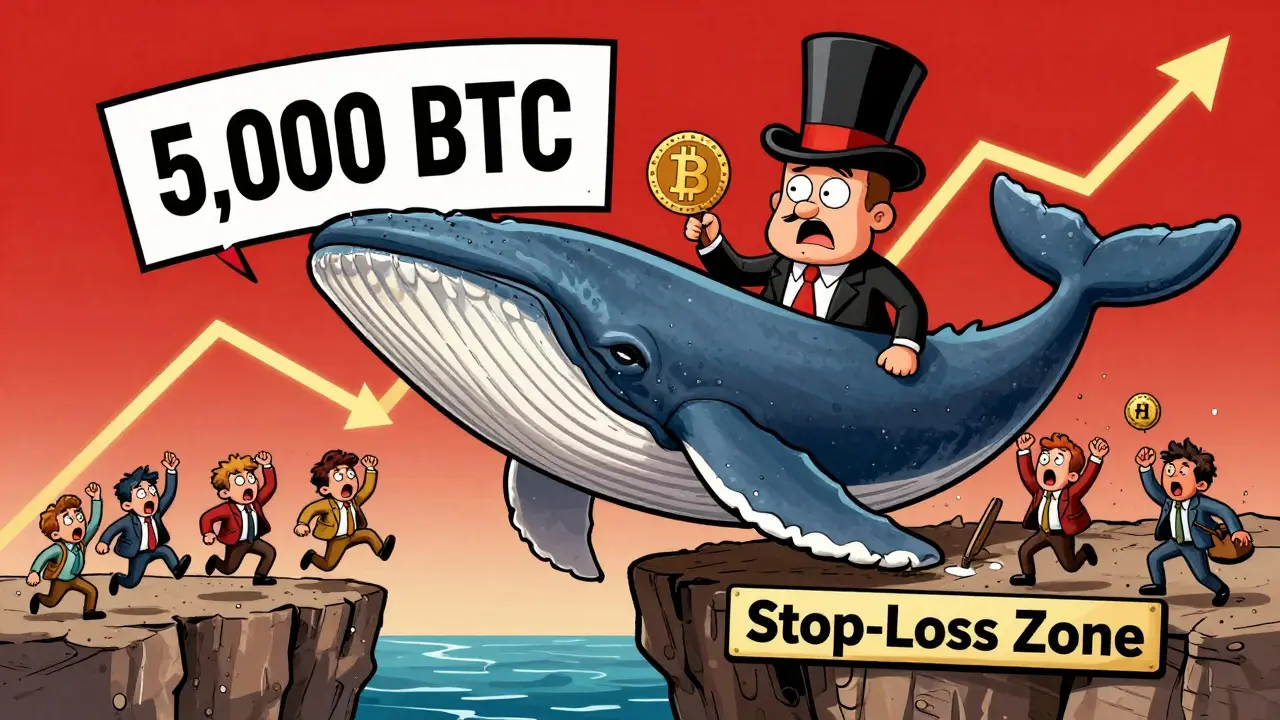
Every time Bitcoin drops 8% in under two minutes, only to rocket back up 5% right after, something’s off. It’s not a bug. It’s not a glitch. It’s whale manipulation.
Whales aren’t mythical creatures. They’re real people - or institutions - with enough crypto to move markets. Just 100 wallets control nearly 15% of all Bitcoin. The top 10,000 addresses hold over 91% of it. That kind of concentration creates power. And power, when unchecked, gets abused.
What Whale Manipulation Actually Looks Like
Whale manipulation isn’t about guessing the future. It’s about forcing others to act. These players don’t need to predict price movements - they create them. Their goal? Buy low, sell high, and make sure retail traders get caught in the crossfire.
Here’s how it works in practice:
- Sell walls: A massive sell order appears at $60,000 on BTC. It’s huge - say, 5,000 BTC. Retail traders see it and panic. They sell before it crashes. Then, within seconds, the wall vanishes. The whale buys up the panic-selling coins at a discount.
- Buy walls: The opposite. A giant buy order pops up at $62,000. Prices rise. FOMO kicks in. People rush in. Then - poof - the wall disappears. The whale dumps their position as the crowd buys in.
- Stop-loss hunting: Whales know where most retail traders place their stop-losses. They push the price just below $61,000 - the level where 80% of stop orders cluster - trigger a cascade of liquidations, then reverse direction. The price rockets back up. The whale bought the liquidated positions at fire-sale prices.
This isn’t theory. It’s documented. On March 15, 2024, a Reddit user watched BTC drop 8% in 90 seconds after hitting $61,200 - then surge to $63,500. That’s textbook stop-loss hunting. TradingView analysts confirmed it as a manipulation event. Chainalysis reported over 1,200 such events across top cryptocurrencies in 2024 alone.
The Two Main Tactics: STB and BTS
Whales don’t guess. They follow patterns. Two frameworks dominate:
- Sell to Buy (STB): The whale opens a short position. Then they dump enough volume to crash the price, triggering stop-losses from long holders. As those positions get liquidated, the whale buys back the asset cheaply. Once the panic settles, they push the price back up - liquidating their own short position for profit.
- Buy to Sell (BTS): The whale buys aggressively to spike the price. Retail traders jump on the momentum. Then the whale stops buying. The price falls. The whale sells their position into the crowd’s FOMO. The result? Retail traders are left holding the bag.
Both rely on one thing: liquidity gaps. Crypto markets are thin. A $5 million order can move the price 5%. In forex or stocks, that’s impossible. But in crypto? Easy. That’s why whales love it.
Spotting the Spoof: Whale Wall Trickery
One of the most common tricks? Spoofing. It’s not just placing big orders. It’s placing big orders you never intend to fill.
MITRE AADAPT officially labeled this as ADT3021.004 - a recognized financial threat. Here’s how it plays out:
- You see a $30 million sell wall at $3,450 on ETH.
- You think, “This is resistance. I won’t buy here.”
- Price slowly creeps toward $3,450.
- At the last second - the wall disappears.
- Price surges past $3,500. You missed the entry.
- Then - the whale dumps 2,000 ETH at $3,520.
This isn’t luck. It’s engineered. The whale used the wall as bait. They didn’t want to sell at $3,450. They wanted you to believe they did. That’s spoofing. And it’s everywhere.
One trader on Bitstamp’s forum called CryptoWolf documented this exact pattern in April 2024. He watched a 15,000 ETH sell wall vanish in 45 seconds. He didn’t buy. He waited. Price spiked, then collapsed. He made a 12% profit on his short.

How to Detect It - Step by Step
You don’t need a PhD. You need to look at the right things.
- Check volume spikes. Did price jump 5% with 3x normal volume? That’s a red flag. Organic moves don’t spike like that.
- Look at the order book. Are there huge, unnatural walls? Are they right at key support/resistance levels? If yes, they’re likely fake.
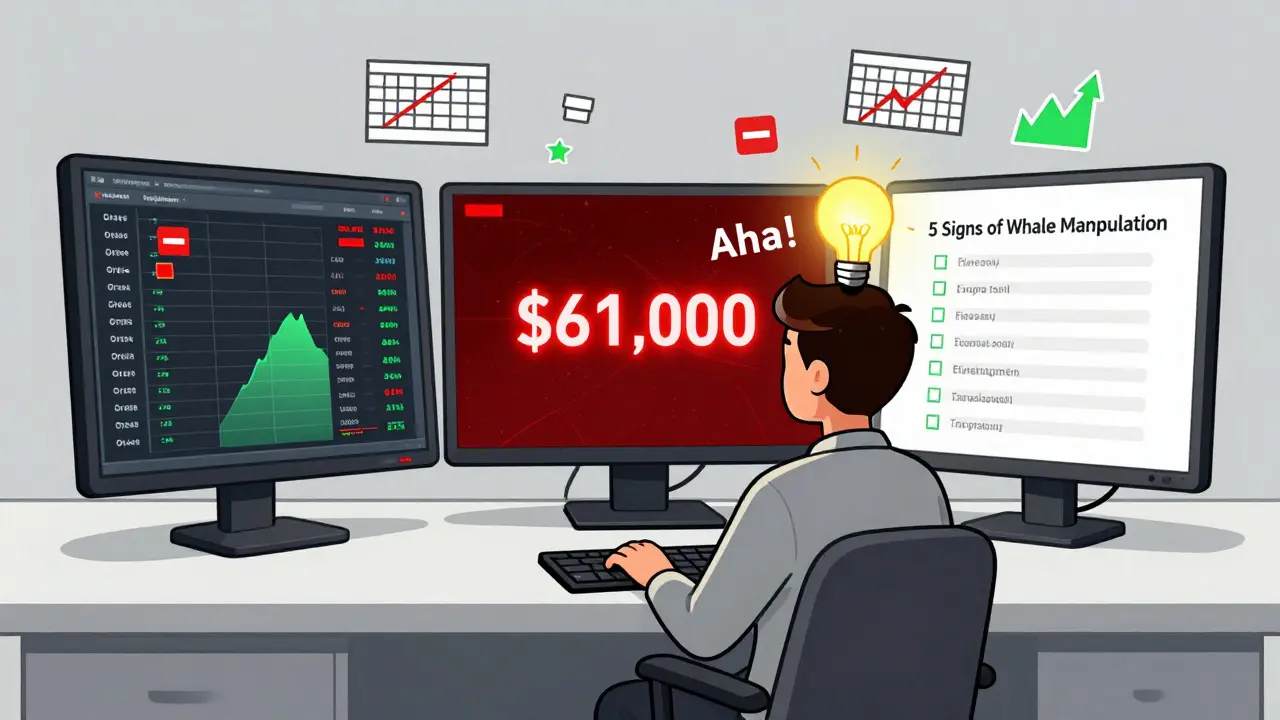
- Watch the liquidation heatmap. Platforms like Coinglass show where most stop-losses are clustered. If price suddenly spikes or drops right into one of those zones - it’s manipulation.
- Compare funding rates. If long funding rates are sky-high and price crashes, whales are likely liquidating longs to reset the market.
- Check social sentiment. If Reddit and Twitter explode with “BTC is going to $70K!” right before a crash - that’s a signal. Whales use hype to lure you in.
- Look for pattern repetition. Did this exact move happen last week? Last month? Manipulation follows cycles. Once you see it once, you’ll see it again.
Binance Academy’s 7-step verification process works because it layers evidence. One sign? Maybe coincidence. Five signs? That’s a pattern.
Why Retail Traders Lose
90% of retail traders lose money in crypto, according to Binance’s own data. Why? Because they trade like gamblers.
- They use market orders - the worst move when whales are active.
- They trade with 50x leverage - turning small moves into total wipeouts.
- They place stop-losses right at obvious levels - the exact spots whales target.
- They chase pumps. They panic-sell dips. They’re emotionally predictable.
Whales don’t trade emotions. They trade psychology. They know you’ll buy when everyone else is buying. They know you’ll sell when the chart looks scary. That’s their edge.
How to Protect Yourself
You can’t stop whales. But you can stop them from taking your money.
- Use limit orders only. Never use market orders in volatile markets. Limit orders ensure you only trade at your price - not theirs.
- Avoid leverage above 5x. Higher leverage = higher liquidation risk. Whales love leveraged markets because one move wipes out hundreds of traders.
- Place stop-losses outside liquidity zones. Don’t put them at $60,000 if everyone else is doing it. Put them at $59,200 or $60,800 - where the crowd isn’t clustered.
- Trade during high-liquidity hours. Asian session? Avoid it. U.S. and European overlap? That’s when real volume flows. Whales move less when there’s real competition.
- Never risk more than 2% of your capital on one trade. Even if you get manipulated, you survive to trade another day.
The Bigger Picture: Regulation Is Coming
For years, crypto was the Wild West. No rules. No oversight. Whales ruled.
That’s changing. In June 2024, the EU’s MiCA regulation forced exchanges to deploy real-time surveillance tools to catch spoofing and layering. The CFTC filed 17 enforcement actions in 2023 - up 217% from 2022. Binance now uses “Anti-Whale Algorithms” that auto-detect and cancel spoof orders.
But here’s the truth: regulation won’t eliminate manipulation. It will just make it harder. Whales will adapt. They’ll use cross-exchange coordination. They’ll exploit new DeFi protocols. They’ll find new gaps.
Deloitte’s 2024 outlook says it best: “Whale manipulation will persist but become more sophisticated.”
So your job isn’t to stop whales. It’s to outsmart them.
What You Should Do Today
Start small. Pick one coin you trade. Open its order book. Look for:
- Any order larger than 10x the average trade size.
- Walls that appear right before price moves.
- Walls that vanish within 60 seconds.
Track it for a week. You’ll start seeing the pattern. It’s not magic. It’s math. It’s psychology. It’s predictable.
Whales want you to think they’re smarter. They’re not. They’re just better at reading you.
Learn their moves. Avoid their traps. Trade like a pro - not a pawn.
How do I know if a large order is real or a spoof?
Real orders stay in the book until filled. Spoofed orders vanish quickly - often right before price moves toward them. Watch the timing: if a massive sell wall disappears the second price hits it, it’s fake. Use tools like TradingView’s order book depth chart to track order persistence over time.
Can whales manipulate Bitcoin like they do altcoins?
Yes, but it’s harder. Bitcoin has more liquidity and more participants. Whales still manipulate it - especially during low-volume periods like weekends or Asian hours - but they need bigger moves to affect price. Altcoins with under $100 million in market cap are far easier to manipulate. A $5 million order can move an altcoin 30%. On Bitcoin, that’s barely a blip.
Do exchanges help stop whale manipulation?
Some are trying. Binance, Kraken, and Coinbase now use AI to detect spoofing and cancel fake orders. MiCA in Europe requires exchanges to monitor for manipulation. But most platforms still prioritize volume over fairness. They don’t want to scare traders away. So they often turn a blind eye - unless regulators force their hand.
Is whale manipulation illegal?
In traditional markets, yes - spoofing is a federal crime. In crypto, it’s a gray area. The U.S. CFTC has prosecuted cases, and the EU’s MiCA makes it illegal. But many exchanges operate in unregulated jurisdictions. Enforcement is slow and patchy. So while it’s technically illegal in some places, most whales operate with impunity.
Should I avoid trading crypto because of whale manipulation?
No - but you need to trade smarter. Whale manipulation isn’t a reason to quit. It’s a reason to level up. The same tools that help you spot manipulation - order book analysis, volume profiling, liquidation maps - also help you find real opportunities. Many profitable traders use whale activity as a signal, not a threat.
How long does it take to learn to spot whale manipulation?
Most traders need 6 to 12 months of daily practice to reliably spot manipulation. It’s not about memorizing patterns - it’s about building intuition. Start by watching one pair for 15 minutes a day. Note when price reacts to order book changes. After a few weeks, you’ll start seeing the same tricks repeat. That’s when you know you’re learning.
Bianca Martins
January 2, 2026 AT 02:10alvin mislang
January 2, 2026 AT 07:50Monty Burn
January 3, 2026 AT 09:33Alexandra Wright
January 3, 2026 AT 12:25Jack and Christine Smith
January 5, 2026 AT 03:59Jackson Storm
January 6, 2026 AT 04:52Raja Oleholeh
January 8, 2026 AT 03:50Prateek Chitransh
January 9, 2026 AT 16:18Amy Garrett
January 9, 2026 AT 18:07Antonio Snoddy
January 10, 2026 AT 10:04