
When you hear about DeFi, you think of trading, lending, or earning interest. But behind every trade on Uniswap or Curve, there’s a hidden engine: liquidity providers. These are real people - not bots or institutions - who lock up their crypto to keep markets running. Without them, you couldn’t swap ETH for USDC in seconds. And they don’t do it for free. Protocol incentives are the system that pays them. But here’s the thing: not all rewards are created equal. Some pay you well. Others eat your money. Let’s break down how these incentives actually work today, what’s changing, and how to avoid getting burned.
How Liquidity Providers Keep DeFi Running
Imagine you’re at a farmers market, and someone wants to buy apples for oranges. But no one has oranges to trade. The market stalls. That’s what crypto markets looked like before liquidity pools. Automated Market Makers (AMMs) fixed this by letting users deposit pairs of tokens - say, ETH and USDC - into a shared pool. Every time someone trades, they pull from that pool. In return, the people who put the tokens in get a cut of the trading fees. Simple, right? But it’s not that easy.
When you add $1,000 worth of ETH and USDC to a pool, you get back LP tokens. These aren’t just receipts. They represent your share of the pool. If you own 1% of the pool, you get 1% of all fees generated. On Uniswap V3, that’s usually between 0.01% and 1% of each trade, depending on how the pool is set up. For high-volume pairs like ETH/USDC, that adds up. But here’s the catch: if the price of ETH swings wildly, you could lose more than you earn. That’s called impermanent loss. And it’s real. A Reddit user in January 2025 lost 28.7% of their $50,000 stake even after earning 14.2% in rewards. That’s not a typo. You can earn rewards and still lose money.
The Evolution of Rewards: From Fees to Token Emissions
Early DeFi just paid trading fees. But that wasn’t enough to attract capital. So protocols started giving out their own tokens. This became known as liquidity mining. Curve, SushiSwap, and others began handing out CRV, SUSHI, or MAGIC tokens to LPs. These tokens had value - at least on paper. In 2021, Curve was distributing 2.4 million CRV per month. That’s over $10 million in rewards every 30 days. Suddenly, people were locking up millions just to earn more tokens.
But here’s what happened next. As more people joined, the price of those reward tokens dropped. Some tokens fell 80% in a month. Your 15% APY in SUSHI? Now it’s 2%. And your principal? Still stuck in the pool. This is why 65-78% of liquidity providers leave these pools every month. It’s not because they’re done earning. It’s because they got spooked by the price crash. That’s churn. And it’s killing long-term stability.
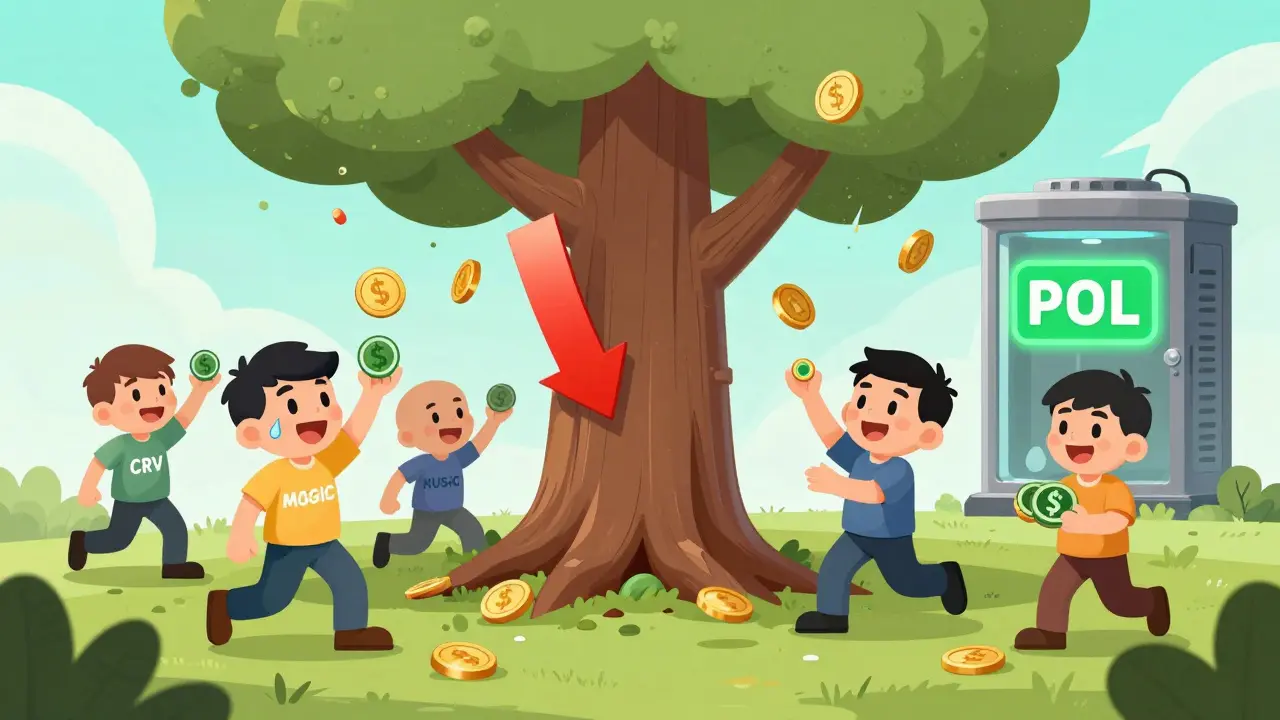
Today, the smartest protocols are moving beyond just token emissions. They’re combining three things: trading fees, token rewards, and protocol-owned liquidity (POL). POL is when the protocol itself buys and holds liquidity. OlympusDAO did this with OHM/DAI. Instead of paying users to supply liquidity, they bought it themselves using discounted token sales. By December 2025, 99.8% of OHM/DAI liquidity was owned by the protocol. That means fewer people leaving. Higher stability. But it also means the protocol has to manage its treasury carefully - or risk collapse, like Wonderland.money did in 2024 when its APY hit 100,000% and the token imploded.
Protocol-Owned Liquidity: The New Standard?
POL isn’t just for wild experiments. It’s becoming the backbone of serious DeFi. Tokemak, for example, lets protocols rent liquidity direction. Instead of begging users to deposit, they pay TOKE holders to route liquidity where it’s needed. The result? 85% lower volatility in market depth compared to traditional pools. That’s huge. It means less slippage for traders and more predictable returns for LPs.
Curve’s latest update, released January 15, 2026, now allocates 40% of its CRV emissions based on how much liquidity is protocol-owned. That’s a signal: the future isn’t about begging users. It’s about building your own infrastructure. The numbers back this up. In Q4 2025, 63% of new DeFi protocols launched with POL. In 2023, it was just 29%. The shift is real. And it’s happening fast.
What You Should Be Looking For
If you’re thinking about becoming a liquidity provider, don’t just chase the highest APY. Here’s what actually matters:
- Fee tier matters: ETH/USDC on Uniswap V3 with 0.05% fees gives you 0.5-1.2% APY from fees alone. That’s solid. Avoid pools with 1% fees unless you’re trading high-volatility assets - they’re riskier.
- Token emissions are dangerous: If a protocol is giving out more than 10% of its total supply in rewards per year, it’s unsustainable. Stanford research shows 83% of such protocols fail within 18 months. That’s not a gamble. That’s a countdown.
- Check for POL: If the protocol owns at least 30% of its own liquidity, it’s a good sign. It means they’re betting on their own success, not just paying for attention.
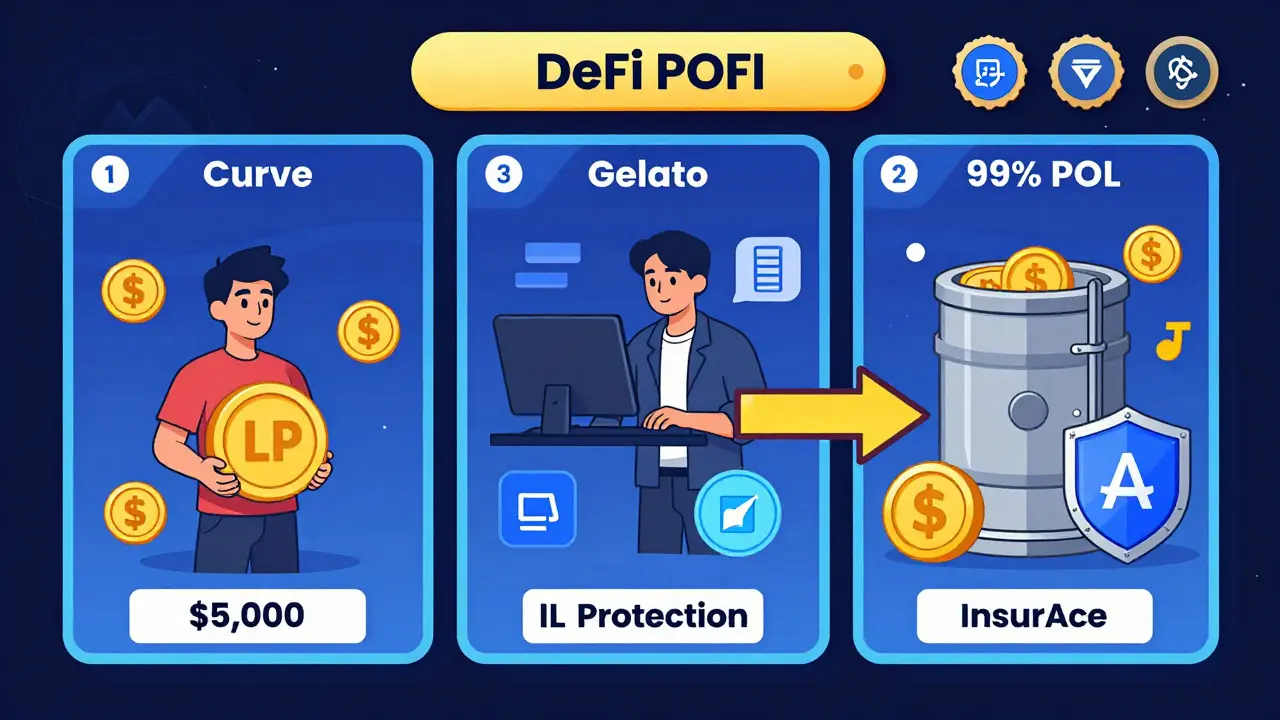
- Use impermanent loss protection: Tools like Bancor’s IL Protection or Gamma Strategies on Uniswap V3 can reduce losses by up to 40%. If a pool doesn’t offer this, it’s a red flag.
- Don’t overextend: The average LP puts in less than $5,000. The top 5% have over $50,000 and use advanced tools to manage price ranges. If you’re new, start small. Learn before you scale.
The Hidden Costs No One Talks About
There’s more to LPing than rewards. Gas fees on Ethereum are $1.20-$3.50 per transaction. Claiming rewards, moving positions, adding liquidity - each costs money. If you’re only earning $20 a month, a $3 gas fee eats 15% of your profit. That’s why many LPs now use automated services like Gelato Network. It’s not free - it costs about 0.5% annually - but it saves you time and gas. 37% of professional LPs use it.
Then there’s smart contract risk. Even audited protocols get hacked. Immunefi’s 2025 report says 1.2% of DeFi protocols suffer exploits annually. That’s 1 in 80. You can’t eliminate it. But you can reduce it. Stick to platforms covered by InsurAce - they insure 85% of the top 20 protocols. Premiums are around 0.85% per year. Worth it.
And don’t forget regulation. The SEC classified some liquidity mining rewards as securities in February 2025. Now, 32% of U.S.-accessible platforms require KYC. If you’re using a platform that doesn’t ask for ID, you might be on shaky legal ground.
What’s Coming in 2026
Change is accelerating. Uniswap’s ‘Concentrated Liquidity 2.0’ launched in February 2026. It automatically adjusts fee tiers based on market volatility - cutting impermanent loss by 23% in tests. Curve’s ‘gauges v3’ now rewards LPs not just for supply, but for how much liquidity is locked up long-term. And Tokemak’s ‘Reactor 2.0’ is coming in Q3 2026. It will let liquidity flow across chains without bridges - cutting costs by 75%.
The big picture? The industry is moving away from short-term mining toward sustainable infrastructure. By 2028, Gauntlet Network predicts 60% fewer standalone liquidity mining pools. The winners will be those that combine fee sharing, capped token emissions, and protocol-owned liquidity. Not the ones offering 50% APY for a week.
Final Takeaway: It’s Not a Free Lunch
Liquidity providers are the unsung heroes of DeFi. But they’re not charities. The incentives are designed to attract capital - not to make you rich. The best returns go to those who understand the math, manage risk, and avoid chasing hype. If you’re new, start with stablecoin pairs on Curve. Low volatility. Low impermanent loss. Solid fees. No toxic tokens. You’ll earn less than 10%, but you’ll keep your money. And that’s the real win.
What exactly is a liquidity provider in DeFi?
A liquidity provider (LP) is someone who deposits two tokens into a decentralized exchange pool - like ETH and USDC - to enable trading. In return, they earn a share of trading fees and sometimes additional token rewards. LPs are essential because without them, automated market makers (AMMs) like Uniswap or Curve couldn’t function. Their deposits create the "order book" that lets users swap assets instantly.
How do protocol incentives actually pay liquidity providers?
There are three main ways: (1) Trading fees - a percentage of every swap (usually 0.01%-1%) is distributed to LPs based on their share of the pool. (2) Token emissions - protocols give out their own tokens as rewards, like CRV or SUSHI. (3) Protocol-owned liquidity (POL) - the protocol itself buys and holds liquidity, reducing reliance on external providers. Many modern pools combine all three for stability.
What is impermanent loss and why does it matter?
Impermanent loss happens when the price of the two tokens in a pool changes after you deposit. Even if you earn fees, your total value can drop because you’re forced to sell high and buy low as the market moves. For example, if ETH rises sharply while USDC stays flat, your ETH share gets sold off in trades, and you end up with less value than if you’d just held the tokens. It’s called "impermanent" because if prices return to original levels, the loss disappears - but in volatile markets, it rarely does.
Are liquidity mining rewards sustainable?
Most aren’t. Stanford research found that protocols giving out more than 15% of their token supply annually as rewards fail within 18 months for 83% of cases. High rewards attract users, but when the token price crashes, LPs leave, and the pool collapses. The most sustainable models combine modest fee rewards with capped emissions and protocol-owned liquidity - not just token giveaways.
Should I use protocol-owned liquidity (POL) pools?
Yes - if they’re well-designed. POL pools, like those from Tokemak or OlympusDAO, reduce churn and improve stability because the protocol has skin in the game. They often have lower volatility and better slippage. But avoid POL pools where the protocol’s treasury is mostly in its own volatile token. Look for ones with at least 60% of treasury in stablecoins or ETH. That’s a sign of responsible design.
What’s the safest way to start as a liquidity provider?
Start with stablecoin pairs on Curve Finance - like USDC/USDT. These have near-zero impermanent loss, low fees, and high trading volume. Avoid high-volatility pairs (like ETH/DOGE) and reward tokens you don’t understand. Use a wallet with gas optimization tools like Gelato, and only invest what you can afford to lose. Keep it under $5,000 until you’ve tracked performance for 3 months.
Alex Williams
February 19, 2026 AT 12:45Let me tell you something real - most people think LPing is just depositing tokens and watching APY climb. Nah. It’s a full-time job now. You gotta track fee tiers, monitor impermanent loss, watch token emissions, and time your exits. I’ve lost more on CRV dumps than I’ve made on fees. And don’t even get me started on gas fees eating 20% of your $300 monthly yield. If you’re not using Gelato or a similar automator, you’re leaving money on the table. And yeah, POL is the future. If a protocol doesn’t own at least 30% of its own liquidity, it’s just a Ponzi with a whitepaper.
yogesh negi
February 20, 2026 AT 03:49Brooo, I just started with $2k in USDC/USDT on Curve, and I’m already seeing 8.7% APY with zero IL 😍. No toxic tokens, no drama. Just stable, steady, simple. If you’re new, start here. Don’t chase 50% APY on some random meme coin pool - that’s not investing, that’s gambling with your life savings. I’ve seen too many friends lose everything. Stay humble, stay stable. You got this 💪
jennifer jean
February 21, 2026 AT 09:34Yessss this is so true!! 🙌 I’ve been LPing for 2 years and I swear by stablecoin pairs. No drama, no tears, just chill passive income. Also, I use Bancor’s IL protection - saved me during the LUNA crash. If you’re not using it, you’re playing Russian roulette with your portfolio 😅
Rajib Hossaim
February 23, 2026 AT 01:38While the article presents a comprehensive overview of liquidity provider incentives, it is imperative to note that the regulatory landscape is evolving rapidly. In jurisdictions such as the United States, the classification of token emissions as securities may impose significant compliance obligations on both protocols and participants. Ignorance of legal frameworks may result in unintended liabilities. Therefore, due diligence is not optional - it is foundational.
Beth Erickson
February 24, 2026 AT 09:31Everyone’s scared of impermanent loss like it’s the plague. Bro, it’s just math. If you can’t handle price swings, don’t touch DeFi. Go buy Bitcoin and HODL. Stop pretending you’re a DeFi farmer when you’re just a scared retail guy with a Coinbase account. And stop using IL protection - that’s for bots, not real players. Real LPs take the loss and move on.
Jeremy Fisher
February 25, 2026 AT 19:04Look, I’m from Texas, grew up on oil rigs, and now I’m farming liquidity on Ethereum. Weird? Maybe. But here’s the thing - DeFi isn’t just tech. It’s a cultural shift. People in India, Nigeria, Brazil - they’re not waiting for banks anymore. They’re building their own financial systems. And yeah, some of these pools are wild. But the fact that a guy in Mumbai can earn more from LPing than his job? That’s power. We’re not just trading tokens. We’re rewriting the rules. And the old guard? They don’t even know what hit them.
Anandaraj Br
February 27, 2026 AT 04:10Oh wow another one of these ‘DeFi is the future’ sermons. I’ve seen 12 different protocols collapse since 2021. Curve? Sushi? Olympus? All dead. Just a bunch of devs printing tokens and hoping people are dumb enough to chase them. And now they’re calling POL the ‘new standard’? LOL. It’s the same game with a new name. The treasury is still in their own garbage token. You think the SEC is gonna let this slide? Wake up. This whole thing is a pyramid scheme with a blockchain sticker on it.
AJITH AERO
February 27, 2026 AT 05:18So you’re telling me I have to read 1000 words to find out I shouldn’t put money into DeFi? Thanks, Captain Obvious. Just say ‘don’t do it’ next time. I’ll save 10 minutes and my sanity.
Ian Plunkett
February 27, 2026 AT 22:52The real story here isn’t LPs or POL - it’s the silent collapse of trust. Every time a protocol offers token rewards, it’s essentially saying: ‘We have no revenue, so here’s our future equity as a bribe.’ That’s not innovation. That’s desperation. And when the token crashes? The protocol doesn’t vanish - the LPs do. And they’re never coming back. The market is learning. The era of ‘yield farming’ is over. Now it’s about infrastructure. And infrastructure doesn’t need hype. It needs stability.
Avantika Mann
February 28, 2026 AT 20:35I love how this article breaks it down so clearly. I’m a new LP and honestly, I was terrified. But now I get it - stablecoin pairs are the way to go. I started with $1k in USDC/USDT on Curve and I’ve been earning consistently for 6 months. No drama, no panic. Just steady returns. Thank you for the clarity - I feel way more confident now 🙏
Tarun Krishnakumar
March 1, 2026 AT 06:37Did you know that 87% of all liquidity mining rewards are just a front for insider dumps? The devs mint tokens, pump them with farming incentives, then dump on retail LPs before the token crashes. And now they’re calling it POL? It’s the same scam, just rebranded. They even changed the name from ‘liquidity mining’ to ‘protocol-owned liquidity’ so you don’t realize you’re still being used. The SEC is watching. They’re building cases. And when they hit, your ‘safe’ LP position? Gone. Poof. All gone. They’re not coming to warn you. They’re coming to seize it.
george chehwane
March 3, 2026 AT 03:05It’s not about APY. It’s about epistemological alignment. Are you optimizing for utility or for speculative capital appreciation? Most LPs confuse the two. They think they’re participating in a decentralized financial system - but they’re really just betting on tokenomics as a proxy for value. The real innovation isn’t in the pool mechanics - it’s in the ontological shift from permissioned to permissionless capital allocation. But that’s too abstract for Reddit. So we get ‘avoid 1% fee tiers’ instead of a critique of the commodification of liquidity itself.
Alan Enfield
March 3, 2026 AT 09:53Just wanted to say thanks for the clear breakdown. I used to chase high APY pools until I lost $1,200 in impermanent loss. Now I stick to ETH/USDC on Uniswap V3 with 0.05% fees. Earn less, but I sleep better. Also, Gelato is a game-changer. Saved me like 80% in gas. Simple advice: don’t overcomplicate it.
Jennifer Riddalls
March 4, 2026 AT 20:35So many people treat DeFi like a casino. Just because you earn 12% APY doesn’t mean it’s safe. I’ve been in this space since 2020. I’ve seen it all. Start small. Learn the risks. Use tools. And if a protocol doesn’t have insurance? Walk away. You’re not missing out - you’re protecting yourself.
Kyle Tully
March 5, 2026 AT 01:31You think you’re smart because you’re farming LP rewards? Congrats. You’re the fuel for the machine. The real winners are the ones who built the protocol, sold their tokens early, and left you holding the bag. You’re not an investor. You’re a liquidity drone. And the system? It’s designed to keep you busy, distracted, and profitable for them. Enjoy your 7% APY while you still can.