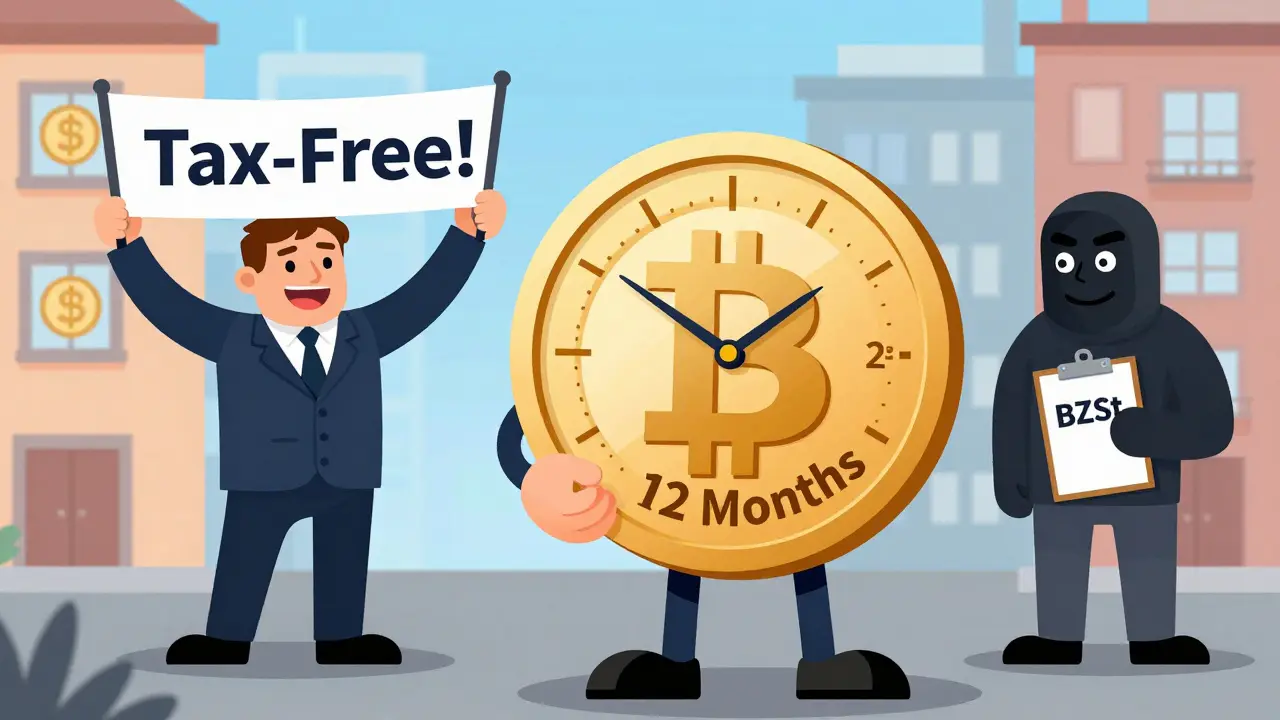
Germany doesn’t tax Bitcoin or any other cryptocurrency if you hold it for 12 months. That’s not a rumor. It’s the law. And if you’re sitting on crypto in Germany, this rule could save you thousands. But here’s the catch: it only works if you get the details right. Miss the deadline by one day? You could owe nearly half your profit in taxes. This isn’t about speculation. It’s about understanding how the system actually works - and how to use it without tripping up.
How the 12-Month Rule Actually Works
Under Section 23 of Germany’s Income Tax Act (EStG), cryptocurrencies like Bitcoin, Ethereum, and others are treated as private money, not capital assets. That’s unusual in Europe. Most countries treat crypto like stocks - you pay capital gains tax every time you sell. Germany says: if you hold it for 365 days or more, any profit is tax-free. No matter how much it grew. No matter how much you sell.The clock starts ticking the moment you buy. Not when you transfer it. Not when you move it to a wallet. When you first acquire it. If you bought 0.5 BTC on January 15, 2024, you can sell it tax-free on January 15, 2025 - exactly 365 days later. Even if you sell at 3 a.m. on that day, it counts. But if you sell at 2:59 a.m.? You’re still in the short-term zone. The German Federal Central Tax Office (BZSt) counts every minute. No grace period. No rounding.
What Happens If You Sell Too Soon?
Sell before 12 months? Welcome to the taxman’s door. Short-term crypto gains are taxed as personal income. Rates range from 14% to 45%, depending on your total income. Add the 5.5% Solidarity Tax, and the max effective rate hits 47.475%. That’s higher than most corporate tax rates in Germany.There’s a small escape hatch: the €1,000 annual exemption. If your total crypto gains in a year are under €1,000, you don’t have to report anything. But here’s the trap - if you make €1,001, you pay tax on the entire €1,001, not just the extra euro. No partial exemption. That’s why many people hold off on small sales until they can bundle them into a single long-term trade.
It’s Not Just Bitcoin - It’s Everything
This rule isn’t limited to Bitcoin. It applies to Ethereum, Solana, Polkadot, even stablecoins like USDT and DAI - as long as they’re not used as payment for goods or services. Staking rewards? Taxable when you receive them. But if you hold those rewards for 12 months before selling, they become tax-free. Same with mining income. Same with airdrops.DeFi is trickier. If you deposit ETH into a liquidity pool and earn yield, that’s a taxable event the moment you get the reward. But if you hold that reward for a year before cashing out? Tax-free. The German tax office doesn’t care how you made the crypto - only how long you held it before selling.
What You Can’t Do: No Loss Harvesting
This is where Germany’s system gets harsh. In the U.S., if you lose money on crypto, you can offset it against your gains. Up to $3,000 per year. Germany doesn’t allow that. If you bought ETH at €5,000 and sold it at €3,000? You lost €2,000. But if you also made €2,500 on Bitcoin in the same year? You still pay tax on the full €2,500. The loss doesn’t help. You can’t carry it forward. You can’t use it next year. It just disappears.That’s why many German investors keep two separate wallets: one for long-term holds (over 12 months) and one for short-term trades. Mixing them can accidentally trigger taxes on assets you meant to hold long-term. FIFO accounting (First-In-First-Out) is mandatory. The system assumes you sold your oldest coins first. So if you bought BTC in 2022 and again in 2025, and you sell 0.1 BTC in 2026, the system treats it as if you sold the 2022 coins - even if you meant to sell the 2025 ones. That could turn a tax-free sale into a taxable one.

How to Prove You Held It Long Enough
The BZSt doesn’t ask for receipts. But they can ask for proof. If you’re audited, you need to show:- The exact date and time you bought each coin
- The exchange or wallet where you bought it
- The transaction ID or hash
- The date and time you sold or spent it
Most people use crypto tax software like Koinly, BitcoinSteuer, or Blockpit. These tools connect to your wallets and exchanges, track every transaction, and generate a BZSt-compliant report. About 42% of German crypto owners with more than €5,000 in holdings use them, according to a CoinGecko survey. Manual tracking? Possible. But risky. One user on Reddit lost €3,200 because they miscalculated the holding period by 12 hours.
Pro tip: Screenshot every transaction. Include the timestamp. Store it in a folder labeled with the coin name and date. Even if you don’t need it now, you’ll thank yourself when the tax office asks.
What Gets Reported - And How
All crypto transactions must be reported via the Elster online tax portal. Paper filings are still allowed, but the BZSt strongly discourages them. The portal now has a dedicated crypto module (introduced in 2023), but it’s not foolproof. Over 60% of users still rely on external software to prepare their data before importing it into Elster.Deadline? July 31 of the following year. In 2024, it was extended to September 30 due to backlogs. Don’t count on that happening again. File on time. The BZSt has been automating data collection from major exchanges like Coinbase, Kraken, and Bison. Starting in 2026, they’ll get your transaction history automatically. That means fewer mistakes - but also less privacy. If you didn’t report a trade, they’ll find it.
How It Compares to the Rest of Europe
Germany isn’t alone. Portugal also has a crypto tax exemption - but only if you hold for 28 days. That’s much easier. But Portugal changed its rules in 2024, and now only non-residents qualify. Germany’s exemption is still open to residents.France taxes all crypto gains at a flat 30%. The UK gives you a £6,000 annual allowance - but that’s been cut in half since 2023. Germany’s €1,000 short-term threshold is low, but the 12-month exemption is powerful. For buy-and-hold investors, it’s the best deal in Europe. For active traders? A nightmare. If you do more than 12 trades a year, you’ll likely pay the maximum rate on nearly everything.

Who Benefits Most?
Statista shows 29.7% of Germans own crypto - second highest in the EU. And 73% of them hold assets longer than 12 months - not because they believe in the tech, but because they know the tax rule. The real winners? People who bought Bitcoin in 2020 or 2021 and never touched it. They’re sitting on tax-free gains. Someone who bought 1 BTC in 2021 at €30,000 and sold in 2025 at €80,000? That’s €50,000 profit. Zero tax. In most countries, that would be over €20,000 in taxes.It’s also attracting foreign investors. Over 18,500 people moved to Germany in 2024 specifically because of the crypto tax exemption. They call it the “crypto immigrant” trend.
The Big Question: Is This Going to Last?
The EU is pushing for a unified crypto tax rule called DAC8. It’s scheduled to roll out in 2027. The draft proposes a flat 15% tax on all crypto gains after a 365-day holding period. That’s still a long-term exemption - but it’s not tax-free. It’s a flat rate.Industry experts warn: Germany’s current system might not survive. PwC’s 2025 Crypto Tax Competitiveness Index ranks Germany #1 - but they also say the EU’s pressure is growing. Deloitte estimates a 60% chance that DAC8 passes by 2027. If it does, existing holdings might be grandfathered in. But new ones? Probably not.
Right now, Germany’s rule is the most generous in Europe. But it’s also fragile. If you’re holding crypto here, treat it like a temporary advantage - not a permanent one.
What You Should Do Right Now
If you own crypto in Germany:- Check every coin you own. When did you buy it?
- Use a tax tool like Koinly or BitcoinSteuer to track your acquisition dates.
- Separate your wallets: one for long-term, one for short-term.
- Take screenshots of all transactions - include timestamps.
- If you’re close to 12 months on any asset, wait. Don’t rush to sell.
- If you’re unsure, hire a tax advisor who specializes in crypto. The average cost is €285 - less than what you’d save.
This isn’t about getting rich. It’s about not giving away money you don’t have to. Germany’s system is simple - if you follow the rules. But if you ignore them? You’ll pay for it.
Does the 12-month rule apply to NFTs in Germany?
Yes. NFTs are treated the same as cryptocurrencies under Germany’s tax law. If you hold an NFT for 365 days or longer before selling, any profit is tax-free. If you sell before that, the gain is taxed as personal income. This was officially confirmed in the Federal Ministry of Finance’s March 6, 2025 guidance.
Can I avoid taxes by gifting crypto to a family member?
No. Gifting crypto is considered a disposal event. You’ll owe tax on any gain up to the time of the gift. The recipient starts their own 12-month clock from the date they received it. The tax office tracks these transfers. Don’t assume gifting avoids taxes - it just shifts the liability.
What if I use crypto to buy a car or a house?
Spending crypto on goods or services is treated as a sale. You must calculate the gain based on the euro value of the crypto at the time of the transaction. If you held it less than 12 months, you pay income tax on the profit. If you held it longer, the gain is tax-free. The same 12-month rule applies.
Do I need to report crypto if I didn’t sell any?
No. You only report crypto if you sold, swapped, spent, or received it as income (like staking or mining). Simply holding crypto in your wallet - even if its value went up - doesn’t trigger a tax event. You only pay tax when you dispose of it.
Is the €1,000 exemption per person or per household?
Per person. Each adult taxpayer gets their own €1,000 threshold. So if you and your partner both hold crypto, you each have €1,000 of tax-free gains. But you must file separate tax returns. Joint filing doesn’t combine the exemption.
Elizabeth Choe
February 12, 2026 AT 21:46Elijah Young
February 14, 2026 AT 16:27monique mannino
February 14, 2026 AT 18:44Will Lum
February 16, 2026 AT 17:43Brittany Meadows
February 16, 2026 AT 23:51Santosh kumar
February 18, 2026 AT 09:24Claire Sannen
February 19, 2026 AT 01:23blake blackner
February 20, 2026 AT 04:53Andrea Atzori
February 21, 2026 AT 07:09Joe Osowski
February 21, 2026 AT 13:07Sakshi Arora
February 21, 2026 AT 19:30bala murali
February 23, 2026 AT 01:24Ekaterina Sergeevna
February 24, 2026 AT 05:42SAKTHIVEL A
February 24, 2026 AT 09:35krista muzer
February 26, 2026 AT 00:02Tammy Chew
February 26, 2026 AT 19:11Lindsey Elliott
February 28, 2026 AT 13:15