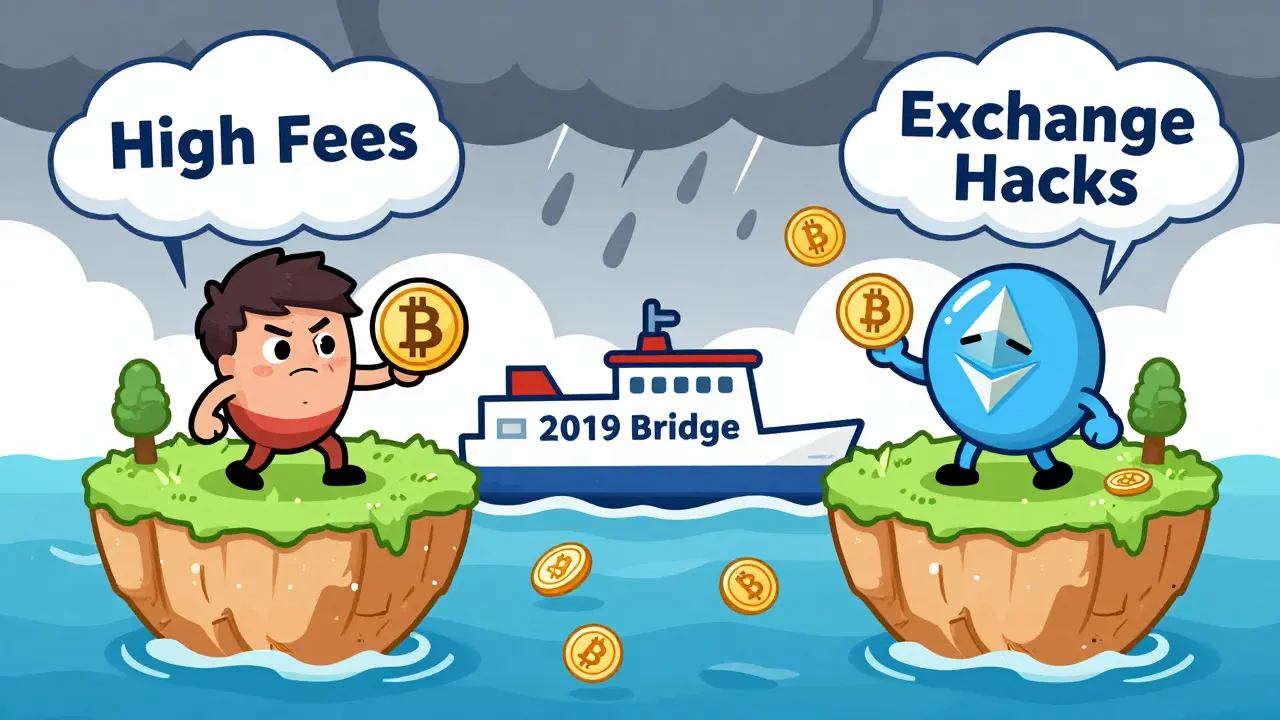
Back in 2019, if you owned Bitcoin and wanted to earn interest on it, you were stuck. Bitcoin’s network couldn’t talk to Ethereum’s DeFi apps. You had to sell your BTC, buy ETH, and move your funds-all while paying high fees and risking exchange hacks. That’s when cross-chain bridges started to matter. They weren’t just a nice-to-have anymore. They became the lifeline between isolated blockchains. Today, bridges move billions in assets daily, but they’re far from perfect. Some are fast. Some are safe. Most are still risky.
What Exactly Is a Cross-Chain Bridge?
A cross-chain bridge is a smart contract system that lets you send tokens from one blockchain to another. Think of it like a ferry between two islands that don’t have a direct road. The bridge doesn’t move your original Bitcoin or Ethereum. Instead, it locks your asset on the source chain and creates a matching token on the destination chain. That new token is called a wrapped token. For example, Wrapped Bitcoin (WBTC) is Bitcoin locked on Ethereum, represented as an ERC-20 token. When you want to get your original Bitcoin back, the bridge burns the wrapped version and unlocks your real BTC.
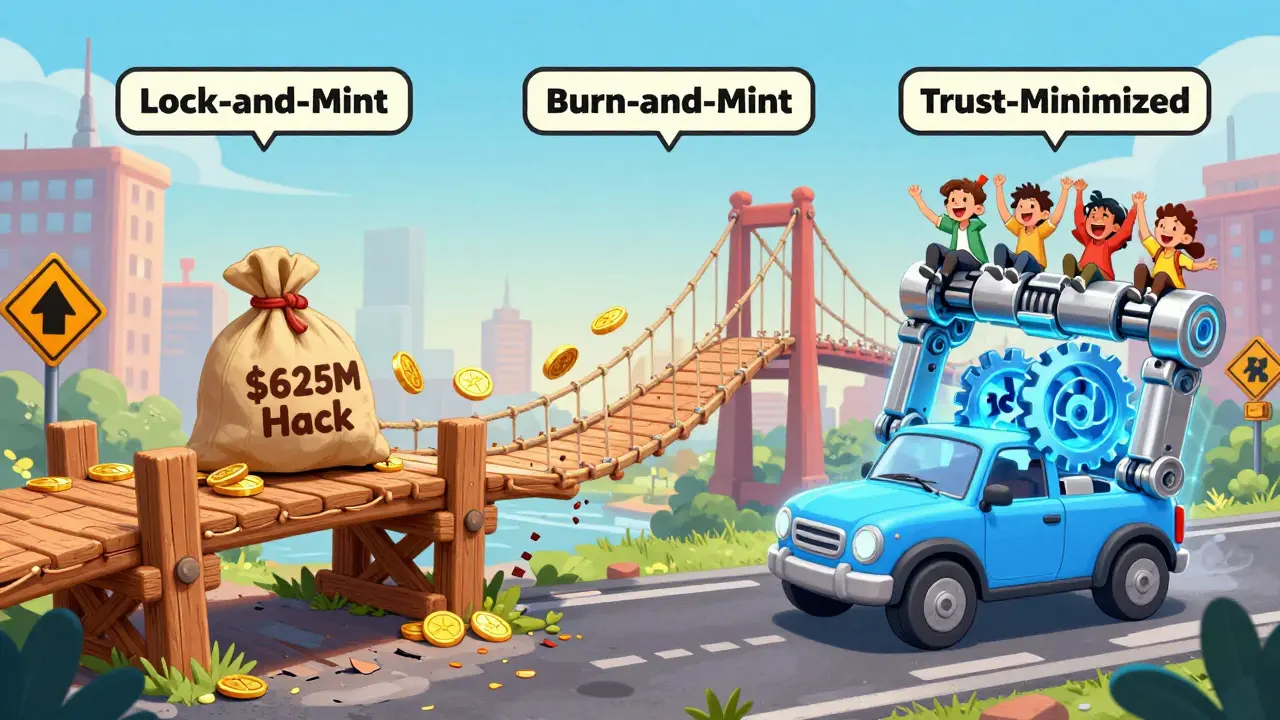
This might sound simple, but the real challenge is trust. Who controls the lock? Who decides when to mint or burn? Early bridges used centralized operators-like a single company holding keys. That’s how the Ronin Bridge got hacked in 2022, losing $625 million. The attackers didn’t break the blockchain. They stole the private keys of the validators. That’s the Achilles’ heel of many early bridges.
The Three Main Types of Bridges
Not all bridges work the same way. There are three dominant models, each with trade-offs in security, cost, and speed.
- Lock-and-Mint (68% of TVL): Your asset gets locked on Chain A, and an equivalent wrapped token is created on Chain B. This is the most common model. WBTC, stETH, and USDC bridges use this. But it’s also the most vulnerable. If the smart contract is hacked or the custodian is compromised, your funds vanish. Over 73% of all bridge hacks involved this type.
- Burn-and-Mint (17% of TVL): You burn your original token on Chain A, and a new one is minted on Chain B. No wrapped tokens. No custody. But this only works if both chains support the same token standard. It’s cleaner, but less flexible. THORChain uses a variation of this, letting you swap native assets without wrapping.
- Lock-and-Unlock (15% of TVL): Liquidity pools on both chains hold assets. When you send funds, the bridge moves liquidity between pools using economic incentives. THORChain’s model is the standout here. It doesn’t rely on trusted parties. Instead, validators are slashed if they act dishonestly. It’s slower and has slippage (up to 0.87%), but it’s trustless and has been running for over two years without a major exploit.
There’s also a fourth, emerging type: programmable token bridges. These don’t just move tokens. They move data. Chainlink’s CCIP lets you send a token and a command-like ‘swap this for ETH when it arrives’-in one transaction. This is the future. Imagine sending USDC from Ethereum to Solana, and automatically using it to buy a NFT the moment it lands. That’s possible now.
Security: The Biggest Weak Spot
Between 2021 and 2023, cross-chain bridges lost over $2.1 billion to hacks. That’s more than half of all DeFi losses in that period. Why? Because bridges are the weakest link in a chain of strong chains.
Chainlink’s 2022 analysis broke down security models into three categories:
- Custodial (12%): A single company holds the keys. High risk. Low decentralization. Examples: early versions of Multichain.
- Semi-Custodial (31%): A group of validators (like 15-20 nodes) must sign off. They’re slashed if they cheat. Better, but still a target. The Wormhole hack exploited this model.
- Trust-Minimized (57%): Uses cryptographic proofs-like ZK-SNARKs-to verify transactions without trusting anyone. Gravity Bridge and Cosmos IBC use this. They’re slower and cost more, but they’re the only ones that come close to native chain security.
Here’s the truth: if you’re moving $10,000 or more, avoid custodial bridges. Stick to trust-minimized ones like Cosmos IBC or LayerZero. Yes, they take longer. Yes, they cost more. But you’re not gambling with your funds.
Performance: Speed vs. Cost vs. Reliability
Not all bridges are created equal when it comes to speed and fees.
| Bridge | Avg. Transfer Time | Avg. Gas Cost | Security Model |
|---|---|---|---|
| Polygon Bridge | 2-3 minutes | $0.50 | Semi-Custodial |
| Avalanche Bridge | 5-8 minutes | $1.20 | Semi-Custodial |
| THORChain | 10-15 minutes | $3.50 | Trust-Minimized |
| Gravity Bridge | 15-20 minutes | $8.75 | Trust-Minimized |
| Arbitrum Bridge | 1-2 minutes | $0.15 | Optimistic Validation |
Notice something? The fastest bridges are also the least secure. Arbitrum’s bridge is lightning-fast because it assumes transactions are valid unless proven otherwise. That’s a gamble. If a fraud proof isn’t submitted in time, bad actors could steal funds. THORChain and Gravity Bridge take longer because they wait for cryptographic proofs. But they don’t have to trust anyone.
Real User Stories: Successes and Disasters
People aren’t just theorizing about bridges. They’re using them-and losing money.
One user on Reddit moved $5,000 from Ethereum to Avalanche in 8 minutes using the official Avalanche Bridge. They saved $187 in gas fees compared to using a centralized exchange. That’s a win.
Another user lost $22,500 in the Nomad Bridge hack. The bridge’s smart contract had a flaw that let anyone mint unlimited tokens. Nomad’s team had to shut it down. The user never got their money back. That’s not an edge case. It’s the norm for poorly built bridges.
Trustpilot reviews show a 3.2/5 average. Users love how easy it is to connect MetaMask. But they hate when transactions fail with no explanation. Or when they can’t find support. Many bridges have no live chat. No email. Just a GitHub issue tracker. If you’re not a developer, you’re stuck.

What’s Changing in 2025-2026?
The bridge market is consolidating. In 2022, there were over 70 active bridges. Today, fewer than 20 are moving significant value. The rest are dead. Why? Because users are getting smarter. They’re not using bridges just because they’re there. They’re choosing based on security, not convenience.
Two trends are dominating:
- Trust-minimized bridges are winning. In 2023, 67% of new bridges used ZK-proofs or similar cryptographic methods. By 2026, experts predict over 75% of TVL will be in trust-minimized bridges. No more custodians. No more single points of failure.
- Native interoperability is coming. Projects like Polkadot’s XCM and Cosmos IBC let blockchains talk natively. No wrapping. No bridges needed. If you’re building a new blockchain, you’ll likely join one of these ecosystems instead of building a bridge.
But here’s the catch: native interoperability is hard. It requires every chain to adopt the same communication protocol. That’s why bridges aren’t going away anytime soon. Even if Ethereum and Solana become compatible tomorrow, Bitcoin will still need a bridge to interact with DeFi. And Bitcoin isn’t going to change its consensus.
What Should You Do Today?
If you’re a casual user: Stick to bridges built by major ecosystems. Use the official bridge for Ethereum → Polygon, Ethereum → Arbitrum, or Avalanche → Ethereum. These are maintained by teams with skin in the game. Avoid random bridges you found on CoinGecko.
If you’re moving large sums: Use THORChain or Cosmos IBC. They’re slower. They cost more. But they’re the only ones that don’t require you to trust a company.
If you’re building something: Don’t rely on a bridge for critical functionality. Use it as a temporary bridge (pun intended). Plan for native interoperability. Build for chains that already support it.
Remember: bridges are tools, not magic. They solve a real problem-but they create new ones. The best bridge is the one you don’t need to use.
Are cross-chain bridges safe to use?
Some are, most aren’t. Bridges using trust-minimized models like ZK-proofs or decentralized validator sets (e.g., Cosmos IBC, THORChain) are far safer than those relying on centralized custodians. Over 73% of bridge hacks occurred on lock-and-mint bridges with custodial controls. Always check how the bridge secures assets before sending funds.
Why do some bridges have higher fees than others?
Higher fees usually mean stronger security. Trust-minimized bridges use cryptographic proofs that require heavy computation, increasing gas costs. Bridges like Arbitrum’s are cheap because they assume transactions are valid unless challenged. That’s faster but riskier. You’re paying for speed versus safety.
Can I lose my crypto using a bridge?
Yes. If the bridge is hacked, the smart contract has a flaw, or you send funds to the wrong address, you can lose everything. There’s no FDIC insurance. No customer support team that can reverse transactions. Always test with a small amount first. Double-check addresses. And never use a bridge with no public audit history.
What’s the difference between wrapped tokens and native tokens?
Wrapped tokens (like WBTC or wETH) are representations of real assets on another blockchain. They’re backed 1:1 by the original asset but aren’t the same thing. Native tokens exist on their own chain. For example, BTC is native to Bitcoin; wBTC is wrapped. Native tokens are more efficient and avoid bridging risks, but they can’t move across chains unless the chain supports interoperability.
Will bridges become obsolete?
Not anytime soon. While projects like Polkadot and Cosmos aim for native interoperability, Bitcoin and other legacy chains won’t change. Bridges will continue to be the only way to connect these networks. The future isn’t eliminating bridges-it’s making them trustless. By 2026, most bridges will use cryptographic proofs instead of custodians, making them safer and more reliable.
maya keta
February 24, 2026 AT 06:08Okay, but let’s be real - if you’re still using lock-and-mint bridges in 2025, you’re basically leaving your keys under the doormat and hoping no one’s got a crowbar. WBTC? More like WORSTBTC. I’ve seen so many ‘DeFi gurus’ lose life savings because they trusted a bridge with 5 validators who all live in the same co-working space in Miami. Trust-minimized or bust. ZK-proofs aren’t a trend - they’re the baseline now. If your bridge doesn’t use them, it’s a liability, not a tool.
Curtis Dunnett-Jones
February 24, 2026 AT 06:15While the technical exposition presented herein is both comprehensive and commendable, I must respectfully assert that the prevailing narrative undersells the macroeconomic imperative of interoperability. The fragmentation of liquidity across consensus mechanisms constitutes a systemic inefficiency of unprecedented magnitude. The emergent paradigm of trust-minimized architectures does not merely mitigate risk - it reconstitutes the very ontological foundation of decentralized value transfer. One must, therefore, regard not merely the mechanism, but the epistemological shift it enables.
bella gonzales
February 25, 2026 AT 13:48Ugh. I tried to read this. So much text. Like… why? I just wanna move my ETH to Solana without losing my shirt. Can we just… make it easier? And why does everyone sound like a whitepaper? I’m not a dev. I just want my crypto to not vanish. 😩
Paul Reinhart
February 27, 2026 AT 09:49I remember the first time I bridged from Ethereum to Polygon - I was terrified. My hands were sweating. I double-checked the address three times. I sent 0.01 ETH as a test. It worked. I cried. Not because I made money - but because for once, the system didn’t betray me. That’s what these bridges are really about: restoring trust in a world that’s been built on code, not contracts. The fact that we’ve gone from centralized custodians to cryptographic proofs in five years? That’s not progress. That’s a revolution. And we’re still not done. I’m not just watching this - I’m living it.
Amita Pandey
February 28, 2026 AT 14:57It is a lamentable state of affairs that so many individuals continue to conflate convenience with security. The notion that a bridge with a 1-minute transfer time is preferable to one that requires 20 minutes for cryptographic verification is not merely misguided - it is morally irresponsible. One does not sacrifice foundational integrity for the sake of temporal efficiency. The user who lost $22,500 on Nomad Bridge did not fall victim to bad luck - they fell victim to their own intellectual complacency. A truly rational actor would never entrust their assets to a system lacking a publicly audited, on-chain verification mechanism.
aaron marp
March 1, 2026 AT 08:56Great breakdown. I’ve been using THORChain for my BTC-ETH swaps for over a year now. Slippage is real, but I’ve never lost a satoshi. The 15-minute wait? Totally worth it. I’d rather wait and know I’m not gambling than rush and wake up to a $0 balance. Also - anyone else notice how the ‘fastest’ bridges are always the ones with zero public audits? Red flag. Always.
Patrick Streeb
March 1, 2026 AT 15:52While the analysis presented is largely accurate, it is perhaps worth noting that the classification of bridges into three primary models may be overly reductive. The emergence of hybrid architectures - such as those combining ZK-proofs with liquidity pool incentives - suggests a fourth category is not merely emerging, but已然 established. Furthermore, the assertion that ‘bridges are the only way’ to connect Bitcoin with DeFi overlooks the growing adoption of Layer-2 sidechains that operate with Bitcoin’s UTXO model. The future may not be bridges per se - but rather, protocol-level interoperability.
Phillip Marson
March 3, 2026 AT 09:28Y’all act like bridges are some kind of sacred temple but they’re just glorified middlemen with a fancy smart contract. I lost $10K on a bridge that had ‘Powered by Solana’ on its homepage. Turns out Solana didn’t power it - some guy in a basement in Moldova did. I’m not mad. I’m just… done. Next time I wanna move crypto? I’m using a CEX. At least they have a customer service line. And a refund policy. And a human being who doesn’t speak in blockchain buzzwords.
Tracy Whetsel
March 4, 2026 AT 07:23Thank you for writing this. 💙 I’ve been scared to bridge for years - I thought I was too dumb to understand it. But this? This made me feel like I could actually do it. I sent $100 to Polygon last week using the official bridge. It worked. No panic. No tears. Just… smooth. And now I’m not scared anymore. You helped me feel safe. That’s worth more than any gas fee. 🫶