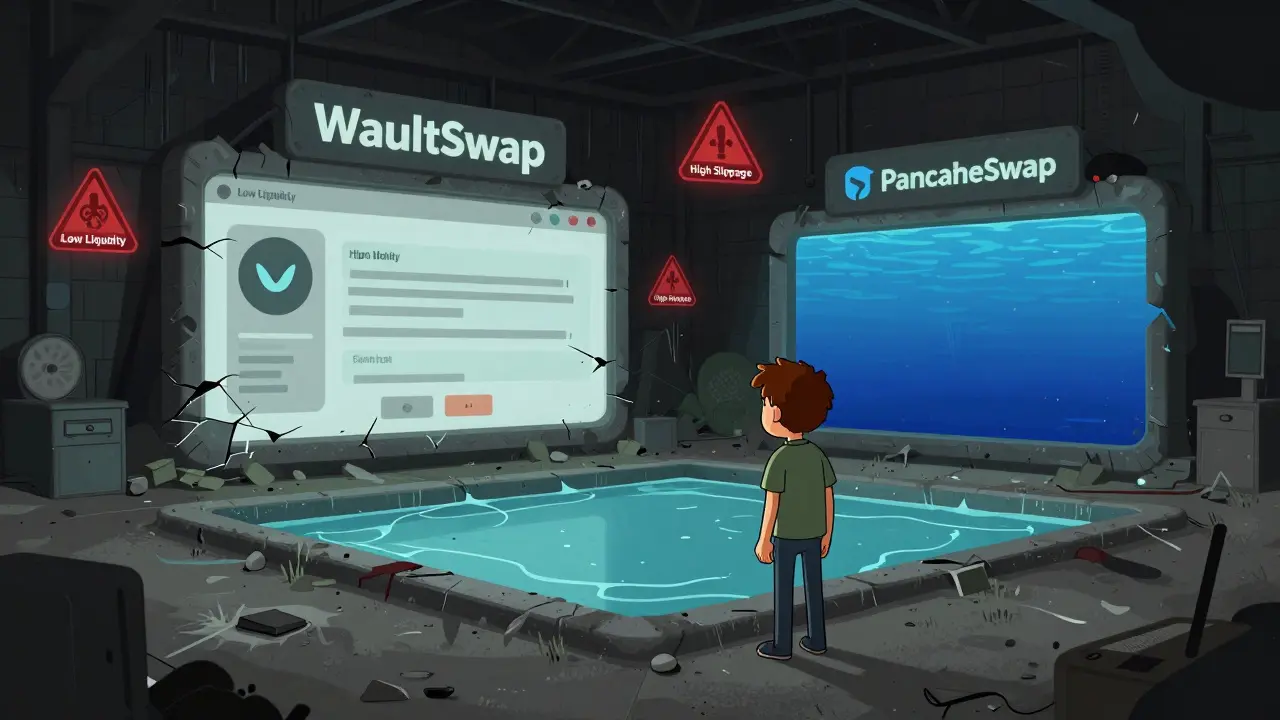
You’ve probably seen the ads promising massive returns on WaultSwap, a decentralized exchange built on the Binance Smart Chain. The promise is simple: low fees and high yields. But here is the hard truth you won’t find in their marketing emails. As of mid-2026, WaultSwap is struggling to stay relevant. With negligible trading volume, stagnant development, and a shrinking community, it sits far behind giants like PancakeSwap. If you are thinking about putting real money into this platform, you need to understand exactly what you are getting into before you connect your wallet.
Key Takeaways
- Low Liquidity Risk: WaultSwap has extremely thin liquidity, leading to high slippage (often over 15%) on trades.
- Stagnant Development: No major updates have been released since early 2025, with zero developer commits in recent months.
- High Fees Relative to Value: While the 0.17% fee is lower than Uniswap, the lack of volume makes it inefficient for serious trading.
- Community Decline: Telegram membership has dropped by nearly 75% since January 2025, signaling loss of user trust.
- Not for Beginners: Poor documentation and unresponsive support make this platform dangerous for new DeFi users.
What Exactly Is WaultSwap?
To understand the risks, we first need to define what WaultSwap actually is. WaultSwap is an automated market maker (AMM) operating on the Binance Smart Chain (BSC). It was created by Wault Finance, which positioned itself as an "all-in-one" DeFi ecosystem. The native token used for governance and trading is called WEX.
In theory, AMMs allow you to swap tokens without a traditional order book. You trade against a pool of liquidity provided by other users. WaultSwap claims to offer some of the lowest transaction fees on BSC at 0.17%. For context, PancakeSwap charges 0.25%, and Uniswap charges 0.30%. On paper, that looks attractive. However, price isn't everything. A cheap flight is useless if it never lands. In the world of decentralized finance, liquidity is the fuel that keeps the engine running. Without it, even the lowest fees can’t save you from losing money through slippage.
The Liquidity Trap: Why Your Trade Might Fail
This is the most critical part of this review. Liquidity refers to how easily you can buy or sell an asset without affecting its price. Major exchanges like PancakeSwap have billions of dollars in liquidity. WaultSwap? Not so much.
Data from late 2025 shows that WaultSwap had only three active trading pairs: WEX/BUSD, WEX/BNB, and WEX/ETH. Each pair had less than $5,000 in daily volume. To put that in perspective, PancakeSwap processes over $1.2 billion in daily volume across thousands of pairs. When you try to trade on WaultSwap, you are hitting a very shallow pool.
Here is what happens when liquidity is low:
- High Slippage: If you try to swap 0.5 BNB for WEX, the price might move drastically during the transaction. Users have reported slippage rates of 22% on small trades. That means if you intended to buy $100 worth of tokens, you might only receive $78 worth because the price jumped against you.
- Failed Transactions: Many users report transactions that confirm on the blockchain but don’t result in receiving tokens. This often happens when the smart contract cannot find enough liquidity to complete the swap within the parameters set by your wallet.
- Price Manipulation: With such low depth, a single large trader can crash or spike the price of WEX, trapping smaller investors.
If you are looking for a place to park stablecoins or trade major assets efficiently, WaultSwap is currently not viable. The risk of losing value due to slippage outweighs the savings from the lower fee structure.
Security and Trust: Are Your Funds Safe?
Wault Finance claims that "safety is a top priority" and states that their smart contracts are fully audited. However, they rarely specify which firms performed these audits or when they were last updated. In the crypto world, an audit is not a lifetime guarantee. It is a snapshot in time. If the code changes, the security posture changes.
More concerning is the track record of user support. According to data tracked in late 2025, WaultSwap received an average of 37 support tickets daily, mostly regarding failed transactions and missing funds. The average resolution time was 72 hours. For a decentralized platform, this suggests a lack of automated recovery tools or responsive human oversight.
User feedback on platforms like Reddit and CoinGecko paints a grim picture. One user reported losing tokens after a confirmed transaction, with no response from support for two weeks. Another noted that the platform’s Telegram community, once a hub of activity, has shrunk from nearly 5,000 members in early 2025 to just over 1,200 by late 2025. A dying community is often the first sign of a dying project.
| Feature | WaultSwap (BSC) | PancakeSwap |
|---|---|---|
| Trading Fee | 0.17% | 0.25% |
| Daily Volume | < $15,000 | > $1.2 Billion |
| Active Pairs | 3 | 2,500+ |
| Market Cap | ~$3,750 | ~$412 Million |
| Support Response | ~72 Hours | Automated / Fast |
| Developer Activity | Stagnant (Last update Feb 2025) | Active (Weekly updates) |
Development Stagnation: Is the Project Dead?
A cryptocurrency project needs constant maintenance and innovation to survive. Blockchains evolve, security threats emerge, and user expectations change. WaultSwap appears to have stopped evolving.
The last significant platform update was version 1.3.7, released in February 2025. Since then, GitHub logs show zero major developer commits. The official documentation hasn’t been updated since March 2024. Compare this to competitors who release new features, security patches, and UI improvements regularly.
Industry analysts have classified WaultSwap as a "low-activity DEX project at high risk of abandonment." Historical data suggests that projects with similar metrics-negligible volume, no development, and shrinking communities-have a 92% chance of becoming completely inactive within 18 months. If the developers abandon the project, there will be no one to fix bugs, respond to hacks, or manage liquidity incentives. You would be left alone with a broken interface and potentially inaccessible funds.
Who Should Avoid WaultSwap?
Based on the current state of the platform, I strongly advise the following groups to avoid WaultSwap entirely:
- Beginners: If you are new to DeFi, do not start here. The lack of clear documentation and high risk of slippage can lead to confusing and costly errors. Start with established platforms like PancakeSwap or Uniswap where tutorials are plentiful and liquidity is deep.
- Large Traders: If you plan to trade amounts larger than $100, the slippage on WaultSwap will eat into your profits significantly. You need deep liquidity pools to execute large orders without moving the market.
- Long-Term Investors: Investing in the WEX token based on "high APY" farming rewards is risky. These high yields (sometimes advertised up to 187%) are compensation for extreme risk. If the project fails, those rewards become worthless.

Are There Better Alternatives?
Absolutely. The Binance Smart Chain ecosystem is mature and offers safer, more efficient options.
PancakeSwap remains the king of BSC. It has the highest liquidity, the most trading pairs, and a robust staking ecosystem. While the fees are slightly higher than WaultSwap, the efficiency and safety are unmatched.
Biswap is another strong contender, offering competitive fees and regular token burns to reduce supply inflation. It has a growing community and active development.
If you are looking for cross-chain functionality (swapping between Ethereum, BSC, Polygon, etc.), look into aggregators like 1inch or Matcha. These platforms scan multiple DEXs to find you the best price, ensuring you aren’t stuck with the poor liquidity of a single niche exchange.
How to Protect Yourself If You Must Use WaultSwap
If you still decide to interact with WaultSwap-perhaps for speculative reasons or to farm WEX tokens-take these precautions:
- Use a Burner Wallet: Never connect your main wallet holding your life savings to a low-tier DEX. Use a separate MetaMask or Trust Wallet address with only the funds you are willing to lose.
- Verify Contract Addresses: Always double-check the WEX token contract address on official sources like CoinGecko or CoinMarketCap. Phishing sites often mimic DEX interfaces to steal funds.
- Set Slippage Tolerance Carefully: Due to low liquidity, you may need to increase slippage tolerance to get trades through. However, this increases the risk of paying more than expected. Monitor the trade preview closely.
- Check Gas Fees: Ensure you have enough BNB in your wallet for gas fees. Failed transactions still cost gas, and on a congested network, this can add up quickly.
- Do Your Own Research (DYOR): Don’t rely on social media hype. Look at the on-chain data. If volume is dropping and developers are silent, walk away.
Final Verdict
WaultSwap started with an ambitious vision of being an all-in-one DeFi hub. Today, it is a shadow of that promise. With minimal liquidity, stagnant development, and a declining user base, it poses significant risks to anyone connecting their wallet. The slightly lower fees are not worth the potential loss of funds due to slippage or technical failures.
For most users, sticking to established leaders like PancakeSwap is the smarter choice. They offer better security, deeper liquidity, and a vibrant community. In the volatile world of crypto, safety and reliability should always come before marginal cost savings.
Is WaultSwap a scam?
While WaultSwap is not officially labeled a "scam" by regulatory bodies, it exhibits many red flags associated with failing projects. These include extremely low liquidity, unresponsive support, and a lack of recent development. Users have reported lost funds and failed transactions. It is considered high-risk and potentially unsafe for significant investments.
What is the WEX token used for?
WEX is the native governance token of the Wault Finance ecosystem. It is used for voting on proposals, staking to earn rewards, and providing liquidity on the WaultSwap exchange. However, due to low trading volume, its utility is currently limited compared to tokens on more active platforms.
Why are my transactions failing on WaultSwap?
Transactions often fail due to insufficient liquidity in the trading pools. When you try to swap a token, the system may not have enough of the target token to complete the trade at the expected price. Additionally, incorrect slippage settings or insufficient BNB for gas fees can cause failures.
Is WaultSwap safe for beginners?
No, WaultSwap is not recommended for beginners. The platform lacks comprehensive documentation, has poor customer support, and carries high risks of slippage and fund loss. New users should start with well-established DEXs like PancakeSwap or Uniswap that have better educational resources and deeper liquidity.
How does WaultSwap compare to PancakeSwap?
PancakeSwap is significantly larger and more secure than WaultSwap. It has billions in daily volume, thousands of trading pairs, and active development. WaultSwap has less than $15,000 in daily volume and only three active pairs. While WaultSwap has slightly lower fees, the lack of liquidity makes it inefficient and risky compared to PancakeSwap.