
Have you ever tried to extract data from a messy PDF or scan through hundreds of legal documents only to realize manual entry is the only option? That’s the exact problem Docs-Insights (Taτsu), operating as Subnet 84 (SN84) on the Bittensor network, aims to solve. It isn’t just another meme coin hoping for a viral moment; it’s a utility token built for a specific job: powering artificial intelligence that reads, analyzes, and structures unstructured documents.
If you’ve heard whispers about SN84 in crypto circles, you might be confused by the name changes or the technical jargon. Let’s cut through the noise. This guide breaks down what SN84 actually does, how it fits into the broader Bittensor ecosystem, and whether it’s worth your attention in early 2026.
The Core Concept: What Is Docs-Insights (Taτsu)?
To understand SN84, you first need to understand its home: Bittensor (a decentralized machine learning network). Launched with a vision to democratize AI, Bittensor allows developers to create specialized subnets-mini-networks dedicated to specific AI tasks. Think of it like an app store, but instead of apps, you’re buying access to raw computational power and AI models.
Docs-Insights (Taτsu) is one of these subnets, specifically designated as Subnet 84. Its sole purpose is document intelligence. While other subnets might focus on search indexing (like Subnet 1) or content generation (like Subnet 11), SN84 specializes in taking chaotic inputs-scanned contracts, medical records, research papers-and turning them into clean, structured data.
The native token, SN84, acts as the fuel for this process. Users pay in SN84 to access the document analysis services, while validators and miners earn SN84 for providing the computing power and accuracy required to process those files. It’s a classic supply-and-demand model, but tied directly to real-world utility rather than speculative hype.
How SN84 Works Within the Bittensor Ecosystem
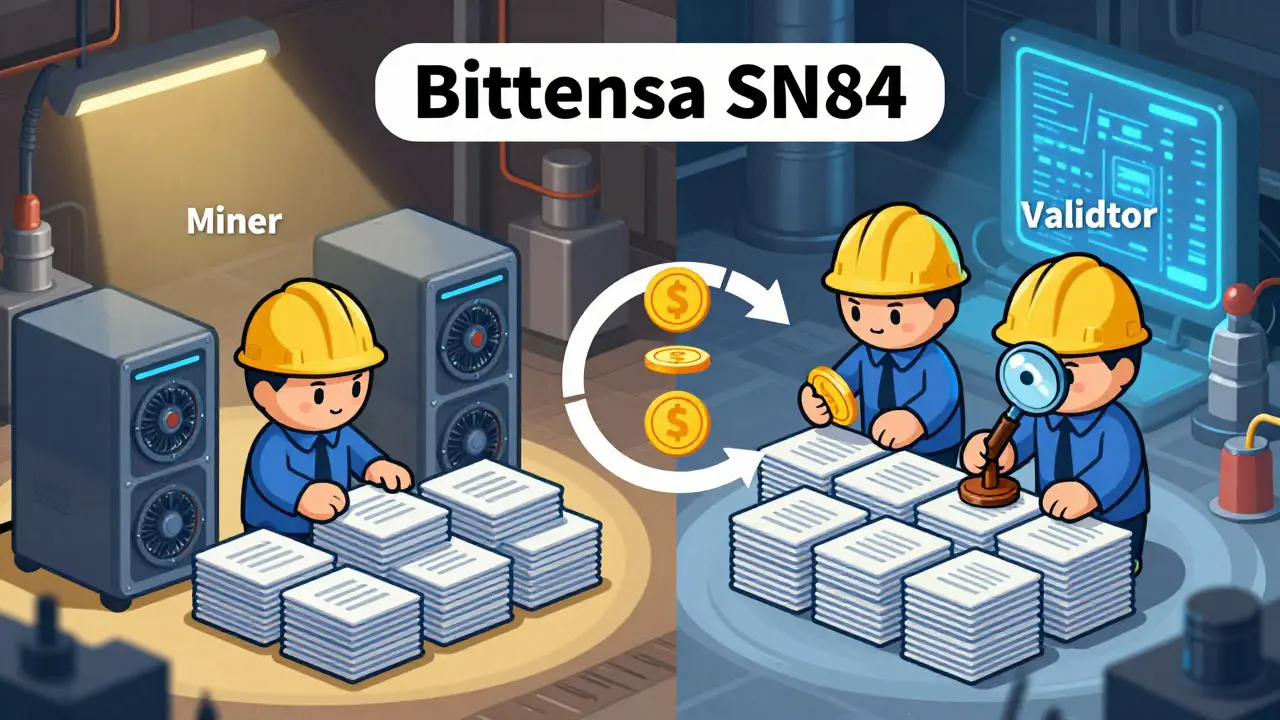
The beauty of the Bittensor model lies in its economic incentives. Here’s how the cycle works for SN84:
- Miners: These are the nodes running the actual AI models. They receive document requests, process them using their GPU power, and return the insights. The better their accuracy, the more rewards they get.
- Validators: These nodes check the work done by miners. If a miner returns garbage data, the validator penalizes them. If the data is accurate, the validator confirms the transaction.
- Users: Developers or enterprises integrate SN84 into their workflows to automate document processing. They pay fees in SN84 tokens.
This structure ensures quality. In traditional centralized AI, you trust the company not to mess up your data. In Bittensor’s SN84, the protocol mathematically enforces accuracy. However, this complexity comes with a steep learning curve. Setting up a validator node requires intermediate Python skills, familiarity with blockchain concepts, and hardware that includes an NVIDIA GPU with at least 8GB of VRAM and 32GB of system RAM.
Tokenomics and Supply Details
When evaluating any cryptocurrency, the numbers matter. For SN84, the data tells a story of a young, niche project still finding its footing.
| Metric | Value / Detail |
|---|---|
| Max Supply | 21,000,000 tokens |
| Circulating Supply | ~537,322 to 1,081,821 (varies by source) |
| Primary Exchange | Subnet Tokens DEX (trades against TAO/SN0) |
| Market Cap Range | $344,000 - $1.18 million |
| Fully Diluted Valuation (FDV) | ~$15.61 million |
Note the discrepancy in circulating supply figures across platforms like CoinGecko and CoinMarketCap. This is common for newer subnet tokens where liquidity pools are fragmented. The fully diluted valuation (FDV) suggests that if all 21 million tokens were in circulation at current prices, the market cap would be significantly higher, indicating potential inflationary pressure as more tokens are unlocked or minted as rewards.
Performance and Market Position
As of mid-2026, SN84 holds a modest position within the Bittensor ecosystem. Out of 39 active subnets, it ranks around 28th by market capitalization. It doesn’t trade on major centralized exchanges like Binance or Coinbase for direct fiat pairs; instead, it lives primarily on the Subnet Tokens DEX, trading against SN0 (the native Bittensor token).
Liquidity remains a significant challenge. Users have reported bid-ask spreads averaging 0.6%, which can eat into profits during quick trades. One Reddit user noted attempting to sell 500 tokens caused an 18% price drop due to shallow order books. This “chicken-and-egg” problem-adoption needs liquidity, but liquidity needs adoption-is typical for utility tokens in early stages.
Price volatility is high. In January 2026, SN84 saw an 18.6% weekly increase despite daily declines, signaling speculative interest rather than steady organic growth. Experts like Dr. Elena Rodriguez from Blockchain Intelligence Group have rated its viability at 6.2/10, citing solid technical implementation but unspectacular market traction compared to competitors.
Real-World Use Cases and Enterprise Adoption
Why would anyone use SN84 instead of Adobe Acrobat or a simple Python script? The answer lies in scalability and decentralization. For large enterprises dealing with massive volumes of sensitive data, SN84 offers a privacy-preserving way to process documents without relying on a single central server.
By late 2025, three verified enterprise integrations emerged:
- DocumentAI Inc. (Contract signed Oct 2025)
- LegalTech Solutions (Nov 2025)
- MedRecords Digital (Dec 2025)

Risks and Challenges
No investment is risk-free, and SN84 carries several red flags you should consider before diving in:
- Limited Liquidity: Selling large amounts can crash the price. You might find yourself holding tokens with no easy exit strategy.
- Technical Barrier: Running a node isn’t plug-and-play. Expect to spend over 14 hours setting up your environment, debugging sync issues, and managing hardware.
- Competition: Centralized AI giants are improving rapidly. If Adobe or Microsoft integrates similar features into their existing suites at a lower cost, SN84’s unique selling point diminishes.
- Regulatory Uncertainty: Under the EU’s MiCA framework, utility tokens with profit-sharing elements could face classification as securities, potentially limiting international accessibility.
Furthermore, community engagement is low. The SN84 Discord channel sees only about 12 messages daily compared to hundreds for top-tier subnets. Support response times average 37 hours, meaning if you hit a technical snag, you won’t get help immediately.
Future Outlook: Will SN84 Survive?
The roadmap for Q1 and Q2 2026 focuses on multilingual support and enterprise API development. Integration with Bittensor’s new ‘DocuChain’ protocol aims to enhance verification capabilities. Yet, analysts remain divided. CryptoQuant predicts a probable sunset by Q4 2026 due to insufficient validator incentives, while the Bittensor Foundation internally rates it as “medium priority.”
For SN84 to thrive, it needs to cross a critical threshold: consistent monthly service volume of $50,000. As of December 2025, it hadn’t consistently hit this mark. If enterprise adoption accelerates in the next six months, SN84 could become a vital tool in the decentralized AI stack. If not, it may fade into obscurity, serving as a cautionary tale for niche subnet projects.
Final Thoughts
Docs-Insights (Taτsu) SN84 is a fascinating experiment in specialized decentralized AI. It solves a real problem-document chaos-with a transparent, incentive-aligned model. But it’s not ready for the mass market. If you’re a developer interested in building on Bittensor or an enterprise looking for innovative document solutions, SN84 deserves a look. If you’re a casual investor seeking quick gains, the low liquidity and high technical barriers make it a risky bet. Always do your own research, and remember that in crypto, utility doesn’t always equal immediate profitability.
What is the primary function of the SN84 token?
SN84 is the native utility token for the Docs-Insights (Taτsu) subnet on Bittensor. It is used to pay for AI-powered document analysis services and to reward validators and miners who provide computing power and ensure data accuracy.
Can I buy SN84 on major exchanges like Binance or Coinbase?
No, SN84 is not listed on major centralized exchanges. It primarily trades on the Subnet Tokens DEX within the Bittensor ecosystem, usually paired against SN0 (the native Bittensor token). This limits accessibility and liquidity for retail investors.
Is SN84 a good investment for beginners?
Probably not. SN84 has low liquidity, high volatility, and requires understanding of the Bittensor ecosystem. Beginners might find safer opportunities in more established cryptocurrencies with deeper markets and clearer regulatory statuses.
How does SN84 compare to other Bittensor subnets?
SN84 is highly specialized in document analysis, whereas subnets like SN1 focus on search and SN11 on content generation. It ranks lower in market cap and trading volume compared to top subnets, reflecting its niche appeal and limited adoption.
What hardware do I need to run an SN84 validator node?
You need an NVIDIA GPU with at least 8GB VRAM, 32GB of system RAM, and a Python 3.8+ environment. Setup is complex, requiring intermediate programming skills and patience for debugging synchronization issues.