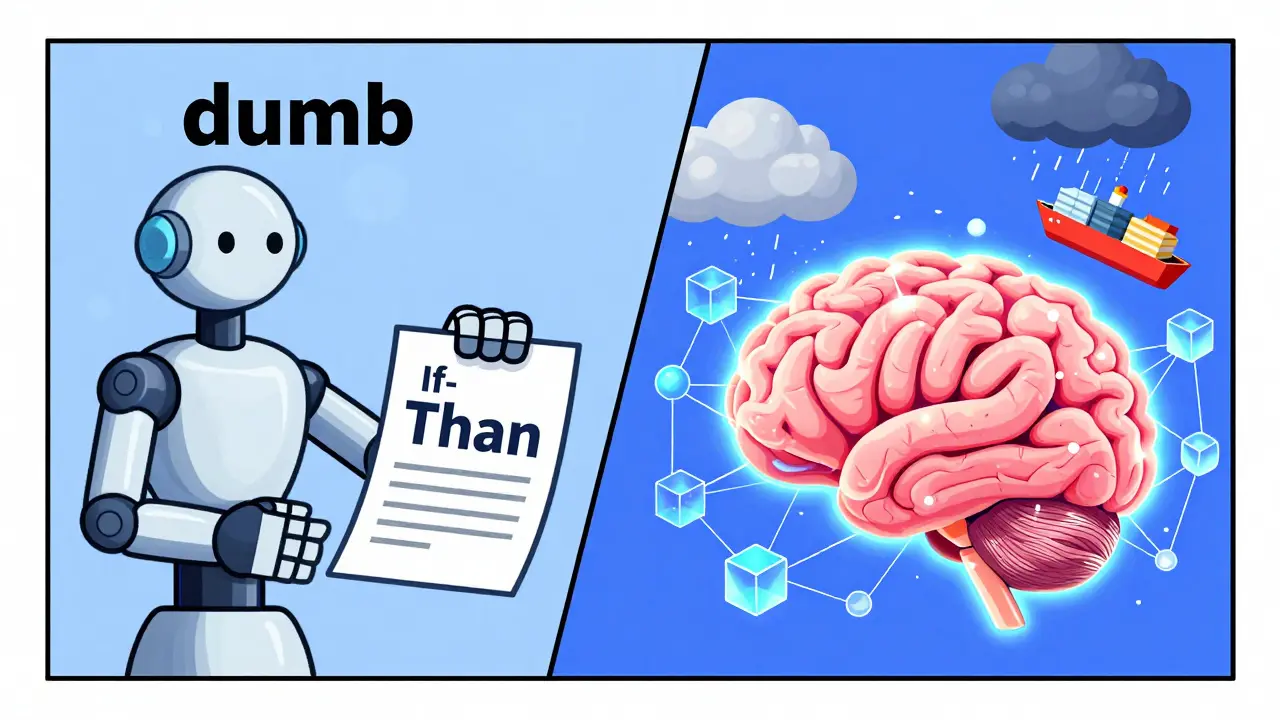
Imagine a contract that doesn't just follow a rigid set of rules but actually thinks and adapts to the real world. For years, we've dealt with traditional smart contracts-essentially digital "if-then" statements. If the package arrives, then the payment is released. It's efficient, but it's brittle. If a storm reroutes a ship or a market crashes unexpectedly, those rigid rules can't handle the nuance. That's where AI-powered smart contracts is the integration of artificial intelligence, specifically machine learning and natural language processing, with blockchain-based self-executing agreements. By adding a layer of intelligence, these contracts can analyze data, predict outcomes, and make dynamic decisions on the fly.
Quick Summary: The Shift to Intelligent Agreements
- Adaptive Logic: Moves beyond "if-then" to predictive and self-correcting execution.
- Higher Accuracy: Machine learning improves decision precision by 15-22% over time.
- Real-World Impact: Reduces logistics costs and claim processing times (e.g., AXA reducing claims from 14 days to 47 minutes).
- Trade-offs: Higher computational costs (gas fees) and a need for substantial training data.
Why "Dumb" Contracts Aren't Enough Anymore
Traditional smart contracts, popularized by Ethereum in 2015, are great for simple tasks. They are immutable and transparent, but they lack context. If you have a contract that pays out based on a specific price point, it can't "understand" if that price spike was a flash crash or a genuine market trend. It just executes.
AI-powered versions change the game by incorporating Machine Learning (ML). Instead of a static script, these contracts use models that learn from historical transaction data. They can recognize patterns and anomalies that a human might miss and a standard contract would ignore. For example, while a normal contract sees a transaction, an AI contract sees a 98.7% probability of fraud based on previous insurance claim patterns. This turns the contract from a passive tool into an active participant in the business process.
The Technical Engine Under the Hood
Building these isn't as simple as plugging a chatbot into a blockchain. It requires a sophisticated tech stack. Most developers use TensorFlow or PyTorch to build the ML models, and then use Solidity to write the blockchain logic. To bridge the gap between the "off-chain" AI brain and the "on-chain" execution, they rely on Oracles-services that feed real-time external data into the blockchain.
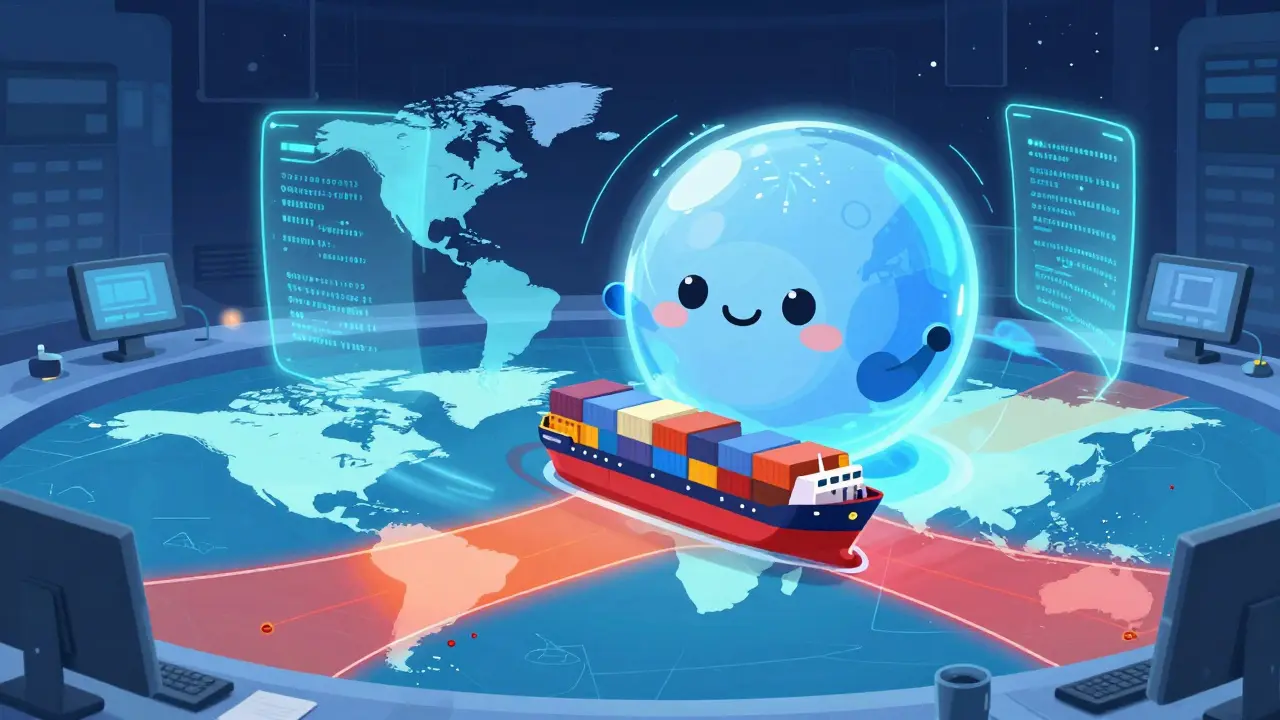
The performance difference is stark. In complex scenarios, like optimizing a global supply chain, AI contracts perform nearly 4 times better than traditional ones. They don't just execute a payment; they can dynamically reroute a shipment based on port congestion or fuel prices. In a 2024 pilot with Maersk, this capability slashed logistics costs by 22.4%. However, this intelligence comes at a price. Because AI computations are heavier, gas fees are higher. In early 2025, the average cost was around 0.045 ETH, compared to just 0.015 ETH for a basic contract.
| Feature | Traditional Smart Contracts | AI-Powered Smart Contracts |
|---|---|---|
| Logic Type | Deterministic (If-Then) | Probabilistic (Predictive/Adaptive) |
| Data Handling | Static inputs via Oracles | Continuous learning from historical data |
| Processing Speed | Near-instant for simple tasks | 40-65% faster for complex conditional logic |
| Computational Cost | Low (Lower Gas Fees) | High (Higher Gas Fees) |
| Best Use Case | Simple payment releases | Supply chain, dynamic insurance, risk mgmt |
Real-World Wins and Costly Blunders
The transition to AI contracts isn't without growing pains. On the success side, look at the insurance industry. AXA implemented these contracts for flight delay compensation, turning a grueling 14-day manual claim process into a 47-minute automated breeze with 99.2% accuracy. When the AI sees the flight is delayed via a trusted data feed, it triggers the payment instantly without a human ever touching a file.
But there is a dark side: the "black box" problem. When an AI makes a decision, it can be hard to explain why it did so. This creates a legal nightmare in regulated industries. We saw this in late 2024 when a major European bank lost $1.2 million because an AI model misinterpreted market volatility as a trigger for a massive series of erroneous transactions. The code worked perfectly, but the AI's "logic" was flawed. This highlights a critical truth: these systems are only as good as the data they are fed. If your historical data is messy, your contract's decisions will be too.

How to Actually Implement AI Contracts
If you're looking to move from a pilot to production, be prepared for a steep learning curve. You can't just hire a blockchain dev; you need a hybrid team. Usually, this means one blockchain architect, two AI specialists, and a domain expert who actually understands the business logic.
The rollout typically follows four distinct phases:
- Data Preparation (8-12 weeks): Cleaning and organizing historical data. You need at least 5,000 records for the AI to even begin functioning reasonably.
- Model Training (4-6 weeks): Training your ML model on those records to recognize the patterns required for your specific contract.
- Blockchain Integration (2-3 weeks): Writing the Solidity code and connecting it to your AI model via oracles.
- Testing & Deployment (3-5 weeks): Running simulations to ensure the AI doesn't accidentally bankrupt the company during a market swing.
To keep costs down, many are now using hybrid architectures. They use the AI off-chain to make the "heavy" decision and then send a simple "yes/no" trigger to the blockchain for the actual execution. Tools like Chainlink's AI oracle framework have helped reduce gas costs by about 35% using this method.
The Road Ahead: Regulation and Hardware
We are currently in a phase of "inflated expectations," but the infrastructure is catching up. The EU's MiCA framework now requires "sufficient explainability" for AI contracts in financial markets, meaning the "black box" era has to end if these things are to survive legally. Developers are now focusing on Explainable AI (XAI) to prove how a decision was reached.
Hardware is also evolving. NVIDIA's announcement of a dedicated Blockchain AI Inference Engine GPU shows that the industry realizes standard servers can't keep up with the demand for decentralized intelligence. By 2030, it's predicted that 40% of global commercial transactions will be handled by these intelligent contracts, shifting the role of lawyers and accountants from "drafting rules" to "auditing AI models."
What is the main difference between a smart contract and an AI smart contract?
Traditional smart contracts are deterministic, meaning they follow a strict "if-then" logic (e.g., if A happens, then do B). AI-powered smart contracts are probabilistic; they use machine learning to analyze patterns and make dynamic decisions based on data, allowing them to handle complex, changing conditions that a simple script cannot.
Are AI-powered smart contracts more expensive to run?
Yes, generally. Because they require more computational power to process ML models and complex data, they consume more gas on networks like Ethereum. In early 2025, costs were roughly 3 times higher than traditional contracts, though hybrid off-chain models are helping to lower these fees.
How much data is needed to train an AI smart contract?
For basic functionality, a minimum of 5,000 historical transaction records is typically required. However, performance and accuracy improve incrementally as the dataset grows, with significant gains seen once the model processes over 50,000 records.
What is the "black box problem" in these contracts?
The black box problem refers to the difficulty in understanding exactly how an AI model reached a specific decision. In a legal or financial context, this lack of transparency can lead to liability issues because the execution logic isn't easily explainable to regulators or auditors.
Which industries are adopting this technology the fastest?
Financial services lead the way (41% of implementations), followed by supply chain and logistics (29%) and insurance (18%). These sectors benefit most from the ability to automate complex, data-heavy decision-making processes.
Mike Krasner
April 20, 2026 AT 21:27gas fees are basically a scam anyway who actually cares about a 22 percent cut for maersk when the whole thing is just a black box that loses millions in a heartbeat lol
Kathleen Bergin
April 21, 2026 AT 07:50The black box thing is just basic AI. It is called a neural network for a reason because it works like a brain. You do not need to be a genius to see that the law will never let this fly without a human signing off on it first.
Jagdish Sutar
April 21, 2026 AT 17:59It is really fascinating to see how this could bridge gaps in global trade, especially for smaller vendors in emerging markets who often struggle with rigid trust mechanisms. These adaptive agreements could actually level the playing field for a lot of people! 🌟
Candace Sherrard
April 22, 2026 AT 09:14There is something profoundly unsettling about the idea of our legal obligations being dictated by a probabilistic outcome rather than a deterministic one, as it suggests a future where justice is not a matter of following agreed-upon rules but rather an approximation of what a machine deems likely to be correct based on historical patterns that may themselves be flawed. If we outsource the very essence of a 'promise'-which is the guarantee of a specific action-to a model that only offers a percentage of probability, we are essentially redefining the social contract into a statistical gamble, which makes me wonder if the efficiency gains in logistics are worth the erosion of absolute certainty in our professional agreements.
Alex Hunter
April 24, 2026 AT 08:42That's a heavy perspective, but it's where we're heading. The key is that hybrid approach mentioned-keeping the AI off-chain. It allows us to use the intelligence for the 'decision' but keeps the 'execution' transparent on the ledger. It's a good middle ground for those of us who aren't ready to fully trust the black box yet.
Keith Garcia
April 25, 2026 AT 21:13The sheer audacity of suggesting that a GPU from NVIDIA will solve the ontological crisis of a 'black box' is truly whimsical. 🙄 One does not simply purchase an Inference Engine and suddenly possess an ethical framework for autonomous financial arbitration. It is a pedestrian attempt to mask systemic instability with shiny hardware. Absolutely gauche. 💅
Charlie Queen
April 27, 2026 AT 13:47Love the energy here! 🚀 I honestly think the XAI stuff is going to be the real breakthrough. Once we can actually see the "why" behind the decision, the adoption is going to explode globally! Imagine the possibilities for climate insurance! 🌍✨
Tara Aman
April 28, 2026 AT 15:22I'm sure there's a way to make this work for everyone if we just collaborate on the standards. It would be so great to see the insurance industry actually help the little guy for once instead of just cutting their own processing times!
Jennifer L
April 30, 2026 AT 00:46My heart simply bleeds for the people who lost money in that European bank glitch, it is just so tragickally unfair!!
The thought of a machine making a mistake and just taking millions of dollars away is truly an absolute catastrophy of the highest order. We must be so careful with these things because human lives are at stake when the money vanishes into a digital void of bad data and poor logic!!