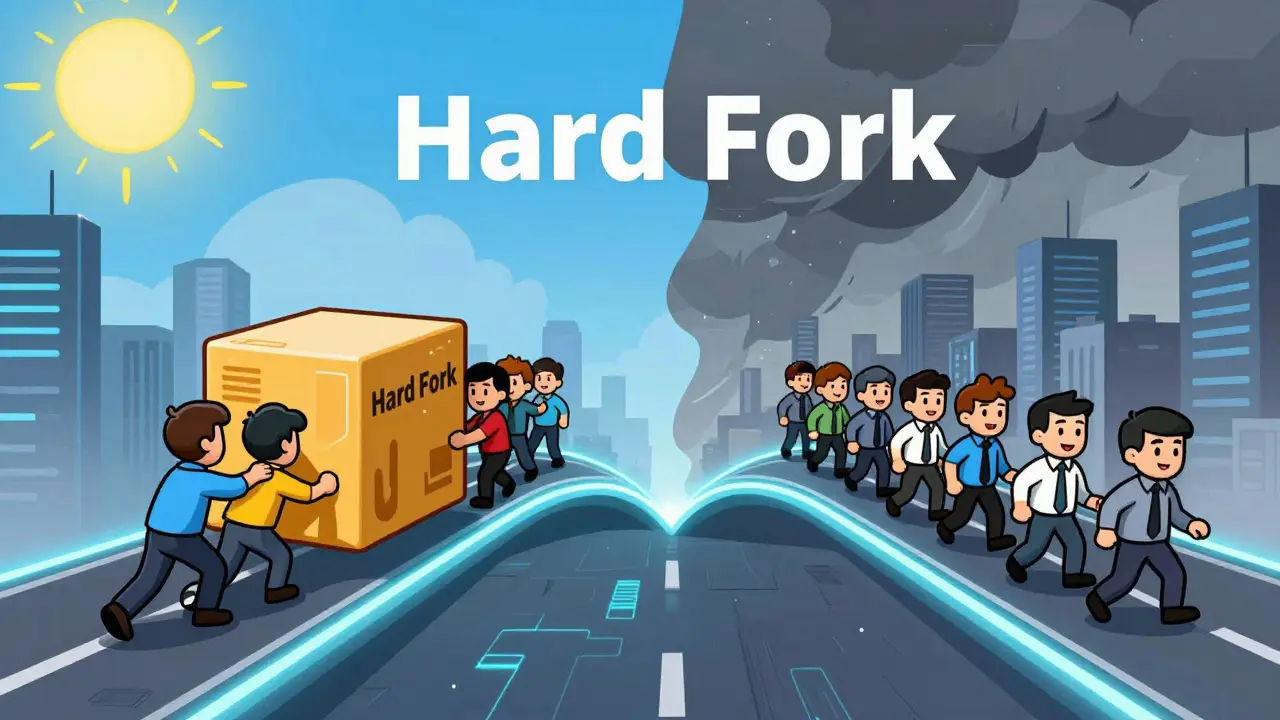
Imagine you own a house. Suddenly, the government changes the zoning laws, and your house now sits on two different streets at once. You have to decide which street address to keep, or maybe you get to keep both. That is essentially what happens during a blockchain fork. It sounds like a technical glitch, but in reality, it is one of the most powerful tools-and controversial events-in cryptocurrency history.
A fork occurs when developers change the rules of a blockchain protocol. If everyone agrees, the network moves forward together. If they don’t, the chain splits into two separate paths. This process has created some of the biggest cryptocurrencies we know today, including Bitcoin Cash and Ethereum Classic. But not all forks are successful. Many vanish within months, leaving investors confused and wallets empty.
To understand where crypto is going, you need to look at where it has split before. From the ideological battles over block size to the emergency rescue missions after massive hacks, these historical forks shaped the industry’s rules for governance, security, and scalability.
Hard Forks vs. Soft Forks: The Core Difference
Before diving into specific coins, you need to know the two main types of forks. The difference comes down to compatibility.
- Soft Fork: Think of this as a backward-compatible update. New nodes can talk to old nodes. It tightens the rules (like changing a speed limit from 65 mph to 55 mph). Old cars still obey the new limit because they were already driving slower. An example is Bitcoin’s Segregated Witness (SegWit).
- Hard Fork: This is a permanent divergence. New nodes cannot talk to old nodes because the rules have changed fundamentally (like changing the speed limit to 100 mph, which old cars physically cannot do safely). This creates two separate chains. Bitcoin Cash and Ethereum Classic are results of hard forks.
Soft forks usually happen smoothly with high adoption rates. Hard forks are messy. They require community consensus, miner support, and wallet updates. If even a small group refuses to upgrade, they continue mining the original chain, creating a rival cryptocurrency.
The Bitcoin Block Size Wars: BTC, BCH, and BSV
The most famous series of forks in history revolves around Bitcoin’s scalability. In 2015, Bitcoin transactions were slow and expensive. Developers disagreed on how to fix it. One side wanted to increase the block size (the amount of data processed per block) to handle more transactions. The other side preferred keeping blocks small for security and decentralization, using secondary layers like Lightning Network instead.
This disagreement led to a cascade of forks:
- Bitcoin XT and Classic (2014-2016): Early attempts to increase block size to 8MB or 2MB failed to gain lasting traction. They served as testing grounds for the community’s appetite for change.
- Bitcoin Cash (BCH) - August 2017: This was the big one. At block 478,558, Bitcoin split. Bitcoin Cash increased the block size to 8MB (later 32MB), aiming to be "digital cash" for everyday payments. Immediately after the fork, BCH became the fourth-largest cryptocurrency by market cap. However, its value has fluctuated wildly since then.
- Bitcoin SV (BSV) - November 2018: A faction of Bitcoin Cash supporters, led by Craig Wright, argued that Bitcoin Cash had deviated from Satoshi Nakamoto’s original vision. They forked again to create BSV, focusing on massive scaling for enterprise use. This split further fragmented the community.
- eCash (XEC) - November 2020: Another fork from BSV, attempting to rebrand and improve usability with a 1:1,000,000 conversion ratio.
Why did this matter? It proved that Bitcoin’s code could be copied and modified easily. But it also showed that having a coin isn’t enough; you need network effects. While Bitcoin remained dominant, the forks struggled to maintain consistent user bases.
The Ethereum DAO Hack and the Birth of ETC
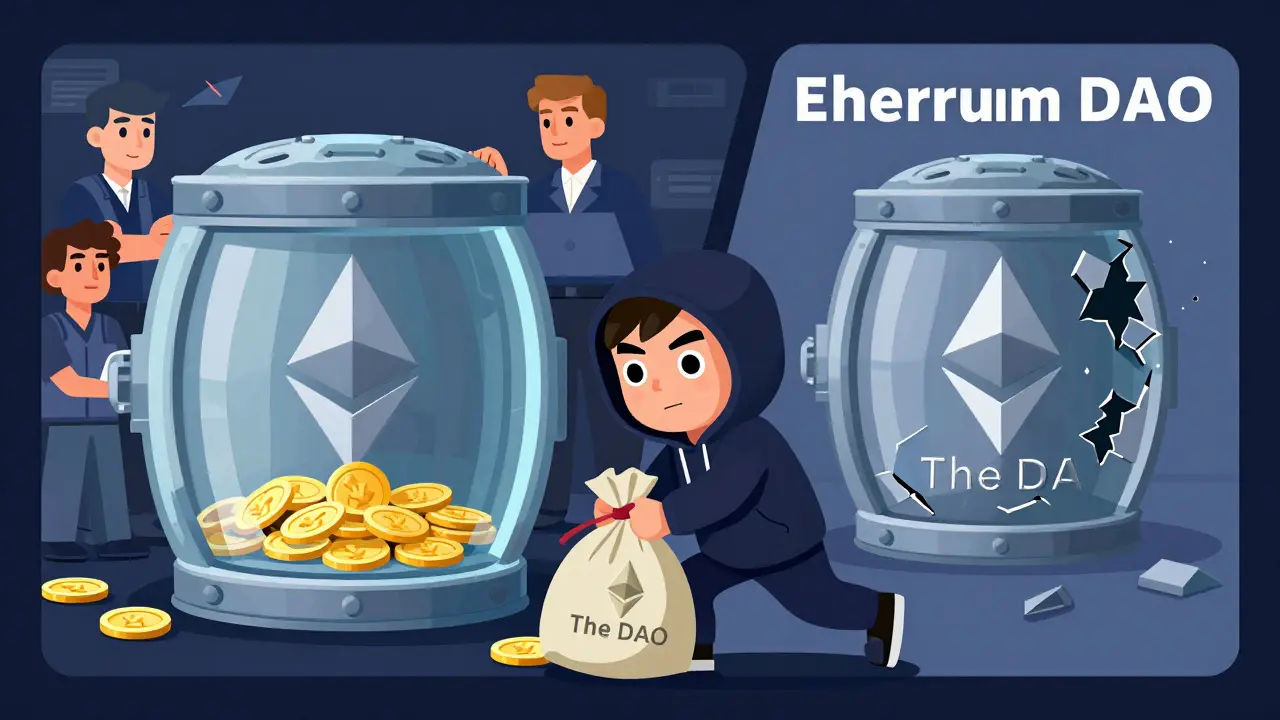
If Bitcoin’s forks were about ideology, Ethereum’s first major fork was about ethics. In June 2016, a decentralized autonomous organization called The DAO was hacked. Attackers drained 3.6 million ETH (worth about $50 million at the time) by exploiting a vulnerability in the smart contract code.
The Ethereum community faced a impossible choice:
- Option A: Do nothing. Uphold the principle of "code is law." The money is gone, and the lesson is learned.
- Option B: Perform a hard fork to reverse the hack and return the funds to their owners.
Vitalik Buterin, Ethereum’s co-founder, supported Option B. The majority of miners and users agreed. On July 20, 2016, the network forked at block 1,920,000. The stolen funds were returned to a refund contract. This new chain became modern-day Ethereum (ETH).
However, a minority of users refused to accept the reversal. They believed tampering with transaction history violated the core promise of immutability. They continued mining on the original chain, which became known as Ethereum Classic (ETC). Today, ETC still exists with a market cap around $1.2 billion, serving as a living reminder of that philosophical split.
Technical Upgrades: SegWit and The Merge
Not all forks create new coins. Some are essential maintenance tasks designed to improve the network without splitting the community.
Segregated Witness (SegWit) - August 2017: Proposed by Pieter Wuille, SegWit was a soft fork for Bitcoin. It moved signature data (which takes up space) out of the main block structure. This didn’t change the 1MB block size limit technically, but it effectively increased capacity by 1.7x. It also fixed a bug called transaction malleability, which allowed attackers to alter transaction IDs. SegWit paved the way for the Lightning Network, enabling faster, cheaper payments.
The Merge - September 2022: This was arguably the most significant event in blockchain history. Ethereum transitioned from Proof-of-Work (mining) to Proof-of-Stake (staking). This required a complex hard fork that synchronized the execution layer (where transactions happen) with the consensus layer (where validators agree on the state). The result? Energy consumption dropped by 99.95%. No new coin was created; instead, the entire network evolved together. It demonstrated that large-scale coordination is possible if the incentives align.
Market Impact and Investor Lessons
Forks often cause short-term volatility. When a fork is announced, prices may spike as traders speculate on the outcome. After the fork, assets are often distributed 1:1 to holders. For example, if you held 1 BTC before the Bitcoin Cash fork, you received 1 BCH. If you held ETH before the DAO fork, you received 1 ETC.
However, holding the asset doesn’t guarantee profit. According to data from University of California studies, 68% of Bitcoin hard forks disappear within 18 months. Only a few, like Litecoin (which forked from Bitcoin in 2011) and Bitcoin Cash, have survived long-term. Most forked coins lose value as liquidity drains away and development teams disband.
| Fork Name | Type | Date | Primary Goal | Outcome |
|---|---|---|---|---|
| SegWit | Soft Fork | Aug 2017 | Scalability & Security | Successful integration into Bitcoin |
| Bitcoin Cash | Hard Fork | Aug 2017 | Larger Blocks (8MB) | New coin (BCH), volatile market position |
| Ethereum DAO | Hard Fork | Jul 2016 | Recover Hacked Funds | Split into ETH and ETC |
| The Merge | Hard Fork | Sep 2022 | Switch to Proof-of-Stake | Massive energy reduction, no new coin |
Risks for Users During Forks
If you hold cryptocurrency, forks present real risks. The biggest danger is the replay attack. Because the two chains share the same history initially, a transaction sent on Chain A might be automatically replicated on Chain B. If you send BCH to an exchange, the same transaction might happen on BTC, draining your Bitcoin wallet too. Always check if your wallet supports replay protection.
Another risk is confusion. Wallets and exchanges must update their software to recognize the new token. If they don’t, you might see your balance drop or fail to receive the forked coin. During the DAO fork, MyEtherWallet saw a 400% spike in support tickets as users struggled to separate their ETH and ETC holdings.
Future of Blockchain Forks
The nature of forks is changing. Early forks were often contentious splits driven by ideology or disaster response. Modern forks are increasingly coordinated upgrades. Projects like Ethereum’s Shanghai upgrade (April 2023) enabled staked withdrawals through a planned hard fork with near-universal consensus.
Industry analysts predict future forks will focus less on creating new coins and more on interoperability-helping different blockchains talk to each other. As networks mature, the goal is stability, not fragmentation. However, the possibility of a fork remains a fundamental feature of open-source blockchain technology. It ensures that if a project goes off the rails, the community always has an exit strategy.
What is the difference between a hard fork and a soft fork?
A hard fork is a permanent split in the blockchain where new rules are incompatible with old ones, creating two separate chains. A soft fork is a backward-compatible update where new nodes can interact with old nodes, resulting in a single upgraded chain.
Do I get free coins when a fork happens?
Often, yes. If you hold the original cryptocurrency at the time of the fork, you typically receive an equal amount of the new forked coin. However, you must use a compatible wallet to claim them, and the value of the new coin can vary significantly.
Why did Ethereum split into ETH and ETC?
Ethereum split after The DAO was hacked in 2016. The majority of the community voted to reverse the hack via a hard fork to recover funds, creating modern Ethereum (ETH). A minority refused to alter the ledger's history, continuing on the original chain, which became Ethereum Classic (ETC).
Is Bitcoin Cash still relevant today?
Bitcoin Cash remains active and is used for payments due to its larger block sizes and lower fees. However, its market capitalization and developer activity are significantly lower than Bitcoin's, making it a niche player compared to its early success.
Can a fork destroy my cryptocurrency?
A fork itself doesn't destroy your coins, but replay attacks can. If you transact on a forked chain without protection, the same transaction might occur on the original chain, draining your funds. Always ensure your wallet supports replay protection during fork events.