
Imagine buying a pair of luxury sneakers or a bottle of wine and instantly knowing every step of its journey from factory to shelf. That is the core promise of VeChain, a public layer-1 blockchain designed specifically for enterprise use cases like supply-chain traceability and sustainability data. Unlike general-purpose blockchains that focus on decentralized finance or gaming, VeChain aims to solve real-world business problems by making data transparent and tamper-proof.
If you are wondering what the VET token actually does, why it has a companion token called VeThor (VTHO), and whether this project is worth your attention in 2026, this guide breaks it all down. We will look at how the technology works, who uses it, and what the numbers say about its current standing in the crypto market.
The Origin Story: From Private Consortium to Public Chain
VeChain didn't start as a public cryptocurrency you could buy on an exchange. It began in 2015 as a private consortium chain founded by Sunny Lu and Jay Zhang. Their initial goal was practical: help large enterprises manage data more efficiently. Early pilots included working with Renault on digital vehicle passports and collaborating with Microsoft and Viseo on data solutions.
In 2017, the project launched its first token, VEN, as an ERC-20 token on the Ethereum network. This crowdsale raised about $20 million and distributed 1 billion tokens. However, running on Ethereum meant dealing with high fees and congestion, which isn't ideal for massive industrial operations. So, in 2018, they launched their own mainnet, VeChainThor. During this transition, they executed a token swap where 1 VEN became 100 VET. This expanded the total supply to 86.7 billion VET but kept the economic value equivalent for holders. Today, roughly 85% of these tokens are in circulation.
How VeChain Works: The Dual-Token Model
One of the most confusing aspects for beginners is why VeChain has two tokens. The answer lies in its attempt to stabilize transaction costs for businesses. Most blockchains have one token used for both value storage and paying fees (gas). If the token price spikes, transaction costs become unpredictable and expensive. VeChain solves this with a dual-token system:
- VET (VeChain Token): This is the primary asset. It acts as a store of value, a medium for transferring wealth, and collateral for governance. Holding VET generates the second token over time.
- VTHO (VeThor Energy): This is the "gas" token. You spend VTHO to execute transactions and smart contracts. Crucially, VTHO is not mined; it is generated automatically by holding VET.
Think of VET as a savings account that earns interest (VTHO), and VTHO as the cash you withdraw to pay bills (transactions). As of mid-2023, the base generation rate was approximately 0.000432 VTHO per 1 VET per day. This design allows the protocol to adjust VTHO generation rates to keep transaction fees stable, regardless of VET's market price volatility. For a company shipping millions of goods, predictable micro-fees are essential.
Technology Under the Hood: Proof of Authority
VeChainThor uses a consensus mechanism called Proof of Authority (PoA). In many crypto circles, PoA is criticized for being less decentralized than Proof of Work (Bitcoin) or Proof of Stake (Ethereum). However, for enterprise clients, speed and reliability often trump pure decentralization.
In PoA, only a limited set of vetted "Authority Nodes" can produce blocks. These nodes are approved by the VeChain Foundation and must stake a significant amount of VET. This creates accountability: if a node acts maliciously, they lose their stake and reputation. In November 2022, VeChain upgraded to PoA 2.0, introducing "Finality with One Bit." This ensures that once a block is added, it is final and cannot be reorganized, preventing data loss-a critical feature for legal and financial records.
This architecture allows VeChain to boast zero downtime since its 2018 launch. While purists might argue about centralization risks, enterprises prioritize the deterministic performance and low carbon footprint that PoA provides.
Real-World Use Cases: Who Is Using VeChain?
The true test of any enterprise blockchain is adoption. VeChain claims over 300 global partnerships, spanning logistics, agriculture, luxury goods, and healthcare. Here are some notable examples:
| Company | Sector | Use Case |
|---|---|---|
| BMW Group | Automotive | Cobalt supply chain tracking for electric vehicle batteries |
| DHL | Logistics | Supply chain visibility and freight documentation |
| Walmart China | Retail/Food | Food safety traceability (e.g., pork products) |
| LVMH | Luxury Goods | Product authenticity and anti-counterfeiting |
These aren't just pilot programs; many have been running for years. For instance, BMW uses VeChain to track cobalt from mines in Africa to battery factories, ensuring ethical sourcing. Walmart uses it to verify the origin of food products, reducing waste and improving safety. The platform integrates with RFID chips and IoT sensors, allowing physical items to broadcast their status directly to the blockchain.
VeBetterDAO: The Sustainability Push
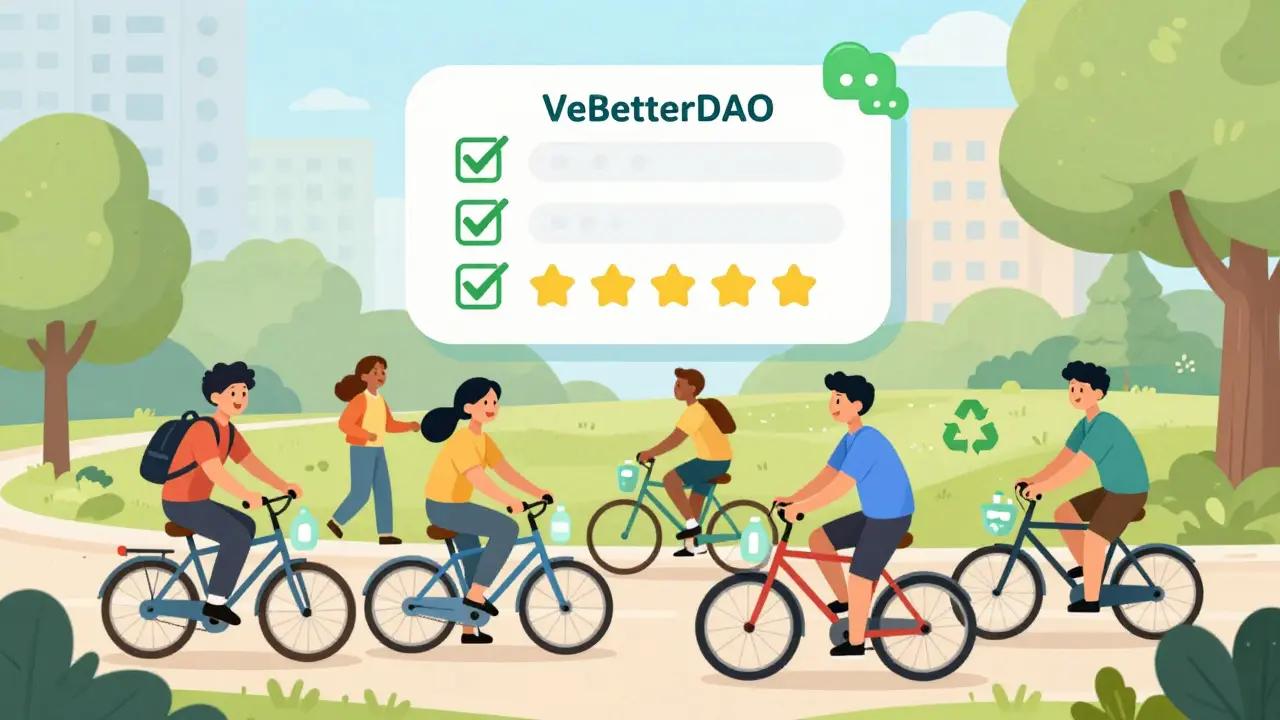
In 2024, VeChain expanded beyond corporate supply chains into consumer engagement with VeBetterDAO. This initiative rewards individuals for sustainable actions. By September 2025, the platform reported verifying over 37 million sustainability-related actions across 5 million unique wallets. Users can log activities like recycling or using public transport and earn rewards. This shift attempts to bridge the gap between B2B infrastructure and B2C participation, creating a broader ecosystem around environmental responsibility.
Investment Context: Price and Market Position (July 2026)
As of July 2, 2026, VET is trading around $0.004418 USD, with a market capitalization of approximately $379.9 million. This places it in the mid-cap range, significantly below top-tier L1s like Ethereum or Solana. Why the disparity? Critics point out that while VeChain has impressive partnerships, it is unclear how much of the actual value flows back to the VET token. Many partners may use VeChain as a backend data tool without deeply integrating the token economy.
Additionally, the self-reported metrics (like user counts) lack independent verification. Investors should weigh the strong technical stability and enterprise traction against the centralized governance model and the niche nature of its utility compared to general-purpose smart contract platforms.
Getting Started with VeChain
If you want to hold VET, the process is straightforward:
- Buy VET: Purchase VET on major centralized exchanges like Kraken, Binance, or Coinbase.
- Store it: Transfer your tokens to a compatible wallet. Hardware wallets like Ledger support VeChain securely.
- Earn VTHO: Simply holding VET in your wallet automatically generates VTHO daily. No staking contract needed.
- Optional Staking: For higher yields, you can participate in the StarGate staking platform introduced in the Hayabusa upgrade (April 2026), which allows validators to stake up to 600 million VET.
Remember, VTHO is useful for paying transaction fees if you interact with dApps on the network. If you are just holding, you accumulate VTHO passively.
Is VeChain fully decentralized?
No. VeChain uses Proof of Authority, meaning a limited number of vetted nodes validate transactions. This sacrifices some decentralization for higher speed, lower costs, and greater regulatory compliance, which appeals to enterprises.
What is the difference between VET and VTHO?
VET is the main asset used for value storage and governance. VTHO is the energy token used to pay for transaction fees. Holding VET automatically generates VTHO over time.
Who owns VeChain?
VeChain is operated by the VeChain Foundation, a non-profit organization based in Europe. The foundation oversees the development and strategic direction of the network.
Can I mine VeChain?
No. VeChain does not use mining (Proof of Work). Instead, it relies on Authority Nodes for consensus, and VTHO is generated by holding VET, not mined.
Is VeChain safe for storing valuable data?
Yes. VeChainThor has had zero downtime since its 2018 launch. Its PoA 2.0 consensus provides deterministic finality, making it highly secure for enterprise-grade applications requiring immutable records.
Brad Semp
July 4, 2026 AT 06:02It is frankly astonishing that the general public continues to conflate enterprise utility with speculative asset value. VeChain’s architecture is sound, yes, but let us not pretend that a Proof of Authority consensus mechanism offers anything resembling true decentralization. It is a permissioned ledger masquerading as a blockchain, designed for corporate compliance rather than ideological purity. The dual-token model is an elegant solution to fee volatility, certainly, but it does little to address the fundamental lack of organic demand for VTHO beyond paying for transactions on a network controlled by a handful of vetted nodes.
Kat Barr
July 4, 2026 AT 09:18Oh my gosh!! I love this guide so much!!! 🌟✨ It makes everything feel so clear and manageable!! 😍 I was totally confused about the two tokens before, but now it clicks!! 💡 Holding VET like a savings account is such a cool concept!! 🏦💰 And knowing where your sneakers come from?? That sounds amazing for the planet!! 🌍👟 I am super excited to try it out!! 🚀💖
Logan Edmison
July 5, 2026 AT 14:45the duality of man... or in this case the duality of tokenomics. we hold one to pay for the other. it feels like a metaphysical loop, doesnt it? we are trapped in a cycle of generation and consumption. the machine eats itself. i dont know if i trust the authority nodes. they seem like gatekeepers of a new digital feudalism. why do we need their permission to exist on the chain? it is all just code pretending to be truth.
Korn Arrieta
July 6, 2026 AT 10:37The article conveniently omits the glaring flaw in the economic model: there is no burn mechanism for VTHO that creates genuine scarcity. You are generating infinite energy to pay for transactions that have negligible real-world cost implications. This is not innovation; it is a subsidy scheme for large corporations who already have the capital to build their own private ledgers. The partnerships listed are largely vanity metrics. BMW tracking cobalt is fine, but does it move the needle for VET price action? Absolutely not. The market cap reflects the reality that this is a niche tool, not a foundational layer of the internet. Stop pretending otherwise.
Ruth Williams
July 7, 2026 AT 22:13One must exercise extreme caution when evaluating projects that prioritize 'enterprise adoption' over cryptographic sovereignty. The reliance on Proof of Authority renders the network susceptible to regulatory pressure and single points of failure. While the author presents the zero-downtime statistic as a virtue, it is merely a testament to its centralized nature. True resilience requires redundancy and unpredictability, not curated stability. The VeBetterDAO initiative is a superficial attempt to gamify sustainability without addressing the core inefficiencies of the token distribution. It is a classic case of form over substance.
Sophie Nakasako
July 8, 2026 AT 13:13This is such a fascinating perspective on how technology can bridge the gap between physical goods and digital verification! 🤔 I find myself wondering how this impacts the average consumer's daily life beyond just luxury items. Could we see this applied to local farmers markets or community recycling programs? The idea of rewarding sustainable actions through VeBetterDAO feels incredibly promising for fostering a more conscious society. It really makes you think about the hidden stories behind the products we use every day! ✨
Antony Lopez
July 8, 2026 AT 18:29Another foreign project trying to infiltrate our supply chains. Who are these 'Authority Nodes'? Are they even American? We need to support domestic blockchain solutions that adhere to our values and regulations. This European foundation nonsense is a security risk. Keep your data here where it belongs. Patriotism matters in crypto too. Don't let these globalists dictate our digital infrastructure. Buy American, stay safe.
Kim Kay
July 9, 2026 AT 16:12i think its important to note that while the tech is cool, the learning curve is steep for most people. i tried setting up a wallet and got confused by the vtho generation rate. maybe more tutorials would help beginners feel included in this space. it seems like a lot of jargon that could be simplified. just my two cents though!
Russ Fincham
July 10, 2026 AT 09:42Let's cut the crap. The price is shit. $0.0044? Pathetic. All these partnerships mean nothing if the token doesn't pump. I've been holding since 2018 and I'm still underwater. The PoA thing is just an excuse for centralization. If you want real decentralization, go back to Bitcoin. VeChain is for suits who don't understand crypto. Sell high, buy low, stop reading these fluff pieces.