
Imagine logging into a crypto exchange and starting to trade within three minutes. No selfies, no passport scans, no waiting days for identity verification. Just you, your wallet, and the market. That is the promise of Nonkyc.io, a platform that has carved out a niche for traders who prioritize privacy above all else. But here is the catch: in the world of finance, anonymity often comes with hidden costs. As we navigate through mid-2026, the question isn't just whether you *can* trade anonymously-it's whether you *should*.
Nonkyc.io launched in 2023 as a centralized exchange registered in Seychelles. It markets itself on one core feature: eliminating Know Your Customer (KYC) requirements. For many, this is a dream come true. For regulators and security auditors, it raises red flags. In this review, we will strip away the marketing hype and look at the hard data. We will examine the fees, the security architecture, the available assets, and the real risks involved in trusting an unregulated platform with your funds.
The Core Proposition: Privacy vs. Regulation
To understand Nonkyc.io, you have to understand what it is giving up. Most major exchanges like Coinbase or Kraken require strict identity verification to comply with global anti-money laundering laws. Nonkyc.io bypasses this entirely. You create an account, deposit crypto, and start trading. The signup process takes roughly three minutes. There is no friction, no bureaucracy, and no personal data stored on their servers linked to your trading activity.
This model appeals to two specific groups. First, privacy advocates who believe financial data should remain private. Second, users in regions where access to traditional banking or regulated crypto exchanges is restricted or heavily monitored. However, this freedom comes at a price. Because Nonkyc.io operates without oversight from top-tier financial authorities, you do not have the same legal recourse if something goes wrong. If the exchange freezes your funds or disappears, there is no insurance fund or regulatory body to help you recover them. You are operating in a trust-based environment, not a legally protected one.
Security Architecture: How They Protect Your Funds
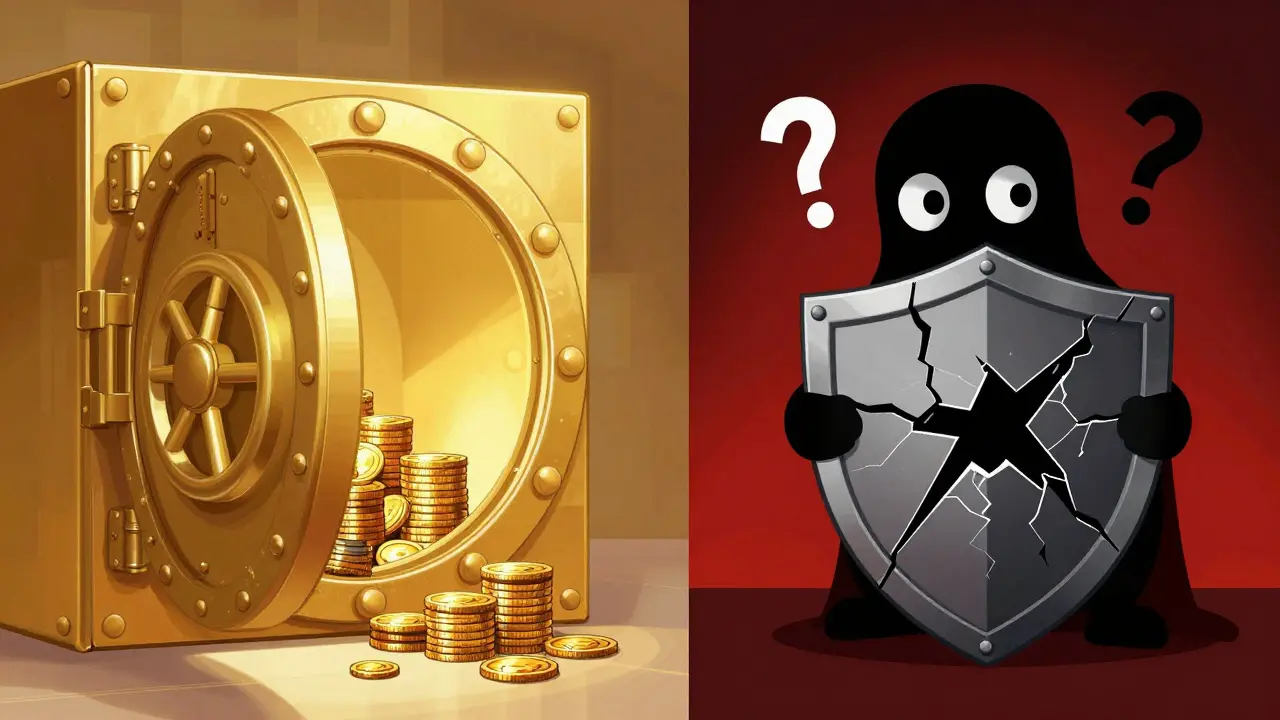
When you trade without KYC, security becomes even more critical. Since they cannot verify who you are, they must ensure that hackers cannot steal from you either. Nonkyc.io employs a tiered storage system. Small amounts of cryptocurrency are kept in "hot wallets"-online accounts connected to the internet-to facilitate fast trades. Larger sums are moved to "cold wallets," which are offline storage solutions that are much harder to breach.
The platform also uses standard security protocols like Two-Factor Authentication (2FA) and DDoS protection to keep their website running smoothly during high traffic. However, independent security assessments paint a mixed picture. Some reports give the platform an A-rating for basic security hygiene. Others, like those from CER.live, issue a concerning DD-rating, citing a lack of approved penetration testing, no active bug bounty program, and no public proof of reserves. Proof of reserves is crucial because it proves the exchange actually holds the money users think they have. Without it, you are trusting their word.
Trading Experience: Assets, Fees, and Liquidity
If you decide to take the risk, what can you actually trade? Nonkyc.io supports around 190 to 300 cryptocurrencies, depending on the source. This includes major players like Bitcoin (BTC), Ethereum (ETH), and stablecoins like USDT. It also supports privacy coins like Monero and popular memecoins like Dogecoin. The most active pair is ETH/USDT, which sees millions of dollars in volume daily.
| Metric | Value |
|---|---|
| Minimum Deposit | 1 USDT |
| Supported Coins | ~190 - 300+ |
| Trading Pairs | 361 |
| 24h Volume (Approx) | $5M - $35M |
| Futures/Derivatives | No |
The fees are generally low, which is a major selling point. While exact percentages vary based on your trading volume, they are competitive with other mid-tier exchanges. However, liquidity can be an issue. With a 24-hour trading volume ranging between $5 million and $35 million, Nonkyc.io is significantly smaller than giants like Binance or OKX. Lower liquidity means larger trades might slip in price, meaning you buy higher or sell lower than expected. For small investors, this rarely matters. For whales, it is a dealbreaker.
Also note what is missing: there are no futures contracts, no options, and no NFT marketplace. If you are looking to leverage your position or trade derivatives, Nonkyc.io is not the place for you. It is strictly a spot trading platform.
Risks and Red Flags: What Experts Say
You need to go into this with your eyes open. Expert reviews are sharply divided. Traders Union gives it a low score of 3.04 out of 10, labeling it "higher-than-average risk." They acknowledge it is good for anonymity but warn about the lack of regulatory safeguards. BrokerChooser is even harsher, explicitly advising users to avoid the platform because it is not regulated by any strict financial authority.
Why does this matter? In 2026, the crypto landscape is maturing. Regulated exchanges offer insurance, customer support backed by law, and transparent audits. Unregulated ones like Nonkyc.io operate in a gray area. The primary risk is counterparty risk-the chance that the exchange itself fails, gets hacked, or acts maliciously. Without KYC, it is also easier for bad actors to use the platform for illicit activities, which could attract unwanted attention from law enforcement agencies, potentially leading to sudden shutdowns or frozen assets.

Who Should Use Nonkyc.io?
Let’s be realistic about who this platform is for. It is not for the average investor who wants to buy Bitcoin as a long-term savings account. For them, a regulated exchange with insurance is safer. Nonkyc.io is designed for:
- Privacy Purists: Users who refuse to share personal data with any corporation or government entity.
- Censored Regions: People living in countries with heavy capital controls or banned crypto access.
- Small-Scale Traders: Individuals moving small amounts of money who want speed and low fees over institutional-grade security.
If you fall into these categories, Nonkyc.io offers a functional, easy-to-use interface. The browser-based platform is intuitive, and the 24/7 customer support is reportedly responsive. But if you are moving large sums of money, or if you value regulatory protection and legal recourse, you should look elsewhere.
Final Verdict: Proceed with Caution
Nonkyc.io delivers exactly what it promises: fast, anonymous, low-fee crypto trading. It removes the barriers to entry that frustrate many users. However, in the financial world, free lunches rarely exist. The cost of that anonymity is the absence of regulatory protection and verified security audits.
If you choose to use Nonkyc.io, treat it like cash. Only put in what you can afford to lose. Never store long-term holdings on any exchange, especially an unregulated one. Use a hardware wallet for your main portfolio and only transfer small amounts to Nonkyc.io when you are ready to trade. By understanding the trade-off between privacy and protection, you can make an informed decision that fits your risk tolerance.
Is Nonkyc.io safe to use in 2026?
Safety depends on your definition. Technically, it uses cold storage and 2FA, which helps against hacks. However, it lacks regulatory oversight and public proof of reserves, making it higher risk than regulated exchanges. You should only use it if you accept the risk of losing funds due to operational failure or fraud.
Does Nonkyc.io require ID verification?
No. The core feature of Nonkyc.io is that it does not require Know Your Customer (KYC) verification. You can sign up and start trading without submitting a passport, driver's license, or selfie.
What cryptocurrencies can I trade on Nonkyc.io?
You can trade major coins like Bitcoin (BTC), Ethereum (ETH), and Tether (USDT), as well as altcoins like Dogecoin and privacy coins like Monero. The platform supports over 190 different digital assets.
Are there limits on withdrawals without KYC?
While specific limits are not always publicly detailed, unregulated exchanges often impose lower withdrawal limits for non-verified accounts to manage risk. Always check the current terms on their site before depositing large amounts.
Can I buy crypto with fiat currency on Nonkyc.io?
Generally, no. Nonkyc.io operates primarily as a crypto-to-crypto exchange. Deposits and withdrawals are made via cryptocurrency wallets. Buying directly with USD or EUR usually requires a regulated on-ramp service first.
How do Nonkyc.io fees compare to Binance or Coinbase?
Nonkyc.io advertises ultra-low trading fees, often comparable to or slightly higher than Binance's maker/taker rates. However, because liquidity is lower, you may experience higher slippage costs on large trades compared to top-tier exchanges.
Is Nonkyc.io regulated?
No. Nonkyc.io is registered in Seychelles but is not regulated by major financial authorities like the SEC or FCA. This lack of regulation is what allows them to skip KYC checks but also means you have less legal protection.
What happens if Nonkyc.io gets hacked?
Since the exchange is unregulated and lacks public proof of reserves or insurance funds, recovering stolen funds would be difficult. This is why experts recommend never storing long-term holdings on such platforms.
Does Nonkyc.io offer futures or leverage trading?
No. Nonkyc.io is a spot trading platform only. It does not offer derivatives, futures contracts, or leveraged positions.
Is my data private on Nonkyc.io?
Yes, relative to other exchanges. They do not collect personal identification documents. However, they still log IP addresses and transaction data, so it is not completely anonymous in a technical sense, just personally unidentified.
Drew M
July 13, 2026 AT 09:51Oh, please. The idea that privacy is some noble virtue in 2026 is just adorable coming from people who don't understand the geopolitical landscape 🙄. You think you're being 'free' by using a Seychelles-registered shell company with no proof of reserves? That's not freedom, that's financial suicide wrapped in a libertarian fantasy 📉. I've been trading since the Bitcoin halving of 2012, and let me tell you, the only thing these no-KYC platforms protect you from is your own ability to recover funds if they rug pull 💸. It's not sophisticated, it's just lazy security architecture disguised as rebellion 🛡️. And don't get me started on the liquidity slippage; trying to move any real volume there is like trying to drink water through a coffee stirrer ☕. The elites know where the money is safe, and it's definitely not on an exchange rated D by CER.live 📉.
Deep Rahman
July 13, 2026 AT 22:05I have spent many years thinking about the nature of trust and how it changes when we remove the human element from our financial interactions, and this platform represents a very strange middle ground that I find difficult to accept because it pretends to offer safety while actually offering nothing but a void where accountability should be, and when we look at the history of money we see that every time people tried to hide their transactions from the state or from each other without proper safeguards, the result was usually chaos and loss for the little guy who did not have the power to fight back, so I worry that by choosing this path we are not gaining freedom but losing the basic protections that society has built over centuries to keep us from being cheated by those who wish to take advantage of our ignorance, and perhaps we need to ask ourselves why we are so afraid of showing who we are that we would risk everything on a platform that does not even prove it has the money it claims to hold.
Melissa Beckwith
July 15, 2026 AT 10:07You are all missing the fundamental technical reality here which is that without KYC the exchange cannot legally interact with fiat on-ramps effectively which means their liquidity is artificially constrained by the fact that they can only trade crypto-for-crypto which creates a closed loop that is highly susceptible to wash trading and manipulation by insiders who control large portions of the available order book, and furthermore the lack of regulatory oversight means they are not required to undergo regular third-party audits which is a massive red flag for any serious trader who understands the importance of solvency proofs, and I have analyzed similar platforms in the past and found that the majority of them eventually collapse under the weight of their own operational inefficiencies or outright fraud because there is no incentive structure to maintain integrity when there is no legal consequence for failure, so anyone suggesting this is a viable long-term solution is either ignorant of how centralized exchanges operate or deliberately misleading others for their own gain.
Josephine Finlayson
July 15, 2026 AT 20:04I completely understand why someone might feel drawn to the idea of keeping their financial data private, especially given how much information companies collect these days, and it is perfectly valid to want that sense of control over your personal identity, however, I gently suggest that we also consider the other side of the coin, which is that regulation exists primarily to protect users from exactly these kinds of unverified risks, and while it may feel restrictive, it provides a safety net that can be incredibly comforting when things go wrong, so perhaps we can find a balance where we advocate for better privacy laws rather than turning to platforms that offer zero recourse, and I hope everyone stays safe and makes choices that bring them peace of mind, because stress is not good for anyone!
Tuan Nguyen
July 16, 2026 AT 14:09The entire premise of this review is flawed because it treats Nonkyc.io as if it were a legitimate financial institution rather than what it truly is: a honeypot for retail traders who are too lazy to use decentralized exchanges or hardware wallets properly. The 'security architecture' mentioned is laughable; hot wallet exposure combined with no bug bounty program is an invitation for sophisticated threat actors to drain the pool, and the 'cold storage' claim is unverifiable without multi-sig transparency which they obviously lack. This is not a niche for privacy advocates; it is a graveyard for capital efficiency. If you are smart enough to care about privacy, you are smart enough to use Monero directly or run your own node. Using a centralized intermediary for anonymity is an oxymoron that only appeals to the intellectually dishonest.
Hazel Fruitman
July 16, 2026 AT 15:16its really bad that ppl dont see the moral issue here, its not just about safety its about supporting systems that allow bad actors to launder money and evade justice, and i think we have a responsibility to not participate in platforms that enable that kind of behavior even if it feels convenient, because every time we use these shady sites we are contributing to a larger problem that hurts society, and its just selfish to put your own desire for secrecy above the well-being of others, so please stop promoting this garbage and do the right thing by sticking to regulated exchanges that play by the rules.
Autumn Story
July 16, 2026 AT 20:16I totally get the appeal of quick and easy trading without all the paperwork, and it sounds super convenient for small amounts, but I always feel a little nervous about places that don't verify who you are, because it makes me wonder if they are hiding something, so I usually stick to bigger names just to be safe, but hey, everyone has their own comfort level, and I hope you all make choices that feel right for you, even if I would probably just use Coinbase or Binance for peace of mind, because I value my sleep more than I value saving a few seconds on signup!
Mark Tuason
July 16, 2026 AT 23:10While I appreciate the detailed breakdown of the fees and supported assets, I must respectfully point out that the absence of regulatory compliance is a significant factor that cannot be overlooked by prudent investors. It is important to acknowledge that while the user experience may be streamlined, the potential for counterparty risk remains elevated due to the lack of insurance funds and legal recourse. Therefore, I would advise readers to carefully weigh these operational conveniences against the substantial security implications before committing any significant capital to such a platform.
Ella Collinson
July 18, 2026 AT 16:16Let's deconstruct the narrative here: the 'privacy' angle is merely a marketing vector designed to obscure the fundamental insolvency risks inherent in non-transparent custodial models. The lack of Proof of Reserves (PoR) is not a feature; it is a critical vulnerability indicator that suggests potential fractional reserve practices. Furthermore, the reliance on IP logging undermines the claimed anonymity, rendering the 'no-KYC' proposition functionally redundant for true privacy seekers. The low liquidity depth ($5M-$35M daily) indicates severe market impact costs for institutional-sized orders, making this venue exclusively suitable for retail arbitrageurs with negligible capital exposure. Do not confuse obscurity with security.
Ray Arney
July 19, 2026 AT 17:01I guess it works for small trades, but I'd never put anything big there.