
Imagine logging into your favorite crypto exchange to check your portfolio, only to find the website completely blocked. Your funds are trapped, and you have no idea who to call for help. This isn’t a hypothetical nightmare scenario for users in Southeast Asia anymore; it is the reality for thousands of Thai residents following the implementation of the Royal Decree on Digital Asset Businesses (No. 2) B.E. 2568 (Thailand's strict 2025 cryptocurrency regulatory framework). Effective from April 13, 2025, this decree has turned Thailand into one of the most heavily regulated crypto markets in the world.
The message from the authorities is clear: if you want to trade digital assets in Thailand, you must play by the rules. The Securities and Exchange Commission (SEC) of Thailand, working alongside the Ministry of Digital Economy and Society (MDES) and the Bank of Thailand (BOT), has stopped playing nice with non-compliant operators. The result? Severe financial penalties, criminal prosecution, and immediate blocking orders for platforms that ignore local laws. If you are operating a business or trading personally in Thailand, understanding these stakes is not just about avoiding fines-it is about protecting your livelihood and your freedom.
The New Enforcement Reality: Blocking Orders and Immediate Action
Gone are the days when regulators would send warning letters before taking action. Under the new framework, enforcement is swift and decisive. On June 28, 2025, the SEC announced the first major wave of enforcement actions under the new rules, blocking access to five unauthorized crypto trading platforms. These weren't obscure sites; they were platforms that had previously operated openly in the market.
The Royal Decree grants the MDES unprecedented authority to block access to unlicensed digital platforms without needing prior court approval. This means the government can cut off internet access to specific domains almost instantly. For users, this creates a high-pressure situation. The SEC advised users of these five blocked platforms to withdraw or transfer their assets to licensed entities before the deadline. After June 28, 2025, many Thai users found themselves permanently locked out of their funds because the platforms could no longer process withdrawals due to the block.
This aggressive approach extends beyond just platform names. The SEC’s jurisdictional reach now includes any platform offering Thai-language services, processing payments in Thai baht (THB), or targeting local users through search engine marketing. Even if a company is based overseas, if they are actively trying to attract Thai customers, they fall under Thai law. This closes the loophole that foreign exchanges used to rely on, where they claimed they were "not operating in Thailand" simply because their servers were located elsewhere.
Criminal Penalties for Individuals: The "Mule Account" Trap
While most attention goes to big exchanges, individual traders face serious risks too. The regulatory framework specifically targets individuals who operate "mule accounts." These are financial accounts or crypto wallets knowingly used for unlawful purposes, such as receiving funds from scams or money laundering operations.
The penalties here are severe. Under the Royal Decree on Measures to Prevent and Suppress Technology Crimes (No. 2) (Legislation expanding MDES powers against cybercrime), individuals caught running mule accounts face imprisonment for up to 3 years. Additionally, they can be fined up to THB 300,000 (approximately $8,400 USD). In many cases, courts impose both penalties simultaneously.
You might think, "I wouldn't do anything illegal." But the risk often comes from ignorance or peer pressure. Scammers frequently recruit ordinary people, especially students or those looking for quick side income, to lend their bank accounts or crypto wallets for "processing fees." Once you hand over control of your wallet, you become legally responsible for whatever illicit funds flow through it. The Thai authorities are cracking down hard on this, treating the account holder as an accomplice to the crime.
Licensed Platforms Face Joint Liability and Unlimited Risk
If you run a licensed crypto platform in Thailand, the safety net you might expect doesn't exist. The new regulations introduce a concept known as joint liability. Licensed cryptocurrency platforms are held jointly liable for damages arising from cybercrime if they fail to meet compliance obligations. This mirrors the liability frameworks applied to traditional banks and telecommunications companies.
What does this mean in practice? It means potentially unlimited financial liability for security breaches or fraud facilitated through your platform. If a hacker steals millions from your users because your two-factor authentication system was weak, or if you failed to monitor suspicious transactions adequately, you can be sued for the full amount of the losses. Legal experts note that this joint liability framework represents a significant departure from traditional regulatory approaches and may make operating a crypto platform in Thailand financially prohibitive for smaller startups.
Furthermore, platforms are required to assist in refunding stolen or fraudulently transferred funds. This creates a massive operational burden. You are not just a passive intermediary; you are an active participant in loss recovery. The SEC requires platforms to implement mechanisms for refunding fraud victims, which can drain liquidity and hurt profitability, especially during periods of high scam activity.

Localization Requirements for Foreign Exchanges
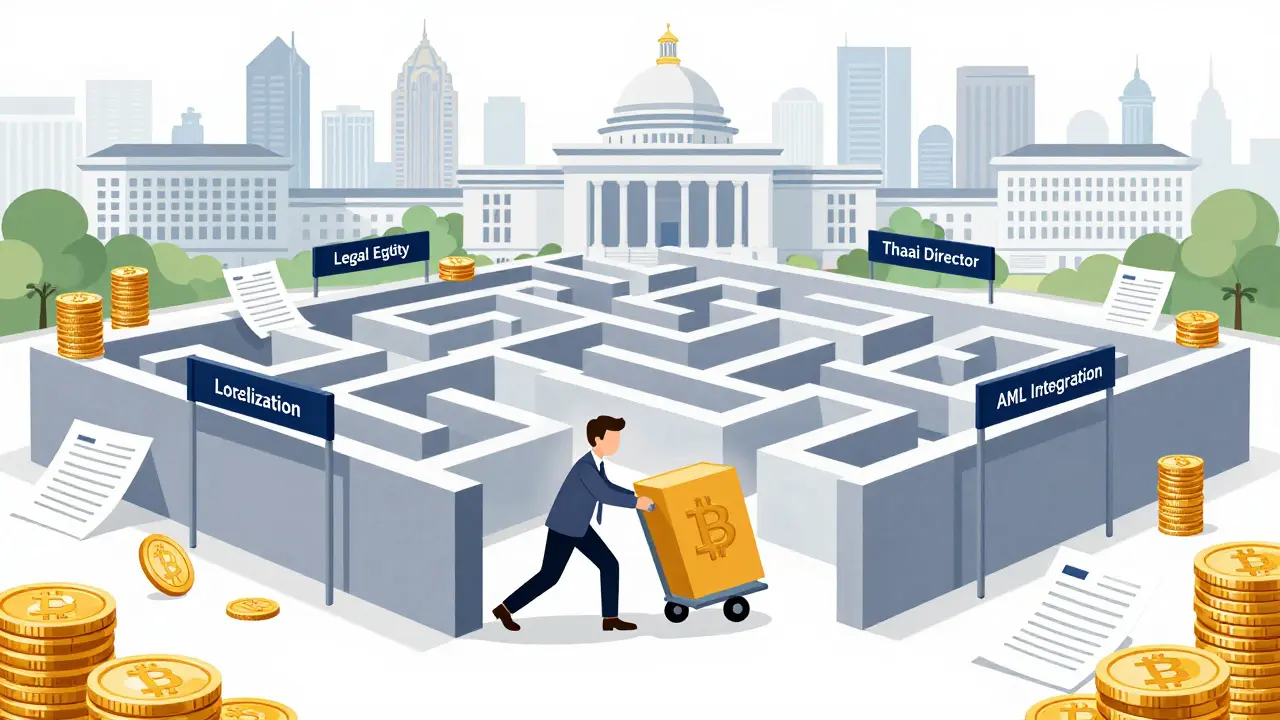
For foreign cryptocurrency platforms targeting Thai users, the bar for entry is higher than ever. Mandatory localization obligations took effect in January 2025. You cannot simply set up a website and start accepting Thai customers. To operate legally, you must:
- Establish a legal entity within Thailand.
- Appoint a local Thai director.
- Maintain Thai bank accounts.
- Integrate directly with national Anti-Money Laundering (AML) services.
- Obtain a license from the SEC Thailand.
- Implement Financial Action Task Force (FATF) algorithms for transaction monitoring.
These requirements are designed to ensure that foreign operators have skin in the game. By requiring a local presence, the SEC ensures there is a physical entity they can hold accountable if things go wrong. Non-compliant foreign platforms face immediate blocking orders. The learning curve for international operators is steep, requiring a comprehensive understanding of Thai corporate law, banking regulations, and cybercrime legislation. Most foreign firms need 6-12 months to complete these localization requirements.
Compliance Costs and Operational Burdens
The cost of doing business in Thailand’s crypto sector has skyrocketed. Specialized law firms in Bangkok charge between THB 500,000 and THB 2,000,000 ($14,000-$56,000 USD) for complete licensing and localization services. This doesn't include ongoing operational costs.
Licensed platforms must perform strict Know Your Customer (KYC) procedures and maintain continuous transaction monitoring capabilities. They must also establish data-sharing protocols with law enforcement agencies, including the Anti-Money Laundering Office (AMLO). Failure to meet these obligations results in license revocation, heavy financial penalties, and potential criminal prosecution of platform operators.
Users feel this friction too. Traders on licensed platforms report enhanced security measures and improved fraud protection, which is a positive outcome. However, they also complain about increased transaction monitoring delays and more invasive KYC procedures. What used to take minutes now takes hours or even days as human analysts review flagged transactions. While frustrating, this delay is the price of admission in a highly regulated market.
| Requirement | Licensed Platforms | Unauthorized Platforms |
|---|---|---|
| Local Entity | Mandatory | None |
| Thai Director | Required | Not Required |
| AML Integration | Full Integration with AMLO | Self-declared (often fake) |
| Fraud Refunds | Joint Liability / Must Assist | No Responsibility |
| Penalty for Non-Compliance | Fines, License Revocation, Criminal Charges | Blocking Orders, User Fund Loss |
Market Impact: Fewer Choices, Higher Fees
The impact of these regulations on the market structure is visible. According to the Association of Digital Asset Businesses (Thailand), the number of licensed cryptocurrency platforms decreased from 12 to 7 between January and June 2025. Several operators chose to exit the market rather than meet the enhanced compliance requirements.
However, trading volumes on the remaining licensed platforms increased by 23% during the same period. Users are migrating to compliant platforms despite reduced options. This consolidation leads to less competition, which often translates to higher trading fees for consumers. Thai cryptocurrency traders generally report positive experiences with the enhanced consumer protections but express concern about the limited number of compliant platforms.
There is a silver lining for some investors. The tax regime has been adjusted to encourage activity within licensed markets. Individuals enjoy a five-year exemption on capital gains from trades conducted on licensed exchanges, valid from January 1, 2025, until December 31, 2029. This temporary tax incentive is designed to pull volume away from the black market and into the regulated ecosystem. However, it creates uncertainty about long-term tax treatment after the exemption period expires.
Navigating the Stablecoin Exception
In March 2025, the SEC approved USDT and USDC stablecoins for certain transactions under the Emergency Decree. This represented a gradual broadening of the regulatory perimeter. However, these stablecoins cannot be used for general payments. The Bank of Thailand maintains its prohibition on cryptocurrencies as payment methods while piloting Central Bank Digital Currency (CBDC) initiatives.
This creates a complex environment where digital assets are permitted for investment but restricted for payments. Platforms handling these stablecoins face additional compliance obligations. The TouristDigiPay program offers a small exception, allowing foreign tourists to use digital wallets and stablecoins without full registration, but this applies only to limited use cases and does not extend to general trading activities.
What Should You Do Next?
If you are a trader in Thailand, audit your current platforms immediately. Ensure every exchange you use holds a valid SEC Thailand license. Withdraw funds from any platform that does not meet the localization requirements. The window for safe withdrawal from blocked platforms is closing rapidly.
If you are a business operator, consult with a specialized legal firm like Silk Legal or COREDO. Do not attempt to navigate Thai corporate law and AML requirements alone. The cost of a mistake is not just a fine; it could be prison time for directors and permanent reputational damage. Prepare for a 6-12 month timeline for full compliance. Budget for significant upfront legal and technical integration costs.
The era of wild west crypto trading in Thailand is over. The new reality is strict oversight, heavy penalties, and mandatory localization. Adapt quickly, or get left behind-or worse, blocked entirely.
What happens if I use an unauthorized crypto platform in Thailand?
If you use an unauthorized platform, you risk having your access blocked suddenly by the MDES without prior notice. As seen in June 2025, users of blocked platforms may permanently lose access to their funds if they do not withdraw them before the enforcement deadline. Additionally, you have no legal recourse to recover stolen funds, as these platforms are not subject to Thai consumer protection laws.
Can I go to jail for crypto-related crimes in Thailand?
Yes. Operating "mule accounts"-using your bank account or crypto wallet to receive funds for scams or money laundering-can result in imprisonment for up to 3 years. You can also face fines of up to THB 300,000. Both penalties can be applied simultaneously.
Do foreign crypto exchanges need a local office in Thailand?
Yes. Since January 2025, foreign platforms targeting Thai users must establish a legal entity in Thailand, appoint a local Thai director, and maintain Thai bank accounts. They must also integrate with national AML services and obtain an SEC license. Failure to comply results in immediate blocking orders.
Is there a tax exemption for crypto trading in Thailand?
Yes, but only for trades conducted on licensed exchanges. Individuals enjoy a five-year exemption on capital gains from January 1, 2025, to December 31, 2029. Trades on unauthorized platforms do not qualify for this exemption and may be subject to standard taxation and legal scrutiny.
What is joint liability for crypto platforms?
Joint liability means that licensed platforms are financially responsible for damages arising from cybercrime if they fail to meet compliance obligations. This can include unlimited liability for security breaches or fraud facilitated through their systems, similar to the liability faced by traditional banks.
Can I use USDT or USDC for payments in Thailand?
No. While the SEC approved USDT and USDC for certain transactions in March 2025, the Bank of Thailand prohibits using cryptocurrencies for general payments. These stablecoins are allowed for investment purposes but come with strict compliance obligations and cannot replace fiat currency for daily transactions.
How much does it cost to comply with Thai crypto regulations?
Initial compliance costs are high. Legal firms charge between THB 500,000 and THB 2,000,000 ($14,000-$56,000 USD) for licensing and localization services. Ongoing costs include KYC infrastructure, AML integration, and continuous transaction monitoring systems.