
Imagine a room full of strangers trying to agree on the total amount of money in a jar without anyone trusting each other. That is essentially what a blockchain is a decentralized digital ledger that records transactions across many computers so that the record cannot be altered retroactively. But how do thousands of independent computers reach a single, agreed-upon truth? The answer lies in consensus mechanisms are protocols that allow distributed nodes in a blockchain network to agree on the validity of transactions and the state of the ledger. These rules act as the backbone of trust in a system where no central authority exists.
Without these mechanisms, blockchains would crumble into chaos. Double-spending, fraud, and conflicting data would run rampant. Consensus algorithms solve the "Byzantine Generals Problem," a classic computer science puzzle about achieving agreement among unreliable parties. In simple terms, they ensure that every node sees the same version of reality. This article breaks down how these agreements happen, comparing the major methods used today and explaining why your choice of mechanism matters for security, speed, and energy use.
The Core Problem: Trusting Without a Boss
In traditional banking, a central server verifies your transaction. If you send $10 to a friend, the bank updates its database, and everyone accepts this new balance. In a decentralized network, there is no bank. Instead, you have a mesh of nodes-computers running software-that all hold a copy of the ledger. When a transaction occurs, it broadcasts to all nodes. The challenge is ensuring that malicious actors cannot fake transactions or rewrite history.
Consensus mechanisms provide the mathematical and economic rules to prevent this. They rely on three key properties:
- Safety: Ensuring all honest nodes agree on the same valid output.
- Liveness: Guaranteeing the network continues to process new transactions despite failures.
- Fault Tolerance: Determining how many bad actors the network can withstand before breaking.
If even one of these fails, the network’s integrity is compromised. For example, if safety fails, two different versions of the ledger might exist simultaneously, leading to confusion over who owns which assets. Understanding these properties helps clarify why different blockchains choose different approaches.
Proof of Work: The Energy-Intensive Pioneer
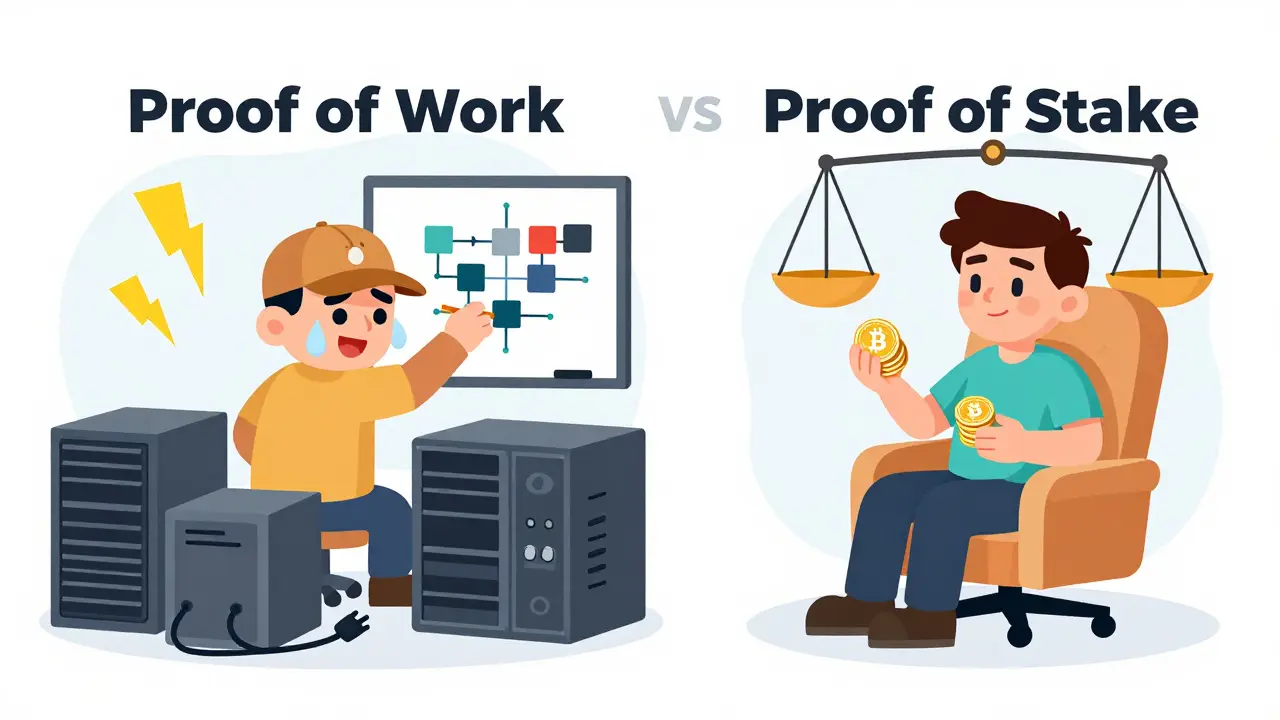
Proof of Work (PoW) is a consensus mechanism where miners compete to solve complex mathematical puzzles to validate transactions and create new blocks. Introduced by Satoshi Nakamoto in Bitcoin’s 2008 whitepaper, PoW remains the gold standard for security. Here’s how it works: miners use powerful hardware to guess a specific number (called a nonce) that, when hashed with the block’s data, produces a result below a certain target. This process requires massive computational power.
The first miner to solve the puzzle broadcasts the solution. Other nodes verify it quickly and add the block to their chains. Because solving the puzzle is hard but verifying is easy, it prevents spam and attacks. To alter past transactions, an attacker would need to redo the work for that block and all subsequent ones, requiring more than 51% of the network’s total computing power-a feat that is economically prohibitive for large networks like Bitcoin.
However, PoW comes with significant drawbacks. It consumes enormous amounts of electricity. As of early 2023, Bitcoin’s annual consumption was estimated at 143.26 TWh, comparable to the energy usage of medium-sized countries. Additionally, PoW is slow. Bitcoin processes only about 7 transactions per second (TPS) with block times around 10 minutes. This makes it unsuitable for high-frequency applications like retail payments.
Proof of Stake: The Eco-Friendly Alternative
Proof of Stake (PoS) is a consensus mechanism where validators are chosen to create new blocks based on the amount of cryptocurrency they hold and are willing to 'stake' as collateral. Ethereum transitioned to PoS in September 2022 during "The Merge," marking a pivotal shift in the industry. Unlike PoW, which relies on physical resources (electricity), PoS relies on financial incentives.
In PoS, participants lock up their coins as a stake. Validators are randomly selected to propose blocks. If they act honestly, they earn rewards. If they try to cheat-for instance, by validating fraudulent transactions-they lose part or all of their stake through a process called "slashing." This creates a strong economic disincentive for bad behavior. Vitalik Buterin, Ethereum’s co-founder, noted that PoS improves security economics by making attacks financially suicidal.
The benefits are clear. PoS reduces energy consumption by approximately 99.95% compared to PoW. Ethereum now uses just 0.0037 kWh per transaction versus Bitcoin’s 707 kWh. Speed also improves; Ethereum’s PoS processes 15-45 TPS with 12-second slot times. However, PoS faces criticism regarding centralization. Critics argue that those with more wealth have greater influence, potentially leading to oligopolies. Staking pools currently control over 63% of Ethereum’s validators, raising concerns about democratic participation.
Practical Byzantine Fault Tolerance: Speed for Enterprises
For businesses that prioritize speed and finality over decentralization, Practical Byzantine Fault Tolerance (PBFT) is a consensus algorithm designed for permissioned blockchain networks where known nodes vote to agree on the next block. Used in platforms like Hyperledger Fabric, PBFT operates through three phases: Pre-prepare (a primary node proposes a value), Prepare (nodes acknowledge), and Commit (nodes finalize). It tolerates up to one-third faulty nodes.
PBFT offers instant finality, meaning once a transaction is confirmed, it cannot be reversed. This is crucial for supply chain management and financial settlements. Transactions settle in 3-5 seconds. However, PBFT scales poorly. Due to O(n²) communication complexity, it struggles beyond 100 nodes. Enterprise users often implement sharding or hybrid models to overcome this limitation. While PBFT provides robust security for closed networks, it sacrifices the open, permissionless nature that defines public blockchains.

Comparing Consensus Mechanisms: Which Is Right?
Choosing a consensus mechanism depends on your priorities. Are you building a global currency store? A fast payment processor? An enterprise supply chain tool? Below is a comparison of key metrics:
| Mechanism | Security Model | Energy Efficiency | Speed (TPS) | Best Use Case |
|---|---|---|---|---|
| Proof of Work (PoW) | Computational Power | Low (High Consumption) | ~7 TPS | Digital Gold / Store of Value |
| Proof of Stake (PoS) | Economic Stake | High (Low Consumption) | 15-45 TPS | Smart Contracts / DeFi |
| PBFT | Voting Among Known Nodes | Medium | Instant Finality | Enterprise / Supply Chain |
| Ripple Protocol | Unique Node List Voting | High | ~1,500 TPS | Cross-Border Payments |
Note that Ripple uses a unique variant involving Unique Node Lists (UNLs), requiring 40% overlap between lists to maintain consensus. Stellar uses Federated Byzantine Agreement with "quorum slices." Each approach trades off decentralization for performance or regulatory compliance.
Future Trends: Hybrids and Scalability
The landscape is evolving rapidly. Pure PoW is facing regulatory pressure, with 32 countries partially restricting mining as of January 2026. Meanwhile, PoS dominates new Layer 1 launches, accounting for 89% in 2025. Experts predict hybrid models will lead enterprise adoption by 2028, combining PoS for validator selection with BFT variants for finality.
Ethereum’s upcoming Deneb-ProtoDanksharding upgrade (Q2 2026) aims to boost throughput to 100,000 TPS using advanced sharding. Bitcoin’s Layer 2 solutions, like Stacks, are exploring "Proof of Transfer" to leverage Bitcoin’s security while enabling smart contracts. These innovations address the scalability trilemma: balancing decentralization, security, and speed.
As adoption grows, the focus shifts from ideological purity to practical utility. Businesses care less about whether a network is "purely decentralized" and more about whether it meets their needs for cost, speed, and reliability. Consensus mechanisms will continue to adapt, blending the best aspects of existing models to serve diverse applications.
What is the main difference between Proof of Work and Proof of Stake?
Proof of Work relies on computational power and energy consumption to secure the network, while Proof of Stake uses financial collateral (staking) to incentivize honest behavior. PoS is significantly more energy-efficient and faster but may face centralization risks.
Why is energy consumption important in blockchain consensus?
High energy use raises environmental concerns and increases operational costs. Regulatory bodies like the EU’s MiCA framework classify PoW as environmentally unsustainable, pushing industries toward greener alternatives like PoS.
Can a blockchain be both decentralized and fast?
Achieving both is challenging due to the scalability trilemma. Most networks sacrifice some decentralization for speed. Hybrid models and Layer 2 solutions aim to balance these factors by offloading transactions from the main chain.
What is slashing in Proof of Stake?
Slashing is a penalty mechanism where validators lose part or all of their staked funds if they act maliciously or fail to perform duties. It ensures accountability and deters bad behavior.
Which consensus mechanism is best for enterprise use?
Enterprises often prefer PBFT or permissioned PoA models because they offer instant finality, high throughput, and controlled access. These features suit supply chain tracking and internal financial settlements.