
You might have stumbled upon the name SIRIN LABS Token in an old portfolio or a dusty forum thread. It was once one of the most hyped projects in the entire cryptocurrency space. But if you look at it today, May 1, 2026, it looks like a ghost. So, what exactly is SRN, why did it fail so spectacularly, and is there any chance it could come back?
Let’s cut through the noise. SRN is an ERC-20 utility token that belongs to Sirin Labs, a company that promised to bring blockchain technology into your pocket via smartphones. They raised a massive amount of money during their initial coin offering, but the execution never matched the hype. Today, the token trades for fractions of a cent with almost zero volume.
The Original Vision: Blockchain Meets Hardware
To understand where SRN stands now, you need to know where it started. In October 2017, Sirin Labs launched its crowdsale. This wasn’t just another whitepaper; it was a promise of tangible hardware. The company, co-founded by Moshe Hogeg and Kenges Rakishev, wanted to build the first true blockchain smartphone.
The idea was seductive for investors at the time. Imagine a phone that doesn’t just store your crypto keys but actually runs on a blockchain infrastructure. Sirin Labs announced the FINNEY smartphone, named after cryptographer David Chaum. This device was supposed to run SirinOS, a custom operating system built on top of Android. The goal? To make digital assets as easy to use as sending a text message.
The SRN token was designed to be the fuel for this ecosystem. It wasn’t just a currency; it was a key. You needed SRN to access services within the SirinOS environment, pay for decentralized applications (dApps), and secure transactions. The total supply was set at 572.16 million tokens. During the ICO, they managed to raise $157 million USD. That made it the fourth-largest ICO of 2017. At that moment, everyone believed Sirin Labs was going to disrupt Apple and Samsung.
How the SRN Token Works Technically
If you are wondering how to hold or use SRN, the technical details are straightforward, even if the project itself has stalled. SRN operates on the Ethereum network as an ERC-20 token. This means it behaves like other popular tokens such as Chainlink or Uniswap in terms of compatibility. You can store it in standard wallets like MetaMask or Ledger.
However, Sirin Labs also claimed to have their own infrastructure called the Finney Blockchain. This was described as a scalable, ASIC-resistant network designed to support the high-speed transactions required by mobile devices. In theory, SRN would operate on both Ethereum and the Finney Blockchain simultaneously. This dual-layer approach was meant to provide security from Ethereum while offering speed from their proprietary chain.
Unlike Bitcoin or Ethereum, SRN is not mineable. You cannot dig it up with powerful computers. The only way to get SRN is to buy it on an exchange or receive it from someone else. As a utility token, its value was supposed to derive from its usefulness within the Sirin ecosystem. If people used the phones and the OS, demand for SRN should rise. That’s the economic model they pitched.
The Market Crash: From .80 to Near Zero
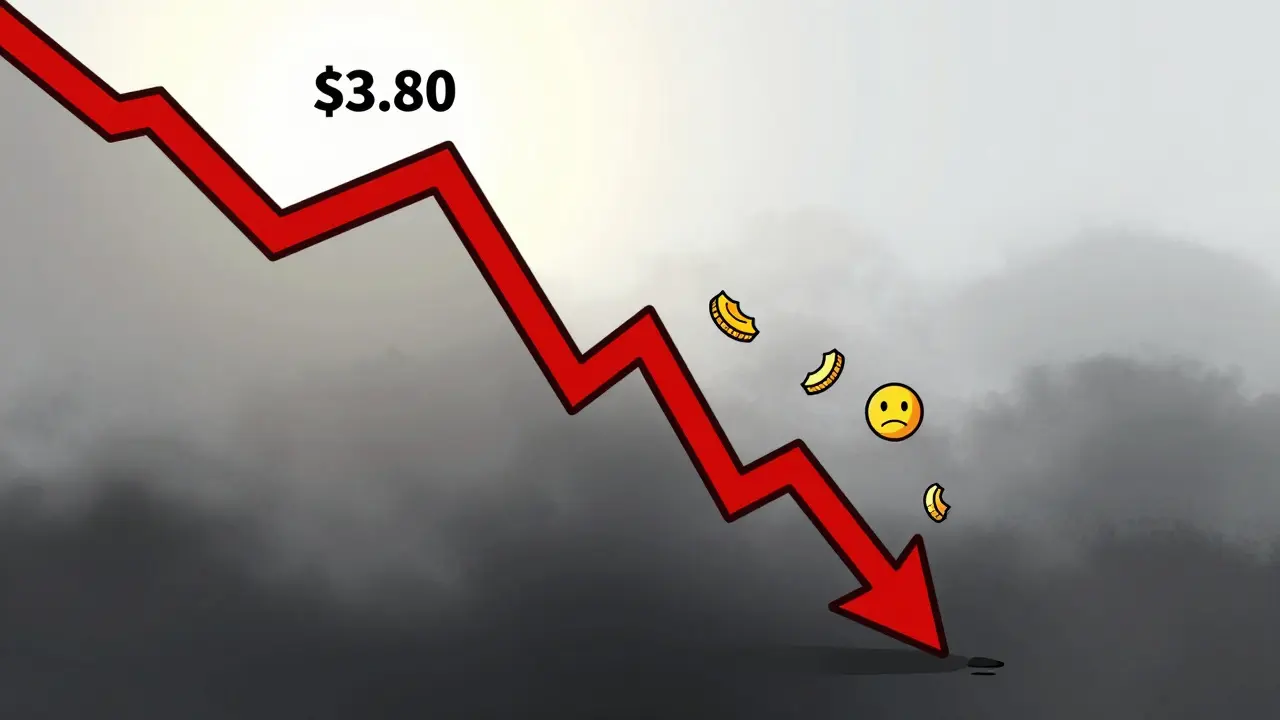
Here is the part that hurts to read for anyone who bought in early. On January 22, 2018, SRN hit an all-time high of $3.80 USD. The market was euphoric. Then, reality set in. By May 2026, the price of SRN fluctuates between approximately $0.000134 and $0.000200 USD. That is a decline of roughly 99.99% from its peak.
Why did it drop so hard? Several factors contributed to this collapse:
- Lack of Product Adoption: While the FINNEY smartphone was released, it failed to gain significant market share against established giants. The niche for blockchain phones remained tiny.
- Tokenomics Issues: With a large circulating supply of over 530 million tokens and limited real-world utility outside the specific Sirin hardware, sell pressure outweighed buy pressure.
- Market Sentiment Shift: The broader crypto market moved away from hardware-focused projects toward DeFi, NFTs, and Layer-2 scaling solutions. Sirin Labs got left behind.
- Liquidity Crisis: As trading volumes dried up, exchanges delisted the token or moved it to obscure pairs, making it harder for retail investors to trade.
Today, the market capitalization of SRN sits around $108,000 USD. For context, many new meme coins launch with higher caps than Sirin Labs’ current valuation. The fully diluted valuation is approximately $116,200 USD. These numbers indicate that the project has lost almost all investor confidence.
Current Trading Status and Liquidity
If you are thinking about buying SRN right now, you need to understand the liquidity situation. Liquidity refers to how easily you can buy or sell an asset without affecting its price. For SRN, liquidity is virtually non-existent.
As of May 2026, the 24-hour trading volume ranges from $1.31 to $2.57 USD across all exchanges. Yes, you read that correctly. A few dollars a day. The primary trading pair is SRN/BNT on Bancor (V2). Other major exchanges like Binance or Coinbase do not list SRN anymore. On CoinMarketCap, SRN ranks between #5456 and #5503. On CoinGecko, it’s even lower at #6980.
This lack of activity creates a dangerous environment for traders. If you manage to buy a significant amount of SRN, you might find it impossible to sell it later because there are no buyers waiting on the order books. Any sale could cause extreme slippage, meaning you’d sell for much less than the displayed price. Essentially, the token is illiquid and difficult to trade in any meaningful quantity.
| Metric | Value |
|---|---|
| Current Price Range | $0.000134 - $0.000200 USD |
| All-Time High | $3.80 USD (Jan 22, 2018) |
| Market Cap | ~$108,200 USD |
| 24h Volume | $1.31 - $2.57 USD |
| Total Supply | 572.16 Million SRN |
| Circulating Supply | ~530 - 533 Million SRN |
| Primary Exchange | Bancor (V2) |
Is Sirin Labs Still Active?
This is the million-dollar question. Based on available data, Sirin Labs appears to have stalled significantly. There have been no major product launches, partnerships, or technological breakthroughs reported in recent years. The absence of upward price pressure despite the substantial initial funding suggests that the development team may have shifted focus or reduced operations.
The original vision included brick-and-mortar retail stores and a decentralized application store. Neither of these achieved mainstream success. The blockchain smartphone market remains a niche curiosity rather than a viable alternative to iOS or Android. Without active development or marketing, the SRN token continues to lose relevance.
It’s worth noting that the founders, Moshe Hogeg and Kenges Rakishev, have not made public appearances promoting new initiatives related to SRN in recent times. In the crypto world, silence often signals abandonment. Investors looking for growth will likely find better opportunities elsewhere.
Risks of Holding SRN Today
If you still hold SRN from the ICO days, you’re sitting on a bag of dust. Selling it might mean realizing a loss close to 100%. Holding it in hopes of a comeback is risky because there is no clear catalyst for recovery. Here are the main risks associated with SRN in 2026:
- Delisting Risk: Even Bancor might remove the pair if volume drops further, leaving holders with no way to exit.
- Security Concerns: With low activity, smart contract audits may be outdated, increasing the risk of vulnerabilities.
- Opportunity Cost: Capital tied up in SRN could be invested in more active projects with stronger fundamentals.
- Regulatory Uncertainty: As governments tighten rules around cryptocurrencies, inactive tokens face higher scrutiny and potential bans.
For new investors, the advice is simple: stay away. The risk-reward ratio is heavily skewed against you. There is no utility, no community, and no momentum.
Can I mine SIRIN LABS Token (SRN)?
No, SRN cannot be mined. It is an ERC-20 utility token with a fixed total supply of 572.16 million tokens. All tokens were distributed during the ICO and subsequent sales. You can only acquire SRN by purchasing it on supported exchanges or receiving it from another user.
Where can I buy SRN in 2026?
The primary venue for trading SRN is Bancor (V2) using the SRN/BNT pair. However, liquidity is extremely low, with daily volumes under $3 USD. Major exchanges like Binance, Coinbase, and Kraken do not list SRN. Be cautious of slippage and wide bid-ask spreads.
What happened to the FINNEY smartphone?
The FINNEY smartphone was released but failed to achieve significant market adoption. It faced stiff competition from established tech giants and struggled to convince mainstream consumers of the need for a dedicated blockchain phone. Sales were minimal, and the device did not drive demand for the SRN token as projected.
Is Sirin Labs still developing new products?
There is little evidence of active development or new product launches from Sirin Labs in recent years. The lack of news, partnerships, or price movement suggests that the company has largely stalled. Investors should assume the project is inactive unless official announcements state otherwise.
Why did SRN lose so much value?
SRN lost value due to a combination of factors: failure to achieve product-market fit with the FINNEY smartphone, declining interest in blockchain hardware, poor liquidity, and broader market shifts toward other crypto sectors like DeFi. The initial hype from the $157M ICO was not sustained by actual usage or revenue.
Is SRN a good investment in 2026?
No, SRN is not considered a good investment in 2026. With near-zero liquidity, a 99.99% drop from its all-time high, and no clear path to recovery, the risks far outweigh any potential rewards. It is recommended to avoid allocating funds to this token.
Rachel S
May 1, 2026 AT 10:28Oh my stars, reading this feels like watching a slow-motion car crash in the rearview mirror :o The sheer amount of capital that vanished into the ether is just staggering to think about. I remember when everyone was talking about blockchain phones being the next big thing, but reality has a funny way of setting in. It’s truly dramatic how quickly the hype cycle can evaporate when the product doesn’t deliver on its promises. Sirin Labs really had all the ingredients for success but somehow managed to burn them all down. The liquidity situation described here is absolutely terrifying for anyone who might still be holding bags. You basically can’t exit without taking a massive hit, which is a cruel twist of fate. This serves as a perfect case study in why due diligence matters more than flashy marketing campaigns. The silence from the founders speaks volumes louder than any press release ever could. It’s sad to see such a high-profile project fade into obscurity like this.
Jan Conrad
May 2, 2026 AT 09:28The technical breakdown of the ERC-20 utility model versus the proprietary Finney Blockchain is fascinating from an engineering standpoint. It highlights a common issue in early crypto projects where the infrastructure promised never matched the execution capability. The dual-layer approach sounded innovative on paper but likely introduced unnecessary complexity that hindered adoption. Without clear use cases beyond a niche smartphone market, the token had no fundamental value anchor. The lack of mining mechanics meant there was no organic distribution mechanism to build a decentralized community organically. Instead, it relied entirely on speculative buying pressure during the ICO boom. When that bubble burst, there was nothing left to support the price structure. It’s interesting to note that even with low volume, the token still exists on Bancor, showing some residual infrastructure integrity.
Rushell Perry
May 4, 2026 AT 02:12I always try to look at these situations with empathy because people lost real money and real hope here. It’s tough to watch a project fail so spectacularly after raising so much capital. The key takeaway for me is the importance of patience and realistic expectations in any investment journey. We learn so much from failures like this that we might not get from successes. The community aspect seems to have completely dissolved which is often the first sign of trouble. Maybe there’s a lesson here about focusing on sustainable growth rather than explosive hype cycles. Holding onto something with no activity is emotionally draining and financially risky. It’s better to cut losses and move forward with clearer eyes.
its me
May 5, 2026 AT 03:57People forget that true innovation requires sacrifice and often looks ugly before it becomes beautiful. The critics here are missing the deeper philosophical point about risk and reward in emerging markets. Just because the phone didn’t sell doesn’t mean the vision was wrong, only that the timing was off. You can’t judge a project by its current liquidity alone because history is written by the survivors. The founders took a huge bet on decentralization in hardware which is a noble pursuit. Most people just want easy profits without understanding the underlying technology or the long game. It’s lazy to dismiss this entire effort just because the price dropped. Real pioneers are often misunderstood until it’s too late for them to care.
Ipsita Seal
May 5, 2026 AT 17:59Ugh, another dead coin story. Why do we keep recycling these same narratives? It’s just boring and depressing to read about yet another failed startup. The writing was on the wall from day one with those unrealistic promises. I’m so tired of seeing people defend obvious scams with pseudo-intellectual jargon. Just admit it was a bad idea and move on already.
AP Fisher
May 7, 2026 AT 02:55I just wanted to know if anyone else remembers the FINNEY launch event. It seemed like a big deal back then but now it feels like ancient history. The article explains things well enough for someone who wasn’t paying attention back in 2018. It’s crazy how fast things change in crypto. One minute you’re rich and the next you’re broke. I guess that’s just part of the game. Thanks for the info though.
Wayne Gillis
May 8, 2026 AT 11:09Bro this is wild 🤯 Like seriously $157 million raised for a phone nobody wanted? That’s insane 😂 The charts must look like a cliff dive. I tried looking up SRN on my exchange and it’s just gone everywhere except some obscure pairs. Liquidity is basically zero which means you’re stuck with digital rocks 🪨 Not cool man. Who even buys blockchain phones anyway? Seems like a solution looking for a problem. Anyway good luck to anyone still holding 🙏
Noel Mandotah
May 9, 2026 AT 19:29Classic pump and dump wrapped in a whitepaper. Typical. The ‘blockchain phone’ narrative was always laughable. Apple and Samsung weren’t worried for a second. Now we have a ghost token trading pennies per thousand. Pathetic. Don’t touch it.
Lynne Teperman
May 11, 2026 AT 00:45It is quite a colorful tale of ambition meeting reality isn't it. The vibrant dreams of a blockchain future clashing with the dull grey of market indifference. I find myself respecting the boundary between speculation and actual utility more now. There is a certain beauty in the failure perhaps a lesson in humility for us all. The punctuation of this story is sparse but the meaning is loud and clear. We should celebrate the creativity behind the attempt even if the outcome was bleak. Let us carry this memory gently as we move forward to brighter horizons.