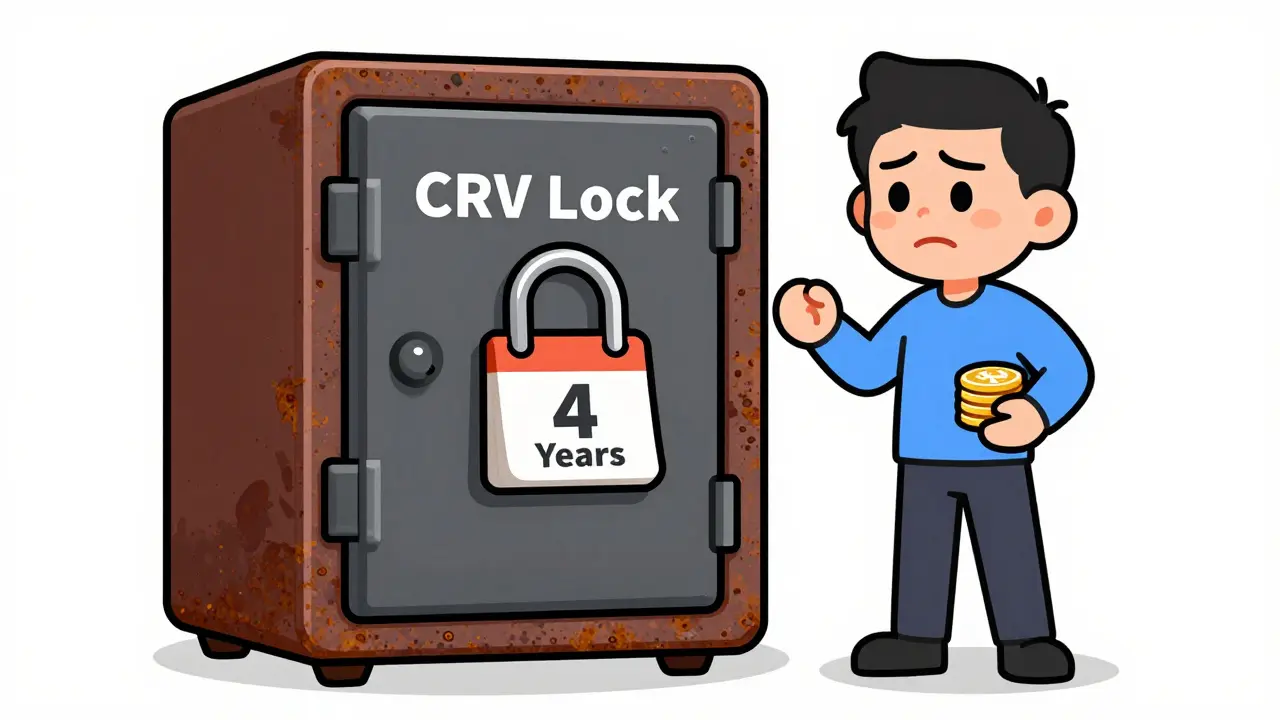
You’ve probably heard the term "yield farming" thrown around in crypto circles. It sounds exciting-passive income from your tokens-but it often comes with a catch: locking up your assets for months or even years. That’s where cvxCRV, a liquid staking derivative created by Convex Finance, changes the game. But what exactly is this token, and why do so many DeFi users prefer it over holding plain CRV?
In short, cvxCRV allows you to earn the high rewards associated with locked Curve Finance (CRV) tokens without actually losing liquidity. It solves one of the biggest problems in decentralized finance: how to get premium yields while keeping your money accessible. If you’re looking to maximize returns on your Ethereum-based assets, understanding cvxCRV is essential.
The Problem with Traditional CRV Staking
To understand why cvxCRV exists, we first need to look at Curve Finance. Curve is a popular automated market maker (AMM) designed for stablecoins. It offers low slippage and low fees, making it ideal for trading stable assets. To incentivize liquidity providers, Curve distributes its native governance token, CRV.
Here’s the catch: if you want the best rewards, you can’t just hold CRV. You have to lock it up for up to four years. This process converts your CRV into vote-escrowed CRV (veCRV). The longer you lock it, the more voting power you get, which allows you to direct reward emissions to specific pools. This boosts your APY significantly.
But locking your crypto for four years isn’t practical for everyone. What if the price crashes? What if you need that capital elsewhere? Traditional staking creates an opportunity cost because your funds are illiquid. This is the gap that Convex Finance identified and filled.
How Convex Finance Solves the Liquidity Trap
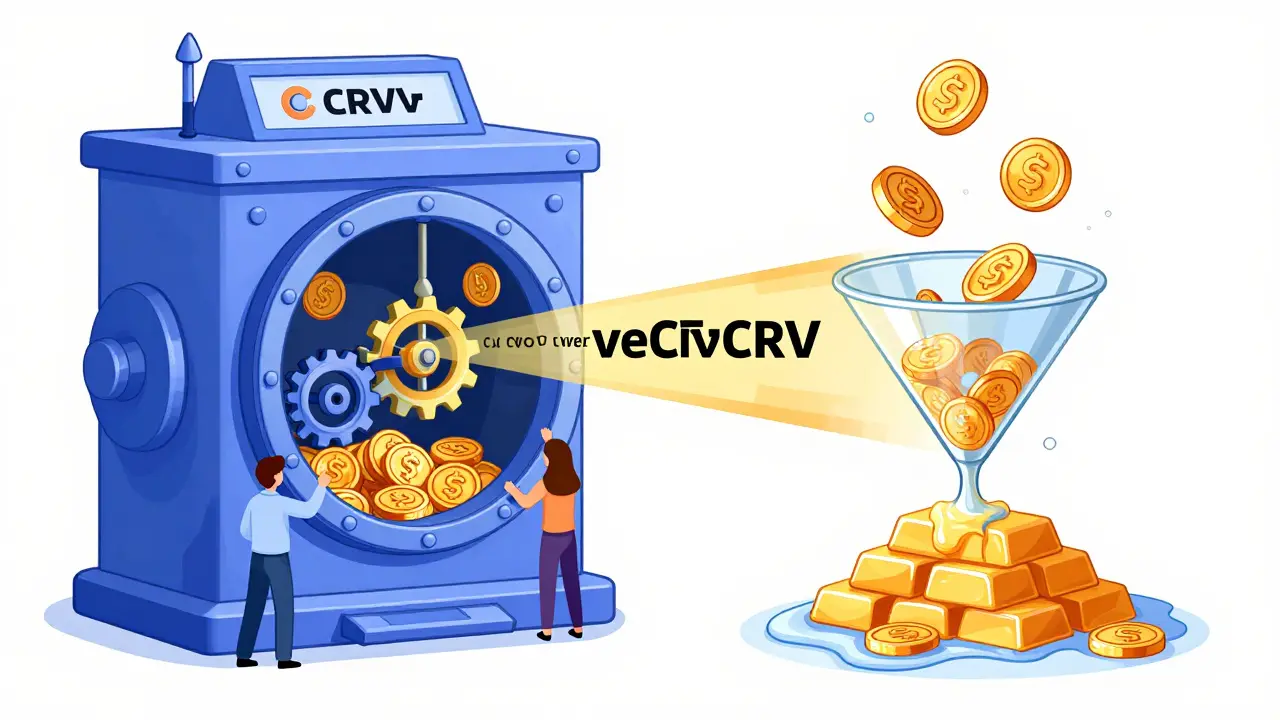
Convex Finance acts as a middleman between individual users and Curve Finance. Instead of each user locking their own CRV tokens individually, Convex pools everyone’s CRV together. It then locks these pooled tokens on behalf of all participants to generate veCRV.
In exchange for depositing your CRV into Convex, you receive cvxCRV tokens. Here is the key difference:
- Illiquid vs. Liquid: When you lock CRV directly on Curve, you get veCRV, which is non-transferable and stuck until the lock expires. When you deposit CRV into Convex, you get cvxCRV, which is fully transferable and tradeable.
- Aggregated Power: By pooling resources, Convex gains massive voting power on Curve. This allows them to optimize gauge votes collectively, ensuring higher rewards for everyone involved compared to solo stakers.
- Simplified Rewards: Convex automates the harvesting of rewards. You don’t need to manually claim CRV, CVX, or other incentives every few hours. The protocol handles the complexity.
Think of it like a mutual fund. Instead of buying individual stocks and managing a portfolio yourself, you buy shares in a fund managed by experts who pool money to achieve better results. In this case, the "fund" is Convex, and the "shares" are cvxCRV.
The Mechanics of cvxCRV: How It Works
The relationship between the tokens can be confusing at first. Let’s break down the flow step-by-step so you know exactly what happens to your assets.
- Acquire CRV: You start by buying CRV tokens on an exchange or via a DEX.
- Deposit into Convex: You send your CRV to the Convex Finance smart contract.
- Receive cvxCRV: Convex credits your wallet with cvxCRV tokens at a nearly 1:1 ratio. Your original CRV is now locked inside the Convex vault as veCRV.
- Earn Rewards: While holding cvxCRV, you automatically earn rewards in two main forms:
- CRV Rewards: A share of the Curve trading fees and emissions boosted by the pooled veCRV voting power.
- CVX Rewards: Additional incentives paid in Convex’s native governance token, CVX.
- Exit Strategy: If you want out, you don’t unlock the underlying CRV (which would take years). Instead, you sell your cvxCRV on the open market or swap it back to CRV using Curve’s dedicated liquidity pool.
This mechanism ensures that your underlying CRV remains locked to generate maximum yield, but you retain the ability to exit your position instantly by selling the derivative token.
Key Differences: cvxCRV vs. veCRV vs. CRV
To make an informed decision, you need to know how these three related entities compare. They serve different purposes within the same ecosystem.
| Feature | CRV (Standard) | veCRV (Vote-Escrowed) | cvxCRV (Liquid Derivative) |
|---|---|---|---|
| Liquidity | Fully Liquid | Locked (Up to 4 Years) | Fully Liquid |
| Governance Rights | None | Full Voting Power | Indirect (via Convex) |
| Reward Boost | Base Rate | Maximum Boost | High Boost (Pooled) |
| Complexity | Low | High (Manual Locking) | Medium (One-Click Deposit) |
| Primary Use Case | Trading/Speculation | Long-Term Holders/Governance | Yield Farming with Liquidity |
Notice that cvxCRV sits in the sweet spot. It offers the high yields of veCRV but keeps the liquidity of standard CRV. However, there is a trade-off: you give up direct control over governance voting. Convex makes those decisions on your behalf.
Risks and Considerations Before Investing
No investment is without risk, and DeFi is particularly volatile. Before you deposit your CRV into Convex, consider these factors.
Smart Contract Risk: Like any DeFi protocol, Convex relies on code. If there is a bug in the smart contract, funds could be at risk. While Convex has undergone multiple audits and has a strong track record since its launch, no system is 100% immune to exploits. Always check the latest audit reports before interacting with new protocols.
Impermanent Loss and Market Volatility: cvxCRV trades at a premium or discount relative to CRV depending on market sentiment and expected future yields. If the value of CRV drops sharply, the value of cvxCRV will likely drop too. Additionally, if the annual percentage yield (APY) offered by Convex decreases, the demand for cvxCRV may fall, causing its price to dip below the underlying CRV value.
Concentration of Voting Power: Because Convex aggregates so much veCRV, it holds significant sway over Curve’s governance. Critics argue this centralizes power away from individual community members. If Convex’s governance decisions misalign with the broader Curve community’s interests, it could negatively impact the ecosystem.
Irreversibility of Conversion: Once you convert CRV to cvxCRV via Convex, you cannot simply "unlock" the original CRV. You must sell the cvxCRV token. During periods of high market stress, liquidity might dry up, making it difficult to exit your position at a fair price.

Who Should Use cvxCRV?
Not every crypto investor needs cvxCRV. It is a specialized tool for specific strategies. Here is who benefits most:
- Yield Farmers: If your goal is to maximize passive income from stablecoin pairs on Curve, cvxCRV is almost mandatory. The boosted rewards significantly outperform standard staking.
- Liquidity Providers: Users providing liquidity to Curve pools often receive CRV rewards. Converting these to cvxCRV allows them to compound returns without locking up their capital indefinitely.
- DeFi Savvy Traders: Those who understand the nuances of impermanent loss and can monitor APY changes can arbitrage the spread between CRV and cvxCRV prices.
If you are a beginner just getting started with Ethereum, you might find the layer of abstraction confusing. Start by learning how Curve works directly before introducing Convex into your strategy.
How to Get Started with cvxCRV
Ready to try it out? Here is a straightforward guide to entering the ecosystem.
- Set Up a Wallet: Ensure you have a compatible Web3 wallet like MetaMask or Rabby installed. Make sure you are connected to the Ethereum network (or Layer 2s supported by Convex, such as Arbitrum or Optimisim, if available).
- Buy CRV: Purchase CRV tokens from a centralized exchange (like Coinbase or Binance) or a decentralized exchange (like Uniswap).
- Navigate to Convex Finance: Go to the official Convex website. Double-check the URL to avoid phishing sites.
- Connect Your Wallet: Click "Connect Wallet" and approve the connection.
- Deposit CRV: Find the CRV vault. Enter the amount of CRV you wish to deposit. Review the transaction details carefully.
- Approve and Confirm: You will need to approve the spending of your CRV tokens first, then confirm the deposit. Pay attention to gas fees; during high network congestion, costs can be steep.
- Monitor Rewards: Once deposited, your dashboard will show your accrued rewards in CRV and CVX. You can harvest these rewards periodically or let them auto-compound if the interface allows.
Remember, gas fees are real costs. For small amounts, the fee might outweigh the initial earnings. It is generally more efficient to stake larger positions.
The Future of Convex and cvxCRV
Convex Finance has evolved beyond just being a wrapper for Curve. The protocol continues to expand its integrations with other DeFi platforms, including Frax Finance. Recent updates have focused on optimizing fee structures and introducing mechanisms to buy back and burn cvxCRV, which could potentially increase scarcity and value for holders.
As the DeFi landscape matures, the demand for liquid staking derivatives is growing. Investors want yield without illiquidity. As long as Curve Finance remains a dominant force in stablecoin swaps, Convex and cvxCRV will likely remain critical components of the DeFi infrastructure. However, always keep an eye on regulatory developments and competitor innovations that could shift market dynamics.
Is cvxCRV safe to invest in?
Like all DeFi investments, cvxCRV carries risks. The primary risks include smart contract vulnerabilities, market volatility affecting the token's price, and dependency on the Curve Finance ecosystem. While Convex Finance has a strong reputation and has handled billions in value, past performance does not guarantee future safety. Always do your own research and never invest more than you can afford to lose.
Can I convert cvxCRV back to CRV directly?
You cannot directly "unlock" the underlying CRV from the Convex vault because it is locked as veCRV for up to four years. However, you can sell your cvxCRV tokens on the open market or swap them for CRV using the dedicated liquidity pool on Curve Finance. This process is instant and maintains liquidity, but you may face slippage depending on market conditions.
What is the difference between CVX and cvxCRV?
CVX is the native governance token of the Convex Finance protocol itself. You earn CVX as a reward when you stake assets on Convex. cvxCRV, on the other hand, is a derivative token representing your locked CRV stake. CVX is used for voting on Convex proposals, while cvxCRV represents your share of the Curve rewards.
Does holding cvxCRV give me voting rights on Curve?
No, holding cvxCRV does not give you direct voting rights on Curve Finance. The voting power belongs to the veCRV held in the Convex vault. Convex Finance uses this aggregated voting power to optimize rewards for all depositors. You indirectly benefit from their governance decisions, but you cannot vote individually.
Why is the APY on Convex higher than staking directly on Curve?
Convex achieves higher APY through collective bargaining. By pooling millions of dollars worth of CRV, Convex gains significant veCRV voting power. This allows them to direct large portions of Curve’s emission rewards to specific pools, boosting yields for liquidity providers. Individual stakers lack this influence, resulting in lower base rewards.
Larry Port
May 4, 2026 AT 19:55Great breakdown of the mechanics. The part about impermanent loss is often overlooked by newbies who just see the APY and dive in headfirst. It's important to remember that cvxCRV isn't magic money, it's a derivative with its own risk profile tied to the underlying CRV volatility. If you're holding long term, the compounding effect of CVX rewards can actually offset some of the downside during bear markets, but you have to be patient.
Amit Varpe
May 5, 2026 AT 08:12why bother with all this complexity when you can just hold BTC? :P
Bronwen Butler
May 6, 2026 AT 19:26the premise is flawed because convex is basically a centralized entity controlling curve governance now so what is the point of decentralization if one protocol holds all the veCRV power anyway
Matt Davis
May 7, 2026 AT 19:59Absolutely catastrophic oversight to ignore the centralization risks here! Convex has become too big to fail within the Curve ecosystem, which creates a single point of failure for the entire stablecoin liquidity layer. If Convex gets hacked or acts maliciously, the entire Curve gauge system collapses. People are blindly trusting code written by a small team while pretending it's 'decentralized finance.' It is nothing more than a high-yield savings account run by a private company with a fancy blockchain wrapper. Wake up!
Albert Lee
May 8, 2026 AT 07:36I get the concern about centralization, but honestly, the yields speak for themselves. I've been using Convex for over two years now and the consistency is unmatched. The key is not putting your life savings into it, but rather using it as part of a diversified DeFi portfolio. The auto-compounding feature alone saves me hours of manual claiming every week. It's a tool, use it wisely.
Tobias Gjerlufsen
May 9, 2026 AT 09:46you people are all missing the forest for the trees the real issue is that cvxCRV is essentially a security disguised as a utility token and the SEC is going to come knocking eventually so enjoy the free ride while it lasts because the rug pull is inevitable
Jocelyn Garcia
May 10, 2026 AT 10:05the delta between crv and cvxcrv is usually pretty tight unless there's a massive sell off on curve so you don't really lose much on entry/exit fees if you time it right also the cvx emissions are a nice bonus that most guides forget to highlight properly
Pauline Larocco71
May 10, 2026 AT 12:24i tried this last year and got confused by the gas fees lol but i think i understand it better now thanks for explaining the difference between veCRV and cvxCRV it makes sense why i would want liquidity even if i give up voting rights
beti macedo
May 12, 2026 AT 05:28This is a very informative guide indeed. The explanation regarding the mutual fund analogy is particularly apt for those who are less familiar with the intricate details of DeFi protocols. One must always conduct thorough due diligence before engaging with such financial instruments. The risks associated with smart contracts cannot be overstated, yet the potential rewards are substantial for the knowledgeable investor.
Michelle Bonahoom
May 12, 2026 AT 18:17another useless article nobody reads these anymore just dump your bags already
Jerry CUNNINGHAM SR
May 13, 2026 AT 15:31I appreciate the detailed comparison table provided in the post. It clarifies the distinctions between the various tokens effectively. However, I believe it is crucial to emphasize the importance of understanding the governance implications further. While Convex aggregates voting power, individual users should still be aware of how their interests might align or diverge from the protocol's strategic decisions. It is a delicate balance between convenience and autonomy in decentralized systems.
Ruben Michel
May 14, 2026 AT 09:11The notion that one requires a 'guide' to understand basic liquid staking derivatives is somewhat disheartening. This technology has been prevalent since early 2021. Those who engage in DeFi without comprehending the fundamental mechanics of veCRV and its derivatives are merely gambling. The premium at which cvxCRV trades is a direct reflection of market sentiment and expected yield differentials, a concept that should be elementary to any serious participant in this space.
Gavin Wonnacott
May 14, 2026 AT 19:20You're all idiots for trusting this garbage. Convex is a scam wrapped in buzzwords. They take your money, lock it up, and pretend they're doing something magical. Meanwhile, the developers are cashing out their CVX tokens left and right. Don't be a sheep. Keep your assets in cold storage and watch the world burn.
Samara McCallum
May 15, 2026 AT 11:00i mean sure its convenient but do we really need another layer of abstraction eating our yields? the whole point of defi was transparency and control not handing the keys to some black box algorithm
Sheldon Friesen
May 17, 2026 AT 01:07Look, let's be real here; if you're not using Convex, you're literally leaving money on the table. The math doesn't lie. Sure, there are risks, but the opportunity cost of holding plain CRV is astronomical. Just make sure you read the docs, check the audit reports, and don't put in more than you can afford to lose. It's that simple. Why complicate it?
Jesse Alston
May 17, 2026 AT 16:14Hey everyone! 👋 Just wanted to add that the recent updates to Convex have made the UI much more user-friendly. 🚀 I've found that setting up alerts for significant changes in the cvxCRV premium can help optimize entry and exit points. It's a great way to stay on top of the market without constantly checking the dashboard. Happy farming! 🌾💰
Shelby Cantu
May 18, 2026 AT 02:08Short and sweet: cvxCRV is the best way to farm CRV without locking up your capital for years.