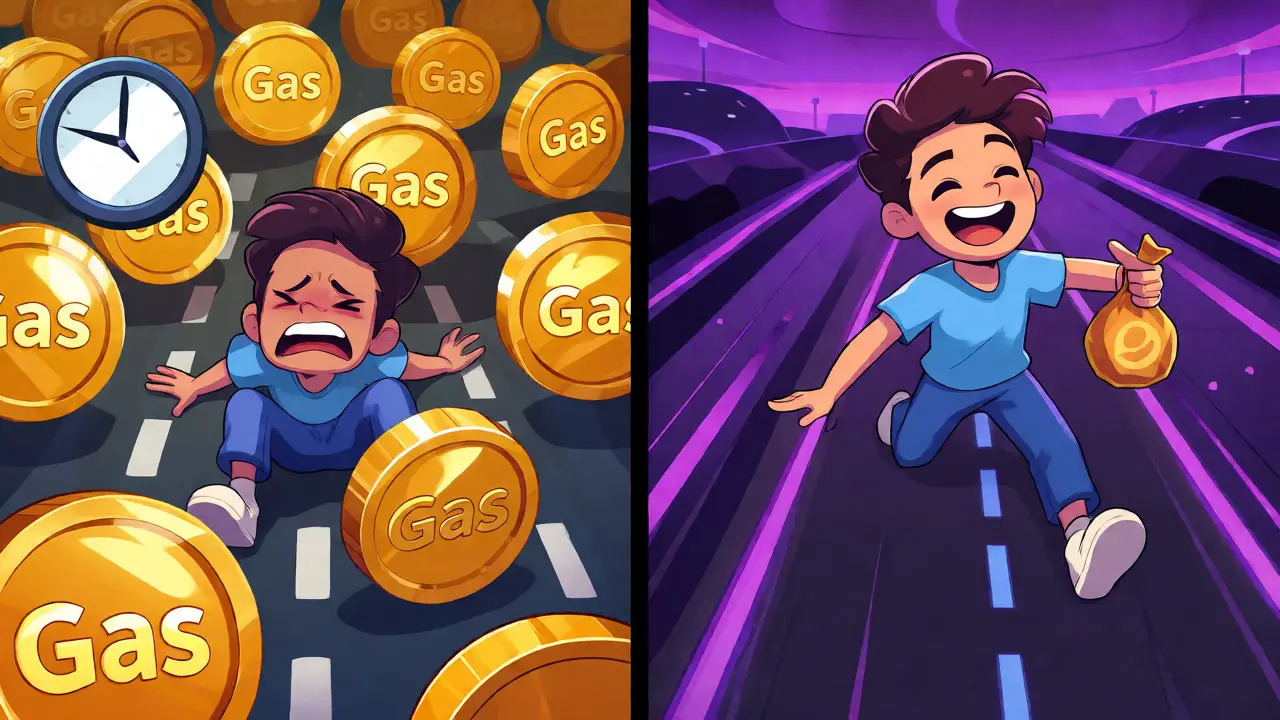
You might think Uniswap is just an Ethereum thing. But if you are still paying $35 per swap on the mainnet while sitting in Wellington or anywhere else with a stable connection, you are leaving money on the table. Enter Uniswap v2 on Polygon. This combination offers a rare sweet spot for traders who want decentralization without the heart-attack fees of Layer 1. Is it still relevant now that v3 and v4 have taken the spotlight? The short answer is yes, but only if you know exactly what you are doing.
Why Choose Uniswap v2 on Polygon Over Mainnet?
Let’s be real about costs. On Ethereum mainnet, swapping a small amount of tokens can cost more in gas than the trade itself. On Polygon, transaction fees average under $1. That is a massive difference when you are executing multiple trades a day. The speed is another factor. Polygon confirms transactions almost instantly. You don’t wait ten minutes for a block to clear; your tokens land in your wallet seconds after you click swap.
Beyond fees and speed, there is the issue of Maximum Extractable Value (MEV). On busy chains like Ethereum, bots often front-run your trades, causing slippage that eats into your profits. Polygon’s sequencer-based architecture significantly reduces this exposure. If you are trading long-tail assets-those smaller, less liquid tokens-you will notice fewer surprises with your final execution price here compared to other networks.
The Technical Edge: How v2 Works Differently
Many users confuse Uniswap versions. Version 2 introduced arbitrary ERC20-to-ERC20 liquidity pools. In version 1, every trade had to route through ETH. If you wanted to swap Token A for Token B, you paid two 0.3% fees. With v2, you pay one 0.3% fee. Simple math, right? Less friction means better prices for you.
The protocol also uses a Time-Weighted Average Price (TWAP) oracle. This isn’t just jargon; it protects you from manipulation. By averaging prices over time rather than relying on a single spot price snapshot, v2 makes it harder for whales to manipulate the market during your trade window. Additionally, the core/periphery design separates the contracts holding your funds from the router contracts you interact with. This modularity allows developers to update user-facing features without touching the immutable core where your money actually sits.
Liquidity Provision: Passive Income Without the Headache
If you are looking to earn yield, Uniswap v2 offers a distinct advantage over its successor, v3. In v3, you must actively manage your position by selecting specific price ranges. If the price moves out of your range, you stop earning fees. On v2, your liquidity covers the entire price range by default. You set it and forget it.
This full-range coverage appeals to passive investors. You earn 0.3% on every swap that uses your pool. While this rate is lower than some high-risk farms, the risk of impermanent loss is easier to understand and manage because you don’t need to constantly rebalance. Creating a new pool takes seconds via the interface’s Pools tab. You can import existing pools or add liquidity directly. For many users, especially those new to DeFi, this simplicity is worth more than the potential extra yield from complex v3 strategies.
| Feature | Uniswap v2 | Uniswap v3 |
|---|---|---|
| Fee Structure | Fixed 0.3% | Variable (0.05%, 0.3%, 1%) |
| Liquidity Range | Full Range (Passive) | Custom Ranges (Active Management) |
| Capital Efficiency | Lower | Higher (if managed correctly) |
| User Experience | Simpler, Set-and-Forget | Complex, Requires Monitoring |
| Best For | Beginners & Passive LPs | Pro Traders & Active Managers |

Getting Started: Wallets and Swapping
You don’t need a fancy account. Just connect a compatible wallet like MetaMask. MetaMask supports automatic token detection, which is handy when you buy obscure tokens on Polygon. Ensure you switch your network to Polygon within MetaMask before visiting app.uniswap.org. The interface will detect the network change and adjust the available pairs accordingly.
One quirk to remember: native ETH doesn’t exist natively on Polygon in the same way it does on Ethereum. When you want to trade against ETH, the router automatically wraps it into WETH (Wrapped Ethereum). You usually won’t see this step unless you are interacting with smart contracts directly, but it’s good to know why your balance shows WETH instead of ETH.
The interface routes swaps intelligently. Even though you are on the v2 page, the router may check v3 pools to find the best price. However, on Polygon, most liquidity has migrated to v2 or specific v3 concentrated liquidity pools. Always check the quote screen. If the price impact looks high, try splitting your trade or checking if a different pair offers better liquidity.
Market Reality: Volume and Liquidity Depth
Here is the catch. Uniswap v2 on Polygon isn’t the busiest DEX anymore. According to recent data, 24-hour trading volumes hover around $122,000, which is modest compared to Ethereum mainnet or even Solana-based DEXs. This means liquidity is thinner. Large trades will suffer higher slippage. If you are moving six figures, you need to be careful. Check the depth of the order book in the pool stats before executing large swaps.
The most active pairs tend to be USDT-stablecoin pairs or major wrapped tokens like WBTC and WMATIC. If you are trying to swap a brand-new meme coin, you might find better liquidity on niche Polygon-specific exchanges like QuickSwap. Uniswap remains a top-tier player due to its security reputation, but it doesn’t dominate every single token pair on this chain.

Security and Risks You Can’t Ignore
Is it safe? Uniswap v2 code has been battle-tested since its launch in May 2020. It is considered highly reliable infrastructure. The separation of core and peripheral contracts adds a layer of safety. However, decentralized exchanges come with inherent risks. Smart contract bugs, however rare, are possible. More common is user error. Sending tokens to the wrong address or approving unlimited allowances for malicious routers can drain your wallet.
Always verify the token contract address before adding it to your wallet. Scammers often deploy fake tokens with similar names. Since anyone can create a pool on Uniswap, a fake token paired with USDC might look legitimate until you try to sell it and realize there is no exit liquidity. Use tools like DexScreener or CoinGecko to verify the legitimacy of a token before diving in.
Final Verdict: Who Should Use It?
Use Uniswap v2 on Polygon if you value low fees and simplicity. It is perfect for small to medium-sized trades where saving $30 in gas matters more than squeezing out the last 0.01% of price efficiency. It is also ideal for passive liquidity providers who don’t want to babysit their positions.
Avoid it if you are a whale looking for deep liquidity in exotic pairs, or if you are a pro trader wanting to optimize capital efficiency through concentrated liquidity. In those cases, Uniswap v3 on Ethereum or specialized Polygon DEXs might serve you better. But for the everyday user wanting to dip toes into DeFi without breaking the bank, this setup remains a solid, practical choice.
Is Uniswap v2 on Polygon safe to use?
Yes, the underlying smart contracts are battle-tested and secure. However, always verify token addresses to avoid scams, as anyone can list a token on the platform.
Do I need ETH to pay for gas on Polygon?
No, you pay gas fees in MATIC (now POL), not ETH. You should keep a small amount of MATIC in your wallet to cover transaction costs.
Can I provide liquidity on both v2 and v3 simultaneously?
Yes, you can split your capital between v2 full-range positions and v3 concentrated liquidity positions to balance passive income with higher potential returns.
Why is my swap failing on Uniswap v2 Polygon?
Common reasons include insufficient MATIC for gas, setting slippage tolerance too low for volatile tokens, or lack of liquidity in the specific token pair you are trading.
Does Uniswap take custody of my funds?
No, Uniswap is non-custodial. Your funds remain in your wallet until you execute a trade, at which point they are swapped directly peer-to-peer via smart contracts.