You've got your Bitcoin or Ethereum sitting in a wallet. You see a long string of numbers and letters for your public address. But what actually controls that money? It's the private key. Yet, you probably didn't write down a 64-character hex code to back up your funds. Instead, you wrote down 12 or 24 words. This is the seed phrase, also known as a recovery phrase or mnemonic phrase. It looks simple, almost too simple. How can a few English words control millions of dollars worth of digital assets? The answer lies in a clever cryptographic trick that turns human-readable text into mathematical certainty.
This process isn't magic; it's engineering. Specifically, it relies on standards like BIP-39 and BIP-32. These protocols allow wallets to generate an infinite number of private keys from a single seed. If you understand how this conversion works, you stop treating your seed phrase like a password and start treating it like the master key to a vault. Let's break down exactly how those words become keys, why the order matters, and where things usually go wrong.
The Birth of the Seed Phrase
Before 2013, backing up a cryptocurrency wallet was a nightmare. You had to save raw hexadecimal strings. One typo, one smudge, and your coins were gone forever. Humans are bad at copying random characters. We swap 'l' for '1', miss a zero, or forget the order. To fix this, Marek Palatinus and Pavol Rusnak created BIP-39 (Bitcoin Improvement Proposal 39). Their goal was simple: make backups human-friendly.
The solution wasn't to invent new math but to map existing math to words they chose from a specific list of 2,048 words. Why 2,048? Because $2^{11} = 2,048$. Each word represents 11 bits of information. By combining these words, you reconstruct the original binary entropy (randomness) needed to create your wallet. This standardization means any compliant wallet-whether it's MetaMask, Trezor, or Ledger-can read the same set of words and produce the exact same private keys. That interoperability is the backbone of self-custody today.
From Entropy to Words: The Generation Process
It starts with randomness. When you create a new wallet, your device generates a large number of random bits, called entropy. For a standard 12-word phrase, this is 128 bits of entropy. For a 24-word phrase, it's 256 bits. But you can't just take 128 random bits and chop them into words directly. You need a way to check if you made a mistake when writing them down.
Here is the step-by-step technical flow:
- Generate Entropy: The wallet creates 128-256 random bits using a cryptographically secure random number generator.
- Create Checksum: The wallet runs a SHA-256 hash on the entropy. It takes the first few bits of this hash (4 bits for 12 words, 8 bits for 24 words) and appends them to the end of the entropy.
- Split into Segments: The combined string (Entropy + Checksum) is divided into groups of 11 bits.
- Map to Words: Each 11-bit segment corresponds to a specific index in the official BIP-39 wordlist. Index 0 might be "abandon," index 2047 might be "zoo." The wallet displays these words in order.
That checksum is the secret sauce. If you miswrite a word, the checksum won't match the rest of the phrase. Your wallet will tell you, "Hey, this doesn't look right," before trying to derive any keys. Raw private keys don't have this safety net. If you type a private key wrong, it just results in a different, empty address. With seed phrases, you get an error message. That built-in error correction saves people from losing billions annually.
Turning Words Back Into Keys: Derivation
So, you have your 12 words. How do they become a private key? You don't store the private key in the words. You use the words to recreate the private key every time you open your wallet. This is deterministic generation. Same input, same output, always.
When you enter your seed phrase, the wallet performs a heavy computational task. It uses the PBKDF2 function (Password-Based Key Derivation Function 2). This function takes two inputs:
- Password: Your space-separated seed phrase.
- Salt: The string "mnemonic" plus an optional passphrase (if you added one).
PBKDF2 runs HMAC-SHA512 thousands of times (usually 2,048 iterations by default, though some wallets use more) to stretch the short seed phrase into a massive 512-bit number. This is called the Seed. Notice the difference? The seed phrase is the human interface. The 512-bit Seed is the machine interface. They are related, but not identical. You cannot easily reverse-engineer the seed phrase from the seed without brute-forcing it, which makes it computationally expensive for attackers.
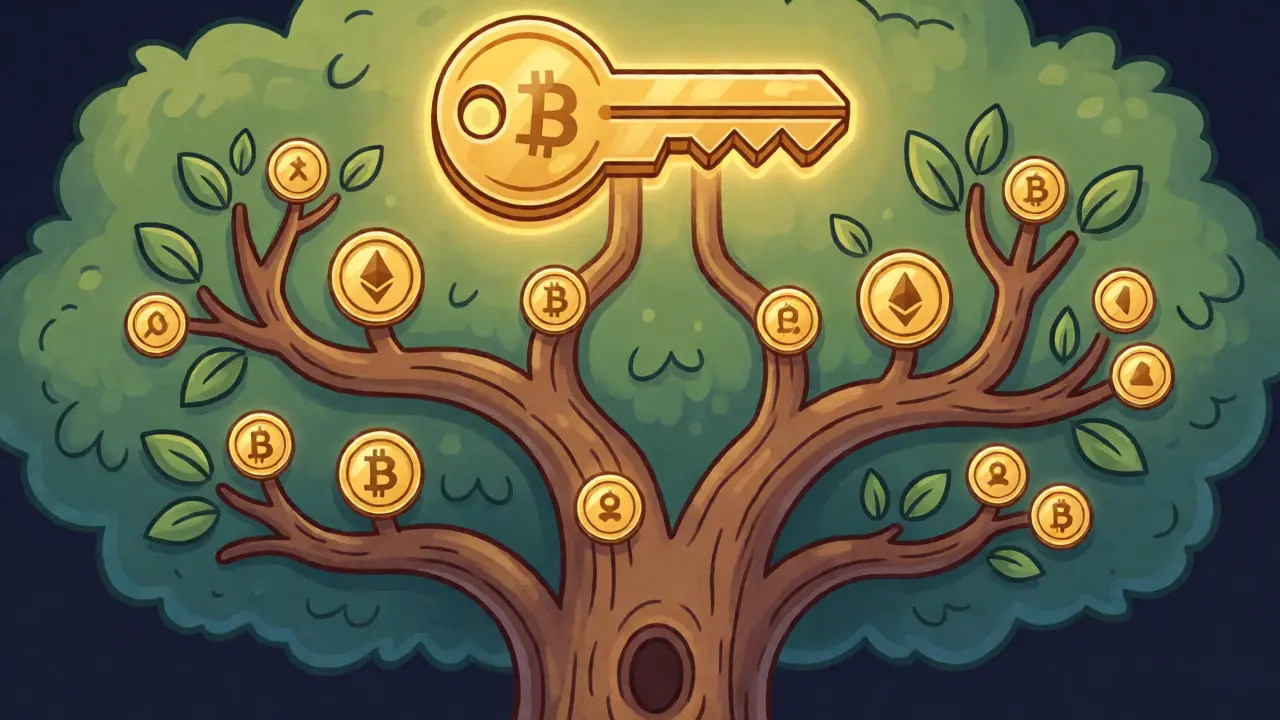
Once the wallet has this 512-bit Seed, it passes it to the BIP-32 algorithm. This is where Hierarchical Deterministic (HD) wallets come in. BIP-32 treats the Seed as a master key. From this master key, it derives a tree of child keys. Think of it like a family tree. The Master Key is the grandparent. It spawns Child Key 0, Child Key 1, etc. Each child key can spawn its own children. This allows you to have thousands of addresses-all recoverable from that one seed phrase-without needing to back up each address individually.
Why Order and Standardization Matter
A common misconception is that the order of words doesn't matter, or that any dictionary words work. Both are false. The order defines the specific 11-bit segments. Swapping word 1 and word 2 changes the entire binary structure, resulting in a completely different wallet. Also, you must use the official BIP-39 wordlist. There are 2,048 specific English words. If you substitute "cat" for "cattle" because they sound similar, the wallet might reject it or, worse, interpret it as a valid but different word if "cat" happens to be in the list (it isn't, but "cactus" is). Always verify against the official list.
Furthermore, different cryptocurrencies use different derivation paths. This is defined by BIP-44. A derivation path looks like this: m/44'/60'/0'/0/0. Here's what that means:
m: Master key.44': Purpose (BIP-44).60': Coin Type (60 is Ethereum, 0 is Bitcoin).0': Account index.0: External/Internal chain.0: Address index.
If you import your Bitcoin seed phrase into an Ethereum wallet, it won't show your Bitcoin balances. It will derive Ethereum addresses instead. The seed phrase contains the potential for all these keys, but the derivation path tells the wallet which branch of the tree to climb. This is why you need to know which path your previous wallet used if you're switching providers.
Security Risks and Human Error
The cryptography is solid. 128 bits of security is unbreakable with current technology. The weak link is us. Security researcher Dan Guido notes that over 90% of seed phrase compromises happen due to physical exposure, not math failures. People photograph their seed phrases and upload them to cloud storage. Hackers scrape cloud backups. Or people write them on paper and leave them next to their computer, visible through the window.
Another major risk is the "passphrase" feature. Many wallets allow you to add a 25th word (a passphrase) to your 12 or 24 words. This creates a hidden wallet. If you lose the passphrase, you lose access to those funds, even if you have the seed phrase correct. Conversely, if someone steals your seed phrase but doesn't know the passphrase, your funds are safe. This adds complexity. Do not use a passphrase unless you fully understand the implications and have a backup plan for it.
| Feature | Private Key | Seed Phrase |
|---|---|---|
| Format | 64-character Hex String | 12 or 24 English Words |
| Human Readability | Low | High |
| Error Correction | None | Built-in Checksum |
| Scope | Controls 1 Address | Generates Infinite Addresses |
| Backup Method | Digital Copy/Paste | Physical Writing/Metal Plate |
Best Practices for Storing Your Seed
Since the seed phrase generates all your keys, losing it means losing everything. Gaining it means gaining everything. Treat it like cash. In fact, treat it better than cash, because cash can be insured; crypto often cannot.
First, never digitize your primary backup. No screenshots, no text files, no emails. If your computer is compromised by malware, it can scan your file system for 12-word patterns. Second, use acid-free paper or metal plates. Paper burns at around 451°F (233°C). Metal plates, like those from CryptoSteel or Billfodl, withstand temperatures over 1,500°C. Third, separate your copies. If you keep two copies in the same house, a fire destroys both. Keep one copy in a safe deposit box and another in a home safe, ideally in different geographic locations.
Finally, test your recovery. After setting up a new wallet, wipe the app, reinstall it, and try to restore using only your written seed phrase. If you can't do it smoothly under stress, you haven't truly backed it up. Practice makes perfect, especially when panic sets in after a lost phone or stolen laptop.
Can I change my seed phrase?
You cannot change the seed phrase itself without creating a new wallet. However, you can move your funds to a new wallet with a new seed phrase. This is recommended if you suspect your old seed phrase was exposed. Simply send all your assets to the new address generated by the new seed phrase.
What happens if I mix up the order of my words?
The order is critical. Changing the order changes the binary data, resulting in a completely different private key and thus a different wallet address. Most modern wallets will detect the checksum error and warn you that the phrase is invalid, but if you accidentally swap two words that result in a valid checksum, you might access an empty wallet and think your funds are lost.
Is a 12-word phrase safer than a 24-word phrase?
For most users, 12 words provide sufficient security (128 bits). A 24-word phrase offers 256 bits of security, which is theoretically stronger against future quantum computing threats. However, 24 words are harder to write down correctly and easier to lose. Unless you are holding an enormous amount of wealth and worried about long-term quantum risks, 12 words are generally considered secure enough.
Can I use any words for my seed phrase?
No. You must use words from the official BIP-39 wordlist. While there are localized versions for other languages, the standard English list has exactly 2,048 specific words. Using a word not on the list will cause the wallet to reject the phrase or fail to derive the correct keys.
Does adding a passphrase make my wallet more secure?
Yes, but it adds risk. A passphrase acts as a 25th word. Even if someone steals your 12-word seed phrase, they cannot access your funds without the passphrase. However, if you forget the passphrase, your funds are permanently lost, even with the correct seed phrase. Only use passphrases if you are confident in your ability to remember or securely store them.