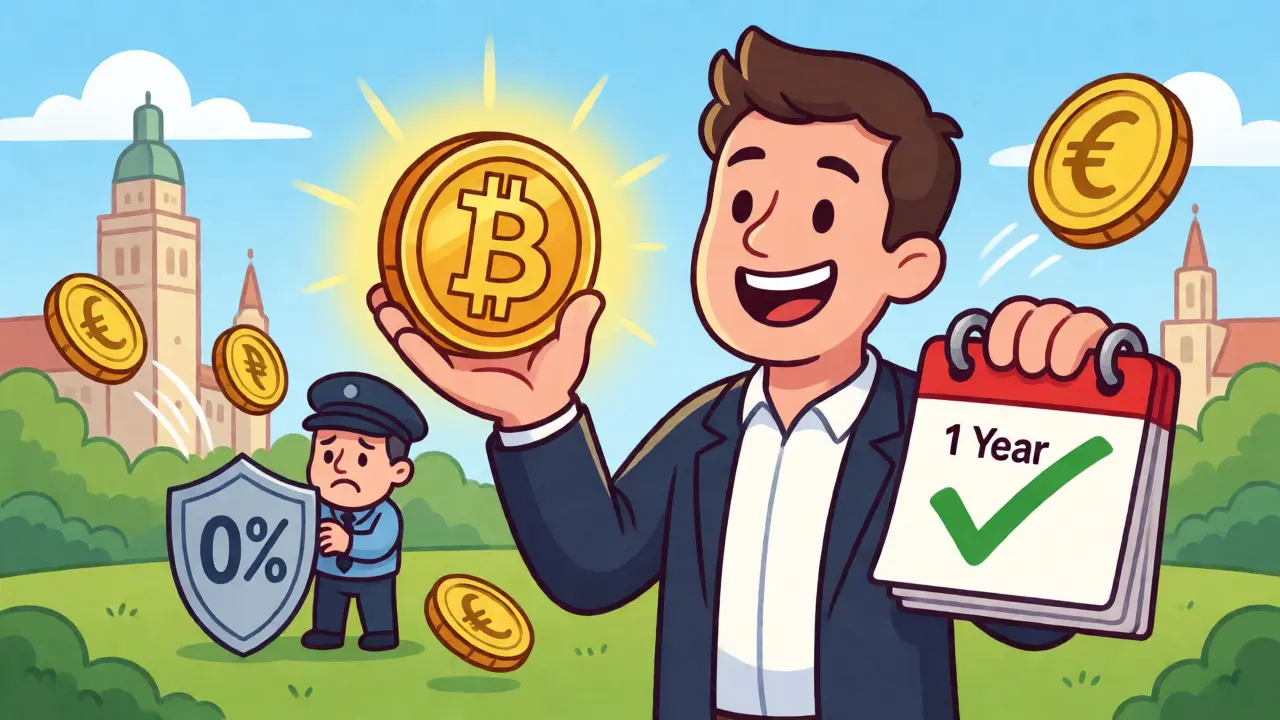
Imagine buying Bitcoin when it was worth a few hundred euros and selling it years later for tens of thousands. In most countries, you’d owe the government a significant chunk of that profit. But if you’re a tax resident in Germany, you might pay absolutely nothing. That’s not a loophole or a mistake-it’s the law.
Germany's crypto tax policy is widely considered one of the most investor-friendly frameworks in Europe. It hinges on a simple concept: hold your digital assets for more than one year, and any profit you make becomes completely tax-free. This isn't just theoretical; it’s codified in Section 23 of the German Income Tax Act (EStG), which treats cryptocurrencies as private assets rather than securities. For millions of Germans who have jumped into the crypto space, this rule changes everything about how they manage their portfolios.
The One-Year Holding Period Rule
The core mechanism here is surprisingly straightforward. If you sell, swap, or spend cryptocurrency after holding it for exactly twelve months or longer, the gain is exempt from income tax. It doesn’t matter if you made €100 or €1 million-the tax rate drops to zero.
This classification comes from the German Federal Ministry of Finance (BMF), which views crypto as "private Veräußerungsgeschäfte" (private disposal transactions). Because these are treated like personal collectibles or precious metals, they fall under a different set of rules than stocks or bonds. The clock starts ticking the moment you acquire the asset. Whether you bought it on an exchange like Coinbase or received it via mining, that timestamp is critical.
But what happens if you sell early? If you dispose of your crypto before the one-year mark, you enter the realm of short-term speculation. Here, profits are taxed at your personal income tax rate, which can range from 14% to 45%. Add the solidarity surcharge (Solidaritätszuschlag) of 5.5%, and the top marginal rate hits roughly 47.375%. However, there is a safety net: an annual tax-free allowance (Freibetrag) of €1,000. This means you can realize up to €1,000 in short-term gains each year without paying a cent in taxes.
How Germany Compares to Other European Jurisdictions
To understand why this matters, look at the neighbors. France charges a flat 30% tax on all crypto gains, regardless of how long you held them. The United Kingdom applies Capital Gains Tax rates of 10% or 20%, with a meager £3,000 allowance for 2025. Portugal offers tax-free status but has tightened regulations significantly, making compliance harder for newcomers.
| Country | Tax Treatment for >1 Year Hold | Tax Rate for <1 Year Hold | Annual Allowance |
|---|---|---|---|
| Germany | 0% (Tax-Free) | Personal Income Tax (14-45%) + Solidarity Surcharge | €1,000 |
| France | 30% Flat Tax | 30% Flat Tax | None specific to crypto |
| United Kingdom | Capital Gains Tax (10-20%) | Capital Gains Tax (10-20%) | £3,000 |
| Switzerland | Wealth Tax applies | No Capital Gains Tax for individuals | N/A (Wealth Tax based) |
Germany stands out because it combines low taxes with high regulatory clarity. While Switzerland also avoids capital gains tax for individual traders, it imposes a wealth tax on holdings, which can erode value over time. Germany’s approach rewards patience directly through the elimination of tax liability upon sale.

Practical Implications for Investors
If you live in Germany, this policy encourages a "HODL" strategy. Many investors deliberately delay selling until the 366th day to maximize their returns. This psychological shift is powerful. Instead of chasing quick flips, users focus on long-term accumulation.
However, simplicity ends where complexity begins. What counts as a "disposal"? Selling Bitcoin for Euros is obvious. But swapping Bitcoin for Ethereum? That’s also a taxable event in Germany. Each trade resets the holding period for the new asset. If you swap BTC for ETH, you must track the acquisition date of the ETH separately. If you then swap ETH back to BTC, you need to know exactly when you got that second batch of BTC.
Staking rewards and DeFi activities add another layer. Staking rewards are generally treated as other income (Sonstige Einkünfte) and are taxed at your regular income rate when received. They do not benefit from the one-year rule immediately because they are income first, then capital. Once those rewards become part of your wallet balance, they start their own one-year countdown.
Record-Keeping and Compliance
You cannot claim tax-free status if you can’t prove when you bought the asset. The German tax authorities (Finanzamt) require meticulous records. You need to document:
- Date and time of purchase (down to the minute).
- Currency pair and amount purchased.
- Exchange fees paid.
- Date and time of sale or swap.
- Transaction hashes for blockchain verification.
For casual users, this might sound tedious. But tools like Koinly, CoinTracker, and Blockpit have built specific features for German tax laws. These platforms automatically calculate FIFO (First-In-First-Out) or specific lot identification methods to determine which coins were sold. Setting up your portfolio usually takes a few hours. If you have complex DeFi transactions, hiring a specialized crypto accountant costs between €150 and €500 annually, which is often worth avoiding audit penalties.
Penalties for unreported gains can be severe. If the Finanzamt discovers unreported short-term gains, they can impose fines up to 40% of the unpaid tax plus interest. So, while the reward for holding long-term is high, the risk of ignoring short-term trading obligations is real.

Future Outlook and Regulatory Changes
Will this favorable treatment last forever? Currently, there are no announced changes to Section 23 EStG through 2026. The European Union’s Markets in Crypto-Assets (MiCA) regulation is rolling out, focusing mainly on consumer protection and issuer transparency rather than changing national tax codes. Most analysts believe Germany will maintain its competitive edge by keeping taxes low to attract blockchain companies and investors.
That said, political pressure exists. Some EU members argue for harmonized taxation to prevent "tax tourism." If Germany were to change this rule, it would likely give taxpayers a transition period. Until then, the one-year rule remains a cornerstone of German financial planning for crypto holders.
Frequently Asked Questions
Does the one-year tax exemption apply to all cryptocurrencies?
Yes, the exemption applies to all digital currencies recognized as private assets, including Bitcoin, Ethereum, altcoins, stablecoins, and even NFTs, provided they are held for more than one year before disposal.
What happens if I swap Bitcoin for Ethereum?
A swap is considered a disposal of the original asset. If you held the Bitcoin for less than a year, you owe tax on the gain relative to its purchase price. The new Ethereum tokens start a fresh one-year holding period from the moment of the swap.
Are staking rewards tax-free after one year?
No. Staking rewards are taxed as income at your personal rate when they are credited to your account. Once they are in your wallet, they begin their own one-year holding period. After one year, selling those specific reward tokens is tax-free.
Do I need to report crypto if I made no profit?
Generally, if your total gains from all private sales are below the €1,000 annual allowance, you don't need to file a separate schedule for them. However, keeping records is still essential in case the tax office requests proof of the source of funds.
Can non-residents benefit from this rule?
This rule applies to German tax residents. If you move to Germany, your existing crypto holdings' acquisition dates remain unchanged. However, you must establish residency to benefit from future disposals being tax-exempt under German law.