
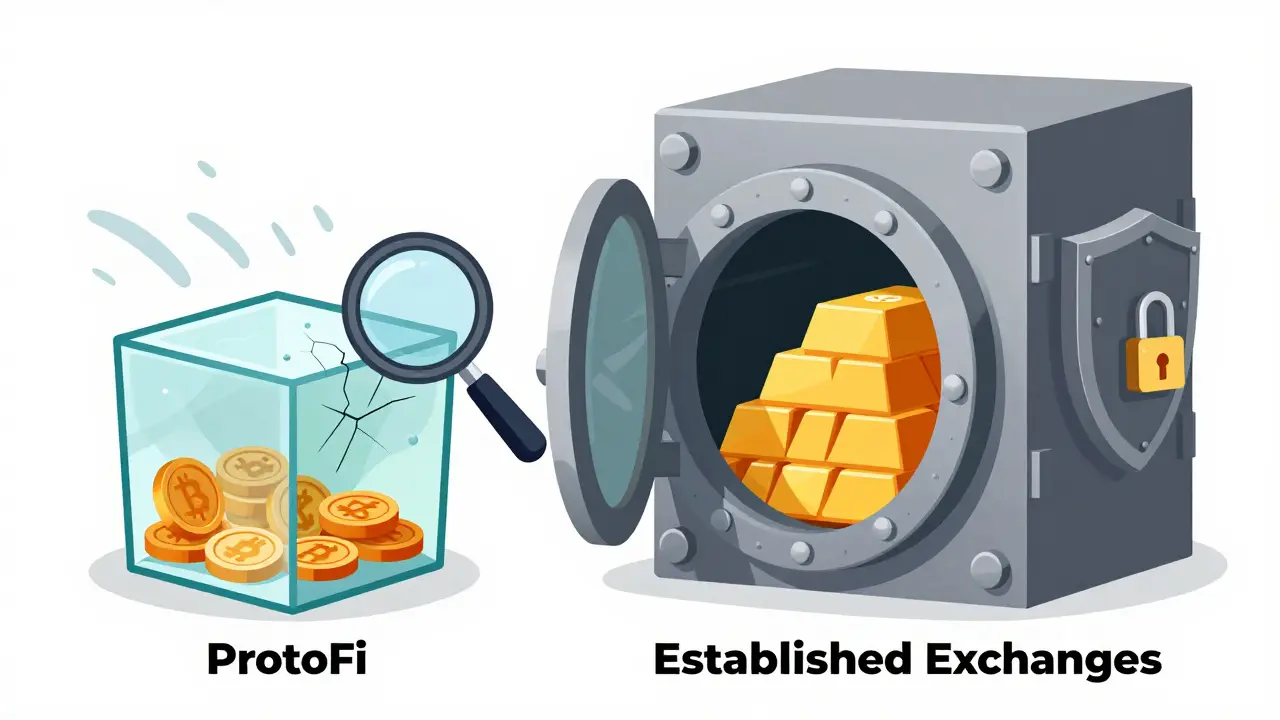
Have you ever stumbled upon a new cryptocurrency platform that promises easy trading but feels strangely quiet? That’s exactly the situation with ProtoFi. If you are looking for a clear answer on whether this platform is safe, profitable, or even legitimate, you have landed in the right place. The short answer? Proceed with extreme caution. While ProtoFi exists and has a native token, it lacks the transparency, regulatory clarity, and user trust that established exchanges provide.
In the world of digital assets, your capital is only as safe as the platform holding it. With major players like Coinbase and Kraken setting high standards for security and compliance, smaller platforms face a steep hill to climb. This review breaks down what we know about ProtoFi, its risks, and why you might want to look elsewhere for your trading needs.
What Is ProtoFi?
ProtoFi is a cryptocurrency platform operating in both token trading and decentralized finance (DeFi) sectors. It is primarily known for its native asset, the Protofi Token (PROTO), which serves as the core utility within its ecosystem.
Unlike traditional centralized exchanges where you buy Bitcoin or Ethereum directly from the platform, ProtoFi seems to blur the lines between an exchange and a DeFi project. This hybrid model can be confusing for beginners. Essentially, you are likely interacting with a platform that facilitates trades involving its own token while potentially offering access to other digital assets through decentralized protocols.
The lack of comprehensive documentation regarding its specific exchange operations is a significant red flag. Most reputable platforms publish detailed whitepapers, fee schedules, and lists of supported cryptocurrencies. ProtoFi’s absence from these standard informational channels suggests it may cater to a niche audience or operate with limited oversight.
Is ProtoFi Legit? Analyzing the Evidence
Determining legitimacy in crypto often comes down to three pillars: regulatory recognition, security track record, and community feedback. Let’s look at how ProtoFi stacks up against each.
- Regulatory Recognition: There is no public evidence that ProtoFi holds licenses in major jurisdictions like the United States, the European Union, or the United Kingdom. Established exchanges undergo rigorous audits and register with financial authorities to protect users. ProtoFi’s absence from these registries means you have little legal recourse if something goes wrong.
- Tax Compliance Signals: Interestingly, services like Crypto Tax Calculator offer specific tax guides for ProtoFi transactions. This indicates that the platform generates taxable events, proving it is not just a static website. However, being taxable does not equal being safe. It simply means the IRS or local tax authorities recognize the activity, not the platform’s integrity.
- Scam Databases: ProtoFi does not currently appear in prominent crypto scam tracking databases. While this sounds positive, it is more likely due to its limited user base or low profile rather than a proven history of safety. A clean record in obscurity is different from a clean record under scrutiny.
For context, compare this to Coinbase or Kraken. These platforms are frequently audited, publicly traded or backed by venture capital, and have millions of verified users. ProtoFi operates in the shadows compared to these giants.
Security Risks You Need to Know
When you deposit funds into an exchange, you are trusting them with your private keys. If they get hacked, your money is gone. Security is not a feature; it is a requirement.
Major exchanges employ multi-signature cold storage, two-factor authentication (2FA), and insurance funds to protect user assets. Information regarding ProtoFi’s security infrastructure is virtually non-existent. Without knowing if they use cold wallets or have bug bounty programs, you are gambling with your principal investment.
| Feature | ProtoFi | Coinbase / Kraken |
|---|---|---|
| Public Security Audits | None found | Regular third-party audits |
| Cold Storage Policy | Unknown | 98%+ assets in cold storage |
| Regulatory Licenses | None identified | Licensed in US/EU/UK |
| User Insurance | Not disclosed | FDIC insured cash / Asset insurance |
If a platform cannot clearly explain how it keeps your money safe, assume it doesn’t. In the crypto space, ambiguity is dangerous.
PROTO Token Price Predictions: Hype vs. Reality
A significant portion of interest in ProtoFi revolves around its native token, PROTO. Analysts love to speculate on prices, but these predictions should be taken with a grain of salt, especially when the underlying platform is obscure.
Current forecasts vary wildly:
- WalletInvestor: Projects a range of $0.059-$0.074 in the near term, but warns of a potential drop to $0.005 in the long run.
- TradingBeast: Offers optimistic views, suggesting prices could reach $0.076.
- PricePrediction.net: Shows extreme volatility, ranging from $0.0015 to $0.039, with some models predicting $0.09 by 2030.
This divergence-from a potential -20% loss to a 41% gain-highlights the market’s uncertainty. Why such wide margins? Because there is no solid fundamental data to anchor the price. Unlike Bitcoin, which has network effect value, or Ethereum, which powers smart contracts, PROTO’s value is tied entirely to the success and adoption of the ProtoFi platform itself. If the platform fails or loses users, the token becomes worthless.
Remember: Price prediction algorithms are mathematical guesses, not financial advice. They do not account for sudden regulatory bans, hacks, or developer abandonment.
Fees and Trading Experience
One of the biggest frustrations for traders is hidden fees. Major exchanges are transparent about their costs:
- Coinbase: Charges 0% to 3.99% depending on payment method.
- Kraken: Offers maker/taker fees starting at 0.16% for large volumes.
- Crypto.com: Ranges from 0% to 2.99%.
ProtoFi does not publish a clear fee schedule. In DeFi environments, you typically pay "gas fees" to the blockchain network plus any protocol-specific fees. Without clear information, you risk paying exorbitant amounts for simple swaps. Always check the estimated gas cost before confirming any transaction on unknown platforms.
User experience is another concern. Reviews and ratings for ProtoFi are scarce on major comparison sites. This silence is deafening. When a platform has thousands of daily users, you will find complaints about withdrawal delays, poor customer support, or buggy interfaces online. The absence of noise can mean either a very small user base or a platform that has not yet gained traction.

Better Alternatives for Secure Trading
If your goal is to trade cryptocurrencies safely and efficiently, sticking to regulated, well-established platforms is the smartest move. Here is why you should consider alternatives:
- Regulatory Protection: Platforms like Coinbase and Gemini comply with strict financial regulations. If they go bankrupt, your assets are often segregated and protected.
- Liquidity: High-volume exchanges ensure you can buy or sell large amounts without significantly impacting the price.
- Customer Support: Established exchanges have dedicated teams to help resolve issues. ProtoFi offers no visible support infrastructure.
- Educational Resources: Top exchanges provide tools, tutorials, and research to help you make informed decisions.
For DeFi enthusiasts who want exposure to innovative projects without the risk of a centralized exchange failing, consider using reputable decentralized exchanges like Uniswap or PancakeSwap. These platforms allow you to trade tokens directly from your wallet, maintaining control over your private keys at all times.
Final Verdict: Should You Use ProtoFi?
Based on the available evidence, I cannot recommend ProtoFi for general trading purposes. The lack of transparency regarding security measures, fee structures, and regulatory status poses unacceptable risks for most investors. While the PROTO token has speculative interest, the wide variance in price predictions reflects deep market uncertainty.
Cryptocurrency investing is already volatile enough without adding operational risk from obscure platforms. Protect your capital by choosing exchanges with proven track records, clear fee policies, and strong regulatory compliance. If you decide to experiment with PROTO, treat it as high-risk speculation, not a secure investment. Never invest more than you can afford to lose, and always keep the majority of your assets in a self-custody hardware wallet.
Is ProtoFi a safe crypto exchange?
There is insufficient evidence to classify ProtoFi as safe. It lacks public security audits, regulatory licenses, and clear information about fund storage methods. Compared to established exchanges like Coinbase or Kraken, it presents higher operational risks.
What is the future price of PROTO token?
Price predictions for PROTO vary significantly, ranging from $0.005 to $0.09 by 2030. This wide disparity indicates high market uncertainty. Analysts disagree on its long-term viability, so investors should exercise extreme caution.
Does ProtoFi charge hidden fees?
ProtoFi does not publish a transparent fee schedule. Users may incur standard blockchain gas fees plus unknown protocol fees. Without clear disclosure, the total cost of trading remains uncertain.
Is ProtoFi regulated in the US or EU?
No public records indicate that ProtoFi holds regulatory licenses in the United States, European Union, or other major jurisdictions. This lack of compliance means users have limited legal protection.
Can I withdraw my money easily from ProtoFi?
Withdrawal processes and timelines are not clearly documented. On many lesser-known platforms, users report delays or restrictions. Always test with small amounts first if you choose to use such services.
How does ProtoFi compare to Coinbase?
Coinbase is a publicly traded, heavily regulated company with robust security and customer support. ProtoFi is an obscure platform with minimal transparency. Coinbase is suitable for mainstream investing; ProtoFi is high-risk and speculative.