
Imagine a country where hospitals go dark because a server farm next door is hogging all the electricity. This isn't a dystopian novel; it was the daily reality in Angola until recently. In April 2024, the Angolan government pulled the plug on cryptocurrency mining nationwide. The reason wasn't ideological hatred for Bitcoin or blockchain technology. It was survival. With millions of citizens facing daily blackouts, the government decided that powering speculative digital assets came at too high a cost to public health and safety.
The crackdown didn't happen overnight. It built up over months of grid strain, culminating in one of the largest anti-crypto operations in African history. By August 2025, authorities had dismantled dozens of illegal mines, seized tens of millions of dollars in equipment, and arrested operators who were literally stealing power from the national grid. But what exactly happened, why did it escalate so quickly, and what does this mean for the future of energy policy in Africa?
The Core Problem: A Grid Under Siege
To understand the ban, you have to look at the numbers. Angola has a population of roughly 39 million people. Its national grid capacity sits at approximately 5,500 megawatts. That sounds like a lot, but when you divide it by nearly 40 million people, the picture gets grim. Per capita electricity consumption in Angola is just 420 kWh annually-less than 10% of the global average. For context, that’s barely enough to run a refrigerator and a few lights reliably, let alone power modern industries or data centers.
Enter cryptocurrency mining. Specifically, proof-of-work (PoW) mining, which powers Bitcoin and similar coins. These operations are energy vampires. Before the ban, mining farms in Angola were consuming between 50 and 200 megawatts collectively. That’s equivalent to the power needs of 300,000 households. During peak demand periods, these mines accounted for about 15% of available electricity. When the grid is already fragile, losing 15% of your supply to machines that generate no local economic benefit other than foreign currency speculation becomes a political liability.
The infrastructure couldn't handle it. Angola relies heavily on hydropower, with 55% of its electricity coming from dams like the Cambambe Dam. Seasonal droughts regularly slash output by 30%. During the 2023-2024 dry season, reservoir levels dropped to 38% capacity. At the same time, mining operations were running 24/7, often bypassing meters and safety controls. Dr. Elena Mwamba, a Senior Energy Analyst at the African Development Bank, noted that the grid loses 28% of generated electricity through transmission inefficiencies. Adding massive, unregulated loads on top of such an inefficient system created a perfect storm. Urban households experienced daily blackouts while mining facilities hummed along, sometimes using illicit connections that endangered entire neighborhoods with fire hazards.
Operation Serengeti 2.0: The Crackdown
The tipping point came in mid-2025. Interpol launched Operation Serengeti 2.0, a coordinated cybercrime initiative spanning June to August 2025 across 18 African nations and the United Kingdom. Angola became a primary target. The operation wasn't just about arresting criminals; it was about reclaiming national resources.
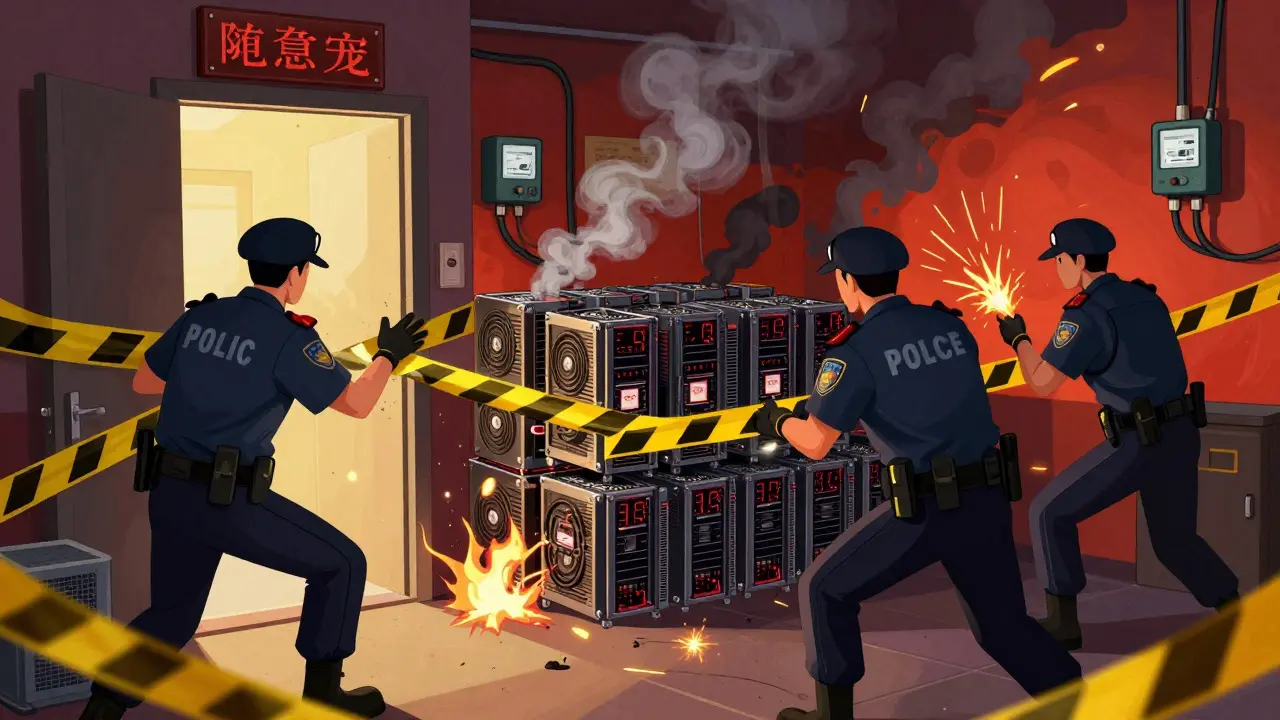
In August 2025, Angolan authorities executed raids on 25 illegal cryptocurrency mining centers. They arrested 60 individuals, all Chinese nationals who had set up shop in the country attracted by cheap power. The seizures were staggering: $37.2 million worth of mining equipment, including 8,300 ASIC miners and 15,000 graphics cards. Perhaps most alarming was the discovery of 45 illicit power stations. These weren't just unauthorized connections; they were sophisticated setups designed to divert electricity directly from the national grid, bypassing meters and safety regulators.
Cybersecurity expert Dmitri Alperovitch highlighted the danger: "The 45 illicit power stations seized in Angola were bypassing grid meters and safety controls, creating fire hazards that endangered entire neighborhoods in Luanda and Benguela provinces." Residents in areas like Sambizanga reported transformer explosions that left hospitals without power for hours. Small business owners in Luanda's Benfica neighborhood saw their electricity tariffs jump by 22% in 2023 due to the strain on the grid caused by these hidden mines. The public sentiment shifted dramatically. A Reddit post from April 2024 noting that clinics were running on generators while mining farms used industrial transformers garnered over 1,200 upvotes, reflecting widespread support for the government's hardline stance.
The Legal Framework and Penalties
Angola didn't just raid; it legislated. Effective April 2024, the country implemented a nationwide ban on cryptocurrency mining. The law is severe. Operating mining equipment or possessing infrastructure used for mining is now a criminal offense. Penalties range from one to five years in prison, plus mandatory confiscation of all related equipment.
The definition of "illegal mining" is technical but clear. Any operation using more than 10 kilowatts of continuous power without authorization from the National Electricity Agency (INE) is considered illegal. Enforcement prioritizes industrial-scale operations exceeding 100 kilowatts. The Ministry of Energy and Water conducted a technical assessment in March 2024, determining that Bitcoin mining consumed 1,440 kilowatt-hours per coin mined at average Angolan rates. That’s 40 times the energy consumption of traditional banking transactions. Given that only 47% of Angolans had reliable grid access as of 2025, the government argued that diverting such vast amounts of energy for speculative assets was unsustainable.
Enforcement mechanisms include monthly grid anomaly scans by the INE using smart meter data to detect facilities with abnormal 24/7 consumption patterns. Police units received specialized training from Interpol’s Digital Crime Directorate, learning to identify mining equipment through thermal imaging (detecting heat signatures above 45°C) and power analysis. A whistleblower program offers 5% of seized equipment value (capped at $50,000) for verified tips, which fueled 73% of the raids in August 2025. Confiscated equipment is inventoried within 24 hours using blockchain-based asset tracking, with high-value items auctioned off within 90 days. Notably, the government announced plans to redistribute 100% of seized computing equipment to public institutions, with 65% going to university computer science departments and 35% to municipal e-government initiatives.

Regional Context and Market Shifts
Angola’s move didn't happen in a vacuum. It reflects a broader trend in Southern Africa. While countries like Nigeria and Kenya focus on regulating exchanges, seven out of 15 Southern African Development Community (SADC) nations have implemented some form of mining restriction since 2022. Angola’s ban is the most severe, but South Africa takes a different approach: permitting mining but taxing it at 15% of energy consumption to fund grid upgrades. This model has generated $120 million annually since 2023.
The impact on the market was immediate. Angola’s hash rate contribution plummeted from 0.8% to 0.02% of the global total-a loss of 1.2 exahashes per second. Neighboring Namibia saw a surge in interest, with Windhoek reporting a 200% increase in mining facility registrations from displaced Angolan operators between April 2024 and August 2025. However, Namibia’s higher electricity costs ($0.12/kWh vs. Angola’s previous $0.03/kWh) slashed profit margins by 60%, making it a less attractive haven than initially hoped.
Industry analysts remain divided on whether Angola missed an opportunity. John Wu of Avanade Capital pointed to Kazakhstan’s success, where 10% of mining operations use flared gas, reducing national carbon emissions by 1.2 million tons annually. He argued that regulation could have turned a problem into a green energy solution. However, Angolan Energy Minister João Baptista Borges countered firmly: "With 15 million citizens lacking reliable grid access, we cannot permit energy diversion for speculative digital assets." This position resonated with 78% of respondents in a nationally representative Sonangol Energy Survey conducted in July 2025.
What Comes Next? The Path to 2028 and Beyond
So, is crypto mining dead in Angola forever? Probably not, but it’s on life support until the grid improves. The government is investing heavily in infrastructure. The $4.5 billion Cambambe III hydropower expansion is scheduled to come online in 2028, adding 1,150 megawatts to national capacity. BloombergNEF projects that without such structural improvements, Angola will remain unattractive for compliant mining operations until at least then.
There are glimmers of potential change. In September 2025, President João Lourenço met with representatives from Solax Power to discuss solar-powered mining pilot projects. However, Energy Minister Borges clarified that any future authorization would require 100% off-grid renewable energy with no connection to the national grid whatsoever. This ensures that mining doesn’t compete with household power. Standard Bank’s Head of Digital Assets, Naledi Molefe, predicts that Angola won’t consider regulated mining until grid reliability exceeds 90%-a threshold unlikely before 2027 given current investment rates.
Meanwhile, enforcement is getting smarter. The Ministry of Energy deployed 200 smart grid sensors across industrial zones in July 2025 capable of detecting hash rate signatures through electromagnetic emissions. This reduces the time to identify illegal operations from weeks to just 72 hours. A permanent Angola Cybercrime Task Force, funded by $2.3 million from the EU, focuses specifically on energy theft related to crypto operations. The World Bank has also committed $15 million to help develop energy allocation frameworks that could eventually accommodate high-priority industrial users, including potential crypto mining zones near new renewable projects.
For now, the message from Luanda is clear: human needs come first. Until every citizen has stable light, the servers stay off.
When did Angola ban cryptocurrency mining?
Angola implemented a nationwide ban on cryptocurrency mining effective April 2024. The ban criminalizes the operation of mining equipment and possession of related infrastructure, carrying penalties of one to five years imprisonment.
Why did Angola decide to restrict crypto mining?
The primary driver was severe electricity shortages. Mining operations were consuming up to 15% of available electricity during peak demand, exacerbating blackouts for the general population. The government sought to redirect power to essential public services like hospitals and schools.
What happened during Operation Serengeti 2.0 in Angola?
In August 2025, as part of Interpol's Operation Serengeti 2.0, Angolan authorities dismantled 25 illegal mining centers, arrested 60 Chinese nationals, seized $37.2 million in equipment, and confiscated 45 illicit power stations that were diverting electricity from the national grid.
Are there any exceptions for renewable energy mining in Angola?
As of late 2025, there are no exemptions for grid-connected mining, even if powered by renewables. However, officials have discussed potential pilot projects for 100% off-grid solar-powered mining that does not draw from the national grid, pending further regulatory development.
How much electricity does Bitcoin mining consume compared to banking?
According to a March 2024 assessment by Angola's Ministry of Energy and Water, Bitcoin mining consumed 1,440 kilowatt-hours per coin mined, representing 40 times the energy consumption of traditional banking transactions.
Will Angola allow crypto mining again in the future?
Analysts predict Angola may reconsider regulated mining around 2028, coinciding with the completion of the Cambambe III hydropower expansion. However, this depends on achieving over 90% grid reliability, a target currently unlikely before 2027.