You’ve probably seen the flood of new cryptocurrencies promising to save the planet. EarthByt (EBYT) is a BEP20 token on the Binance Smart Chain that claims to fund global soil restoration and carbon sequestration through its transaction fees. It positions itself as more than just a speculative asset; it markets itself as an "environmental cryptocurrency" designed to turn every trade into a contribution for ecological projects. But does this micro-cap altcoin actually deliver on its green promises, or is it just another project riding the wave of eco-conscious marketing?
If you are considering buying EBYT, you need to look past the glossy website. You need to understand how the money moves, who controls the funds, and what the market data says about its future. This guide breaks down the mechanics of EarthByt, its controversial price trajectory, and whether it holds any real value in the crowded environmental crypto sector.
How EarthByt Works: The Eco-Tokenomics Model
The core idea behind EarthByt is simple: use blockchain technology to automate charitable giving for environmental causes. Unlike traditional donations where bureaucracy eats up a large portion of the funds, EarthByt uses smart contracts to ensure transparency. Every time you buy, sell, or transfer EBYT tokens, a fee is automatically deducted. This mechanism is what the team calls "eco-tokenomics."
Here is how the transaction structure works:
- 10% Transaction Tax: A flat 10% fee is applied to all trades. This is significantly higher than standard utility tokens, which often charge 0% to 3%. This high tax is the engine of the project’s mission.
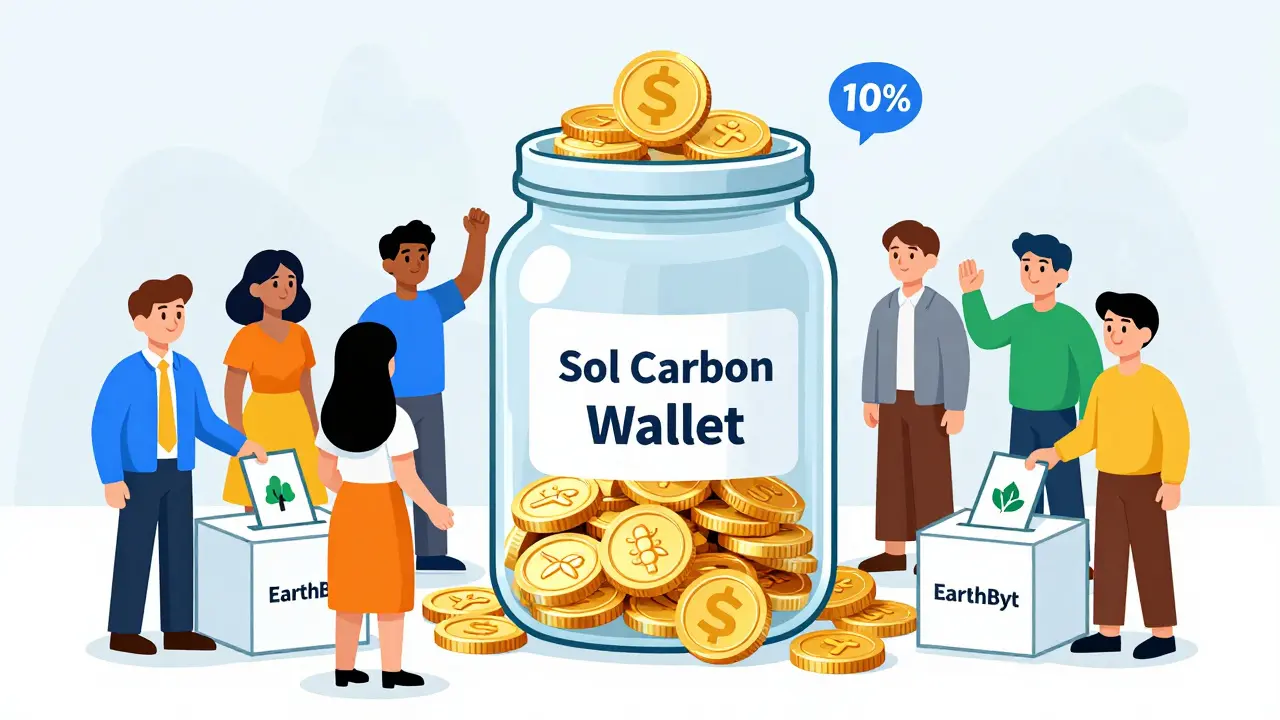
- Funding Soil Restoration: The collected fees are directed into a "Soil Carbon wallet." These funds are used to support agroforestry, regenerative agriculture, and renewable energy projects globally.
- Token Burning: A portion of the supply is burned (permanently removed from circulation) to create deflationary pressure. This aims to increase the scarcity of remaining tokens over time.
- Holder Reflections: Some of the transaction fees are redistributed to existing holders, incentivizing people to keep their tokens rather than selling them.
The total supply of EarthByt is massive-98.19 trillion tokens. As of late 2025, approximately 84.01 trillion tokens were in circulation. While the burning mechanism reduces this number slowly, the sheer volume of tokens means that individual prices remain incredibly low, often trading in fractions of a penny. This high-supply, low-price model is common in meme coins and community-driven projects, but it creates significant hurdles for substantial price appreciation.
Governance and Community Control
One of EarthByt’s strongest selling points is its approach to governance. In many crypto projects, a small group of developers decides where the treasury goes. EarthByt attempts to democratize this process. Token holders can vote on which environmental organizations, charities, and specific restoration projects receive funding from the Soil Carbon wallet.
This system allows the community to suggest new partners and influence the direction of the project. For example, if the community wants to focus more on ocean cleanup instead of soil health, they can vote to shift resources accordingly. This transparency is crucial because it addresses a major criticism of "greenwashing" in the crypto industry. By putting donation records on the public blockchain ledger, anyone can verify that funds are actually moving to the intended recipients.
However, participation requires active engagement. With only about 2,000 holders as of October 2025, the voting power is concentrated among a relatively small group. If most holders do not participate in governance votes, the decisions may not reflect the broader community’s interests. Additionally, the specific technical requirements for voting-such as minimum token holdings or staking periods-are not always clearly detailed in public documentation, which can be a barrier for new users.
Market Performance and Price Reality
Let’s talk numbers. EarthByt is a micro-cap altcoin. Its market capitalization hovers around $197,000, with a fully diluted valuation of roughly $234,000. To put that in perspective, major environmental tokens like Toucan Protocol or KlimaDAO have market caps in the hundreds of millions or billions. EBYT is operating at the very bottom tier of the cryptocurrency market.
| Metric | Value | Context |
|---|---|---|
| Current Price | ~$0.00000000265 | Extremely low unit price due to high supply |
| Market Cap | $197,280 | Micro-cap status; high risk |
| 24h Volume | $40,000 - $63,000 | High volatility relative to size |
| Total Supply | 98.19 Trillion | Deflationary via burning |
| Ranking | #4623 (CoinMarketCap) | Low liquidity and adoption |
The trading volume for EBYT fluctuates between $40,000 and $63,000 daily. This might sound like a lot, but compared to its market cap, it represents a massive percentage of turnover. This indicates high speculation. Traders are likely jumping in and out quickly, chasing short-term gains rather than holding for long-term environmental impact. The Volume-to-Market Cap ratio of over 20% is a red flag for stability. It suggests that a few large trades can swing the price dramatically.
Technical analysis paints a bearish picture. Indicators like the MACD (Moving Average Convergence Divergence) show negative histogram readings on weekly charts. Multiple forecasting platforms, including LiteFinance and TradingBeasts, project a continued decline in value through 2026 and 2027. They predict the token could drop to lows of $0.0000000018. While these predictions are not guarantees, the consensus among analysts is that downward pressure is strong. The lack of institutional interest and limited exchange listings contribute to this trend.
Comparison with Other Environmental Cryptos
EarthByt does not exist in a vacuum. It competes with established players in the carbon credit and environmental blockchain space. Understanding how EBYT compares to these projects helps clarify its position in the market.
| Feature | EarthByt (EBYT) | Toucan Protocol | KlimaDAO |
|---|---|---|---|
| Primary Focus | Soil Restoration & General Eco-Funding | Carbon Credit Bridging | Carbon Backed Stablecoins |
| Blockchain | Binance Smart Chain (BSC) | Ethereum / Polygon | Polygon |
| Market Cap Size | Micro (<$1M) | Large ($100M+) | Medium-Large ($50M+) |
| Transaction Fee | 10% (Funds Charity) | Standard Gas Fees | Standard Gas Fees |
| Governance | Holder Voting on Charities | Protocol Upgrades | Treasury Management |
Toucan Protocol and KlimaDAO are built on Ethereum and Polygon, networks that offer greater security and deeper liquidity but come with higher gas fees. EarthByt uses Binance Smart Chain, which offers faster and cheaper transactions, making it accessible for smaller traders. However, BSC is also associated with higher risks of scams and lower-quality projects. The 10% fee on EBYT is unique; competitors rarely take such a large cut from users. This makes EBYT expensive to trade but aligns with its charity-first model. If you want pure financial efficiency, EBYT is not the choice. If you want to donate while trading, it offers a structured way to do so.
Risks and Red Flags to Consider
Before you connect your wallet, you must weigh the risks. EarthByt operates in a high-risk category for several reasons:
- Liquidity Risk: With a market cap under $200,000, there is not enough money in the pool to handle large sales. If you try to sell a significant amount of EBYT, you could crash the price yourself, losing most of your value. This is known as slippage.
- Concentration Risk: Only 2,000 holders control the entire circulating supply. If a few "whales" (large holders) decide to sell, the price will plummet. There is no guarantee that the top holders are committed to the long term.
- Regulatory Uncertainty: Governments are increasingly scrutinizing cryptocurrencies that make environmental claims. If regulators determine that EBYT’s marketing is misleading or that its environmental impact is unverified, the project could face legal challenges or delisting from exchanges.
- Smart Contract Risk: Like any DeFi project, EarthByt relies on code. If there are bugs or vulnerabilities in the smart contract handling the 10% tax and distributions, funds could be lost or stolen. Audits are essential, but details on independent security audits for EBYT are not prominently featured in public sources.
- Execution Risk: The project promises real-world impact. If the funded soil restoration projects fail to deliver measurable results, community trust will erode. Without proof of impact, the token loses its unique value proposition and becomes just another speculative coin.
How to Buy and Hold EarthByt Safely
If you decide to proceed despite the risks, here is how to interact with the EBYT ecosystem safely. Since EBYT is a BEP20 token, you need a wallet compatible with the Binance Smart Chain.
- Step 1: Get a Wallet. Use a reputable non-custodial wallet like Trust Wallet or MetaMask. Ensure it supports BSC networks.
- Step 2: Acquire BNB. You will need BNB (Binance Coin) to pay for gas fees when swapping tokens. Buy BNB on a major centralized exchange like Binance or Coinbase.
- Step 3: Transfer BNB to Your Wallet. Send the BNB to your Trust Wallet or MetaMask address. Double-check the network (BEP20).
- Step 4: Swap for EBYT. Use a decentralized exchange (DEX) like PancakeSwap. Connect your wallet, paste the official EBYT contract address (verify this on CoinMarketCap or the official site to avoid scams), and swap your BNB for EBYT.
- Step 5: Account for Slippage. Because of the 10% tax, you must set your slippage tolerance on PancakeSwap to at least 12-15%, or the transaction will fail.
Never share your private key or seed phrase. Be wary of fake websites claiming to be EarthByt. Always verify links through official social media channels. Remember that buying EBYT is a high-risk investment. Never invest money you cannot afford to lose entirely.
Is EarthByt Worth It in 2026?
The answer depends entirely on your goals. If you are looking for a profitable investment with steady growth, EarthByt is likely not for you. The bearish technical indicators, low liquidity, and massive token supply make significant price appreciation difficult. The competition from better-funded projects like Toucan and KlimaDAO further squeezes its market share.
However, if you are passionate about soil restoration and want a transparent way to fund environmental projects without dealing with traditional charity overhead, EarthByt offers a unique mechanism. The 10% tax ensures that every trade contributes to the cause. The governance model gives you a voice in where that money goes. For a small group of dedicated eco-investors, this utility may outweigh the financial downsides.
Ultimately, EarthByt is an experiment in combining finance and activism. It has not yet proven its scalability or long-term viability. Treat it as a high-risk niche play, not a core part of your portfolio. Monitor the project’s transparency reports closely. If they continue to publish verified data on trees planted and soil restored, the community may grow. If they go silent, the token’s value will likely fade to zero.
What is the current price of EarthByt (EBYT)?
As of late 2025, EarthByt trades at approximately $0.00000000265 USD. Due to its high supply of 98 trillion tokens, the price per unit is extremely low. Prices are highly volatile and can change rapidly based on small trading volumes.
Is EarthByt a scam?
There is no definitive evidence labeling EarthByt as a outright scam, but it carries high risks typical of micro-cap altcoins. It has a working smart contract, a visible transaction history, and a stated mission. However, the lack of deep liquidity, anonymous development teams, and aggressive marketing tactics require extreme caution. Always verify contract addresses and never invest more than you can lose.
How does EarthByt fund environmental projects?
EarthByt charges a 10% transaction fee on all buys and sells. These fees are collected in a "Soil Carbon wallet" and distributed to environmental organizations chosen by token holder votes. This includes projects focused on soil restoration, agroforestry, and carbon sequestration.
Where can I buy EBYT tokens?
EBYT is primarily traded on decentralized exchanges (DEXs) like PancakeSwap on the Binance Smart Chain. It may also be available on some smaller centralized exchanges. You will need a BSC-compatible wallet (like Trust Wallet) and BNB for gas fees to purchase EBYT.
What is the maximum supply of EarthByt?
The maximum total supply of EarthByt is 98.19 trillion tokens. The project uses a token burning mechanism to reduce the circulating supply over time, aiming to create deflationary pressure. As of late 2025, the circulating supply was approximately 84.01 trillion tokens.
Why is the price of EBYT so low?
The price is low because the total supply is enormous (nearly 100 trillion). Even with a market cap of nearly $200,000, dividing that value by 84 trillion tokens results in a fraction of a cent. This is common in meme coins and community tokens, but it means the price needs to increase exponentially for significant profit, which is statistically unlikely.
Does EarthByt have NFTs?
Yes, the EarthByt ecosystem includes "Net Zero NFTs" and sustainable products. Minting or purchasing these NFTs is linked to tree planting and carbon sequestration efforts. However, detailed information about the utility and marketplace for these NFTs is limited compared to the main token.
What is the future price prediction for EBYT?
Most analytical platforms, including LiteFinance and TradingBeasts, provide bearish predictions for EBYT through 2026-2027. They forecast potential lows around $0.0000000018. Technical indicators like MACD also show negative trends. Investors should expect high volatility and potential further declines unless significant adoption occurs.
lorna erni
May 26, 2026 AT 14:45Look, I get the hype around green crypto but this 10% tax is absolutely insane for a trade. You are literally losing money every time you touch your portfolio just to feel good about saving the planet. It feels like a donation wrapped in a scammy tokenomics structure. If I wanted to donate to soil restoration I would just send cash to a verified NGO and not gamble it on a micro-cap coin with zero liquidity. The math just does not work out for anyone trying to make a profit here.
stalin brian
May 27, 2026 AT 18:09i mean its cool they tryna save the earth but like why bsc? everyone knows bsc is where the rug pulls live lol. also 98 trillion supply?? thats wild. how u gonna pump that without printing more money basically. seems like a meme coin wearing a leaf costume tbh
kamal ifrani
May 27, 2026 AT 22:41This entire project reeks of unearned moral superiority mixed with financial incompetence. The developers claim to be democratizing governance while hiding behind anonymous wallets and vague 'soil carbon' metrics that no independent auditor has verified. It is disgusting how people fall for this greenwashing narrative when the technical indicators are screaming bearish collapse. The community voting is a joke because only the whales with massive holdings actually participate, effectively silencing the small holders who think they have a voice. This is not activism; it is exploitation disguised as altruism. You are not saving the planet; you are funding a marketing budget for a failed altcoin. Wake up before you lose everything to slippage and gas fees on a chain known for scams.
Craig Swanson
May 28, 2026 AT 17:15I appreciate the transparency in breaking down the risks here, especially regarding the liquidity trap. It is crucial for new investors to understand that a market cap under $200k means you are playing with fire if you hold any significant amount. However, I disagree that the high fee is entirely negative. If the goal is purely charitable contribution through transaction volume, then the fee is the mechanism that ensures impact. The problem lies in the expectation of financial return rather than viewing it as a consumption expense for eco-activism. We need more projects that prioritize measurable outcomes over speculative gains, even if the current execution is flawed.
Miss Masquer
May 29, 2026 AT 02:57It is fascinating to consider the broader implications of integrating environmental stewardship directly into the fabric of decentralized finance, yet one must critically examine whether the structural incentives truly align with long-term ecological sustainability or merely serve as a superficial veneer for speculative trading activities that ultimately contribute negligible actual value to the stated mission of soil restoration and carbon sequestration given the overwhelming dominance of short-term profit motives within the current cryptocurrency ecosystem which often prioritizes rapid accumulation and disposal of assets over genuine commitment to sustainable practices that require patience and consistent funding streams rather than volatile transaction-based donations that may fluctuate wildly based on market sentiment rather than actual environmental needs.
trisya hazriyana
May 30, 2026 AT 04:38let's be real the jargon here is thick but the reality is thin. deflationary pressure via burning is cute until you realize the supply is so massive that burning 1% is like removing a drop from an ocean. the sarcasm isn't intended but the situation is absurd. trading fees fund charity sure but at what cost to the trader. nobody wins financially here except maybe the devs who got paid upfront. typical crypto bro dream turned nightmare.
Debbie Lewis
May 30, 2026 AT 13:58I've been watching this space for a while. It looks risky. Probably best to stay away unless you really believe in the mission and don't care about losing the money. The charts look bad.
Eric Grosso
May 30, 2026 AT 15:48hey guys i noticed the slippage setting tip. most ppl forget that and their tx fails. also the contract address verification is key. saw a fake site yesterday trying to phish wallets. be careful out there folks. dont trust links in dm.
Edith Mair
May 31, 2026 AT 22:08The risk section is accurate but understated. Concentration risk with only 2,000 holders is a massive red flag that most casual readers will ignore. If three large holders decide to dump simultaneously, the price will hit zero instantly due to the low liquidity pool. This is not an investment; it is a lottery ticket with a very high probability of loss. Do not let the environmental narrative cloud your judgment regarding basic financial mechanics.
Sam Dashti
June 2, 2026 AT 06:57It's like trying to fill a leaky bucket with a teaspoon while standing in a hurricane. The concept has some merit, sure, planting trees and fixing soil is great, but wrapping it in a 10% tax structure on a volatile asset is just asking for trouble. The whole vibe is chaotic energy mixed with desperate hope. I'd rather see a stablecoin backed by real carbon credits than this speculative mess. Still, gotta respect the hustle, even if it's heading straight for a cliff.
Joe Clements
June 3, 2026 AT 20:19Hey everyone, just wanted to say thanks for sharing these insights. It can be overwhelming to navigate all these new eco-tokens. I think it's important to support projects that care about the environment, but we have to be smart about it. Always do your own research and never invest more than you can afford to lose. Let's keep the conversation respectful and helpful for those who are new to this.
Rosie Morris
June 4, 2026 AT 08:08omg the price is so low its almost funny. like seriously fractions of a penny. i tried buying a little bit just to see how it works but the fees ate my lunch. nice article tho, helped me understand why im broke now lol
saradee dee
June 4, 2026 AT 08:08Oh my goodness! This is such a dramatic situation for the crypto world! I am so worried about the poor soil and the poor investors! It is either going to go to the moon or crash hard! Please be careful everyone! My heart is pounding just reading the risk factors! Is it too late to buy? No wait, don't buy! Oh dear!
Bill Gunn
June 5, 2026 AT 22:37Great breakdown of the tokenomics! 🌍💰 One thing to add: always check the audit status on CertiK or similar platforms. Many BSC tokens skip this step. Also, remember that 'holder reflections' can create a false sense of security. Just because you earn tiny fractions of tokens doesn't mean the underlying value is increasing. Stay safe and DYOR! 🚀📉
Dana Rapoport
June 5, 2026 AT 23:06The philosophical question here is whether we can truly decouple financial speculation from ethical action. EarthByt attempts to merge them, but the result is a hybrid that satisfies neither the investor nor the activist fully. For the activist, the impact is diluted by the inefficiency of the market mechanism. For the investor, the returns are suppressed by the charitable distribution. It is a cautionary tale about mixing incompatible incentives.
Hadleigh Edwards
June 6, 2026 AT 17:35I remain optimistic that innovation in the crypto space will eventually find a way to balance profitability with planetary health, even if current experiments like EarthByt stumble due to immature infrastructure and inexperienced teams, because the desire for positive change is undeniable and persistent among the global community of digital asset enthusiasts who are eager to use their resources for good, and perhaps future iterations of eco-tokens will learn from these early mistakes and develop more efficient, transparent, and scalable models that genuinely benefit both shareholders and the biosphere without requiring exorbitant transaction fees or suffering from severe liquidity constraints that plague many micro-cap projects today.