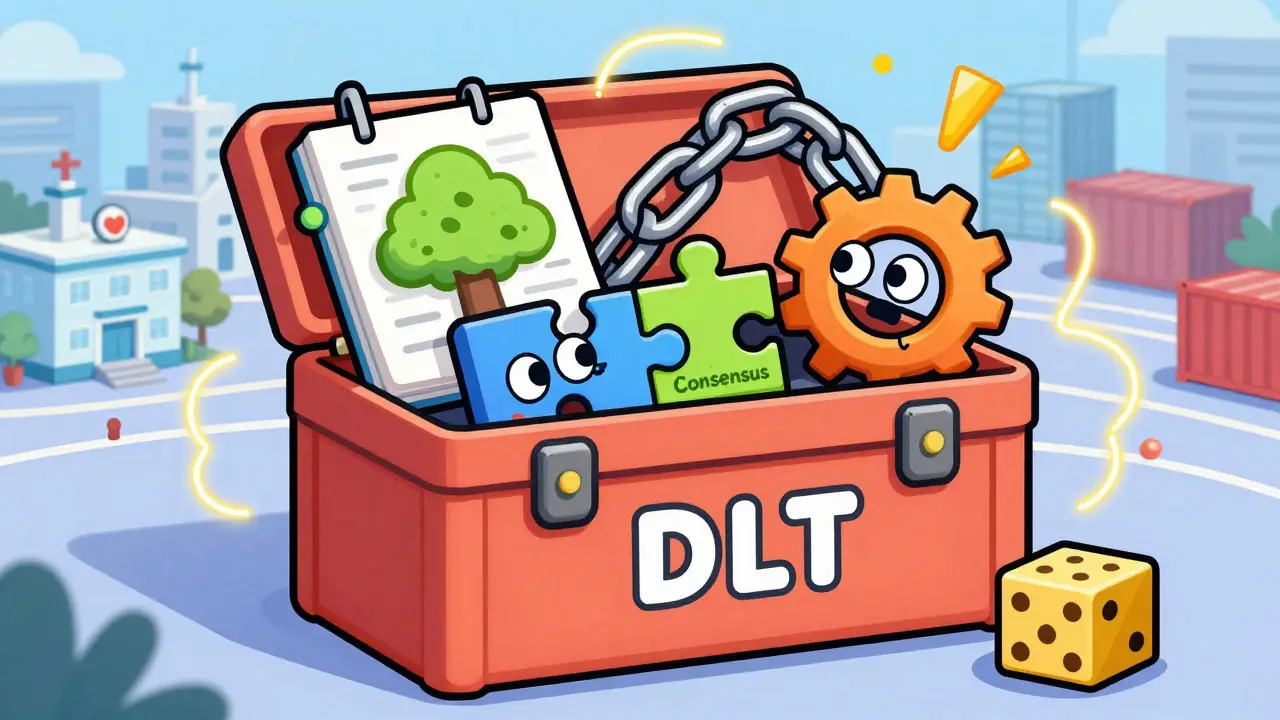
DLT isn't blockchain. That’s the first thing you need to understand. If you’ve only heard of DLT in the same breath as Bitcoin or Ethereum, you’re missing the bigger picture. Distributed Ledger Technology is the foundation - blockchain is just one building made from it. Think of it like cars and engines. Not every car uses a gasoline engine. Some use electric, hybrid, or hydrogen. Similarly, not every distributed ledger uses a blockchain structure.
What DLT Actually Is
DLT is a way to store data across many computers at once - no single company or server holds all the information. Each participant in the network keeps a copy of the same record. When a new entry is made, like a payment or a contract update, the network agrees on it together. No bank, no government, no middleman needs to sign off. The agreement happens automatically through a consensus mechanism - a set of rules the network follows to decide what’s valid.
This isn’t theory. The UK’s Combined Online Information System uses DLT to track medical records across hospitals. BitTorrent, launched in 2001, was one of the first real-world examples - a peer-to-peer file-sharing system that distributed data across thousands of users. It didn’t need a central server. It just worked because every user had a piece of the puzzle.
DLT systems are built to be resilient. If one computer goes down, the data doesn’t disappear. It’s still on dozens, maybe hundreds, of others. That’s why it’s so hard to hack. To change a record, you’d need to alter it on most nodes at the same time - practically impossible without control over the majority of the network.
How DLT Differs From Blockchain
Blockchain is a type of DLT, but not all DLTs are blockchains. The confusion comes from marketing. Crypto projects love saying "blockchain" because it sounds cutting-edge. But DLT can work without blocks, chains, or even tokens.
Here’s how they differ:
- Structure: Blockchain forces data into linear, chained blocks. DLT can organize data in trees, graphs, or even DAGs (directed acyclic graphs). This flexibility lets DLT handle more complex data relationships.
- Consensus: Bitcoin uses proof-of-work - a power-hungry process where miners compete to solve math puzzles. DLT systems can use proof-of-stake, practical Byzantine fault tolerance, or even voting systems. These are faster and use far less energy.
- Token requirement: Blockchain often needs a native cryptocurrency to pay for transactions. DLT doesn’t. You can run a DLT system for supply chain tracking without a single coin being minted.
- Scalability: Because DLT doesn’t require every node to validate every transaction the same way, it can scale better. BBVA tested DLT systems that processed 10,000+ transactions per second - far beyond what Bitcoin or Ethereum can handle.
Think of blockchain as a rigid, one-size-fits-all tool. DLT is a toolkit. You pick the right components for the job.
Why This Matters for Real Businesses
Most companies don’t need Bitcoin. They need trust, speed, and transparency - without the noise.
BBVA, one of Europe’s largest banks, uses DLT to automate international trade finance. Before, a single shipment could take 5-10 days just for paperwork to move between banks, customs, and shipping companies. With DLT, documents are shared instantly. Everyone sees the same version. No fax machines. No email chains. No lost files. The system verifies documents automatically using smart contracts - self-executing rules written into the ledger.
LCX, a regulated tech provider in Liechtenstein, uses DLT for asset tokenization - turning real estate, art, or bonds into digital shares. But here’s the key: they don’t use blockchain. They use a permissioned DLT where only approved investors can participate. No public mining. No volatile tokens. Just secure, traceable ownership records.
Supply chains are another big use case. A shipment of coffee beans from Colombia to Germany can be tracked from farm to shelf. Each step - harvesting, drying, shipping, customs, warehouse - is recorded. If there’s a delay or contamination, you know exactly where it happened. No guesswork. No blame games.

Privacy and Control: Not All Ledgers Are Public
A common myth is that DLT means everything is public. That’s not true. DLT systems can be public, private, or hybrid.
- Public DLT: Anyone can join. All data is visible. Used in crypto networks.
- Private DLT: Only invited participants can join. Data is hidden from outsiders. Used by banks, governments, hospitals.
- Consortium DLT: A group of trusted organizations run the network together. No single entity controls it. Used in trade finance, insurance, and logistics.
For example, a hospital network might use a private DLT to share patient records. Only doctors and nurses with clearance can view or update data. The system logs every change - who accessed it, when, and what was changed. That’s accountability without exposing sensitive data to the public internet.
Where DLT Is Headed Next
The next five years will see DLT move out of pilot projects and into core systems. Here’s what’s coming:
- Interoperability: Different DLT systems will start talking to each other. A supply chain ledger from one company will connect to a payment ledger from another - without needing a middleman.
- Energy efficiency: As climate concerns grow, DLT systems using proof-of-stake or other low-energy consensus methods will replace energy-heavy blockchain models.
- Integration with AI: Smart contracts will get smarter. AI will analyze ledger data to predict delays, flag fraud, or suggest optimal routes in logistics.
- Regulatory clarity: Governments are starting to create legal frameworks for DLT. The EU’s Digital Operational Resilience Act (DORA) already recognizes DLT as a valid infrastructure for financial records.
The goal isn’t to replace databases. It’s to replace trust-based processes with code-based ones. Instead of relying on auditors, lawyers, or middlemen to verify things, the system verifies itself.
When DLT Isn’t the Right Choice
DLT isn’t magic. It’s not better than a regular database in every case.
If you’re running a small online store with 100 customers a day, you don’t need DLT. A simple cloud database is cheaper, faster, and easier to manage.
DLT shines when:
- You have multiple organizations that don’t fully trust each other.
- You need a single source of truth that no one can alter secretly.
- You’re dealing with complex, multi-step processes with lots of paperwork.
- You need audit trails that can’t be deleted or tampered with.
If none of those apply, stick with traditional systems. Don’t force DLT where it doesn’t fit.
Final Thought: It’s Not About the Tech - It’s About the Trust
DLT’s real power isn’t in the code. It’s in what it replaces: uncertainty.
For decades, we’ve relied on institutions - banks, governments, lawyers - to be the middlemen who make sure things are fair. But institutions can fail. They can be slow. They can be corrupt.
DLT doesn’t eliminate the need for trust. It redistributes it. Instead of trusting one entity, you trust a network of rules, cryptography, and shared copies. That’s a more resilient form of trust - one that doesn’t depend on any single person or organization.
Blockchain got the headlines. But DLT is the quiet revolution - quietly fixing broken systems, one shared ledger at a time.
Is DLT the same as blockchain?
No. Blockchain is one type of DLT, but not all DLTs use blockchain. DLT is the broader category - like how "vehicle" includes cars, trucks, and motorcycles. Blockchain is like a specific model: the Tesla Model S. You can have a DLT system without blocks, chains, or tokens.
Do I need cryptocurrency to use DLT?
No. Cryptocurrency is only needed if you’re building a public, permissionless system like Bitcoin. Most enterprise DLT systems - like those used by banks or supply chains - run without any tokens at all. They use internal credentials or digital IDs to grant access.
Can DLT be hacked?
It’s extremely difficult. To alter data, you’d need to control more than half of the network’s nodes at once - called a 51% attack. In public networks, that’s expensive and obvious. In private or consortium DLTs, nodes are trusted and monitored, making such attacks nearly impossible.
Is DLT faster than traditional databases?
It depends. For simple read/write tasks, a traditional database is faster. But DLT wins when you need multiple parties to agree on data without a central authority. In complex, multi-organizational workflows - like shipping or finance - DLT reduces delays caused by manual verification and reconciliation.
What industries use DLT today?
Finance (BBVA, LCX), supply chain (Maersk, Walmart), healthcare (UK’s COIS), energy (grid management), and government (land registries in Sweden and Georgia). These aren’t experiments - they’re live systems handling real transactions.
Can DLT work offline?
Individual nodes can work offline temporarily, but changes won’t be confirmed until they reconnect to the network. DLT relies on constant communication to maintain consensus. It’s not designed for disconnected environments.
Is DLT legal?
Yes. Many countries now recognize DLT records as legally valid. The EU, Singapore, Japan, and parts of the U.S. have passed laws allowing digital ledgers to serve as official records for contracts, identity, and financial transactions.
Surendra Chopde
January 9, 2026 AT 12:21Tre Smith
January 10, 2026 AT 17:20kris serafin
January 10, 2026 AT 19:46Allen Dometita
January 12, 2026 AT 04:05Sherry Giles
January 12, 2026 AT 19:45Meenakshi Singh
January 12, 2026 AT 21:11Kelley Ramsey
January 13, 2026 AT 10:46Krista Hoefle
January 13, 2026 AT 18:29Jessie X
January 15, 2026 AT 18:12Kip Metcalf
January 16, 2026 AT 02:43Frank Heili
January 16, 2026 AT 21:43Jacob Clark
January 17, 2026 AT 20:29Jon Martín
January 17, 2026 AT 21:39Staci Armezzani
January 19, 2026 AT 18:38Tracey Grammer-Porter
January 21, 2026 AT 00:36sathish kumar
January 21, 2026 AT 10:59Don Grissett
January 22, 2026 AT 03:18