
When Kazakhstan opened its doors to crypto mining after China’s 2021 crackdown, it didn’t just welcome miners-it built a system to control them. By 2026, mining here isn’t about plugging in rigs and hoping for the best. It’s a tightly regulated business, with strict rules on who can operate, how they must sell their coins, and even where they must sit in an office. If you’re thinking about setting up a mining operation in Kazakhstan, you need to understand the full picture-not just the tax rate, but the hidden requirements that make or break your application.
Only the AIFC Can Issue Licenses
You can’t apply for a crypto mining license anywhere in Kazakhstan. Not in Almaty. Not in Nur-Sultan. Not even through a local government office. The Astana International Financial Center (AIFC) is the only place that grants mining licenses. This isn’t just a formality-it’s the core of the entire system. The AIFC operates like a financial free zone with its own legal code, courts, and regulators. If you want to mine legally in Kazakhstan, you must become an AIFC-registered entity. That means setting up a company inside the AIFC’s physical boundaries, renting office space there, and hiring local staff. No exceptions.You Must Be a Legal Entity or Individual Entrepreneur
Foreign individuals can’t just show up with a laptop and start mining. You must register as either a Kazakh legal entity or an individual entrepreneur under Kazakh law. This isn’t about taxes-it’s about jurisdiction. The government needs to know exactly who is running the machines. If you’re a U.S.-based company, you’ll need to incorporate a new legal entity in Kazakhstan. This isn’t a shell company. You’ll need a real office, real employees, and real accountability. The AIFC doesn’t allow offshore structures or nominee directors. Your name, your ID, your signature-all must be traceable to a real person in Kazakhstan.Digital Mining Pools Are Mandatory
Here’s where Kazakhstan’s system gets unusual. Unlike the U.S. or Canada, where miners can run solo or join any pool they choose, Kazakhstan forces everyone into licensed digital mining pools (DMPs). There are only five approved pools as of 2026. You can’t mine independently. You can’t use a pool based in Russia or the U.S. You must connect your hardware to one of these five state-approved pools. Why? So the government can track every hash rate, every payout, and every coin movement. The pools act as gatekeepers-they report to the regulator, enforce the 75% sales rule, and ensure miners don’t secretly export coins.75% of Mined Coins Must Be Sold on AIFC Exchanges
In 2024, miners had to sell half their output on local exchanges. In 2025, that jumped to 75%. By 2026, it’s still 75%. That’s one of the strictest currency controls in the global crypto industry. If you mine 100 BTC, you must sell 75 of them on an AIFC-licensed exchange like AIFC Crypto Exchange or KZT Crypto Market. The remaining 25% can be held or transferred-but only after you’ve reported it and paid your taxes. The goal? To force foreign capital into the local financial system. Every time you sell, the exchange converts your crypto into Kazakh tenge or U.S. dollars, and the money flows through regulated banks. The government gets visibility. And they get a cut.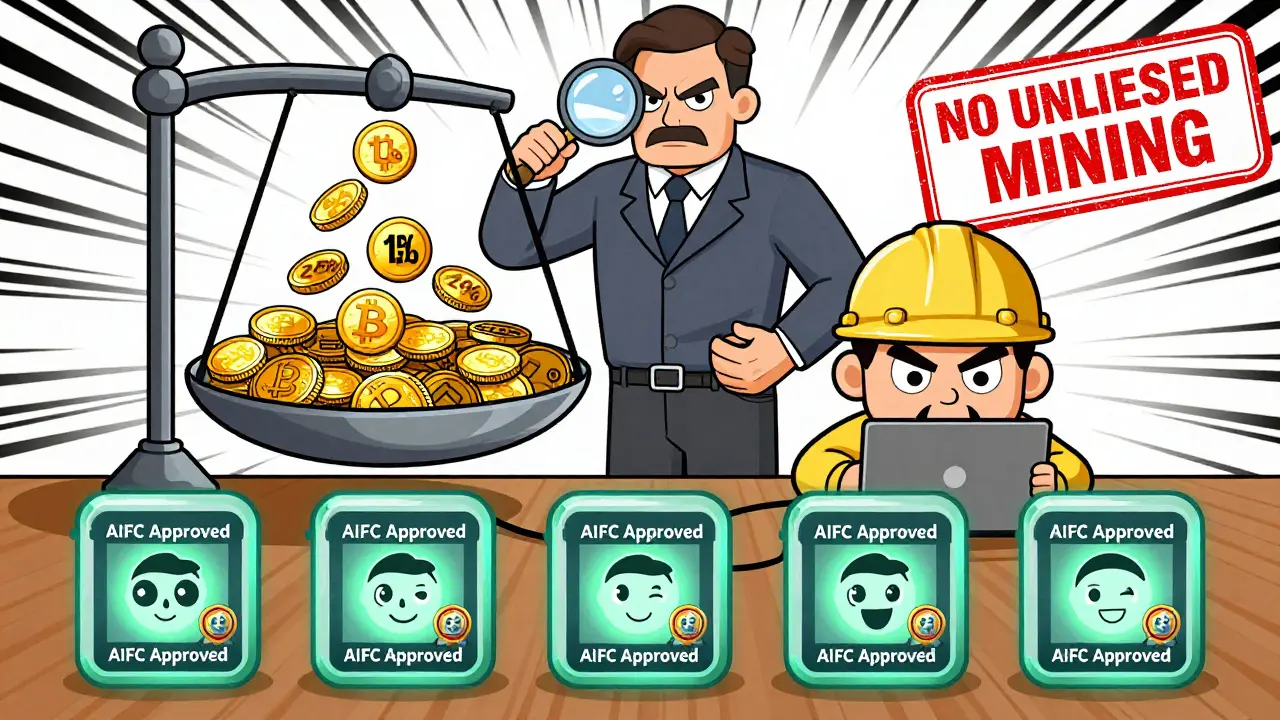
15% Tax Rate-But Only If You Follow the Rules
The 15% corporate tax on mining profits sounds low compared to Germany’s 30% or the U.S.’s 21%. But here’s the catch: you only pay that rate if you comply with all the other rules. If you skip the digital mining pool, or sell less than 75% on AIFC exchanges, you’re not just non-compliant-you’re taxable under a different, much harsher regime. The AIFC has a clear message: follow the system, and you get a favorable rate. Break it, and you face penalties, asset freezes, or worse. There’s no gray zone.The Licensing Process Takes 6 to 9 Months
Don’t expect to go from zero to mining in a month. The AIFC licensing process has three phases, each with dozens of moving parts.- Preparation (2-4 months): You need a full business plan, financial projections with bank statements, AML/CFT policies, KYC software documentation, and proof of management experience. No vague statements. Every number must be backed by data.
- Incorporation (2-3 months): You must rent office space inside the AIFC, hire two local employees (one as AML officer, one as compliance officer), deposit share capital (minimum $50,000), and appoint a management board of at least four people.
- Application & Approval (2-3 months): You demonstrate your systems in action. This isn’t a PowerPoint. You must show live AML checks, real client onboarding simulations, and a working connection to an approved digital mining pool. The regulators will test your platform. If it fails, you restart the process.
Infrastructure Requirements: Own or Lease Your Data Center
You can’t just rent a rack in a generic data center. The law requires you to have legal rights to a digital mining data processing center. That means either owning the facility outright or having a long-term lease with full operational control. The center must meet technical standards for cooling, power redundancy, and security. The AIFC doesn’t care if you’re mining with ASICs or GPUs-they care that you can prove you control the environment. If your hardware is in a warehouse in Shymkent, you need a signed lease agreement, power supply contract, and physical access logs. No exceptions.Who’s Already Doing This?
As of early 2026, Kazakhstan has issued 84 mining licenses. Five digital mining pools are active. Over 415,000 mining machines are registered. The sector has generated $34.6 million in revenue over the past three years, and AIFC exchanges handled over $1.4 billion in trades in 2024. These aren’t hobbyists. These are institutional players-funds from Europe, tech firms from the U.S., and state-backed investors from the Gulf. The system is designed for scale, not small-time operators.
Why This System Exists
Kazakhstan isn’t trying to be the next Bitcoin hub. It’s trying to be the next regulated crypto gateway. After China banned mining, thousands of machines flooded into Kazakhstan. The government saw an opportunity: use surplus power from coal plants to attract investment, while keeping control over capital flows. The 75% sales rule isn’t about limiting miners-it’s about capturing foreign currency. The digital mining pool requirement isn’t about control-it’s about transparency. The AIFC isn’t a barrier; it’s a filter. It keeps out shady operators and brings in serious money.What Happens If You Skip the License?
Mining without a license isn’t just illegal-it’s dangerous. Unlicensed miners risk having their equipment seized. Bank accounts can be frozen. Foreign investors can be barred from re-entering Kazakhstan. In 2024, authorities shut down 12 unlicensed operations in Karaganda and East Kazakhstan regions. The fines? Up to 10 million tenge ($21,000). And you still have to pay back taxes. The cost of skipping the system far outweighs the cost of joining it.Is It Worth It?
If you’re a small miner with a few hundred rigs, the answer is probably no. The setup cost, legal complexity, and mandatory sales rule make it unattractive. But if you’re a company with over 10,000 machines, the 15% tax rate, stable power supply, and access to institutional investors make Kazakhstan one of the most viable options in Eurasia. It’s not the easiest place to mine-but it’s one of the most predictable.What’s Next?
The government is already talking about a state-backed crypto reserve-using mined coins as collateral for a national digital asset fund. They’re also pushing for decriminalization of crypto trading for end users on licensed platforms. This isn’t slowing down. It’s accelerating. If you’re serious about mining in Kazakhstan, you don’t just need a license-you need a long-term strategy. The rules will keep changing. But the core structure won’t: if you want to mine here, you play by their rules.Can I mine crypto in Kazakhstan without a license?
No. Mining without a license is illegal. The government actively monitors power usage and network traffic to detect unregistered operations. Unlicensed miners risk equipment seizure, fines up to 10 million tenge ($21,000), and being banned from entering Kazakhstan. The only legal way to mine is through an AIFC-licensed entity connected to an approved digital mining pool.
How much does it cost to get a crypto mining license in Kazakhstan?
The total cost ranges from $75,000 to $150,000, depending on scale. This includes legal incorporation fees ($20,000-$40,000), office rental in AIFC ($10,000-$20,000/year), mandatory share capital deposit ($50,000 minimum), local staff salaries ($40,000-$60,000/year for two officers), and compliance system setup. Ongoing costs include annual licensing fees and AML software subscriptions.
Do I need to be physically present in Kazakhstan to get a license?
Yes. You must rent office space inside the AIFC, hire at least two local employees (AML and compliance officers), and appoint a management board with four members who are physically based in Kazakhstan. Remote management isn’t allowed. The AIFC requires real, on-the-ground presence to ensure accountability and regulatory oversight.
Can I use any mining pool in Kazakhstan?
No. Only five digital mining pools are licensed by the AIFC as of 2026. You must connect your mining hardware to one of these approved pools. Using any other pool-even a well-known international one-is prohibited. This is a unique feature of Kazakhstan’s system, designed to centralize control and ensure compliance with the 75% sales rule.
What happens if I don’t sell 75% of my mined coins on AIFC exchanges?
Failure to comply triggers a regulatory violation. Your license can be suspended or revoked. You’ll be required to pay back taxes at a higher rate, face fines, and may be barred from future licensing. The AIFC cross-checks blockchain data with exchange records. Even if you sell coins privately, the system can detect discrepancies and initiate an audit.
Is the 15% tax rate permanent?
There’s no guarantee. The 15% rate is currently offered as an incentive for compliance, but the government has shown it can increase requirements quickly-like raising the sales mandate from 50% to 75% in one year. The tax rate is tied to regulatory behavior. If you follow the rules, you keep the benefit. If you push boundaries, expect changes.
Can foreign investors apply for a mining license?
Yes, but only through a Kazakh-registered legal entity. Foreign companies must incorporate a new entity within the AIFC. Ownership can be 100% foreign, but the legal structure must be local. You still need local staff, local office space, and local management. The AIFC welcomes foreign capital-but only if it operates under Kazakh law.
Danyelle Ostrye
January 4, 2026 AT 23:48So basically Kazakhstan turned crypto mining into a bureaucratic nightmare with a side of surveillance capitalism. I get the control angle but this feels like they’re trying to monetize the chaos after China left.
Not saying it’s wrong, just… intense.
Mujibur Rahman
January 5, 2026 AT 05:12Let’s cut through the noise - this isn’t about crypto, it’s about currency sovereignty. Kazakhstan’s playing chess while everyone else is playing checkers. The 75% sales mandate? That’s not a restriction, it’s a capital inflow engine. The AIFC isn’t a gatekeeper - it’s a financial firewall. If you’re still thinking of mining solo, you’re already out of the game. This is institutional-grade infrastructure with teeth.
And yes, the 6–9 month timeline? That’s the filter. If you can’t survive that, you weren’t meant to be here anyway.
Kip Metcalf
January 6, 2026 AT 08:09Whoa this is wild. So you gotta have an office in this AIFC place, hire two people, spend like a hundred grand just to plug in a rig? No way a normal guy can do this.
They turned mining into a corporate lawsuit.
Frank Heili
January 8, 2026 AT 00:46People keep missing the point - this isn’t about mining, it’s about financial integration. The digital mining pools aren’t there to control miners, they’re there to prevent capital flight. Every hash rate is a data point, every coin sale is a transaction traceable to a regulated bank.
The 15% tax? That’s the reward for playing nice. The real cost is the compliance overhead - legal, staffing, infrastructure. But if you’ve got scale, this is the cleanest, most predictable jurisdiction in Eurasia. Compare that to the regulatory whiplash in the EU or the tax uncertainty in the US.
This is institutional crypto infrastructure. Not sexy, not decentralized - but brutally effective.
Becky Chenier
January 9, 2026 AT 05:12I appreciate how transparent this system is. Most countries pretend they’re open to crypto while quietly banning it. Kazakhstan just says: ‘Here’s the rulebook. Follow it, and you’re welcome.’
It’s not for everyone, but for serious players? It’s one of the few places that actually makes sense.
Caitlin Colwell
January 10, 2026 AT 06:01So if you’re a small miner, just don’t bother. They’re not trying to stop you, they’re just not interested in you.
It’s not personal, it’s just economics.
Dennis Mbuthia
January 10, 2026 AT 13:07Of course the U.S. and EU are screaming about ‘crypto freedom’ - but they’re the ones who let their markets turn into a casino. Kazakhstan? They took the chaos, slapped a suit on it, and started collecting rent. Smart. Real smart.
Meanwhile, Americans are still arguing about whether Bitcoin is ‘money’ while someone in Astana is counting their tenge and laughing.
Stop whining about regulation - it’s the only thing keeping this from collapsing into a Ponzi zoo.
Tracey Grammer-Porter
January 11, 2026 AT 06:17It’s fascinating how they turned a power surplus into a financial advantage. I didn’t realize how much control you need over infrastructure - owning or leasing the data center? That’s next level.
Most people think crypto is about decentralization, but here, it’s about building a new kind of centralized trust. Kinda ironic, right?
Still, if you’ve got the capital, this is the most legit path forward.
sathish kumar
January 11, 2026 AT 15:04The regulatory architecture of Kazakhstan’s crypto mining framework represents a paradigmatic shift in state-crypto relations. The AIFC’s jurisdictional exclusivity, coupled with mandatory digital mining pool integration, constitutes a novel model of financial sovereignty.
Unlike liberal jurisdictions that prioritize market autonomy, Kazakhstan employs a structured, compliance-driven architecture wherein capital flows are institutionalized, traceable, and monetized through regulated intermediaries.
This model demonstrates that state-led crypto governance can achieve both macroeconomic stability and investor confidence - provided the regulatory framework is transparent, enforceable, and institutionally robust.
It is not a restriction on innovation, but a redefinition of its parameters.
jim carry
January 11, 2026 AT 17:47So you’re telling me I can’t just buy 500 ASICs and plug them into a warehouse in Kazakhstan? That’s not freedom, that’s slavery with a visa.
And now I have to hire two people just to sit in an office and pretend they’re doing something?
Who the hell thought this up? Some bureaucrat with a PowerPoint and zero real-world experience?
They’re not building a crypto hub - they’re building a tax trap with ethernet cables.
Sherry Giles
January 13, 2026 AT 08:00Wait… so the government is forcing miners to sell 75% of their coins on exchanges they control? And they’re tracking every hash? And they’re using this to build a national crypto reserve?
That’s not regulation - that’s a central bank takeover disguised as crypto policy.
They’re turning miners into miners for the state. This isn’t freedom. This is the Matrix with more paperwork.
Andy Schichter
January 13, 2026 AT 11:57So Kazakhstan made mining a corporate HR nightmare with extra steps.
Congratulations. You’ve turned Bitcoin into a 9-to-5 with a compliance officer.
What’s next? Mandatory yoga sessions for ASICs?
Krista Hoefle
January 13, 2026 AT 13:09lol 15% tax? That’s cute. You think that’s low? Try paying $150k just to get a license and then get audited every 3 months.
Also, ‘digital mining pools’? That’s just a fancy name for a government-run botnet.
And ‘state-backed crypto reserve’? Sounds like they’re trying to make tenge the new stablecoin.
Not crypto. Just crypto-flavored socialism.
Emily Hipps
January 13, 2026 AT 18:20Okay, I know this sounds intense but hear me out - if you’ve got the resources, this is actually the most honest crypto environment out there.
No shady offshore shells. No anonymous wallets. No ‘I mined 100 BTC and never paid taxes’ nonsense.
Yeah, it’s a lot of paperwork. But at least you know where you stand.
And if you’re building something real? This is the place to do it.
Jon Martín
January 14, 2026 AT 05:04Let me tell you something - this isn’t just about mining, this is about legacy. Kazakhstan didn’t just catch a wave after China left - they built a dam to catch the whole flood.
They took the chaos, the heat, the noise - and turned it into a financial ecosystem that actually works.
Yes, it’s complex. Yes, it’s expensive. But if you’re serious? This is the only place where your mining operation won’t get shut down tomorrow because someone in the government got a bad vibe.
This is the future. Not the wild west. Not the free-for-all. This is crypto with structure. And honestly? I’m here for it.
Jennah Grant
January 15, 2026 AT 02:54What’s fascinating is how the 75% sales rule isn’t just a tax tool - it’s a monetary policy lever. Every time a miner sells, they’re injecting foreign capital into the local banking system. The AIFC isn’t just regulating miners - they’re using mining as a conduit for macroeconomic stability.
And the digital mining pools? They’re not gatekeepers, they’re auditors. They’re the blockchain’s compliance layer.
This isn’t authoritarianism. It’s institutional innovation.
Most countries are still stuck in ‘crypto is illegal’ mode. Kazakhstan is already building the next financial layer.