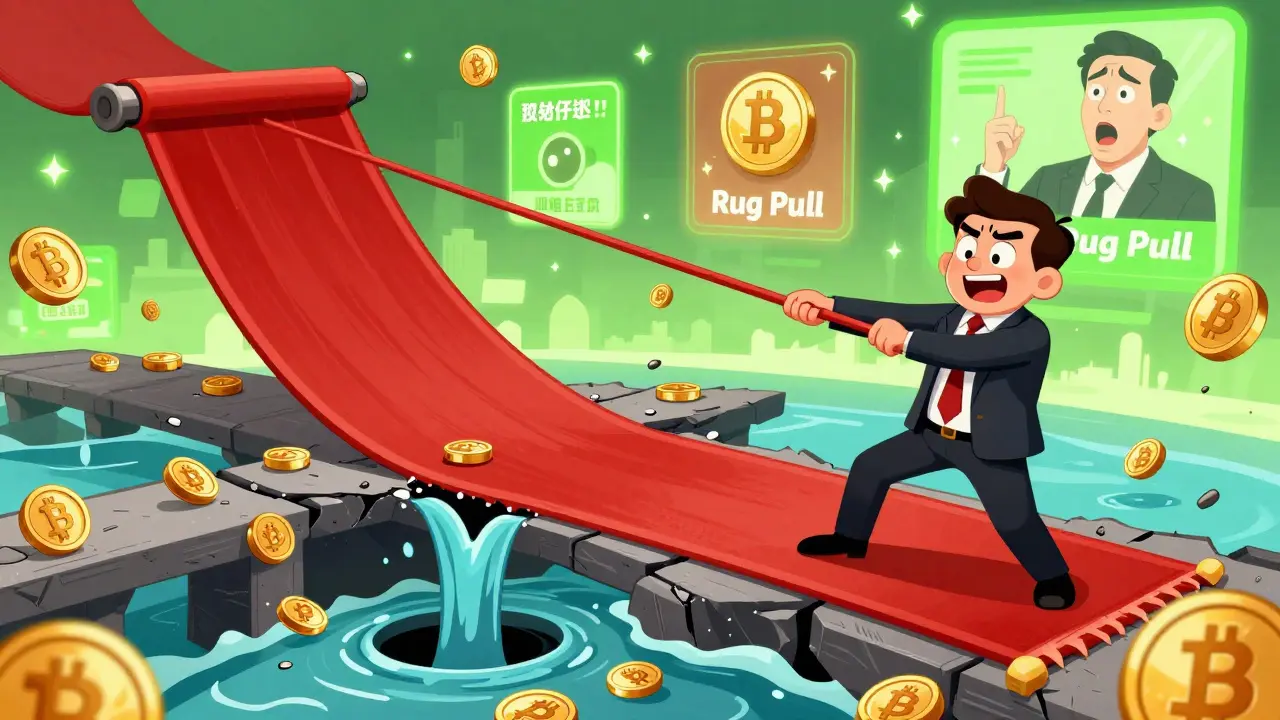
Imagine putting your money into a crypto project that looks legit-promising huge returns, backed by flashy ads, even endorsed by a well-known figure. Then, one day, you try to sell your tokens… and you can’t. The trading pair disappears. Your wallet is frozen. The developers vanish. That’s a smart contract rug pull-and it’s happening more often than you think.
What Exactly Is a Rug Pull?
A rug pull is when the people behind a cryptocurrency project suddenly take all the money and run. The name comes from the phrase "pulling the rug out from under you." In crypto, that rug is the liquidity pool-the pool of funds that lets people buy and sell tokens on decentralized exchanges like Uniswap or PancakeSwap. When developers drain that pool, your tokens turn into digital paper. Worthless. These aren’t random glitches. They’re carefully coded into the smart contract-the self-executing code that runs the token. And they’re designed to look normal until the moment they aren’t.Three Main Ways Rug Pulls Happen
There are three main technical methods scammers use. Each one exploits a different weakness in how DeFi works.Liquidity Pull: The Classic Drain
This is the most common type. Developers create a new token, pair it with ETH, BNB, or USDT, and add some of their own money to the liquidity pool to make it look real. Then they run ads. They hire influencers. They promise moonshots. Investors jump in. The price rises. The liquidity pool grows. And then-boom. The developers call theremoveLiquidity function. It’s a normal part of the protocol. But they’re the only ones with permission to use it. They pull out all the ETH or BNB. The trading pair collapses. The token price hits zero. Investors are left holding nothing.
The SQUID token in 2021 was a textbook case. The team added just enough liquidity to make it look credible. Then, in one transaction, they drained over $3 million. The contract didn’t have a lock. No delay. No warning. Just a clean, silent exit.
Honeypot: The Trap You Can’t Escape
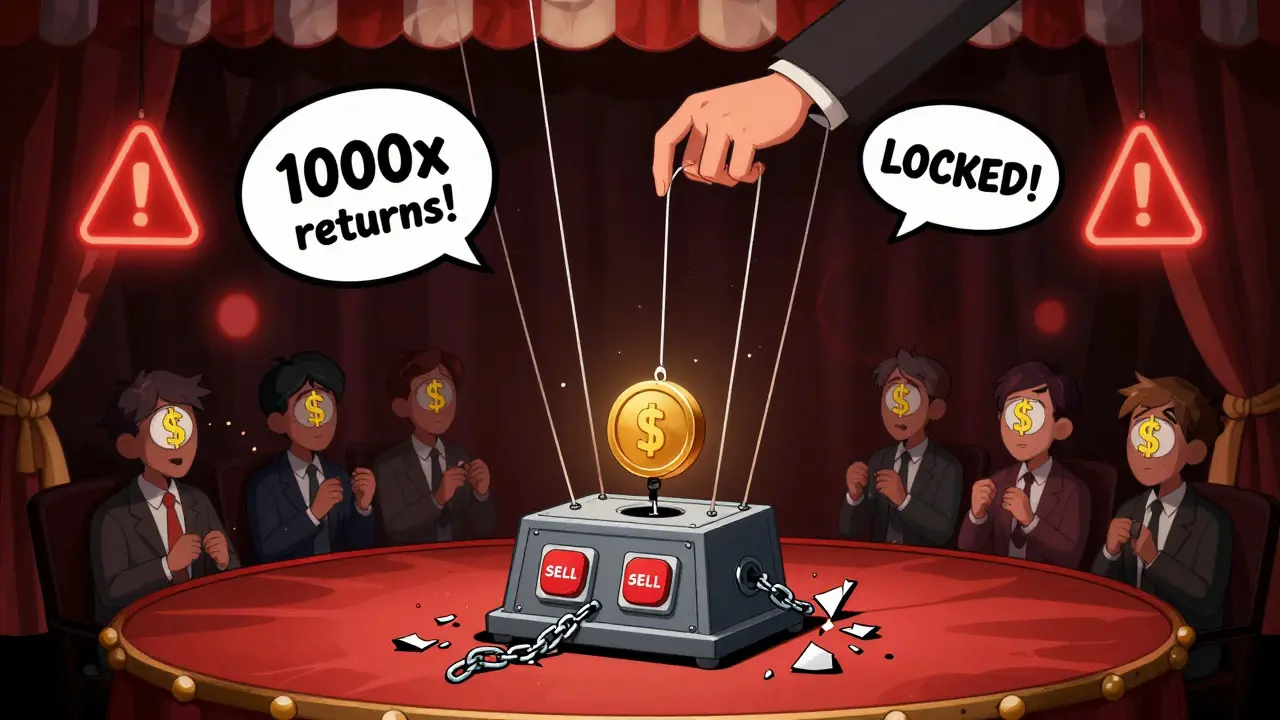
This one is more technical-and more cruel. A honeypot lets you buy tokens… but blocks you from selling them. The smart contract is coded to only allow the developers’ wallets to sell. Everyone else? Locked in. It looks like a normal token. You can see the buy button. You can see the price going up. You think you’re making a smart move. But when you click sell? The transaction fails. The error message might say "insufficient balance" or "reverted." It’s confusing. It feels like a glitch. It’s not. It’s intentional. The SQUID Game token used this method. Only 12 wallets could sell. The rest were trapped. The scammers slowly sold their holdings over hours, pushing the price down just enough to avoid suspicion. By the time people realized what was happening, it was too late. Detecting a honeypot requires checking the contract code. Tools likeToken Sniffer or RugDoc can scan for these traps. But most investors don’t bother. They trust the hype.
Pump and Dump: The Celebrity-Backed Scam
This one doesn’t need fancy code. Just influence. Developers hold 70-80% of the total token supply. They don’t need to lock liquidity or block sells. They just need you to buy. They use social media. They pay influencers. They get politicians to tweet about it. In February 2025, Argentinian President Javier Milei endorsed a token called LIBRA. Within 48 hours, the price spiked 1,200%. Thousands rushed in. Then the insiders sold. All at once. Over $107 million vanished in hours. The price crashed 95%. The tweet stayed up. The website stayed live. But the money? Gone. This is a "soft rug pull." No smart contract trickery. Just market manipulation. And it’s getting more dangerous because it’s harder to prove. Who can stop a president from tweeting?Red Flags You Can’t Ignore
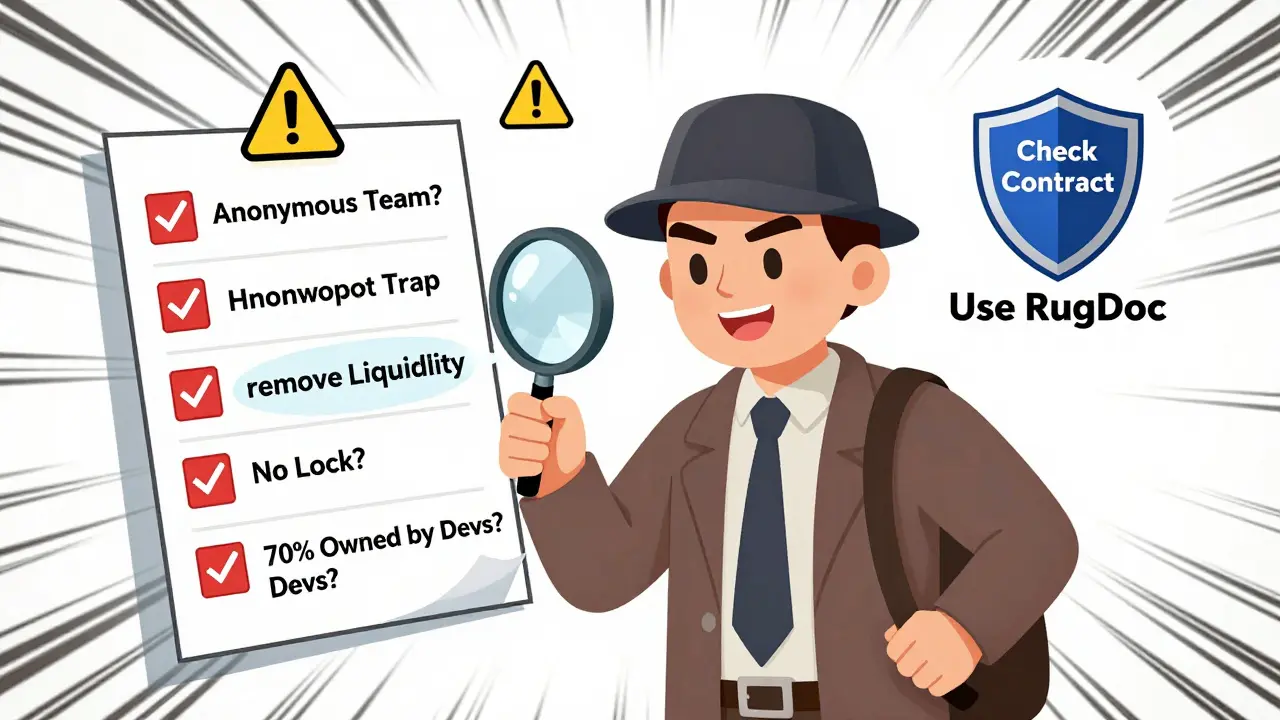
You don’t need to be a coder to spot a rug pull. Here are the warning signs that show up in almost every case:- Anonymous team: No names, no LinkedIn profiles, no real photos. If the team is "anonymous pioneers," that’s a red flag.
- No liquidity lock: Legit projects lock their liquidity for months-even years. If the contract says "no lock," walk away.
- Developer owns too much: If the team holds more than 50% of the tokens, they can dump anytime. That’s not a project. That’s a warehouse.
- Unrealistic promises: "1000x returns in 7 days" or "guaranteed profits"? That’s not innovation. That’s a scam.
- Too much hype, no tech: If the whitepaper reads like a movie pitch and doesn’t explain how the contract works, it’s not a blockchain project. It’s a marketing campaign.
Why Do People Fall for This?
It’s not because they’re stupid. It’s because they’re human. FOMO-the fear of missing out-is a powerful force. When you see your friend making money on a new token, when influencers are shouting "BUY NOW," when the price is climbing-it feels like you’re late to the party. You don’t want to miss out. So you skip the due diligence. And scammers know it. They design their scams to trigger emotion, not logic. They use urgency. They use exclusivity. They use authority. They make you feel like you’re part of something big. The truth? You’re part of their exit strategy.What Can You Do to Protect Yourself?
You can’t stop rug pulls. But you can stop being a victim.- Check the contract: Use tools like Etherscan or BscScan. Look for the
removeLiquidityfunction. See if only the owner can call it. Check if sell functions are restricted. - Verify liquidity locks: Sites like
Team FinanceorUnicryptshow if liquidity is locked. Look for a lock period of at least 6 months. - Look at token distribution: If the top 10 wallets hold more than 60% of supply, it’s a red flag. Use Dune Analytics or DeFiLlama to check.
- Don’t trust influencers: If someone is getting paid to promote a token, they’re not your friend. They’re a paid actor.
- Invest only what you can lose: If you’re risking rent money or savings, you’re already playing with fire. Crypto is volatile. Rug pulls make it deadly.
Is There Any Hope?
The industry is waking up. Tools likeRugDoc, Smart Contract Auditor, and DeFi Safety now scan contracts in real time. Some exchanges block tokens with known rug pull patterns. Community watchdogs on Twitter and Discord flag suspicious projects before they launch.
But the biggest defense? You.
No tool can replace your own judgment. No audit can guarantee safety. If a project feels too good to be true, it is. If you don’t understand how it works, don’t invest. If the team hides behind anonymity, walk away.
Rug pulls will keep happening. The technology is too open. The money is too easy. But the more people learn to spot them, the harder it gets for scammers to succeed.
What Happens After a Rug Pull?
Nothing. Blockchain is immutable. Once the funds are gone, they’re gone. There’s no customer service. No refund button. No regulator to call. The police won’t help unless millions are involved-and even then, the trail is cold. Victims often lose everything. Some lose their savings. Others lose trust in crypto altogether. The emotional toll is real. Reddit threads filled with people crying over lost money aren’t rare. The only way out? Don’t get caught.Can you recover money after a rug pull?
No. Once a rug pull executes, the funds are permanently transferred out of the liquidity pool and into the scammer’s wallet. Blockchain transactions are irreversible. There is no central authority to reverse them. Recovery is impossible. Prevention is the only solution.
Are all new tokens rug pulls?
No. Thousands of legitimate projects launch every year. But the vast majority of new tokens-especially those promoted on social media with hype-are high-risk. Always verify the contract, team, and liquidity before investing. Don’t assume safety just because a token is new.
How do I check if a token has a liquidity lock?
Use platforms like Unicrypt, Team Finance, or Lock Liquidity. Enter the token’s contract address. If liquidity is locked, you’ll see the amount locked, the duration, and the lock address. If it says "unlocked" or shows no lock at all, avoid it. A lock of 6 months or more is a good minimum standard.
Can smart contract audits prevent rug pulls?
Audits help, but they’re not foolproof. Many audits only check for basic vulnerabilities, not backdoors like owner-only withdrawal functions. Some scammers even pay for audits to make their scam look legit. Always read the audit report yourself-look for mentions of "owner privileges," "unlimited minting," or "unlocked liquidity." If those exist, it’s risky.
Why do influencers promote rug pulls?
They’re paid. Often thousands or even tens of thousands of dollars per post. Many influencers don’t verify the project-they just promote whatever pays them. Some even get free tokens in exchange. Their job isn’t to protect you. It’s to get you to buy so they can cash out.
Amy Garrett
January 2, 2026 AT 09:50ok but like… i just lost $800 on some token called ‘DogeMoonLaser’ and now i’m too scared to even look at my wallet 😭 i swear i read the whitepaper… it said ‘decentralized future’ and had a picture of a dog in a spacesuit??
Haritha Kusal
January 3, 2026 AT 11:51samee 😔 i thought i was being smart investing in a project with a ‘team of blockchain ninjas’… turns out the ‘team’ was one guy in a basement with a fake LinkedIn. i’m learning the hard way. but hey, at least i didn’t use my rent money 💪
Mike Reynolds
January 4, 2026 AT 01:41Just wanna say - this post is spot on. I’ve seen so many people get wrecked by honeypots because they trust the chart. Price going up? Must be safe. Nah. The contract is rigged. Tools like RugDoc saved me twice. Always check the code. Always. No exceptions.
dayna prest
January 4, 2026 AT 17:30Let me just say - if you’re investing in a token that has ‘moon’ in the name and no actual product, you’re not a degenerate, you’re a walking ATM with a Twitter account. These scams are so predictable it’s almost poetic. The only thing more tragic than the rug pull? The fact that people still fall for it. Again. And again. And again.
Phil McGinnis
January 5, 2026 AT 13:30The notion that decentralized finance is inherently secure is a dangerous fallacy. The architecture is transparent, yes - but transparency does not equate to integrity. The human element - greed, gullibility, and performative FOMO - remains the most exploitable vector. One cannot out-code human stupidity.
Ian Koerich Maciel
January 6, 2026 AT 18:39Wow. This is… really well-written. 🙏 I’ve lost money before, and honestly, I felt so alone in it. But reading this? It’s like someone finally said what I’ve been too ashamed to admit: I got greedy. I skipped the checks. I trusted a meme. And now… I’m trying again. More carefully. Thank you.
Andy Reynolds
January 6, 2026 AT 22:31Big respect to whoever wrote this. I’m just a guy who used to think ‘DeFi’ meant ‘Dollar For Free’ 😅 But now I check every contract like I’m inspecting a used car. Liquidity lock? Check. Team real? Check. More than 50% held by devs? RUN. I’ve saved myself $15k already just by asking dumb questions. You’re not dumb for asking. You’re smart for caring.
Alex Strachan
January 7, 2026 AT 11:48So… I bought a token called ‘POTATO’ because a guy in a Discord said it was ‘the next Bitcoin’… and now my portfolio looks like a potato farm after a hailstorm 🥔📉. But hey - at least I got a good story. And a new tattoo: ‘FOMO IS A SCAM’. Worth it.
Rick Hengehold
January 8, 2026 AT 23:49Don’t invest. Don’t trust. Don’t click. If you’re not coding the contract yourself, you’re gambling. End of story. Walk away. Save your money. Live longer.
Brandon Woodard
January 9, 2026 AT 02:26It’s not that the technology is flawed. It’s that the incentive structure is designed to reward exploitation. The blockchain doesn’t lie - but the people using it? They’re masters of illusion. The only real audit is your own skepticism. And if you don’t have that? You’re not ready to play.
Antonio Snoddy
January 10, 2026 AT 10:45Think about it: we live in a world where you can buy a digital image of a monkey for $100k, yet you won’t spend five minutes reading a contract. We’ve replaced wisdom with dopamine. We’ve turned finance into a reality show. And the producers? They’re not the devs. They’re the ones who profit from your hope. The rug pull isn’t a bug - it’s the feature. The system isn’t broken. It’s working exactly as designed. And we’re all just the raw material.