
El Salvador is the only country in the world where buying, selling, or holding Bitcoin doesn’t trigger a capital gains tax - and that hasn’t changed, even after major policy shifts in 2025. While the government scaled back some parts of its Bitcoin experiment, the core tax break remains untouched. If you’re an investor wondering whether you can profit from Bitcoin without paying taxes, El Salvador’s rules are still the most extreme in the world.
Why El Salvador’s Bitcoin Tax Rule Still Matters
In September 2021, El Salvador made Bitcoin legal tender. That meant it wasn’t just allowed - it was supposed to be used like the U.S. dollar for everyday payments. But the real game-changer was the law that said: no capital gains tax on Bitcoin. That’s not a loophole. It’s written into the country’s Digital Assets Law. Whether you’re a local citizen or a foreign investor, if you sell Bitcoin and make a profit, you owe zero to the government. No 15%, no 20%, no 30%. Just zero. This rule applies to everyone, even if you’re not a Salvadoran. If you buy Bitcoin elsewhere and later sell it while living in or investing through El Salvador, your profit stays yours. The law doesn’t care where you’re from - only that the transaction happens under its jurisdiction.What Changed in 2025? (And What Didn’t)
You’ve probably heard about El Salvador’s $1.4 billion loan deal with the IMF in late 2024. That deal forced changes: the government stopped buying Bitcoin, stopped requiring businesses to accept it as payment, and began phasing out the Chivo wallet. But here’s the key point: none of those changes touched the capital gains tax exemption. The amendment passed in February 2025 focused on reducing state involvement, not rewriting tax policy. The law still says: Bitcoin transactions are tax-free. The National Commission of Digital Assets (CNAD) still enforces it. The Ministry of Finance still recognizes it. The exemption survived because it’s not just policy - it’s the foundation of El Salvador’s entire crypto strategy.Who Benefits the Most?
Foreign investors who put at least ₿3 (three Bitcoin) into El Salvador get an extra perk: complete exemption on all Bitcoin profits. That includes gains from trading, mining, or holding. Even if you’re not a resident, if you invest that amount, your Bitcoin gains are untouchable by any tax authority. Businesses benefit too. Companies that operate as Bitcoin Service Providers (BSPs) under CNAD licensing don’t pay corporate income tax, services transfer tax, or municipal taxes. They also don’t pay VAT on Bitcoin transactions. That’s rare - most countries tax crypto businesses heavily. In El Salvador, if you’re running a Bitcoin exchange, wallet service, or payment processor, you’re operating in a near-zero-tax zone.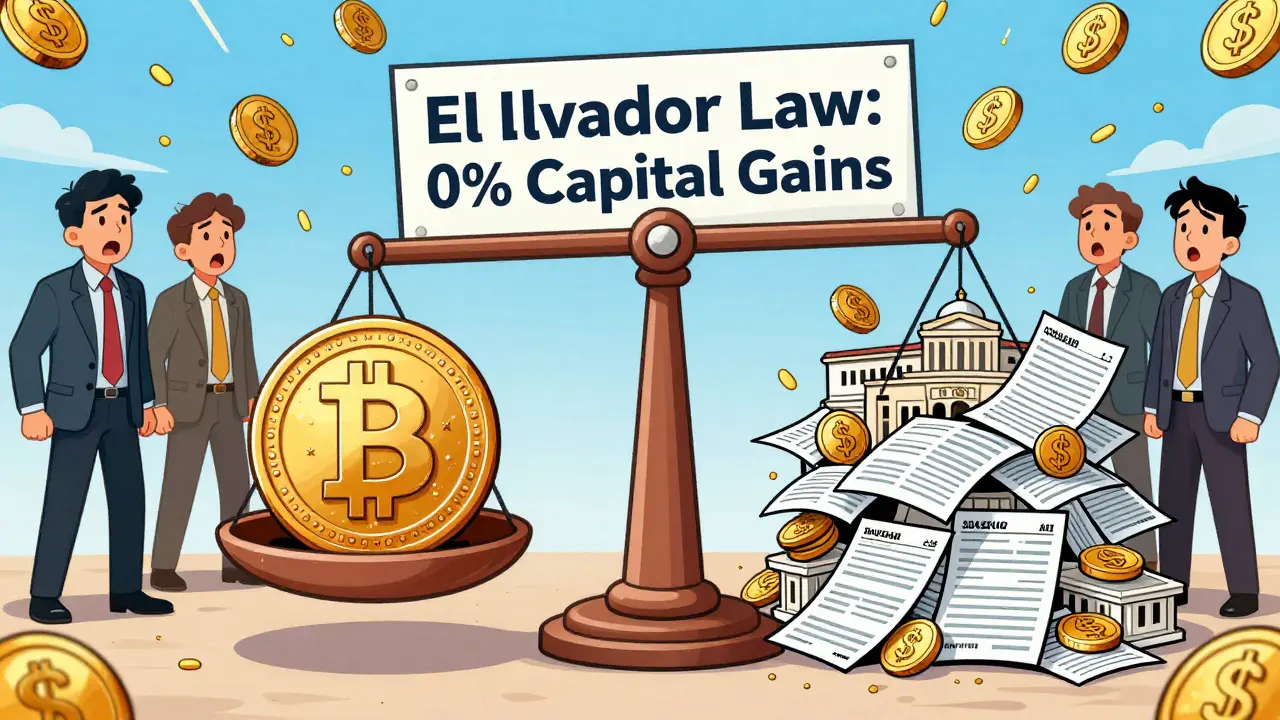
How Does It Compare to Other Countries?
In 2026, only five countries offer full or near-full crypto tax exemptions:- Cayman Islands: No income, capital gains, or corporate tax. Ideal for crypto funds and hedge funds.
- UAE: Zero tax on crypto across all emirates. Clear rules, strong regulation.
- Germany: No tax if you hold Bitcoin for over 12 months. Only applies to individuals.
- Portugal: No tax on long-term gains. Also offers special residency programs for expats.
- El Salvador: No tax on Bitcoin - period. Applies to everyone, regardless of holding time or residency.
Why Aren’t More People Using It?
Here’s the twist: despite the tax break, most Salvadorans aren’t using Bitcoin. A 2024 survey by the Universidad Centroamericana found only 8.1% of locals regularly use Bitcoin for payments. That’s down from 25.7% in 2021. People don’t trust it. They don’t understand it. Many still use dollars. The government spent millions promoting Bitcoin, even giving away $30 in free crypto to citizens through the Chivo wallet. But adoption didn’t stick. The tax exemption didn’t fix usability issues, poor internet access, or lack of education. Still, the policy works for investors - not citizens. El Salvador isn’t trying to make its people rich with Bitcoin. It’s trying to attract foreign capital. And so far, it’s working.What You Need to Do to Use the Tax Break
You can’t just show up and start trading tax-free. There are rules:- You must operate through a licensed entity - either a Bitcoin Service Provider (BSP) or Digital Asset Service Provider (DASP).
- All transactions must be recorded and reported to CNAD and the Ministry of Finance.
- You still need to follow AML and KYC rules. No anonymous trading.
- If you’re a business, you must file annual financial statements and pay VAT on non-Bitcoin services.

AJITH AERO
February 14, 2026 AT 16:15Anandaraj Br
February 16, 2026 AT 15:00Paul David Rillorta
February 16, 2026 AT 17:02george chehwane
February 18, 2026 AT 06:29andy donnachie
February 19, 2026 AT 14:08Angela Henderson
February 20, 2026 AT 09:39Sarah Shergold
February 21, 2026 AT 07:54Alex Williams
February 22, 2026 AT 20:38Tarun Krishnakumar
February 24, 2026 AT 03:04Geet Kulkarni
February 26, 2026 AT 01:30