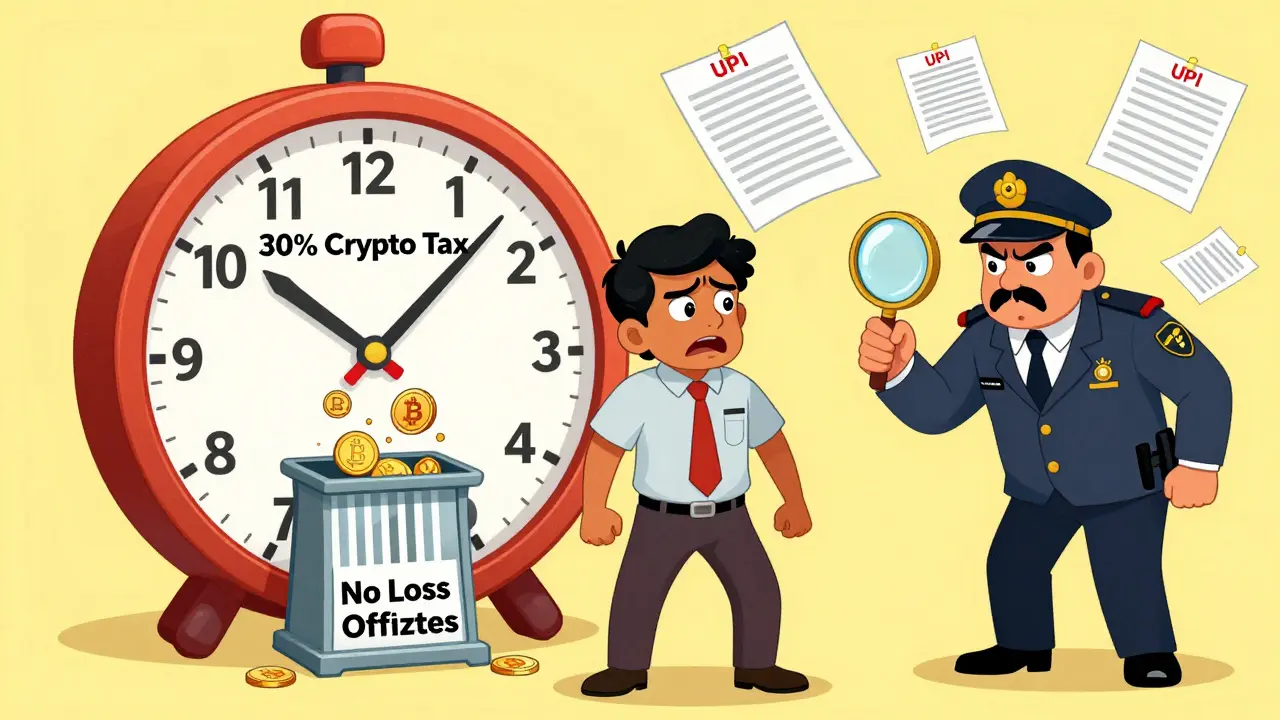
India’s approach to crypto taxes isn’t just strict-it’s one of the toughest in the world. If you’re trading, staking, or even just holding Bitcoin or Ethereum in India, you’re under the microscope. The government doesn’t treat crypto like stocks or real estate. Instead, it’s lumped in with gambling and lottery winnings. And that changes everything.
How Crypto Gains Are Taxed in India
Since April 2022, every profit from selling crypto is taxed at a flat 30%. No deductions. No loss carryforwards. Not even a standard deduction. If you bought Bitcoin for ₹5 lakh and sold it for ₹8 lakh, you pay ₹90,000 in tax-no matter if you lost money on other trades that year. That’s the rule under Section 115BBH of the Income Tax Act.
There’s no way to offset losses. Say you lost ₹2 lakh on Solana but made ₹3 lakh on Ethereum. You still pay tax on the ₹3 lakh. The ₹2 lakh loss? Gone. It doesn’t reduce your tax bill. This is unlike stocks, where losses can balance out gains. For crypto, every gain is treated like a standalone win.
The 1% TDS That Hits Every Trade
On top of the 30% tax, there’s a 1% Tax Deducted at Source (TDS) under Section 194S. Every time you sell crypto-whether on an exchange or peer-to-peer-the buyer must deduct 1% of the sale value and pay it to the government. This applies even if you’re selling to a friend.
It doesn’t matter if you’re breaking even or losing money. The 1% still gets taken. And if you’re using a decentralized exchange (DEX) or a wallet-to-wallet transfer, the law still applies. But here’s the catch: enforcement is messy. Most P2P trades go unreported. Exchanges like WazirX and CoinDCX collect it automatically, but if you’re using Phantom or MetaMask to trade directly, there’s no system to track it. That’s a loophole the government knows about-and is trying to close.
GST on Crypto Services: What You Pay Now
Starting July 7, 2025, 18% GST kicked in on almost every service crypto platforms offer. That includes:
- Trading fees
- Withdrawal or deposit charges
- Staking rewards processing
- Custody fees
- Wallet management
- KYC verification costs
Platforms must now register under GST-even if they make less than ₹20 lakh a year. That’s because they’re classified as Online Information and Database Access or Retrieval (OIDAR) services. It doesn’t matter if they’re based in Singapore or the U.S. If they serve Indian users, they must charge GST. This means your ₹10 trading fee now costs ₹11.80. It’s small, but it adds up.

How to Report Crypto Income
You can’t just ignore this. The government has added a dedicated section to income tax forms: ‘Schedule VDA’ (Virtual Digital Assets). You must file either ITR-2 (for capital gains) or ITR-3 (if you’re running a crypto business or mining operation). Both forms now require you to list every transaction-buy, sell, swap, or reward.
Exchanges provide Form 26AS and annual statements, but they don’t always capture off-platform activity. If you bought ETH from a friend or mined Bitcoin at home, you’re responsible for tracking that. The tax department doesn’t care if you didn’t know-ignorance isn’t a defense.
What Happens If You Don’t Pay?
Here’s the thing: India hasn’t published a single public case of someone being fined for crypto tax evasion. But that doesn’t mean there’s no risk.
Penalties fall under existing income tax rules. If you underreport or don’t file:
- You could face a penalty of up to 50% of the unpaid tax under Section 270A.
- If the tax department thinks you’re hiding income deliberately, the penalty jumps to 200%.
- Interest of 1% per month applies on unpaid tax from the due date.
- Failure to file can trigger a notice under Section 148, leading to a full audit of your finances.
And here’s what’s scary: the tax department now has access to data from exchanges, bank transfers, and even UPI logs. If you sent ₹10 lakh to a crypto exchange and didn’t report it, they can trace it. They’re not asking for your private keys-they’re watching your bank statements.
Why Enforcement Is Struggling
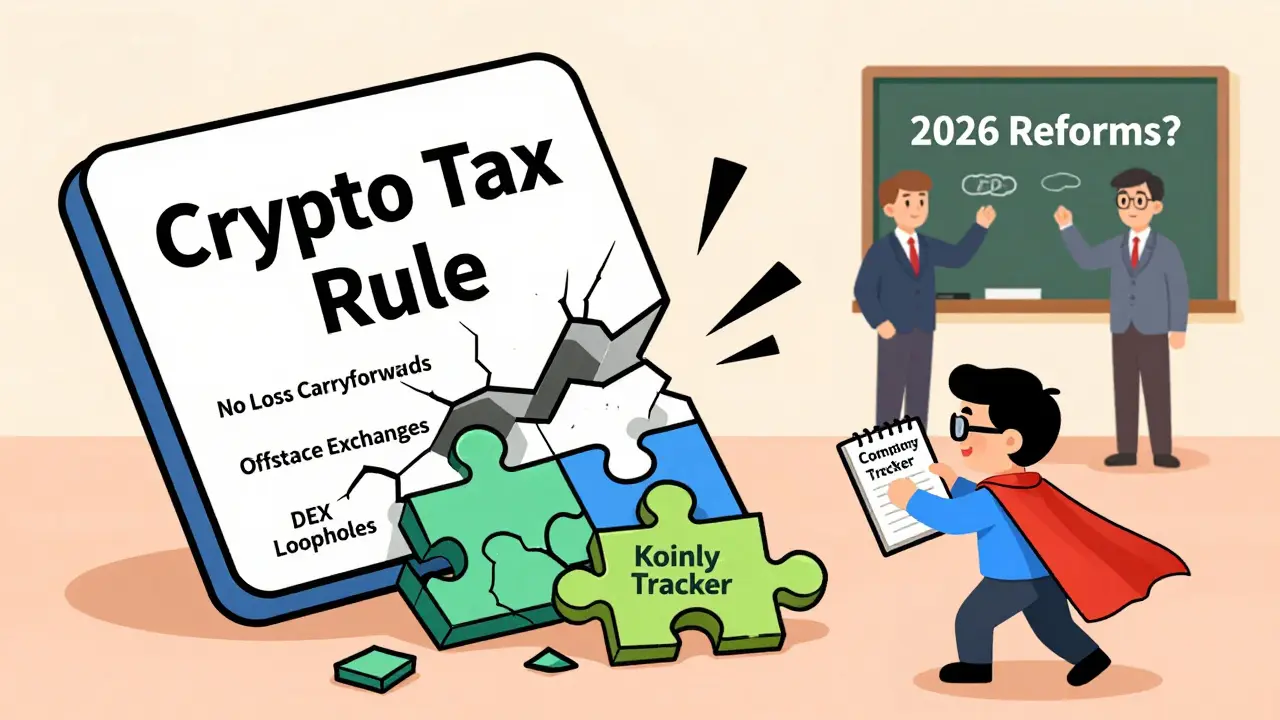
The system looks tight on paper, but it’s falling apart in practice. Here’s why:
- Offshore exchanges: Platforms like Binance and Bybit don’t collect TDS or GST for Indian users. Millions of Indians still trade there. The government can’t force them to comply.
- Decentralized trading: Using Uniswap or PancakeSwap? No one is deducting TDS. No one is reporting. It’s invisible to regulators.
- Miners and airdrops: If you mine Bitcoin or get a token airdrop, you owe tax based on its fair market value at the time. But how do you track that? Most people don’t. The government has no real-time price feed for every token.
- Losses can’t be claimed: This is the biggest flaw. Retail investors get crushed. A trader who lost ₹5 lakh last year still pays 30% on the ₹1 lakh they made this year. No relief. No fairness.
In August 2025, the Central Board of Direct Taxes (CBDT) started asking crypto companies hard questions: Is 30% too high? Is 1% TDS killing liquidity? Should India create a full crypto law? This isn’t just a review-it’s a sign the system is broken.
The Bigger Picture: Is Crypto Legal in India?
Here’s a common myth: crypto is banned in India. It’s not. The Supreme Court lifted the banking ban in 2020. But the government also says crypto isn’t legal tender. So it exists in a gray zone: legal to own, legal to trade, legal to tax-but not legal as money.
The Reserve Bank of India (RBI) still warns that crypto is risky. SEBI is pushing for regulation, not prohibition. The Ministry of Finance wants taxes, not control. That’s why enforcement is so patchy. No one agency owns it. No clear law governs it. Just a tax rule slapped on top of a legal void.
What’s Next? The Road to 2026
The government isn’t done. With crypto trading volumes shifting overseas, tax revenue is falling short. The 1% TDS is collecting billions-but not enough. The GST on services is new, and still being absorbed. The real change might come in 2026, when the CBDT’s review leads to:
- A reduction in the 30% rate
- Allowing loss offsets
- Exempting small traders under ₹10 lakh annual gains
- Creating a licensing system for crypto platforms
Until then, the safest move is to report everything. Even if the system feels unfair, the cost of getting caught far outweighs the tax bill. Keep records. Save screenshots. Track every transaction. Use tools like Koinly or CoinTracker to auto-generate reports. Don’t wait for a notice to come in.
India’s crypto tax system is designed to scare people away, not to raise revenue. But for those who play by the rules, it’s still possible to stay compliant-and avoid disaster.
Sarah Hammon
March 19, 2026 AT 11:04so i just found out that even if you lose money on crypto, india still taxes your gains like it's a lottery win?? that's wild. i'm from the us and we at least get to offset losses. this feels like punishment for trying to invest. i hope they change this soon. also, 1% tds on every trade?? that's gonna kill small traders. 🤦♀️
iam jacob
March 20, 2026 AT 08:10lol at the government pretending this is about revenue and not just control. they don't want you to win. they want you to stop. the 30% tax is basically a 'go away' tax. and don't even get me started on the tds. it's not enforcement, it's harassment.
Diane Overwise
March 20, 2026 AT 15:47Wow. Just... wow. The way India has structured this tax system is less 'policy' and more 'dramatic villain monologue.' 🎭 30% flat tax? No loss carryforwards? 1% TDS on peer-to-peer? This reads like a satirical sketch from The Onion. And yet, it's real. I admire the ambition, but the execution? It's like building a Ferrari with a lawnmower engine. Also, GST on wallet management? Someone's clearly been watching too many fintech webinars. 😅
Ann Liu
March 20, 2026 AT 21:56Correction: Section 115BBH applies to all virtual digital asset transactions, not just sales. Any transfer, including swaps, gifts, or staking rewards, triggers taxable income at fair market value at the time of receipt. Also, Form 26AS does not include off-chain transactions - this is a critical oversight. Users must maintain independent records, including timestamps, wallet addresses, and USD equivalents at time of transaction. Failure to do so risks penalties under Section 270A even if no tax is due.
Dionne van Diepenbeek
March 22, 2026 AT 11:32why is everyone so mad about the 30 percent tax when the real issue is the 1 percent tds on every single transaction even if you break even i mean come on its like taxing the air you breathe also no one talks about how dexes are basically immune to this and that's where all the real trading is happening so the whole system is a joke
Graham Smith
March 23, 2026 AT 03:25The structural inefficiencies of India’s VDA tax regime are symptomatic of a broader macroeconomic misalignment. The 30% flat rate, absent any marginal utility adjustments or capital gains calculus, represents a regression to pre-20th-century fiscal dogma. Furthermore, the imposition of Section 194S TDS without a corresponding mechanism for reconciliation via Form 16 or audit trail creates a compliance asymmetry that violates the principle of equitable administration. In essence, this is not taxation - it’s algorithmic extraction.
Anastasia Danavath
March 24, 2026 AT 13:55so like... i just bought 0.05 eth on binance and paid 1% tds on it?? and then got charged 18% gst on the 2 dollar fee?? and now i owe 30% on a 10 dollar profit?? i'm not even rich and this is already more than my rent. i give up. 🤡
anshika garg
March 25, 2026 AT 12:19as an indian, i feel this in my bones. we are told to be disciplined, to save, to follow rules - but then they slap a tax on our dreams. crypto was supposed to be freedom. now it’s just another ledger of guilt. i know people who lost lakhs last year and still paid tax on the one gain they had. it’s not fair. it’s not smart. it’s just... sad. we need a system that understands risk, not one that punishes hope.
Bruce Doucette
March 26, 2026 AT 17:41of course you’re paying 30% - you’re not a hedge fund, you’re a guy with a phone. if you can’t afford to pay taxes on your crypto gains, maybe you shouldn’t be trading in the first place. also, dex? please. if you’re using metamask to dodge tds, you’re not a pioneer, you’re a tax evader. get a real job.
Marie Vernon
March 27, 2026 AT 07:14hey, i just want to say - this whole system feels so heavy, but honestly? you’re not alone. if you’re reading this, you’re trying. you’re tracking your trades, you’re reading the rules, you’re not giving up. that’s huge. the system is broken, but your effort matters. use cointracker. save screenshots. keep receipts. and if you’re scared? talk to someone. there’s a whole community out here rooting for you. you’ve got this 💪🌍