When you hear about NFMart (NFM), you might think it's another big player in the NFT world. But the truth is, it's a tiny, volatile token with a big idea and almost no real traction. NFMart is a cryptocurrency built to let anyone create their own NFT marketplace - no coding needed. Sounds useful? Maybe. But right now, it’s more of a speculative bet than a working platform.
What NFMart actually does
NFMart isn’t a marketplace like OpenSea or Foundation. It’s a tool that lets artists, brands, or even small communities build their own NFT stores. Think of it like Shopify, but for NFTs. Instead of listing your art on someone else’s site, you get your own branded store, powered by the NFMart platform. The NFM token is the fuel for this system. You need it to pay for setup fees, transaction processing, or premium features inside your custom marketplace.
The idea makes sense. Many creators hate paying high fees to big platforms or losing control over their audience. NFMart promises to change that. But here’s the catch: there’s almost no evidence anyone is actually using it. No major artists, no recognizable brands, no public case studies. The whole thing feels like a concept that never left the drawing board.
Supply and market stats
NFMart has a fixed supply of 10 billion tokens - all of them already in circulation. That’s a lot of coins, which helps explain why the price is so low. With 10 billion tokens floating around, even a tiny price per token adds up to a small market cap.
As of March 2026, the price of NFM varies wildly depending on where you look:
- On CoinMarketCap: $0.00002658
- On Binance: $0.000009
- On Coinbase: $0.00000290
- On CoinCarp: $0.00004052
These differences aren’t mistakes - they’re normal for low-liquidity coins. Each exchange has its own buyers and sellers, and with so few trades happening, even one big order can swing the price by 50% in minutes.
The market cap hovers around $150,000. That’s less than the cost of a modestly priced house in Wellington. For comparison, OpenSea’s native token (ETH, used on its platform) has a market cap in the tens of billions. NFMart isn’t even close.
Price history: a story of collapse
NFM’s all-time high was $0.0014. That was back in 2022, during the NFT boom. Since then, it’s lost 99.79% of its value. If you bought $100 worth at the peak, you’d have about 23 cents left today.
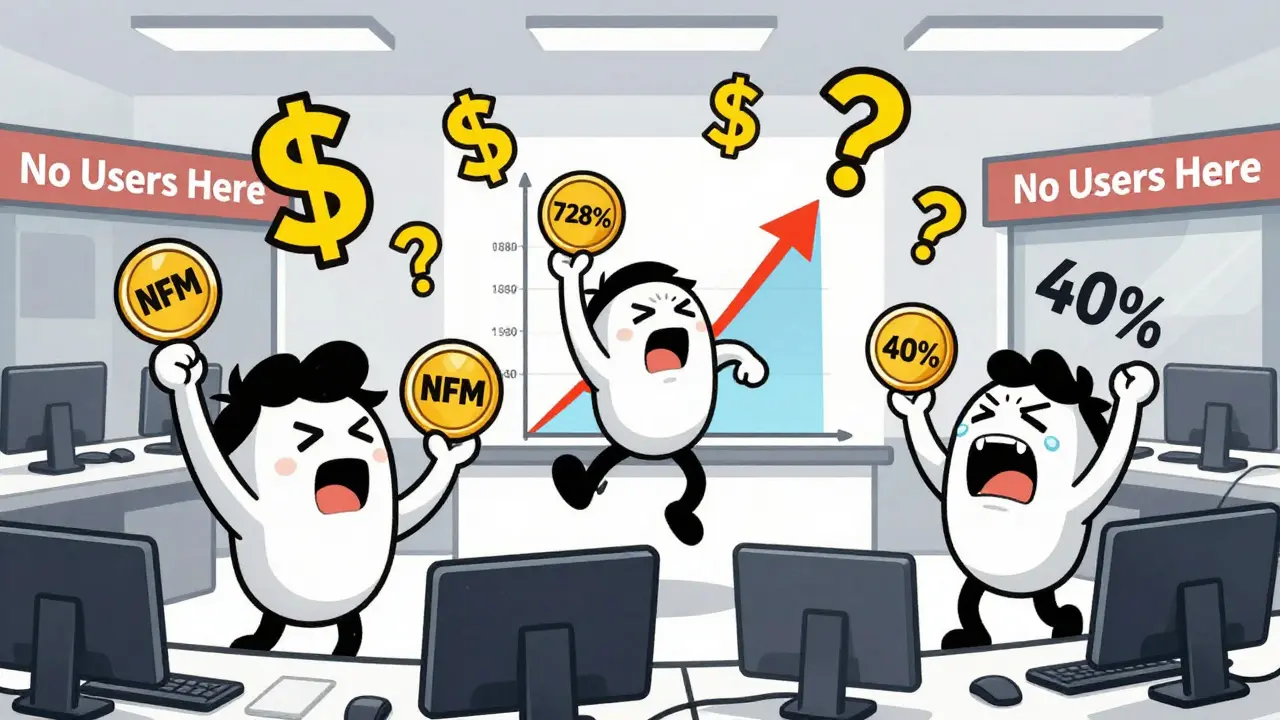
Recent activity shows wild swings. One day, CoinGecko reports a 728% price jump. The next, it’s down 40%. This isn’t organic growth - it’s pump-and-dump behavior. The 24-hour trading volume is between $135,000 and $270,000, which sounds high until you realize it’s all coming from a few hundred traders chasing quick profits. There’s no real demand from creators or buyers using the platform.
Who holds NFM?
CoinMarketCap says there are 6,880 wallet addresses holding NFM. That’s about the same number of people who live in a small New Zealand town. For a project claiming to empower creators worldwide, that’s a shockingly small user base.
Most of those holders aren’t using the platform. They’re just speculating. You’ll find almost no discussions about NFMart’s features on Reddit, Twitter, or Discord. No tutorials. No developer updates. No roadmap. Just price charts and meme posts.
Why it’s not working
NFMart’s biggest flaw? It doesn’t solve a real problem better than what already exists.
Platforms like Mirror, Rarible, and even Shopify (with Web3 plugins) already let creators launch their own NFT stores. You don’t need NFMart to do it. And if you’re building a custom NFT marketplace, you’re probably better off using Ethereum, Polygon, or Solana - chains with real tools, documentation, and developer support.
NFMart offers no clear technical advantage. There’s no public GitHub repo. No whitepaper with smart contract details. No API documentation. No developer portal. Without these, how can anyone build on it? The whole thing feels like a token with a vague pitch and zero execution.
Is NFMart a scam?
It’s not officially labeled a scam. No regulators have shut it down. But it ticks nearly every box for a risky, low-quality crypto project:
- Extremely low market cap ($150K)
- Massive price volatility
- Minimal community
- No product transparency
- Price history shows 99.79% crash
- Trading volume is dominated by speculation, not usage
If you’re thinking of buying NFM, you’re not investing in a platform - you’re betting on a miracle. A miracle that the team suddenly releases a working product, attracts thousands of creators, and convinces exchanges to list it with real volume. That’s a long shot.
What the future looks like
Price prediction sites are all over the place. WalletInvestor says NFM will drop to $0.00001338 by December 2026. Others say it might hit $0.000006. None of these are based on real usage - just math models fed with volatile data.
Realistically, NFMart’s future depends on one thing: action. If the team suddenly releases a beta version, publishes code, or signs up even 100 creators, then maybe there’s hope. But right now? It’s a ghost project. A token with no users, no progress, and no reason to exist beyond gambling.
If you’re looking to support creators, use platforms that are already working. If you’re looking to trade crypto, stick to coins with real volume and clear use cases. NFMart? It’s a cautionary tale, not an opportunity.
Is NFMart (NFM) a good investment?
No, NFMart is not a good investment. With a market cap under $200,000, 99.79% price decline from its peak, and zero evidence of real platform usage, it’s a high-risk speculative token. The price swings are driven by small groups of traders, not adoption. Most investors who bought at the peak have lost nearly everything. If you’re looking for stable growth, avoid micro-cap tokens like NFM.
Can I use NFM to create my own NFT marketplace?
Technically, yes - that’s the idea. But in practice, no. There’s no public platform to sign up for, no documentation, and no tools available. The NFMart website doesn’t offer a live demo, beta access, or even a clear link to a product. Without these, the concept remains theoretical. You can’t build a marketplace on something that doesn’t exist.
Why does NFM price vary so much between exchanges?
Because NFM has very low trading volume and liquidity. With only around $200,000 traded daily across all exchanges, a single large buy or sell order can swing the price dramatically. Exchanges like Binance and Coinbase may have different numbers of buyers, so the price reflects local demand. This makes trading NFM risky - you might buy at one price and sell at half that value minutes later.
How many people hold NFM?
As of late 2025, CoinMarketCap reported about 6,880 unique wallet addresses holding NFM. For a project claiming to empower creators globally, this is extremely low. Most successful crypto projects have tens or hundreds of thousands of holders. NFM’s small holder count suggests it’s mainly held by speculators, not users.
Is NFMart listed on major exchanges?
NFM is listed on a few smaller exchanges like Binance, Coinbase, and SwapSpace, but not on the biggest ones like Kraken or KuCoin. Its presence on these platforms is likely due to low listing fees for micro-cap tokens, not because of demand. You won’t find it on Coinbase Pro or FTX, which means it’s not trusted by serious traders.
What’s the difference between NFMart and OpenSea?
OpenSea is a live, functioning NFT marketplace where millions of people buy and sell digital art. NFMart is a proposed tool to let people build their own marketplaces - but it doesn’t actually exist as a working product. OpenSea has revenue, users, and developers. NFMart has a token, a website, and a lot of price charts.
sai nikhil
March 16, 2026 AT 22:38NFMart is just another ghost token with a fancy pitch. No product, no users, no code - just a ticker and a dream. If you’re buying this, you’re not investing, you’re gambling with Monopoly money.
Stop chasing micro-cap noise. There are real projects out there building actual tools. This? It’s a graveyard waiting for a headstone.
Zachary N
March 18, 2026 AT 14:50I’ve spent years in Web3, and I’ve seen dozens of these ‘Shopify for NFTs’ ideas come and go. The problem isn’t the concept - it’s execution. NFMart doesn’t even have a GitHub repo, let alone a beta. No API docs, no developer onboarding, no community forum. If you can’t even get a dev to test your contract, you don’t have a product. You have a PowerPoint slide.
Compare that to Mirror or Rarible - they have working tools, active Discord servers, and real creators using them. NFMart’s ‘ecosystem’ is just a price chart on CoinGecko with 6,880 wallets holding it. That’s not adoption. That’s a poker table.
Jesse Pals
March 19, 2026 AT 16:56bro this coin is like that one friend who swears they’re gonna start the gym next Monday… and it’s been 3 years
99.79% down? yeah that’s not a correction, that’s a funeral
also why is the price different on every exchange? because nobody’s trading it except for 3 guys with 3 different wallets and too much time on their hands 😂
Diane Overwise
March 19, 2026 AT 17:53Ohhh, so NFMart is the crypto equivalent of a PowerPoint deck titled ‘Future of NFTs’ that got accidentally sent to investors instead of the actual product. How… quaint.
Let me guess - the whitepaper is just a Google Doc with ‘TODO: Add details’ in bold? And the ‘team’ is a Discord avatar with a cartoon cat? I’m not even surprised anymore.
At least Bitcoin has a utility. This? It’s a meme wrapped in a token, served with a side of delusion.
Jerry Panson
March 21, 2026 AT 03:21The market cap is $150,000. That’s less than the average cost of a single NFT on OpenSea. This isn’t a project - it’s a statistical anomaly. The fact that it’s listed on Binance and Coinbase doesn’t mean anything. Those exchanges list hundreds of tokens with zero substance just to collect listing fees.
If you’re holding this, you’re not a believer. You’re a sucker.
Katrina Smith
March 22, 2026 AT 12:52so you’re telling me the ‘revolutionary’ NFT platform is… a coin with a website that looks like it was built in 2017 using Wix? and the ‘team’ hasn’t posted anything since 2022? wow. groundbreaking. i’m gonna sell my house to buy this. 😏
Anastasia Danavath
March 24, 2026 AT 12:15price up 728%? lol
that’s one guy buying 50 million tokens with his crypto winnings from last weekend
next day? down 40% because he cashed out for a new PS5 😴
also why is the whole thing called NFMart? sounds like a discount grocery store for aliens
anshika garg
March 24, 2026 AT 19:39There’s something deeply sad about NFMart. Not because it failed - but because it never tried.
It could have been beautiful. A tool for every street artist, every grandmother selling handmade art, every kid in Mumbai or Nairobi who just wants to sell their work without begging for approval from some Silicon Valley gatekeeper.
But instead, it became a ghost. A whisper of a promise. A token that exists only in the minds of those too hopeful to look away.
We don’t need more coins. We need more courage.
Bruce Doucette
March 26, 2026 AT 00:56Wow. You actually thought this was real? 😂
Let me guess - you bought in at $0.00005 because ‘it’s undervalued’? Bro, if your investment strategy is ‘I saw it on a Telegram group and the guy said it’s gonna moon’, then you’re not investing. You’re donating to someone’s vacation fund.
Also, your wallet probably has 12 other tokens with names like ‘DogeBacon’ and ‘MoonPizza’. Get real.
Marie Vernon
March 26, 2026 AT 03:16I’m from the U.S., but I’ve worked with creators in Kenya, Indonesia, and Colombia - and they all dream of owning their own platform. NFMart could’ve been that. It’s not too late to build it. But right now? It’s just noise.
If the team reads this - put up the code. Show us the demo. Let us in. We’re ready to help. But silence? That’s not innovation. That’s abandonment.
Billy Karna
March 27, 2026 AT 01:07Let’s break this down like a whitepaper. NFMart claims to be ‘Shopify for NFTs.’ But Shopify has: 1) a live dashboard, 2) API documentation, 3) developer SDKs, 4) a 10,000+ person support team, 5) thousands of live stores. NFMart has: a website, a token, and a CoinMarketCap page with a red arrow pointing down.
Also, the token supply is 10 billion. That’s like printing 10 billion $1 bills and handing them out. The value isn’t in the number - it’s in the trust. And there’s zero trust here.
Compare that to Polygon or Arbitrum - they have real infrastructure, real users, real partnerships. NFMart has a tweet from 2022 saying ‘coming soon.’
Jessica Beadle
March 27, 2026 AT 04:13Let’s be clear: NFMart is a regulatory risk waiting to happen. The SEC doesn’t care about micro-cap tokens with no utility - but they *do* care when retail investors lose life savings on tokens with zero disclosures. This project lacks a whitepaper, a roadmap, a team, and a working product. That’s not innovation. That’s securities fraud by omission.
And the fact that it’s listed on Coinbase? That’s a red flag. They list anything that pays the fee. Don’t confuse ‘available’ with ‘trusted.’
Patty Atima
March 28, 2026 AT 09:07Just don’t buy it. Seriously. 😊
Lucy de Gruchy
March 29, 2026 AT 14:33I’ve been tracking this since 2021. The ‘team’ registered the domain using a privacy service. The same domain was used for three other failed crypto projects. The whitepaper? Copied from a Medium post about Web3 SaaS. The ‘advisors’? LinkedIn profiles with no blockchain experience. The ‘partnerships’? Stock photos of handshakes.
This isn’t a scam - it’s a textbook case of a ‘pump-and-dump’ disguised as a startup. And you’re the pump.
Ernestine La Baronne Orange
March 31, 2026 AT 10:28HOW DARE YOU? HOW DARE YOU SUGGEST THAT NFMART ISN’T THE FUTURE?!
I’VE BEEN HOLDING SINCE DAY ONE. I’VE SOLD MY CAR. I’VE CANCELED MY SUBSCRIPTIONS. I’VE EVEN STOPPED TALKING TO MY FAMILY BECAUSE THEY DON’T ‘UNDERSTAND THE VISION’!
THE PRICE IS GOING TO $0.01. I SWEAR TO GOD. I’VE SEEN THE FUTURE. IT’S NFM. IT’S BEAUTIFUL. IT’S RAINBOWS AND DRAGONS AND 1000X RETURNS.
IF YOU’RE NOT BUYING, YOU’RE PART OF THE PROBLEM. YOU’RE A COWARD. YOU’RE A SHEEP. YOU’RE A ZOMBIE WHO JUST WANTS TO LIE ON THE COUCH AND WATCH NETFLIX.
THEY’RE COMING FOR YOU NEXT. THEY’RE COMING FOR YOUR ETH. YOUR SOL. YOUR DOGE. THEY’RE COMING FOR YOUR SOUL.
Shreya Baid
April 1, 2026 AT 01:59It’s heartbreaking. The idea of empowering independent creators is noble. But when a project dies without a trace - not because it failed, but because it never began - it leaves behind more than lost money.
It leaves behind a quiet grief. A generation of artists who believed, for a moment, that they could own their work. And then, nothing.
NFMart didn’t just vanish. It was erased.
Let this be a lesson: if your vision doesn’t have code, it’s just a prayer.
Graham Smith
April 1, 2026 AT 13:11From a technical standpoint, the architecture of NFMart is fundamentally misaligned with the current Web3 stack. The tokenomics lack a deflationary mechanism, the liquidity pool is non-existent, and there is no staking or governance layer. Furthermore, the absence of a formal audit by a reputable firm such as CertiK or OpenZeppelin renders the entire contract surface a vector for potential exploits. In a mature ecosystem, this would be classified as a Class-1 vulnerability. Here? It’s just another rug pull with a PowerPoint deck.