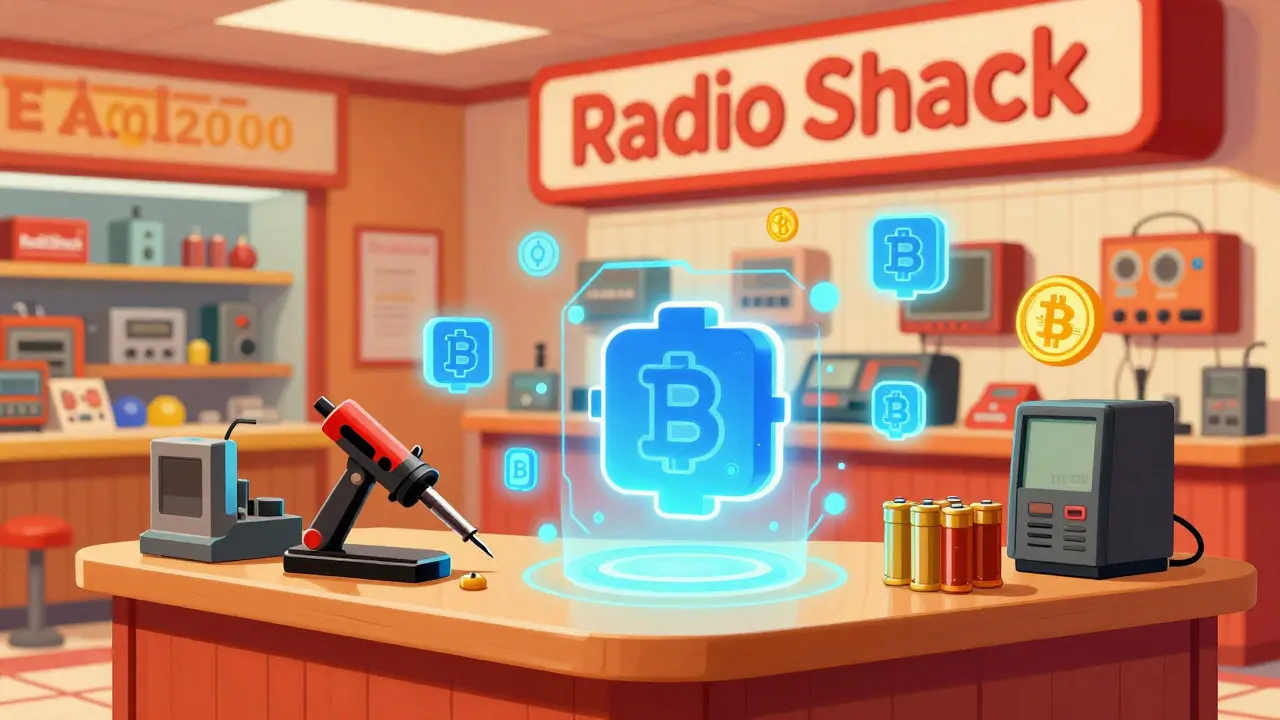
To understand what we're dealing with, we first need to define the core of the project. RadioShack DeFi is a decentralized exchange (DEX) platform built on blockchain technology that allows users to swap cryptocurrencies without a central authority. Unlike traditional exchanges, this platform focuses on peer-to-peer transactions powered by smart contracts. It operates primarily through its utility token, RADIO, which handles everything from governance to fee discounts.
The Quick Verdict: Should You Use It?
If you are a complete beginner who wants to experiment with small amounts of money (under $50) and you love the nostalgia of a classic retail brand, RadioShack DeFi is a curious place to start. The interface is intuitive and the fees for micro-transactions are incredibly low. However, if you are a serious trader or an institutional investor, you should probably look elsewhere. The lack of liquidity and a very small selection of trading pairs make it impractical for anyone moving significant capital.
| Feature | RadioShack DeFi | Uniswap | PancakeSwap |
|---|---|---|---|
| Trading Pairs | ~12 (Low) | 250,000+ (Massive) | High |
| Avg. Transaction Fee | $0.0007 | Variable (Higher) | Low |
| Total Value Locked (TVL) | $1.7 Million | $5.2 Billion | High |
| Avg. Slippage | 1.8% | Very Low | 0.35% |
How the Platform Actually Works
The technical backbone of the platform is designed for speed. It leverages Algorand Standard Assets (ASAs), which allow the platform to create customizable blockchain assets on Layer-1. This is why transaction settlements are nearly instantaneous. In internal tests, confirmation times averaged around 2.3 seconds. For a user, this means you aren't staring at a loading screen for minutes while wondering if your trade went through.
Getting started is relatively straightforward, which is a win for the "everyman" trader. You'll need a Web3 wallet-something like MetaMask, a popular browser extension wallet, or a hardware solution like Ledger. Once connected, you'll undergo a KYC (Know Your Customer) process. While some DeFi purists hate KYC, RadioShack implements it to stay compliant with FinCEN's Travel Rule, especially for transfers over $3,000. The verification usually takes about 22 minutes, which is faster than most traditional bank account openings.
The Role of the RADIO Token
The RADIO Token is the fuel for this entire ecosystem. It isn't just a speculative asset; it has actual utility. If you hold RADIO, you can get discounts on swap fees, which typically range from 0.15% to 0.30%. You also get a seat at the table for governance voting, meaning you can help decide the future direction of the platform.
However, the market performance of RADIO has been volatile. It started trading around $0.000350 in early 2025, and analysts are split on where it's going. Some see a path to $0.00289 by 2031 if the brand can successfully onboard its old retail customer base. Others, like the technical team at CoinDataFlow, have warned that the token is overvalued based on RSI and CCI metrics and could drop significantly if active users don't grow.
Where It Wins: The Micro-Transaction Edge
There is one area where RadioShack crypto exchange actually beats the big players: the cost of tiny trades. For any swap under $50, the fee structure is roughly 47% more cost-effective than what you'd find on Ethereum-based DEXs. If you're just playing around with a few dollars to learn how liquidity pools work, this is a huge advantage. You aren't paying $2 in gas fees to move $5 worth of crypto.
The interface is also designed for people who aren't "crypto-native." It doesn't overwhelm you with complex charts and flashing red numbers immediately. It’s a "clean" experience that makes the learning curve very short-most new users report getting the hang of it in about an hour or two.
The Red Flags: Liquidity and Reliability
Now for the bad news. The biggest problem facing RadioShack DeFi is liquidity. In the crypto world, liquidity is everything; it's the difference between a smooth trade and losing a chunk of your money to "slippage." Because the Total Value Locked (TVL) is only around $1.7 million, the pools are shallow. If you try to make a medium-sized trade, you'll likely experience an average slippage of 1.8%.
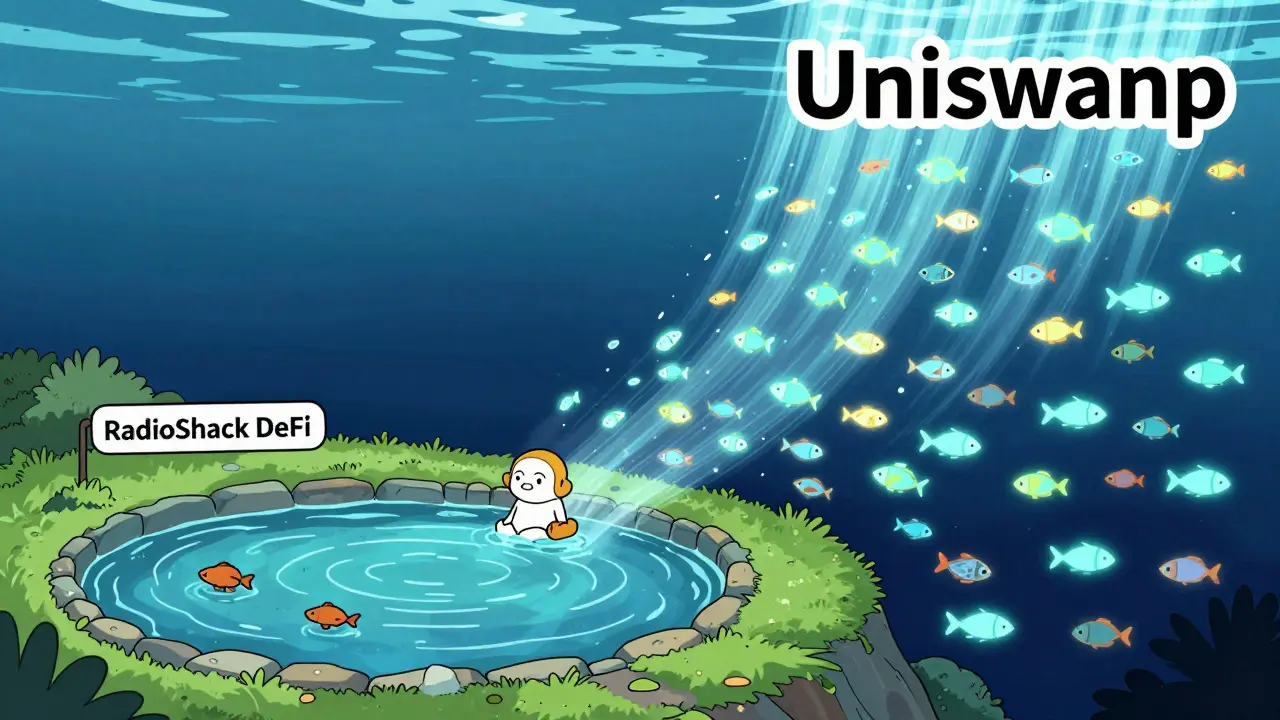
Even worse, if you try to trade more than $7,300 in a single go, the price impact becomes severe. You'll essentially be pushing the price of the asset against yourself. Compared to Uniswap, which handles billions, RadioShack is a pond trying to compete with an ocean. This lack of depth has led to a string of failed transactions during peak hours, a common complaint among the few users on Trustpilot.
Customer support is another weak point. With only a handful of moderators on their Discord server, response times for technical issues can stretch to 72 hours. In a market that moves in milliseconds, waiting three days for a support ticket is an eternity.
The Big Picture: Can a Retail Brand Survive in DeFi?
RadioShack is betting on its history. They have a database of millions of former customers and a few hundred physical stores still operating. The theory is that they can use these stores as "fiat on-ramps," where a person can walk in, hand over cash, and get crypto in their wallet. This is a brilliant strategy on paper because the hardest part of crypto adoption is the bridge from the real world to the digital one.
But brand recognition doesn't equal technical expertise. As Dr. Sarah Kim from the Harvard Blockchain Lab pointed out, there is a massive execution risk here. Building a DEX is easy; maintaining a secure, liquid, and competitive ecosystem is incredibly hard. Currently, they only offer about 12 trading pairs. For comparison, some competitors offer hundreds of thousands. Until they introduce the planned version 2.0-which promises limit orders and cross-chain swaps for Ethereum and Binance Smart Chain-they remain a niche curiosity rather than a serious tool.
What is the RADIO token used for?
The RADIO token is the native utility token of the RadioShack DeFi platform. It is used to pay for transaction fees (with discounts for holders), participate in governance voting to decide platform updates, and earn incentives through liquidity pools.
Is RadioShack DeFi safe to use?
The platform uses standard Web3 security and Algorand's Layer-1 architecture, which is generally secure. However, it has very low liquidity, which can lead to failed transactions and high slippage. Like any DeFi project, there is an inherent risk of smart contract vulnerabilities.
How do I get started with the exchange?
You need a compatible Web3 wallet like MetaMask or Trust Wallet. Connect your wallet to the platform, complete the KYC verification process (which takes about 22 minutes), and fund your account with RADIO tokens or other supported cryptocurrencies.
Why are there so few trading pairs?
RadioShack DeFi is in a very early stage of development. They have focused on a small set of core pairs to establish their infrastructure before expanding. Their roadmap for version 2.0 includes expanded compatibility and more assets.
Does the platform have a mobile app?
Yes, the platform provides mobile applications compatible with iOS 14+ and Android 10+ devices, allowing users to manage their swaps and tokens on the go.
Final Advice and Next Steps
If you're determined to try RadioShack DeFi, start small. Don't dump your life savings into a pool with a $1.7 million TVL. Use it as a learning tool to understand how decentralized swaps work without paying the steep gas fees associated with the Ethereum network.
For those who find the liquidity too limiting, you might want to explore more established alternatives. If you need high volume and thousands of pairs, Uniswap is the industry standard. If you want a balance of low fees and high speed, looking into Solana-based exchanges like Raydium would be a logical next step. Keep an eye on the Q3 2025 update for RadioShack; if they actually deliver limit orders and cross-chain functionality, they might move from a "curiosity" to a "competitor."
Robert Smith
April 29, 2026 AT 00:38Wild times we live in lol 🔋🚀
Felix Eduardo Velasquez
May 1, 2026 AT 00:01The conceptual irony of a bankrupt electronics chain transitioning into DeFi is fascinating. Most people miss the point that brand equity in the physical world rarely translates to trust in the digital asset space. For a platform to survive, it needs deep liquidity and a genuine utility that isn't just a nostalgic wrapper around an Algorand asset. The technical speed is a non-issue since most users don't actually care about 2-second settlement times as much as they care about not losing 2% of their trade to slippage. We are seeing a trend where dead brands try to 'pivot' into crypto to attract venture capital or retail gambles, but without a massive influx of TVL, this is just a ghost town with a famous name. The only real value here is the potential for physical on-ramps, though the regulatory hurdles for a brick-and-mortar store to act as a crypto exchange are immense and often underestimated by the marketing teams. If they can't solve the liquidity problem, the RADIO token is just another speculative asset in a sea of thousands. It is a classic case of style over substance in the current market cycle.
Alex Mazonowicz
May 1, 2026 AT 04:32This sounds like such a cool idea!!! I love the nostalgia factor!!! Hope it actually takes off!!!
Livvy Cooper
May 1, 2026 AT 08:08Just sounds like another scam to me. Why would I use this? It's just bad.
Gabby Puche
May 2, 2026 AT 16:50Totally agree with the point about starting small! Great way to learn for newbies 🌟✨
Veronica Bago
May 3, 2026 AT 22:42It's honestly kind of funny seeing RadioShack try to be high-tech again. I might check it out just for the laughs.
Arti Jain
May 4, 2026 AT 03:37Pathetic. Indian exchanges are far superior. Purely amateur.
VIVEK SINGH
May 5, 2026 AT 14:35Oh wow, a retail store from the 80s is now a DEX. Truly the pinnacle of innovation. I'm sure the 'governance' will be just as efficient as their store inventory management was in 2005. Imagine thinking a brand name fixes a $1.7 million TVL. Absolute genius.
Harvey Alford
May 6, 2026 AT 22:53I lost money on a similar coin. Do you have money now?