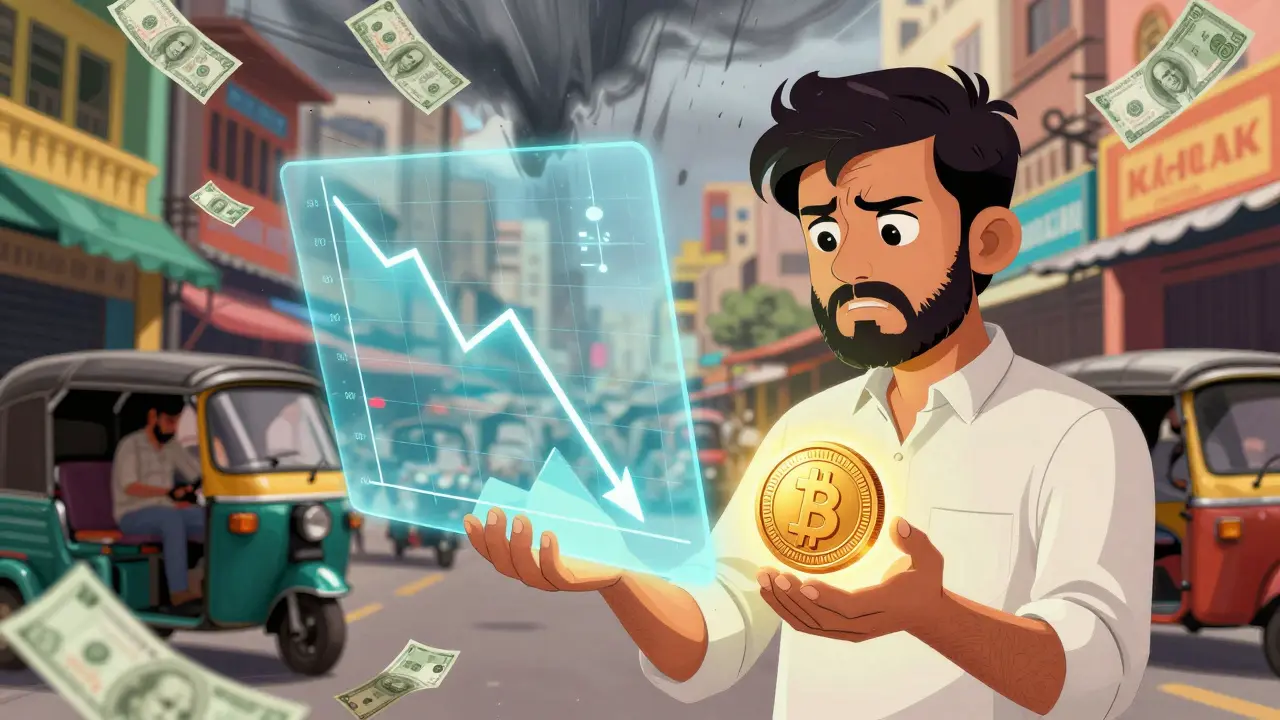
Imagine living in a country where your local currency loses value so fast you can almost feel it happening in real-time. For millions of people in Pakistan, this isn't a hypothetical scenario; it's daily life. Despite a legal gray area and the constant threat of government crackdowns, an estimated cryptocurrency users in Pakistan is a rapidly growing demographic of digital asset holders using blockchain technology to survive economic instability. With numbers climbing toward 27 million, the surge isn't about getting rich quick-it's about financial survival.
The Numbers Behind the Surge
When you look at the data, the growth is staggering. By the end of 2025, projections suggest the user base will hit 27 million. Some estimates are even bolder, suggesting up to 40 million Pakistanis hold some form of digital asset. Why the gap? It comes down to how people trade. While verified exchange accounts show around 18.2 million users, a massive amount of activity happens via peer-to-peer (P2P) networks, which are nearly impossible for regulators to track.
This growth isn't just a fluke. Pakistan added roughly 5.4 million new users in a single year, pushing the country into the top ten global markets for adoption. For a population of over 255 million, this represents a significant shift in how the youth and urban professionals handle money. In cities like Karachi and Lahore, Blockchain is no longer a buzzword; it's a tool for wealth preservation.
Survival Over Speculation: Why Pakistanis Buy Crypto
In developed nations, people often buy crypto as a speculative bet. In Pakistan, it's a hedge. When the Pakistani rupee fluctuates wildly, Stablecoins-digital assets pegged to the US Dollar-become a lifeboat. People aren't necessarily gambling on the next big coin; they are moving their savings into assets that won't evaporate overnight due to inflation.
Beyond saving, there is the freelance economy. Pakistan has one of the largest freelance populations in the world. Traditional banking systems are slow, expensive, and often plagued by bureaucracy. Receiving a payment from a client in New York or London via a bank can take days and eat a huge chunk of the profit in fees. Cryptocurrency allows these workers to receive payments almost instantly with minimal costs. It has turned the country into a global hub for remote talent who prefer Digital Assets over legacy banking.
| Driver | Pakistan (Emerging) | Developed Markets |
|---|---|---|
| Primary Goal | Inflation Hedging & Utility | Investment & Speculation |
| Payment Use Case | Freelance & Remittances | Institutional Trading |
| Adoption Driver | Economic Necessity | Technology Interest |
| Preferred Asset | Stablecoins (USDT/USDC) | Growth Assets (BTC/ETH) |

The Tug-of-War With Regulators
The relationship between the government and crypto users is... complicated. Since 2022, there have been talks of banning cryptocurrency entirely. The government has even considered blocking websites and exchanges. However, a ban is nearly impossible to enforce. How do you ban a decentralized network that lives on thousands of computers globally?
Interestingly, while the government warns against private crypto, the State Bank of Pakistan is moving toward its own digital solution. Plans for a Central Bank Digital Currency (CBDC), expected by 2025, show that the state recognizes the efficiency of digital payments. They want the technology, but they want the control. This creates a strange paradox: the government is building a digital currency while simultaneously making the private ones a legal gray area.

The Digital Divide: The Real Bottleneck
If the demand is so high, why hasn't everyone jumped in? The answer is infrastructure. Only about 45.7% of the population has stable, high-speed internet. If you live in a rural village, the "future of finance" is irrelevant if you can't get a steady signal to load your wallet. This digital divide means that crypto adoption is currently concentrated in urban hubs.
Moreover, while the community is highly engaged on social media and local forums, there is a lack of formal education. Many users rely on YouTube tutorials and WhatsApp groups. This makes them vulnerable to scams, which is often the primary argument the government uses to justify restrictions. But for many, the risk of a scam is smaller than the guaranteed risk of their money losing value in a traditional bank account.

How Pakistan Compares Globally
When you put Pakistan next to other emerging markets, the patterns are striking. Nigeria is a similar story, with over 22 million owners and a massive focus on P2P trading to bypass currency controls. India leads the region with 97.5 million users, but India's market is more diverse, spanning from high-net-worth investors to retail traders.
Pakistan's 4.1% adoption rate (based on conservative estimates) is impressive because it happened despite zero government support and poor internet penetration. Most people in the West don't realize that in these regions, crypto isn't a "luxury" hobby-it's a critical piece of financial infrastructure for the middle class.
What Happens Next?
The trajectory is clear: more people will enter the market as long as the economic pressures remain. The target of 27 million users and $1.6 billion in industry revenue by the end of 2025 isn't just a guess; it's a reflection of the current momentum. The only way growth slows is if the government provides a legal, stable, and efficient alternative for cross-border payments.
Until then, the grassroots movement will continue. We are likely to see a hybrid ecosystem where the CBDC handles official government transactions, while private cryptocurrencies continue to power the freelance and remittance economy in the shadows. The technology has already proven it can thrive without permission.
Is cryptocurrency legal in Pakistan?
It exists in a legal gray area. While there is no law explicitly making it a crime to own crypto, the government and the State Bank of Pakistan have issued warnings against its use and have considered bans. Most users operate via P2P platforms to avoid direct banking restrictions.
Why are so many freelancers in Pakistan using crypto?
Freelancers use crypto to avoid the high fees and long delays associated with traditional banks. It allows them to receive international payments almost instantly and convert them to local currency or hold them as stablecoins to protect against inflation.
What is a CBDC and how does it differ from Bitcoin?
A Central Bank Digital Currency (CBDC) is a digital version of a country's fiat currency, issued and controlled by the central bank. Unlike Bitcoin, which is decentralized and independent, a CBDC is fully regulated and monitored by the government.
How do Pakistanis trade crypto if exchanges are restricted?
Many use Peer-to-Peer (P2P) trading. This involves two individuals trading directly with each other; one sends the crypto, and the other sends the local currency via a mobile wallet or bank transfer, bypassing the need for a centralized exchange to handle the funds.
What is the main risk for crypto users in Pakistan?
The biggest risks are regulatory uncertainty (potential bans) and the prevalence of scams. Because there is no official regulatory framework, users have little recourse if they are defrauded by a fraudulent platform or individual.
Sandeep Bhoir
April 14, 2026 AT 12:40Same story in India, just a different scale. People think it's all about the moon shots, but for most of us in the region, it's just a way to stop the government from eating our savings through inflation. Oh, and the irony of a CBDC being the solution while banning the private stuff is just peak bureaucracy.
John and Lauren Busch
April 15, 2026 AT 00:09Wild how the West thinks this is just a gamble while people are literally using it to survive. Pure irony.
Shantal Sanjur
April 16, 2026 AT 00:23Oh honey, you actually believe these "numbers"? Please. It's probably just a massive money-laundering operation for the elites and they're using these poor freelancers as a cover story to make it look grassroots. Wake up. The CBDC isn't about "efficiency," it's about total surveillance. They want every single cent tracked in real-time so they can flip a switch and freeze your assets the moment you say something "wrong." It's all a game and you're just playing along with the script they wrote for you. Typical.
Mark Pfeifer
April 16, 2026 AT 23:04It's a necessary evil when your banking system is basically a black hole for your money.
Michael Harms
April 18, 2026 AT 17:04This is actually super inspiring to see how people find ways to adapt! The hustle is real and using tech to bypass those old-school banking hurdles is just brilliant. Keep pushing forward!
Thomas Jewett
April 18, 2026 AT 21:06Typicaly of these counrties to ignore laws and just do whatever they want with digital coins that have no real value backing them!! We in the US have a real financial system that actually works and we dont need to be hiding in "gray areas" or using P2P networks like some kind of underground market. Its frankly an insult to the concept of a stable economy that peopel are encouraged to use these unstable tokens just because they cant manage their own currency properly without crashing it every other week. I dont see why we should care about 27 million people breaking the rules in a place that doesnt even have proper internet anyway!!
Sean Mitchell
April 19, 2026 AT 09:40The sheer audacity of the state bank trying to launch a CBDC while treating private crypto like a crime is an absolute tragedy of logic. It is a theatrical performance of hypocrisy.
Ankit Sindhu
April 19, 2026 AT 21:33For anyone struggling with the P2P part, just remember to double check your escrow settings. It's a great tool for us in the region to keep our hard-earned money safe.
Keri Pommerenk
April 21, 2026 AT 08:30Glad to see people finding a way to secure their futures regardless of the hurdles
Luke George
April 23, 2026 AT 04:45CBDCs are just a trap. If you think the government is doing this to help, you're delusional. It's all part of the globalist push to eliminate cash and control every single transaction. They're just using the Pakistan situation as a testing ground for the rest of us.
Anna Grealis
April 25, 2026 AT 00:33totally a scam.. its all a fake numbers game anyway.
Tracy Sperandio
April 26, 2026 AT 13:52This is a vibrant example of financial rebellion! Using stablecoins as a lifeline is a gutsy move that completely disrupts the stale, bureaucratic nightmare of legacy banking. It's a digital revolution fueled by sheer necessity and it's absolutely electric to watch this shift happen in real-time!
Karen Mogollon Gutierrez
April 28, 2026 AT 08:52I find it utterly distressing that the citizenry is forced into such precarious legal positions merely to preserve their wealth. The cognitive dissonance displayed by the government is truly staggering, and one cannot help but feel a sense of profound indignation on behalf of those navigating this chaotic landscape.