
Have you ever felt overwhelmed by the complex interfaces of major cryptocurrency exchanges? If you are looking for a simpler entry point into digital assets, Nexus Trade is a proprietary spot trading platform launched in 2024 that prioritizes simplicity and low flat fees over advanced trading features. However, before you deposit your hard-earned cash, it is crucial to understand exactly what this platform offers-and more importantly, what it leaves out. This review breaks down the reality of using Nexus Trade in 2026, helping you decide if its straightforward approach matches your trading goals or if you need a more robust solution.
The Core Philosophy: Simplicity Over Sophistication
Nexus Trade positions itself as a no-nonsense platform for beginners and intermediate traders who want to buy and hold cryptocurrencies without navigating complex order books or leverage settings. Founded by an anonymous team in 2024, the exchange operates exclusively as a web-based application. There is no mobile app, which immediately sets it apart from industry giants like Binance or Coinbase, both of which offer comprehensive mobile solutions used by millions daily.
This lack of a mobile app is a significant constraint. According to CoinGecko’s 2025 Exchange Report, 98% of the top 20 exchanges offer mobile applications. By choosing Nexus Trade, you are committing to trading only via desktop browsers compatible with Chrome v95+, Firefox v90+, or Safari v15+. If you prefer managing your portfolio on the go, this platform will not work for you. The interface is described as "intuitively simple" by 62% of beginner users in a CryptoCompare usability study, allowing new traders to execute their first trade within 15-20 minutes of verification. But that simplicity comes at a cost: there are no advanced charting tools, no technical analysis indicators, and no API stability for third-party portfolio trackers.
Fees and Trading Costs: What You Actually Pay
One of Nexus Trade’s main selling points is its transparent fee structure. Unlike competitors that use complex tiered systems based on trading volume, Nexus Trade charges a fixed commission rate of 0.22% for both maker and taker orders. This uniformity makes budgeting easier for occasional traders. Let’s compare this to other platforms:
- Binance: Standard fee is 0.1%, but discounts require high volumes or holding BNB tokens.
- Coinbase: Standard fee is 0.6%, which is significantly higher than Nexus Trade.
- Kraken: Offers tiered fees starting at 0.16% for makers.
For a casual trader executing small trades, the 0.22% flat fee is competitive and easy to understand. However, active traders might find it expensive compared to Binance’s lower base rates. Additionally, Nexus Trade supports 63 trading pairs as of Q1 2025, including major coins like Bitcoin (BTC) and Ethereum (ETH), plus various altcoins and fiat-crypto pairs. This selection is tiny compared to Binance’s 1,000+ pairs, limiting your ability to diversify into niche cryptocurrencies.
Security Concerns: The Red Flags You Must Know
When dealing with digital assets, security is non-negotiable. Here is where Nexus Trade raises serious questions. The platform uses standard SSL encryption and two-factor authentication (2FA), which are basic requirements. However, it lacks several critical transparency measures that established exchanges provide.
First, there are no published proof-of-reserves audits. Major platforms like Kraken and Coinbase regularly publish third-party audits showing they hold user funds in cold storage. Kraken, for instance, reports keeping 95% of assets in cold storage. Nexus Trade provides no such data. Second, there is no bug bounty program. Binance and Coinbase offer up to $250,000 in rewards for security researchers who identify vulnerabilities. Nexus Trade has no public record of such incentives.
Dr. Evelyn Reed, a security expert writing for Decrypt in April 2025, warned that "Nexus Trade's lack of transparent security practices... represents a significant risk factor." Furthermore, the exchange operates in a regulatory gray area. It holds no clear licenses in major jurisdictions like the United States, European Union, or Singapore. In contrast, Coinbase is licensed in 48 US states, and Kraken is licensed in New York. If you prioritize regulatory compliance and institutional-grade security, Nexus Trade may not meet your standards.
| Feature | Nexus Trade | Binance | Coinbase | Kraken |
|---|---|---|---|---|
| Mobile App | No | Yes | Yes | Yes |
| Trading Fee | 0.22% (Flat) | 0.1% (Tiered) | 0.6% (Standard) | 0.16% (Maker) |
| Min Deposit | $20 | Varies | $1 | $10 |
| Leverage | No (1:1) | Up to 125x | No (Spot only) | Up to 500x |
| Proof of Reserves | No | Yes | Yes | Yes |
| Regulatory License | Unclear | Global (varies) | USA (48 states) | USA (NY Trust) |

Nexus Vault: Passive Earnings Explained
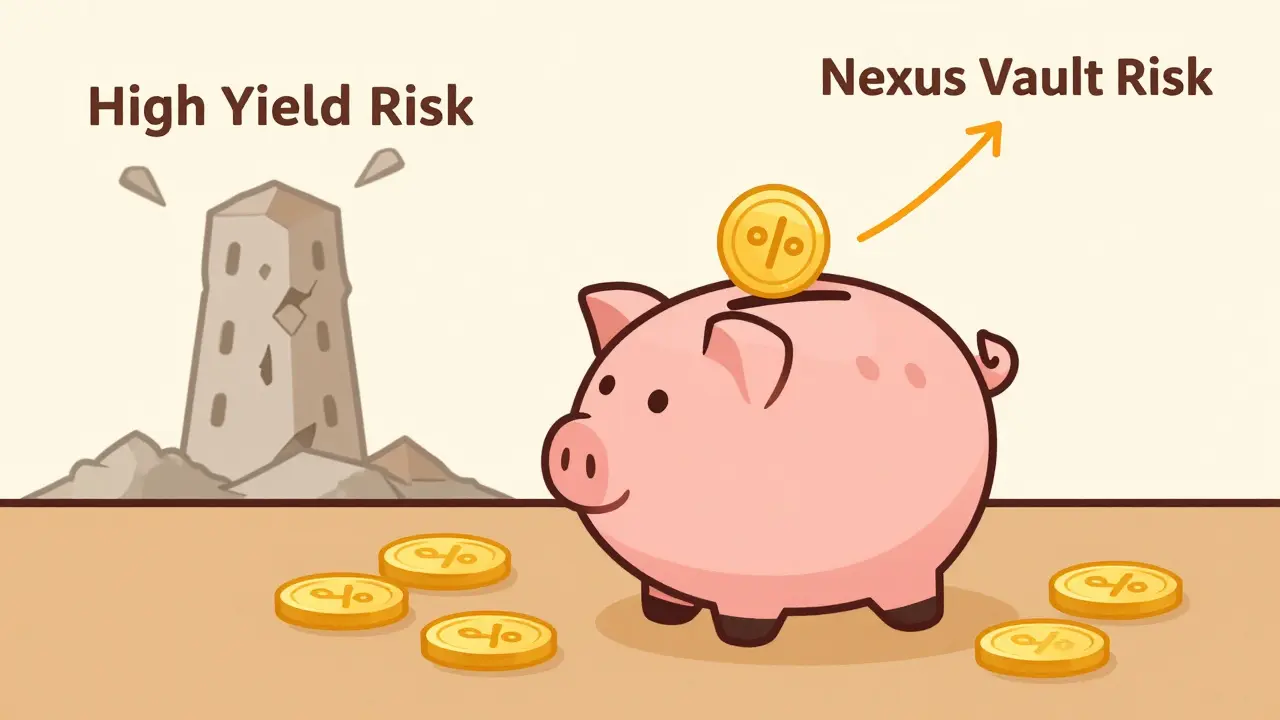
To attract users, Nexus Trade offers a passive earnings program called Nexus Vault. Launched in January 2025, this feature allows you to stake your assets for variable annual percentage yields (APY) ranging from 2.5% to 4.5%, depending on the asset type. For example, stablecoins might earn 3.8% APY.
While this sounds appealing, it is important to contextualize these returns. Historically, platforms like Celsius Network offered 6-10% APY before collapsing in 2022, highlighting the risks of high-yield crypto lending. Current competitors like Nexo offer up to 12% for loyalty tier users. Nexus Trade’s rates are modest, which some users view as a sign of sustainability rather than aggressive risk-taking. One user, "PassiveCrypto," noted on Bitcointalk in April 2025: "The 3.8% APY on stablecoins is lower than some competitors but feels more secure since I don't have to worry about platform insolvency risks like with Celsius." However, without insurance protections or audited reserves, that sense of security is subjective.
User Experience and Customer Support
If you run into issues, getting help on Nexus Trade can be frustrating. The platform relies solely on a ticket system for customer support. There is no live chat, no phone support, and no 24/7 availability. According to TradersUnion’s benchmarking, the average resolution time for non-urgent issues is 3.2 business days. Users on Reddit have reported even worse experiences, with one user stating they waited from March 5th to March 28th for a response regarding a withdrawal issue.
On Trustpilot, Nexus Trade holds a 3.1/5 rating based on 147 reviews (as of May 1, 2025). Positive reviews often praise the simple interface and low fees, while negative reviews cite slow support (mentioned in 78% of complaints) and limited trading pairs. The KYC verification process takes 24-48 hours on average, which is slower than Coinbase (6-12 hours) but comparable to Kraken (24-72 hours).
Who Should Use Nexus Trade?
Nexus Trade is not for everyone. It is best suited for:
- Beginners: Those who want a clean, uncluttered interface to buy Bitcoin or Ethereum without confusion.
- Desktop-only Traders: Users who do not need mobile access and prefer trading from a computer.
- Low-Volume Investors: People making infrequent trades who benefit from the simple 0.22% fee structure.
Avoid Nexus Trade if you are:
- An Active Trader: The lack of stop-loss/take-profit functionality, shallow order book depth (often below $50,000 per pair), and high slippage risks make it unsuitable for day trading.
- A Mobile User: Without an app, you cannot trade on the go.
- Risk-Averse: The lack of regulatory clarity, proof of reserves, and anonymous leadership poses significant security concerns.
Final Verdict
Nexus Trade occupies a narrow niche in the crowded cryptocurrency exchange market. With a global ranking of #87 by trading volume ($14.3 million 24-hour volume in March 2025), it is far behind leaders like Binance ($28.7 billion) and Bybit ($8.2 billion). Its value proposition rests on simplicity and low flat fees, but these benefits are undermined by poor customer support, limited liquidity, and significant security transparency gaps.
If you are determined to try Nexus Trade, start with the minimum deposit of $20 and never store large amounts of long-term holdings on the platform. Consider it a transactional tool rather than a vault. For most users, especially those concerned with security and accessibility, established exchanges like Kraken, Coinbase, or Binance remain safer and more functional choices.
Is Nexus Trade safe to use?
Nexus Trade employs basic security measures like SSL encryption and 2FA, but it lacks critical transparency features such as proof-of-reserves audits and bug bounty programs. It also operates in a regulatory gray area without clear licensing in major jurisdictions. Due to these factors, security experts consider it higher risk compared to regulated exchanges like Coinbase or Kraken.
Does Nexus Trade have a mobile app?
No, Nexus Trade does not offer a mobile application. It functions exclusively as a web-based platform compatible with modern desktop browsers like Chrome, Firefox, and Safari. This limits its usability for traders who prefer managing portfolios on smartphones.
What are the fees on Nexus Trade?
Nexus Trade charges a flat commission rate of 0.22% for both maker and taker orders. This fee structure is simpler than tiered models used by competitors but may be higher for active traders who could qualify for volume discounts on platforms like Binance.
How much can I earn with Nexus Vault?
The Nexus Vault program offers variable annual returns between 2.5% and 4.5% depending on the asset type. For example, stablecoins typically yield around 3.8% APY. These rates are lower than some competitors but may reflect a more conservative approach to lending.
What is the minimum deposit on Nexus Trade?
The minimum deposit requirement on Nexus Trade is $20. This makes it accessible for entry-level investors, though it is higher than platforms like Robinhood Crypto which have no minimum deposit.
Can I use leverage on Nexus Trade?
No, Nexus Trade does not offer leverage trading. It supports spot trading only with a maximum leverage of 1:1. The platform also lacks stop-loss and take-profit functionality, which are essential tools for professional traders.
How fast is customer support on Nexus Trade?
Customer support is provided exclusively through a ticket system with no live chat or phone options. Average resolution times for non-urgent issues are approximately 3.2 business days, with some users reporting delays of several weeks for critical issues.