
Crypto Loan LTV Calculator
Calculate Your Collateral Requirements
Risk Analysis
How It Works
Example: Borrowing $10,000 with a 150% LTV ratio requires $15,000 in collateral. If the collateral value drops to $10,100 (101% LTV), you'll receive a warning. If it falls to $9,500 (95% LTV), your collateral will be automatically liquidated.
Safe Zone: Above liquidation threshold (typically 105-110% of LTV)
Warning Zone: Between 95-105% of LTV
Danger Zone: Below 95% of LTV (liquidation risk)
When you borrow money in traditional finance, banks look at your credit score, income, and job history. In crypto lending, they don’t care about any of that. Instead, they ask: how much crypto do you have? That’s where over-collateralization comes in - the backbone of nearly every decentralized loan.
What Is Over-Collateralization in Crypto Lending?
Over-collateralization means you put up more crypto as security than the loan you’re taking. If you want $10,000, you might need to lock up $15,000 worth of Bitcoin or Ethereum. That extra $5,000 isn’t a bonus - it’s your safety net. And it’s not just a suggestion; it’s built into the smart contracts that run DeFi platforms like Aave, Compound, and MakerDAO. This isn’t random. Cryptocurrencies swing wildly. Bitcoin can drop 20% in a day. If lenders only required collateral equal to the loan amount, a small price drop could leave them with nothing if you default. Over-collateralization creates a buffer. It gives the system time to react before things go south.How It Works Step by Step
Here’s how it plays out in real life:- You decide to borrow $10,000 in USDC.
- You deposit $15,000 worth of ETH as collateral. That’s a 150% loan-to-value (LTV) ratio.
- The smart contract locks your ETH and releases the USDC to your wallet.
- Every few minutes, the system checks the value of your ETH. If it drops to $12,000, you’re now at 125% LTV - still safe.
- If ETH falls to $10,100, you’re at 101% LTV. The system triggers a warning - you need to add more collateral or pay back part of the loan.
- If it drops further to $9,500, the loan is automatically liquidated. Your ETH gets sold to cover the $10,000 debt, and you lose the rest.
Why Lenders Love It
Lenders - whether they’re big institutions or regular users supplying liquidity - rely on over-collateralization because it removes credit risk. You don’t need a bank statement or proof of income. You just need crypto. That’s why platforms like Aave can lend to anyone with a wallet, anywhere in the world. Institutional lenders prefer stablecoins like USDC or DAI as collateral because their value doesn’t jump around. If you lock up $100,000 in USDC to borrow $60,000, you’re not fighting price swings. That makes risk modeling easier. Some even rehypothecate collateral - meaning they use your ETH as security for another loan, multiplying their capital efficiency. Real-time analytics track every dollar’s worth of collateral. If ETH’s price starts slipping, the system alerts lenders to adjust loan terms or raise collateral requirements. This level of automation doesn’t exist in traditional banking, where collateral checks happen monthly - if at all.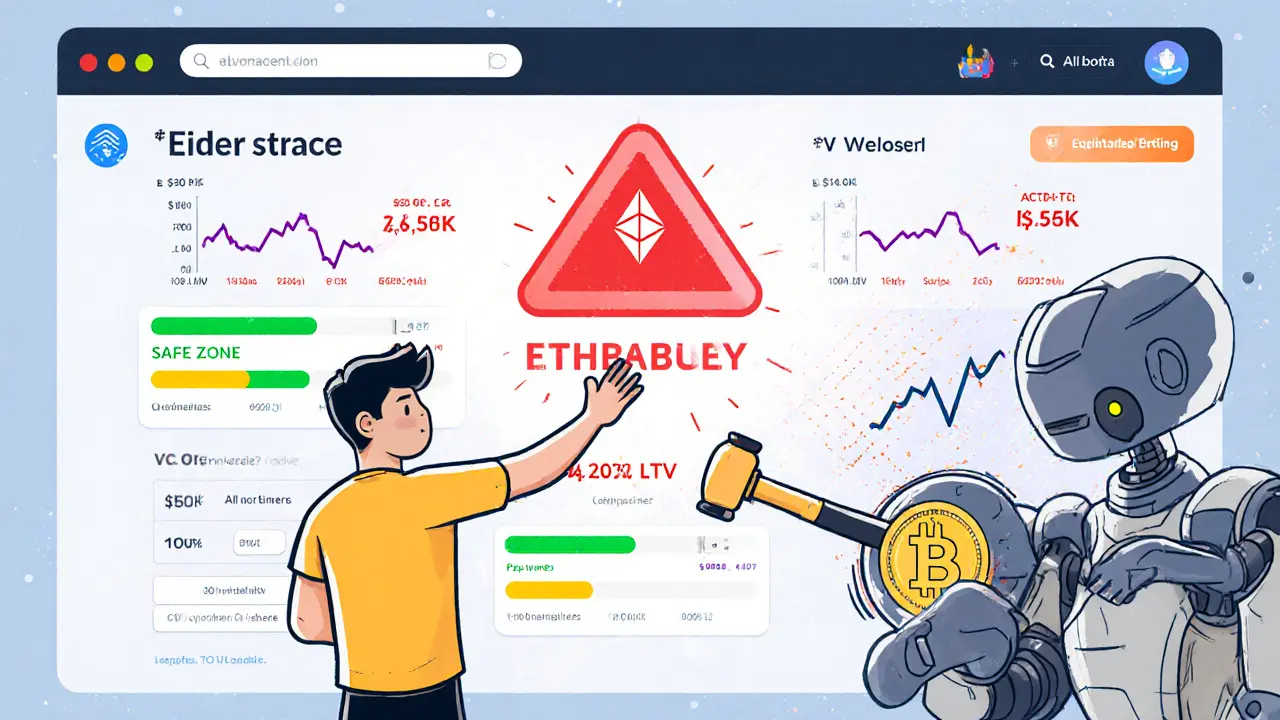
Why Borrowers Do It Anyway
If you’re tying up more money than you get, why bother? One big reason: avoiding taxes. Selling your Bitcoin might trigger a capital gains tax. But borrowing against it? In most countries, that’s not a taxable event. You keep your assets, get cash, and delay selling. Another reason: leverage. If you believe ETH will go from $3,000 to $5,000, you can borrow USDC against your ETH, buy more ETH with that cash, and ride the upside. If you’re right, your gains multiply. If you’re wrong? You get liquidated. And then there’s the long-term play. Some hold crypto because they think it’ll be worth 10x in five years. Instead of cashing out now, they use it as collateral to fund a business, pay bills, or invest elsewhere - keeping their original holdings intact.The Downsides: Opportunity Cost and Complexity
Over-collateralization isn’t free. The biggest cost is opportunity. That extra $5,000 in ETH could’ve been staked, traded, or invested elsewhere. Instead, it’s locked up, earning nothing - or worse, losing value while you wait. Managing these loans takes work. You can’t just set it and forget it. You need to watch prices, set alerts, and be ready to top up collateral if the market turns. A 10% drop in Bitcoin can wipe out your buffer fast. Many beginners get liquidated not because they were reckless, but because they didn’t know how quickly things can change. And it’s not just about price. Liquidity matters too. If you use a low-volume token as collateral, the system might not be able to sell it quickly during liquidation. That’s why most platforms only accept top-tier coins like BTC, ETH, and USDC.
Under-Collateralization: The Holy Grail DeFi Can’t Crack
Here’s the real tension in DeFi: over-collateralization keeps the system safe, but it also keeps out most people. If you don’t own $15,000 in crypto, you can’t borrow $10,000. That’s a huge barrier. Traditional finance lets you borrow based on your income or credit history. DeFi doesn’t. That’s why 95% of DeFi users are crypto whales - people who already have a lot. The industry is trying to fix this. Projects are experimenting with on-chain credit scores - tracking your transaction history, repayment behavior, and even wallet age. Others are testing off-chain solutions: linking your DeFi wallet to your real-world identity or income data. Some platforms, like Maple Finance, already offer under-collateralized loans to institutional borrowers with proven track records. But for retail users? Still mostly over-collateralized. Until we can reliably measure trust without collateral, over-collateralization will stay the rule.How It Compares to Traditional Finance
You might think over-collateralization is unique to crypto. It’s not. Mortgage-backed securities (MBS) and collateralized loan obligations (CLOs) use the same idea. Lenders bundle loans and add extra value as a cushion. If a few homeowners default, the buffer absorbs the loss. The difference? In traditional finance, you need lawyers, paperwork, and months to liquidate. In DeFi, it happens in seconds - automatically, transparently, and without intermediaries. Crypto lending isn’t just a copy of old finance. It’s a faster, more transparent version - with higher stakes because of volatility.What’s Next for Over-Collateralization?
The future won’t be all-or-nothing. We’ll likely see tiered collateralization:- Low-risk borrowers (long-term holders with stable histories) get lower LTVs - maybe 70% instead of 50%.
- New users or high-risk assets still need 150%+.
- Reputation-based lending grows, letting you borrow more based on past behavior, not just wallet balance.
What happens if my crypto collateral drops in value?
If your collateral falls below the liquidation threshold, the smart contract automatically sells part or all of your collateral to repay the loan. You’ll get a warning first - usually when your loan-to-value ratio hits 80-85%. You can avoid liquidation by adding more collateral or paying down the loan.
Can I borrow without collateral in crypto lending?
Very rarely. A few platforms offer uncollateralized loans to institutional borrowers with strong credit histories, but these are exceptions. For retail users, over-collateralization is the standard. No collateral usually means no loan.
Is over-collateralization the same as a margin loan?
They’re similar. Both require you to post assets as security. But margin loans in traditional markets often use lower collateral ratios and rely on human oversight. Crypto loans use smart contracts, higher ratios, and full automation - making them more secure but also more unforgiving.
Why do some platforms require 150% collateral while others ask for 200%?
It depends on the asset’s volatility. Bitcoin might need 150% because it’s relatively stable compared to newer tokens. A new altcoin might need 200% or even 300% because its price can swing 50% in a day. Stablecoins like USDC often allow lower ratios - sometimes as low as 80% - because their value doesn’t change.
Can I use NFTs as collateral for over-collateralized loans?
A few platforms like NFTfi and Arcadia allow NFTs as collateral, but they’re risky. NFTs are illiquid and hard to price. Most lenders demand 500%+ collateral for NFTs because they can’t sell them quickly in a crash. It’s possible, but not efficient - and rarely recommended.
Teresa Duffy
November 16, 2025 AT 17:59Okay but can we talk about how wild it is that you can borrow against your crypto and not pay taxes? I did this last year and it felt like cheating the system in the best way possible. No one’s asking for W-2s, no forms, no audits - just send your ETH and walk away with cash. 🤑
Sean Pollock
November 17, 2025 AT 03:58over-collat??? lmao why do we even need this? just let ppl borrow based on their wallet history. if u keep repaying, u deserve more credit. stop acting like crypto is still in kindergarten 🤡
Carol Wyss
November 19, 2025 AT 03:01I totally get why people hate the 150% rule - it feels like you’re losing out on gains. But honestly? I’d rather have my loan get liquidated than lose everything because someone didn’t monitor their position. Been there, done that. The buffer saved me twice. Just set alerts and you’ll be fine 😊
Student Teacher
November 20, 2025 AT 19:10Wait - so if I use USDC as collateral, I can borrow at 80% LTV? But if I use ETH, it’s 66%? That seems backwards. Shouldn’t stablecoins be riskier since they’re pegged? Or is it just because they don’t move? 🤔
Ninad Mulay
November 20, 2025 AT 21:55Bro in India we don’t even have DeFi access properly. But I read this and thought - imagine if your auntie’s savings in gold could be used like this? No paperwork, no bank visits, just lock your metal and get cash. Crypto’s weird, but it’s also kinda beautiful. 🙏
Mike Calwell
November 21, 2025 AT 09:04so u just lock ur crypto and get money? no credit check? no interview? this sounds like a scam lmao
Jay Davies
November 23, 2025 AT 03:05Actually, over-collateralization is not unique to DeFi - it’s standard in repo markets and mortgage-backed securities. The key difference is automation. In traditional finance, liquidation takes weeks. Here, it’s seconds. That’s not a flaw - it’s an upgrade. The volatility risk is real, but the transparency is unmatched.
Grace Craig
November 24, 2025 AT 07:08One must acknowledge that the structural integrity of decentralized finance hinges upon the rigorous application of over-collateralization as a risk-mitigation mechanism. To eschew this principle would be tantamount to inviting systemic fragility - a luxury we cannot afford in an ecosystem devoid of central authority. The elegance lies not in convenience, but in immutable mathematical certainty.
Ryan Hansen
November 24, 2025 AT 16:07It’s funny how everyone talks about liquidation like it’s some scary monster, but honestly? If you’re not watching your LTV, you’re just lazy. I’ve got alerts set for every position - ETH at 85%, BTC at 80%, even DAI at 90%. I check them once a day while I’m drinking coffee. It’s not hard. The real issue is people treat crypto like a savings account instead of a volatile asset class. You wouldn’t leave your stocks unmonitored for months - why do this with loans? And don’t even get me started on NFT collateral. 500%? That’s not lending, that’s donating.
Derayne Stegall
November 26, 2025 AT 03:27THIS IS THE FUTURE!!! 🚀 No banks. No forms. No waiting. Lock your ETH, get cash, buy more ETH, repeat. If you get liquidated? You weren’t ready. No tears. No excuses. Just code. 💪🔥
Astor Digital
November 27, 2025 AT 10:18I used to think this was all just for rich people. Then I saw a guy on Twitter who borrowed $5k against his 0.3 ETH to pay rent. He wasn’t a whale - just someone who held long-term. That’s the real power. It’s not about being rich, it’s about being patient. The system lets you be both.
Shanell Nelly
November 29, 2025 AT 04:33For anyone new to this - don’t panic when your LTV goes up. Set up notifications, use a dashboard like DeFiSaver or Zerion, and keep a little extra cash on hand to top up if needed. I’ve helped three friends avoid liquidation just by reminding them to check their positions. It’s not magic - it’s just awareness. You got this! 💕
Aayansh Singh
November 29, 2025 AT 15:04Pathetic. You people think this is innovation? It’s just financial babysitting for people too stupid to manage risk. Over-collateralization is a crutch. Real finance uses credit scores, cash flow, and reputation - not just wallet balance. If you need 150% to borrow, you don’t belong here. Go back to Coinbase.
Rebecca Amy
November 30, 2025 AT 16:44Why do people always ignore the fact that you’re paying interest on top of locking up your assets? It’s like renting your own money. And if the price dips? You lose. If it rises? You still lose because your collateral is tied up. Seems like a bad deal to me.
Darren Jones
December 2, 2025 AT 08:32One thing people forget: over-collateralization isn’t just about protecting lenders - it’s about protecting YOU. When the market crashes, you don’t want to be the one begging for a grace period. The system gives you a warning, a chance to fix it. That’s more than banks ever did. I’ve seen friends lose everything because they trusted a ‘human’ to help them. This? This is fair. It’s just cold.
Kathleen Bauer
December 3, 2025 AT 10:10i used to think this was too complicated but then i started using aave and it just… works? like i set my ltv to 70% and forgot about it for 3 months. price dropped 30% and i was still fine. just dont use weird tokens lol
Carol Rice
December 4, 2025 AT 12:59Let’s be real - this isn’t finance, it’s a psychological game. You’re not borrowing money; you’re betting on your own discipline. The system doesn’t care if you’re broke, rich, or in debt - it only cares about your collateral. That’s terrifying. And beautiful. And exactly why DeFi will outlast every bank. No mercy. No bias. Just math. And if you can’t handle that? Then you’re not ready for the future. Period.