There’s no shortage of crypto exchanges these days. You’ve got giants like Uniswap and PancakeSwap dominating headlines, with billions in daily volume and detailed reviews everywhere you look. But what about StationDex v3? If you’ve stumbled across it on CoinGecko or a niche forum, you’re probably wondering: Is this legit? Is it worth using? Or is it just another obscure platform fading into the background?
What Is StationDex v3?
StationDex v3 is listed as a decentralized exchange (DEX) operating on something called "x Layer." That’s it. No official website. No whitepaper. No GitHub repo. No developer updates. Just a listing on CoinGecko with no trading volume, no user count, and no liquidity data. It doesn’t show up in any of the major DEX rankings from January 2026. Not in MEXC’s top 10. Not in Coin Bureau’s deep-dive analysis. Not even in Reddit threads where users debate gas fees on Uniswap or yield farming on PancakeSwap. The name suggests it’s the third version of something, but there’s no record of v1 or v2. No launch date. No team behind it. No announcements. It’s like a ghost in the DEX ecosystem-present on paper, invisible in practice.Why the Silence?
In 2026, the decentralized exchange space is crowded, competitive, and brutally transparent. Top DEXs publish their code, update their roadmaps, and engage with communities. Uniswap V4 rolled out hooks for custom trading logic. Balancer V3 integrated with Aave to boost liquidity yields. Raydium optimized for Solana’s speed. All of them have public GitHub repos, Twitter accounts with thousands of followers, and YouTube tutorials explaining how to use them. StationDex v3 has none of that. No code. No updates. No social presence. No press releases. Even Bitcoin.com’s January 2026 exchange roundup, which covers everything from centralized platforms to obscure DeFi apps, didn’t mention it. If a platform this big in the crypto space can’t even get a single review on Trustpilot or a mention on CryptoSlate, that’s not just low visibility-it’s a red flag.No Liquidity, No Users, No Trust
Liquidity is the lifeblood of any DEX. Without it, trades slippage, orders fail, and users leave. Uniswap processed $175.3 billion in volume last month. PancakeSwap hit $42.8 billion. Even smaller players like Orca on Solana cleared $1.2 billion. StationDex v3? Zero. Not a single figure is tracked. CoinGecko doesn’t even show a volume chart. That means no one’s trading on it. Or worse-people tried, couldn’t find liquidity, and walked away. And if no one’s trading, why would anyone use it? You don’t connect your wallet to a DEX just because it’s listed somewhere. You use it because there’s actual trading activity, deep pools, low fees, and fast settlements. StationDex v3 offers none of that. There’s no way to verify its fee structure. Is it 0.25% like Raydium? 0.30% like Uniswap? Or does it charge hidden costs? No one knows.
What About Security?
Security in DeFi isn’t optional. It’s everything. Leading DEXs get audited by firms like CertiK, Quantstamp, or Trail of Bits. Their code is open for anyone to inspect. StationDex v3 has no audit reports. No smart contract addresses you can verify. No bug bounty program. No history of incidents because, frankly, no one’s using it enough to find any. That’s dangerous. In January 2026, the SEC cracked down on DEXs without clear governance or KYC protocols. Platforms that couldn’t prove they weren’t operating as unregistered securities exchanges got hit with fines. StationDex v3 doesn’t even have a governance model listed. No token. No voting. No community proposals. If it’s not transparent, it’s not safe.Is It Built on x Layer? Maybe. But What Is x Layer?
CoinGecko lists StationDex v3 as running on "x Layer." That’s not a real blockchain. There’s no Ethereum Layer-2 called x Layer. No Solana sidechain. No Polygon zkEVM. No known project by that name. It could be a made-up term to sound technical. Or it could mean the platform is hosted on a private, unverified chain that doesn’t even connect to major networks. Compare that to real Layer-2 solutions: Arbitrum, Optimism, Base, zkSync, and Scroll. They all have public documentation, developer tools, and bridges to Ethereum mainnet. StationDex v3’s "x Layer" doesn’t. You can’t find it on any blockchain explorer. You can’t verify its transactions. You can’t even check if it’s real.How Does It Compare to Real DEXs?
Here’s a quick snapshot of what real DEXs offer in early 2026:| Feature | StationDex v3 | Uniswap V4 | PancakeSwap v3 | Raydium |
|---|---|---|---|---|
| Trading Volume (Monthly) | Not listed | $175.3B | $42.8B | $8.1B |
| Blockchain | "x Layer" (unverified) | Ethereum + 15+ L2s | BNB Chain | Solana |
| Fee Structure | Unknown | 0.05%-0.30% | 0.25% | 0.25% |
| Smart Contract Audit | None | Multiple (CertiK, Trail of Bits) | Yes (Certik) | Yes (OpenZeppelin) |
| Developer Activity | No GitHub, no updates | Active GitHub, weekly commits | Active GitHub, community forums | Active GitHub, Discord support |
| User Reviews | Zero documented | 4.2/5 across platforms | 3.9/5 | 4.1/5 |
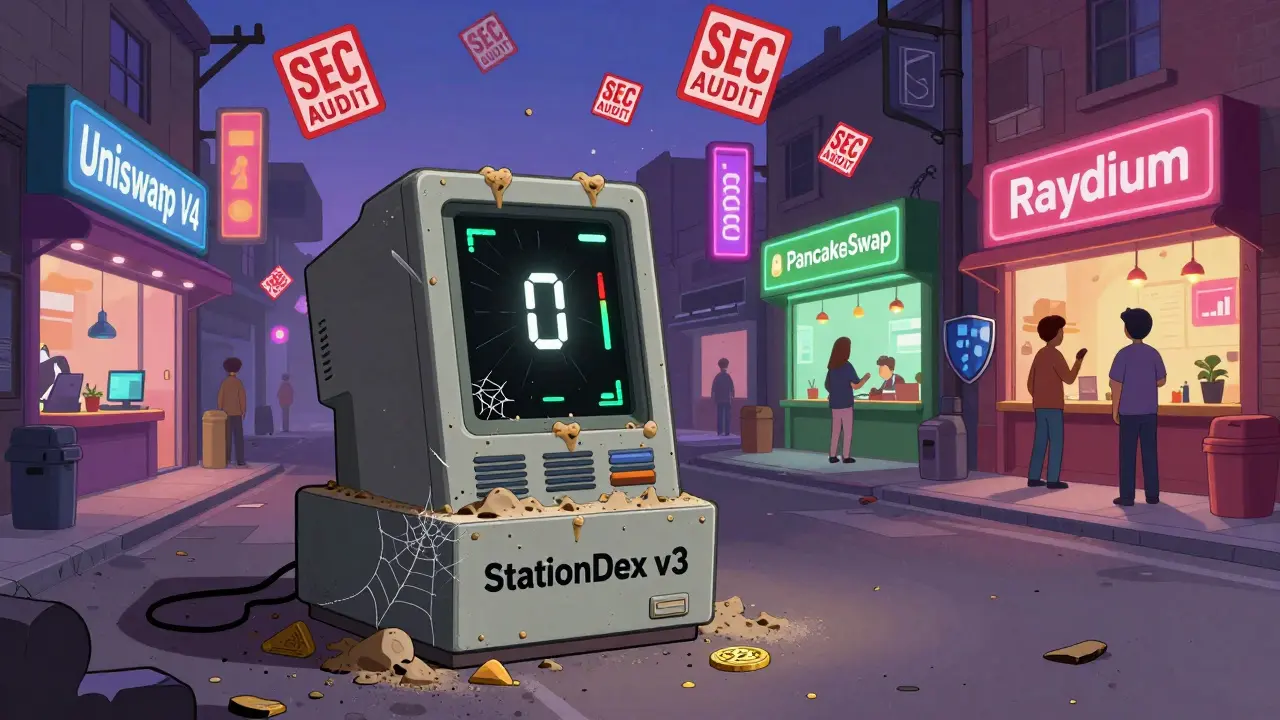
StationDex v3 doesn’t just lose by a little. It doesn’t even show up on the scoreboard.
Should You Use It?
Short answer? No. If you’re looking to swap tokens, earn yield, or trade crypto in a decentralized way, there are dozens of better, safer, and more reliable options. Uniswap works on Ethereum and its Layer-2s. PancakeSwap is cheap and fast on BNB Chain. Raydium gives you Solana’s speed with strong DeFi integrations. All of them have been tested by millions of users. All of them have public records of their performance. StationDex v3 has none of that. No volume. No audits. No community. No transparency. It’s not just underdeveloped-it’s underwhelming in the most dangerous way possible: it looks like it might be real, but every sign points to it being abandoned, incomplete, or possibly a scam.What’s the Real Risk?
The biggest risk isn’t losing money on bad trades. It’s losing your entire wallet to a contract that was never audited, never tested, and never meant to be used by anyone outside the developers. You connect your MetaMask or Phantom wallet to StationDex v3, and you’re trusting code that no one else has seen. No one has verified it. No one has monitored it. No one is watching for exploits. In a space where $100 million in funds have been drained from poorly coded DEXs in the last two years, that’s not a gamble. That’s negligence.Final Thoughts
StationDex v3 isn’t a hidden gem. It’s a ghost. A placeholder. A listing with no substance. In a market that’s moving faster than ever-with new features, better liquidity models, and tighter security standards-this platform offers nothing but questions. And no answers. If you’re new to DeFi, stick with the platforms everyone else uses. If you’re experienced, you already know not to touch something with zero public data. StationDex v3 doesn’t deserve a review. It deserves a warning.Is StationDex v3 a scam?
There’s no direct proof it’s a scam, but it has all the red flags of one: no documentation, no team, no audits, no liquidity, no community, and no updates. Legitimate projects don’t vanish from public view. If a platform can’t be verified by any credible source, treat it as high-risk until proven otherwise.
Can I trade on StationDex v3 safely?
No. Without a verified smart contract address, audit reports, or transaction history, there’s no way to know if the platform is secure. Connecting your wallet could expose you to MEV bots, rug pulls, or malicious code. Even if the interface looks clean, the backend could be anything.
Why is StationDex v3 listed on CoinGecko if it’s inactive?
CoinGecko lists thousands of exchanges, including many that are inactive or low-traffic. Their listings don’t imply endorsement or safety. Many obscure DEXs appear on CoinGecko simply because someone submitted the data. The absence of volume or user metrics on their page is a clue-it’s not being used.
What should I use instead of StationDex v3?
For Ethereum users, try Uniswap V4 on Base or Arbitrum. For low fees, use PancakeSwap on BNB Chain. For speed, Raydium on Solana is hard to beat. All three have active communities, public audits, and millions in daily volume. Avoid anything without those basics.
Does StationDex v3 have a mobile app?
No. There is no official mobile app, and no verified links to download one. Any app claiming to be StationDex v3 is likely fake and could steal your private keys. Always access DEXs through their official websites-never via third-party links or app stores.
Will StationDex v3 ever become popular?
Unlikely. Without developer activity, community support, or liquidity incentives, there’s no momentum. The DEX market is saturated with better alternatives. New projects need funding, transparency, and marketing to survive. StationDex v3 has none of that. It’s not on any roadmap, and no one is building toward it.
Taylor Mills
January 23, 2026 AT 19:25Arielle Hernandez
January 25, 2026 AT 16:31HARSHA NAVALKAR
January 27, 2026 AT 06:37Ryan Depew
January 27, 2026 AT 21:17Mathew Finch
January 28, 2026 AT 18:25Shamari Harrison
January 30, 2026 AT 00:53Nadia Silva
January 30, 2026 AT 04:44Roshmi Chatterjee
January 31, 2026 AT 22:50Deepu Verma
February 2, 2026 AT 01:47MICHELLE REICHARD
February 3, 2026 AT 23:12tim ang
February 5, 2026 AT 12:37Julene Soria Marqués
February 6, 2026 AT 17:55Abdulahi Oluwasegun Fagbayi
February 7, 2026 AT 00:37Andy Marsland
February 7, 2026 AT 23:36steven sun
February 8, 2026 AT 19:53Athena Mantle
February 10, 2026 AT 18:52Paru Somashekar
February 10, 2026 AT 21:12