
On March 4, 2020, the Supreme Court of India did something unexpected: it struck down the Reserve Bank of India’s ban on cryptocurrency. That ruling didn’t make crypto legal overnight - but it did remove the biggest roadblock standing in the way of millions of Indians who wanted to trade, hold, or build with digital assets. Today, in 2026, that decision still shapes how crypto works in India - even as the government still hasn’t passed a single law to replace it.
Before the ruling, banks refused to touch crypto. If you ran an exchange like WazirX or CoinDCX, you couldn’t open a bank account. If you wanted to deposit rupees to buy Bitcoin, you were out of luck. The RBI’s April 2018 circular told every bank, payment provider, and NBFC: Do not deal with virtual currencies. Do not provide services. Do not accept them as collateral. It wasn’t just a warning - it was a shutdown. And it worked. Exchanges scrambled. Users left. The market collapsed.
Why the Supreme Court Said No to the Ban
The court didn’t say crypto is good. It didn’t say it’s safe. It didn’t even say the RBI was wrong to be worried. What it said was this: You can’t ban something that isn’t illegal.
The RBI had no law to back its ban. No Parliament act. No amendment to the Banking Regulation Act. Just a circular - a bureaucratic order with no legal weight. The court called it disproportionate. Why? Because it wiped out an entire industry without proving harm. It punished every user, every startup, every developer just because some people might use crypto for fraud or money laundering.
The judges compared it to banning cash because criminals use it. Or banning the internet because scammers use it. That kind of blanket ban? It violates fundamental rights - especially the right to carry on any trade or business under Article 19(1)(g) of the Indian Constitution.
The ruling didn’t give crypto special protection. It just said: Don’t overreach. If you want to regulate, do it properly. With laws. With debate. With clear rules.
What Changed After the Ruling
Within months, the market bounced back. WazirX saw user sign-ups jump 350%. CoinDCX added over 2 million new users in 2021. ZebPay’s trading volume tripled. By 2025, India had between 15 and 20 million crypto users - one of the highest numbers in the world. That’s more than the entire population of New Zealand.
Bank accounts reopened. Exchanges started accepting UPI, NEFT, and IMPS. You could now buy Bitcoin with your phone in seconds. Crypto ATMs popped up in Delhi, Bangalore, and Pune. Startups began building DeFi protocols, NFT marketplaces, and crypto wallets - all legally, thanks to that single court decision.
But here’s the catch: Just because you can trade doesn’t mean it’s easy.

The Tax Trap: 30% + 1% TDS
While the court opened the door, the government slammed it shut with taxes.
India now has one of the highest crypto tax rates in the world:
- 30% tax on all profits - no matter how long you held the asset. Sell Bitcoin after 1 day? 30%. Hold it for 5 years? Still 30%.
- 1% TDS (Tax Deducted at Source) - every time you trade, even if you’re breaking even. If you swap Bitcoin for Ethereum, your exchange takes 1% of the transaction value and sends it to the government. No exceptions. No deductions. Not even if you’re just moving funds between wallets.
Compare that to the U.S., where long-term gains are taxed at 0-20%. Or Switzerland, where crypto is treated as private money. In India, even a small trade can cost you 1% upfront - and then 30% on top of any profit. That’s why many retail traders avoid frequent trading. It’s not just risky - it’s financially draining.
And there’s no official guidance on how to calculate gains from DeFi staking, NFT sales, or cross-border transfers. You’re left figuring it out yourself - or paying a tax expert thousands of rupees to do it for you.
What’s Still Missing
The Supreme Court made it clear: The government is asleep at the wheel.
In October 2025, the court openly questioned ministers during hearings: “Why are you still doing nothing?” They pointed to the 2021 bill that proposed banning private crypto - a bill that never became law. They mentioned how other countries - the EU with MiCA, the U.S. with SEC guidance, Singapore with its clear licensing rules - have moved forward. India? Still stuck.
Without regulation:
- Exchanges operate in legal gray zones - they follow KYC and AML rules, but there’s no official license to hold.
- Investors have no recourse if an exchange shuts down or gets hacked.
- DeFi protocols, smart contracts, and tokenized assets exist without any legal recognition.
- Startups leave. Many Indian crypto founders moved to Dubai, Portugal, or Singapore because they couldn’t get funding or legal clarity here.
The court called unregulated crypto “a more polished form of Hawala” - a reference to informal money transfer systems. But it didn’t say crypto is Hawala. It said: If you’re going to treat it like that, then regulate it like that.
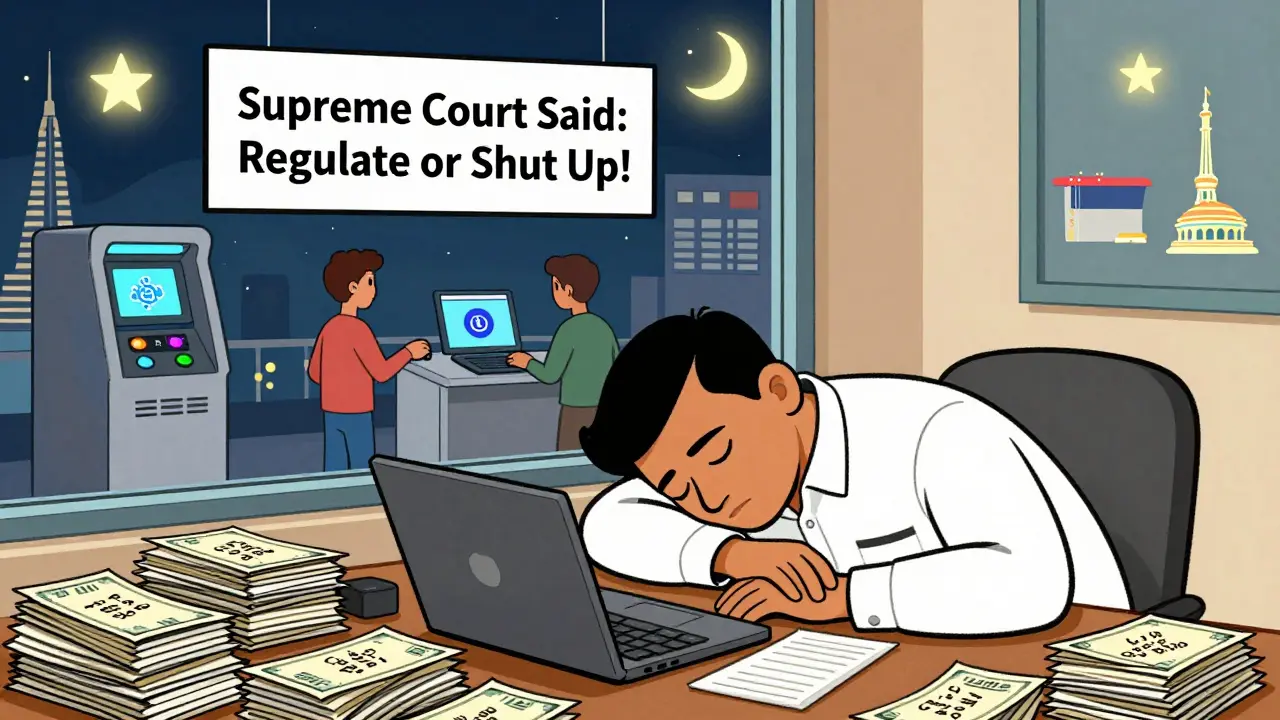
What You Need to Do Today
If you’re trading crypto in India in 2026, here’s what you must do:
- Track every transaction. Buy, sell, swap, stake, receive - all of it matters. Use tools like Koinly or CoinTracker to auto-calculate gains.
- Pay 30% tax on profits. Report all crypto income under “Income from Other Sources” in your ITR. Don’t wait for a notice.
- Keep 1% TDS receipts. Exchanges deduct this automatically, but you need proof for your tax return.
- Use only registered exchanges. Stick to WazirX, CoinDCX, ZebPay - they’re the only ones with KYC and compliance systems in place.
- Don’t assume DeFi or NFTs are safe. No laws protect them. No court has ruled on them. Proceed with extreme caution.
Many people think the Supreme Court ruling made crypto legal. It didn’t. It just stopped the government from banning it. That’s a big difference.
The Bigger Picture
India is caught between two worlds. On one side, millions of young people are using crypto as a tool for financial freedom - sending money abroad, saving in Bitcoin, investing in global tokens. On the other side, the government still sees crypto as a threat - something to control, not to understand.
The Supreme Court has done its part. It stood up for constitutional rights. It refused to let bureaucracy crush innovation without proof. Now the ball is in the government’s court.
Will they create a clear, fair, and modern system? Or will they keep dragging their feet until another court has to step in again?
For now, crypto in India survives - not because of law, but because of the court’s refusal to let fear rule.
Is cryptocurrency legal in India after the Supreme Court ruling?
Yes, cryptocurrency is legal to hold and trade in India. The Supreme Court’s 2020 ruling struck down the RBI’s ban on banks servicing crypto businesses. That means you can buy, sell, and hold Bitcoin and other digital assets without breaking any law. But there’s no specific law that protects or regulates crypto - so it exists in a legal gray zone.
Why is there a 30% tax on crypto profits in India?
The 30% tax was introduced in the 2022 Union Budget as a way to generate revenue from crypto trading. Unlike traditional investments, crypto gains are taxed at a flat rate - no matter how long you hold the asset. There are no deductions, no indexation benefits, and no loss carry-forward. The government’s goal was to discourage speculative trading, but it’s also made small-scale trading unviable for many.
What happens if I don’t report my crypto earnings?
If you don’t report crypto gains, you risk being flagged by the Income Tax Department. Exchanges report transaction data to the government under the 1% TDS system. If your bank account shows large deposits from crypto exchanges and you didn’t declare them, you could face penalties, interest, or even a tax audit. The government has already started matching data from exchanges with income tax returns.
Can I use Indian banks to trade crypto now?
Yes, but only indirectly. Banks don’t offer crypto services themselves, but they allow transfers to and from licensed Indian exchanges like CoinDCX and WazirX. You can use UPI, NEFT, or IMPS to deposit rupees to buy crypto. But if you try to open a bank account specifically for a crypto business, most banks will still refuse - they’re still cautious.
Is the Supreme Court likely to rule again on crypto?
Very likely. In late 2025, the court called out the government for inaction and said the current situation is a “blind eye” to a growing financial sector. If the government delays further, the court may be forced to intervene again - possibly by directing Parliament to pass a law or by clarifying how existing financial laws apply to crypto. The next ruling could define whether crypto is an asset, a commodity, or something else entirely.
Colin Lethem
March 2, 2026 AT 17:04lori sims
March 3, 2026 AT 15:41Reggie Fifty
March 5, 2026 AT 01:12Kristi Emens
March 5, 2026 AT 08:36Deborah Robinson
March 6, 2026 AT 18:33Kaitlyn Clark
March 7, 2026 AT 17:54Amanda Markwick
March 8, 2026 AT 23:38Nicki Casey
March 9, 2026 AT 01:24Jessica Carvajal montiel
March 9, 2026 AT 03:38maya keta
March 9, 2026 AT 17:48Curtis Dunnett-Jones
March 10, 2026 AT 16:57Sean Logue
March 11, 2026 AT 19:49Jeff French
March 12, 2026 AT 02:30Michelle Mitchell
March 13, 2026 AT 04:24christopher luke
March 13, 2026 AT 22:37