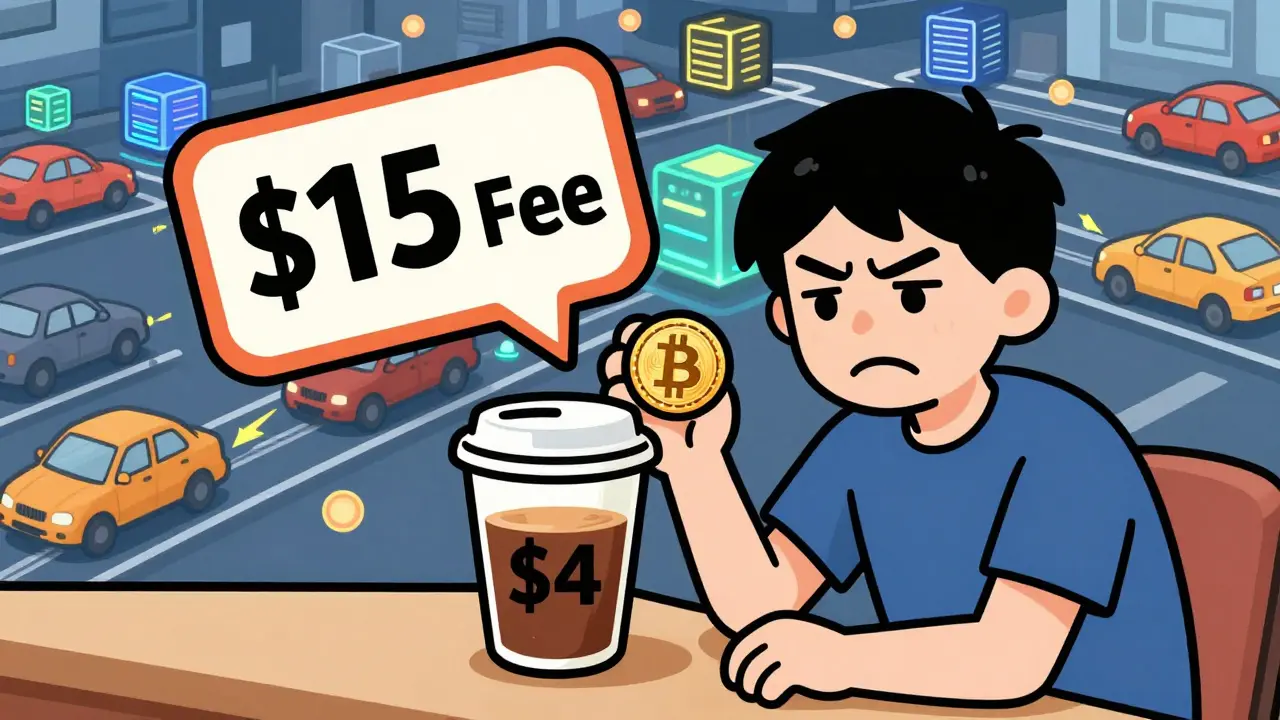
Imagine trying to buy a coffee with Bitcoin. You hand over the digital currency, but the network fee is $15. The coffee costs $4. It doesn't make sense. For years, this was the reality for many users on major blockchains like Ethereum and Bitcoin. High demand clogged the networks, driving fees up to absurd levels. This isn't just an inconvenience; it's a barrier that stops everyday people from using blockchain technology.
Enter rollups, which are Layer 2 scaling solutions that process transactions off-chain and bundle them into single proofs submitted to the main blockchain. Think of rollups as the express lane at a toll booth. Instead of every car stopping to pay individually (slow and expensive), a bus picks up everyone, drives through one checkpoint, and pays one fee. That fee is then split among all the passengers. The result? Your individual cost drops by up to 99%.
Why Are Blockchain Fees So High?
To understand why rollups matter, you first need to see what breaks in the current system. Blockchains like Ethereum have limited space in each block. Imagine a parking lot that can only hold 50 cars. If 1,000 cars want to park, they start bidding against each other for those spots. This is exactly what happens during network congestion. Users bid up the "gas" price to get their transaction included quickly.
This creates a vicious cycle. More users mean higher fees. Higher fees push out small transactions. Small transactions are essential for things like gaming, micropayments, or buying NFTs. Without a fix, blockchain remains a tool only for large institutions or wealthy individuals who can afford the overhead.
The core problem is computational load. Every node in the network must verify every single transaction. If there are millions of transactions, every computer connected to the network has to do millions of calculations. This takes time and energy, limiting how fast the network can move.
How Rollups Actually Work
Rollups solve this by moving the heavy lifting off the main chain (Layer 1). Here is the step-by-step process:
- Transaction Execution: You send a transaction to the rollup network, not directly to Ethereum or Bitcoin. The rollup processes it instantly on its own high-speed server.
- Batching: The rollup collects hundreds or thousands of these transactions over a short period. It bundles them together into a single data package.
- Proof Generation: The rollup creates a cryptographic proof that says, "All these transactions in this batch were valid."
- Submission: The rollup sends this single proof and the compressed data back to the main blockchain (Layer 1) for final settlement.
Because the main blockchain only has to verify one proof instead of thousands of individual transactions, it uses very little bandwidth. This frees up space on the main chain and drastically cuts the cost for the user.
| Feature | Traditional Layer 1 | Rollup Solution |
|---|---|---|
| Processing Location | On-chain (Main Network) | Off-chain (Secondary Network) |
| Data Submitted to L1 | Full transaction details | Compressed proof + batch data |
| Cost per Transaction | High ($1 - $50+ depending on congestion) | Low ($0.01 - $0.10) |
| Security Source | Native consensus | Inherited from Layer 1 |
| Scalability | Limited (~15-30 TPS for Ethereum) | High (1,000+ TPS potential) |
ZK-Rollups vs. Optimistic Rollups: Which Saves More?
Not all rollups are built the same. There are two main types dominating the market right now: Zero-Knowledge (ZK) rollups and Optimistic rollups. They both reduce costs, but they do it differently.
Optimistic rollups assume that transactions are valid by default. They post the data to Layer 1 and give users a week-long window to challenge any fraudulent activity. If someone finds an error, they can submit a "fraud proof," and the bad transaction is reverted. This approach is cheaper to develop because it doesn't require complex math for every transaction. However, the withdrawal time can be slow (up to seven days) if a dispute arises.
ZK-rollups use advanced cryptography called zero-knowledge proofs. These proofs mathematically guarantee that the transactions are valid without revealing the underlying data. Because the math is irrefutable, there is no need for a waiting period. Settlement is almost instant. While ZK-proofs are more computationally intensive to generate, the verification on Layer 1 is extremely cheap and fixed. As more users join a ZK-rollup, the cost per user drops even further due to economies of scale.
In terms of pure cost efficiency, ZK-rollups often win in the long run because their verification cost is constant regardless of network size. Optimistic rollups are currently more popular for general-purpose decentralized finance (DeFi) because they are easier to build for developers familiar with Ethereum standards.

Real-World Cost Savings Examples
Let’s look at concrete numbers. On the Bitcoin network, a standard transfer might cost 5,000 satoshis during peak times. With a Bitcoin rollup solution, that same transfer could cost just 50 satoshis. That is a 99% reduction. Suddenly, sending $1 worth of Bitcoin becomes feasible instead of costing more than the amount sent.
On Ethereum, before rollups became widespread, a simple token swap might cost $20 in gas fees. Today, using a major ZK-rollup like zkSync or an optimistic rollup like Arbitrum, that same swap costs less than $0.10. This shift has unlocked new possibilities:
- Gaming: Developers can now record every sword swing or item pickup on-chain without bankrupting players.
- NFTs: Minting digital art no longer requires a premium wallet balance.
- Supply Chain: Companies can track individual items granularly without prohibitive per-transaction costs.
Trade-Offs: What Are You Giving Up?
If rollups are so great, why hasn’t everyone moved? The answer lies in trade-offs. Nothing in engineering is free.
Liquidity Fragmentation: When funds move to different rollups, they become isolated. Money on Arbitrum isn't easily accessible to a protocol on Optimism without bridging. Bridges introduce risk and complexity. In the past, all DeFi liquidity sat on Ethereum Mainnet, making it easy for protocols to interact. Now, developers must decide which rollup to build on, potentially splitting the user base.
Centralization Risks: Many rollups rely on sequencers-centralized servers that order transactions. While the security comes from Layer 1, the availability depends on the sequencer operator. If the sequencer goes down, the rollup stops working. Researchers are actively working on decentralized sequencers, but most current implementations still have some centralization.
User Experience Complexity: Users need to bridge their assets from Layer 1 to Layer 2. This adds steps to the process. You can't just send ETH from your MetaMask wallet to a friend on a rollup unless both parties are on the same layer. This friction can confuse newcomers.
The Future: Danksharding and Beyond
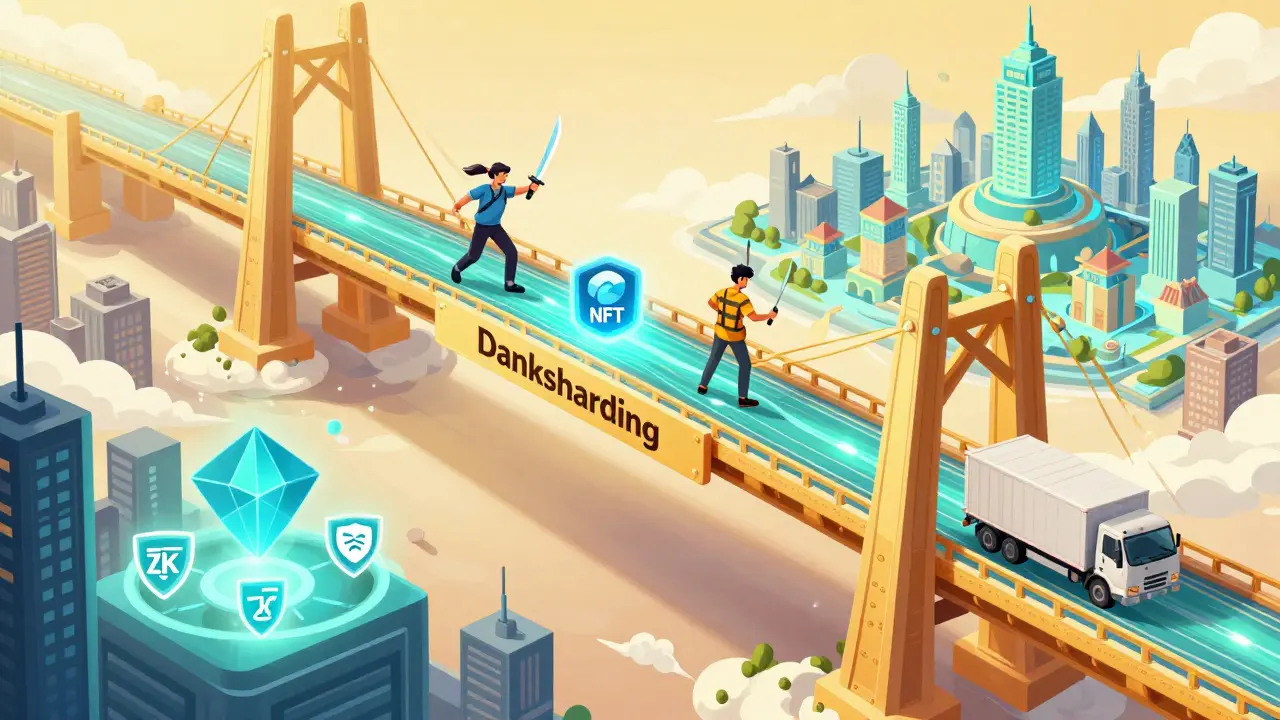
The story doesn't end here. Ethereum is preparing for a major upgrade called Danksharding, which is a scalability improvement that increases the amount of data that can be posted to the Ethereum blockchain per second. Specifically, it introduces "proto-danksharding" via EIP-4844, which creates a new type of transaction specifically for rollup data. This data is cheaper to store because it is treated as temporary blobs rather than permanent state.
When fully implemented, Danksharding will slash the data submission costs for rollups by another 10x to 100x. This means the already low fees we see today could drop to fractions of a cent. It also paves the way for "validiums" and "volitions," hybrid models that offer even greater flexibility for specific use cases.
As these technologies mature, the distinction between Layer 1 and Layer 2 may blur for the average user. Abstracted wallets could handle the bridging and fee payments automatically. You would simply click "send," and the backend would route your transaction through the cheapest available rollup.
Conclusion
Rollups are not just a technical tweak; they are the bridge that brings blockchain from speculative investment to practical utility. By batching transactions and leveraging cryptographic proofs, they solve the trilemma of security, scalability, and cost. While challenges like liquidity fragmentation remain, the trajectory is clear. As infrastructure improves with upgrades like Danksharding, the cost of interacting with blockchain will become negligible, opening the door to a truly global, decentralized internet economy.
What is the difference between a sidechain and a rollup?
Sidechains operate independently with their own security mechanisms. If a sidechain fails or is hacked, you lose your funds. Rollups, however, inherit the security of the main blockchain (Layer 1). Even if the rollup operator disappears, your funds are safe on Layer 1 and can be withdrawn. Rollups are generally considered safer but slightly more complex to implement.
Are rollups completely free?
No, rollups are not free. You still pay a fee to submit data to the main blockchain. However, because many users share that cost, the fee per person is tiny. Additionally, you may pay a small fee to the rollup operator for processing. But compared to Layer 1 fees, the total cost is usually 90-99% lower.
Which rollup should I use for my project?
It depends on your needs. If you need fast finality and maximum security, choose a ZK-rollup like zkSync or StarkNet. If you are building a complex DeFi application and need compatibility with existing Ethereum tools, an Optimistic rollup like Arbitrum or Optimism might be better. Always consider where your target users' liquidity is located.
How do I bridge assets to a rollup?
Most major rollups have official bridges on their websites. You connect your wallet, select the asset and amount, and initiate the transfer. Some third-party aggregators like Orbiter or Jumper also allow cross-rollup transfers. Always use trusted bridges to avoid scams.
Will Danksharding replace rollups?
No, Danksharding enhances rollups. It makes the data posting phase cheaper, allowing rollups to scale further. It is part of Ethereum's roadmap to support thousands of rollups efficiently, rather than replacing them.
robert Whitehead
May 26, 2026 AT 02:12Another day, another article explaining basic scaling solutions to people who probably can't code their way out of a paper bag. The bus analogy is cute, but it ignores the massive centralization risks inherent in sequencer control. You're trading censorship resistance for cheap fees, and most retail users are too stupid to realize they've been sold a bridge that leads nowhere.
H F
May 27, 2026 AT 05:00Hey Robert, maybe tone it down a bit? This guide is actually pretty helpful for newcomers trying to understand why their gas fees were so high last year. Not everyone needs to be a kernel developer to benefit from cheaper transactions! 🚀
Mike S
May 27, 2026 AT 12:12Oh look, someone tried to write a tutorial on blockchain. How original. I’ve been using Arbitrum since 2021 and I didn’t need a flowchart to tell me it’s cheaper than mainnet. The real issue isn’t the tech, it’s the liquidity fragmentation that makes bridging a nightmare. But sure, let’s pretend everything is sunshine and rainbows because we saved $0.05 on a swap. Typical crypto bro optimism.
Michael Berggren
May 28, 2026 AT 03:55I think Mike has a point about fragmentation, but the cost savings are undeniable. I moved my DeFi portfolio to zkSync last month and the difference is night and day. It feels like the early internet when bandwidth was finally becoming affordable for everyone. We are witnessing history in the making! ✨🌍
Kiran CS
May 29, 2026 AT 11:28It is truly amusing how the masses flock to these 'Layer 2' solutions as if they represent some pinnacle of technological achievement. In reality, they are merely stopgaps for a fundamentally flawed base layer architecture. The reliance on optimistic fraud proofs is a testament to the lack of mathematical elegance in current implementations. One must wonder if the authors have read the foundational papers or are simply regurgitating marketing copy.
Bijan Das
May 30, 2026 AT 06:49Kiran is right. Most of you just follow hype. ZK-rollups are overhyped and expensive to compute. Optimistic is easier but slow. Nothing is perfect. Why do people always want simple answers? It's not that simple. You pay for convenience. That's all.
Ashley Rodriguez
May 30, 2026 AT 11:47i really liked this post because it explained things in a way that made sense to me without all the confusing jargon that usually gets thrown around in these threads i mean sure there are trade offs like liquidity fragmentation but honestly i just care that i can buy nfts without paying twenty dollars in gas fees anymore which is huge for me personally and i hope more people start understanding this technology because it could really change how we interact with digital assets in the future
Bridget Coogle
May 31, 2026 AT 06:38Ashley you're absolutely right! It's so important to focus on the user experience improvements. Lower barriers to entry mean more inclusivity in the space. Let's keep supporting projects that prioritize accessibility!
Zara Zaman
June 1, 2026 AT 23:03This entire industry is a scam designed to drain money from unsuspecting victims. American taxpayers should not be subsidizing energy waste for globalist crypto bros. Rollups don't fix the underlying moral bankruptcy of speculative assets. Burn the wallets.
Larry Port
June 2, 2026 AT 23:51Zara, that's a pretty extreme take. While I agree there are regulatory concerns, dismissing the entire technology ignores the potential for decentralized finance to provide banking services to the unbanked. It's worth exploring the technical merits before condemning the whole ecosystem. What do you think about the privacy aspects of ZK-proofs?
Jocelyn Garcia
June 3, 2026 AT 15:12The EVM equivalence debate is heating up again. StarkNet vs Polygon CDK. Which stack offers better composability? The data availability layer changes everything with EIP-4844. Blob space is the new gold rush. Watch out for validiums though, they compromise security for speed.
Amit Varpe
June 5, 2026 AT 02:57Indian devs are building the best rollup infrastructure right now. Look at Polygon and StarkWare teams. We lead the world in blockchain innovation. Don't listen to western critics who only know how to copy paste smart contracts. India first! 🇮🇳💪
Bronwen Butler
June 6, 2026 AT 19:34Actually rollups aren't the solution sharding is the real answer and everyone knows that but they won't admit it because they invested in L2 tokens. Also the bus analogy is terrible because buses break down and drivers steal fares. Bad writing.
Pauline Larocco71
June 8, 2026 AT 14:14I love learning about new tech! I tried bridging to Optimism yesterday and it was soo easy. My wallet felt lighter lol. Thanks for sharing this info it helped me understand why my friend keeps talking about gas fees. Hope more articles like this come out soon!
beti macedo
June 8, 2026 AT 19:36This is an excellently written piece on the intricacies of Layer 2 scaling solutions. The explanation of zero-knowledge proofs versus optimistic fraud proofs is particularly enlightening. It is crucial for investors to understand these distinctions before allocating capital. Well done author.
Michelle Bonahoom
June 10, 2026 AT 05:47typical clickbait title. nothing new here. i've known this for years. lazy journalism. don't waste your time reading this trash. go touch grass instead of staring at charts.
Matt Davis
June 11, 2026 AT 20:16You dare suggest that rollups are the 'practical guide'? Preposterous. The centralisation vector introduced by sequencers renders the entire proposition moot for any serious application requiring true decentralisation. Your ignorance of the Byzantine Generals Problem in this context is staggering. Educate yourself before posting drivel.
Albert Lee
June 13, 2026 AT 02:49Wow, Matt, you really bring the energy! 😅 While the centralization concern is valid, remember that progress is iterative. Many projects are actively working on decentralized sequencer networks. It's okay to be critical, but let's also celebrate the steps forward we're seeing. Keep pushing for better tech, but try to stay positive too!