
Imagine building a video game without writing a single line of code. You just describe the story, the characters, and the rules in plain English, and an AI builds it for you. That is the core promise of AKEDO, also known as AKE. It is not just another cryptocurrency; it is a GameFi and content creation engine that uses AI agents to simplify game development.
If you have seen the ticker symbol $AKE popping up on exchanges like WEEX or Gate.io, you might be wondering what actually powers this ecosystem. The short answer is that AKEDO aims to democratize game creation by removing technical barriers, allowing anyone with an idea to launch a blockchain game instantly. But does it deliver on its bold claims, and is the token worth your attention?
How Vibe Coding Changes Game Development
Traditional game development is expensive and slow. Studios use engines like Unity or Unreal Engine, which require teams of programmers, artists, and designers. AKEDO flips this model using a concept called "vibe coding." This isn't a standard programming term; it refers to describing your desired outcome through natural language prompts.
Here is how it works in practice. Instead of coding a character's movement physics, you tell the AI: "Create a space explorer who floats slowly and shoots laser beams." The platform's multi-agent AI interprets this request and generates the necessary code, assets, and structure. According to reports from AI Invest, this approach claims to boost development efficiency by 100x compared to traditional methods. While that number sounds aggressive, the underlying technology relies on large language models interacting with game logic frameworks to produce functional prototypes rapidly.
This shift targets a specific audience: storytellers, artists, and designers who have ideas but lack coding skills. By lowering the entry barrier, AKEDO hopes to flood the market with new, unique gaming experiences rather than clones of existing titles.
The Role of the AKE Token
Every blockchain ecosystem needs a native currency to function, and for AKEDO, that is the AKE token. Operating primarily on the BNB Smart Chain (BEP20), the AKE token serves three main purposes:
- Platform Fees: Creators pay fees in AKE to generate games and launch tokens.
- Governance: Holders can vote on platform upgrades and feature additions.
- Incentives: The token rewards early adopters and community contributors.
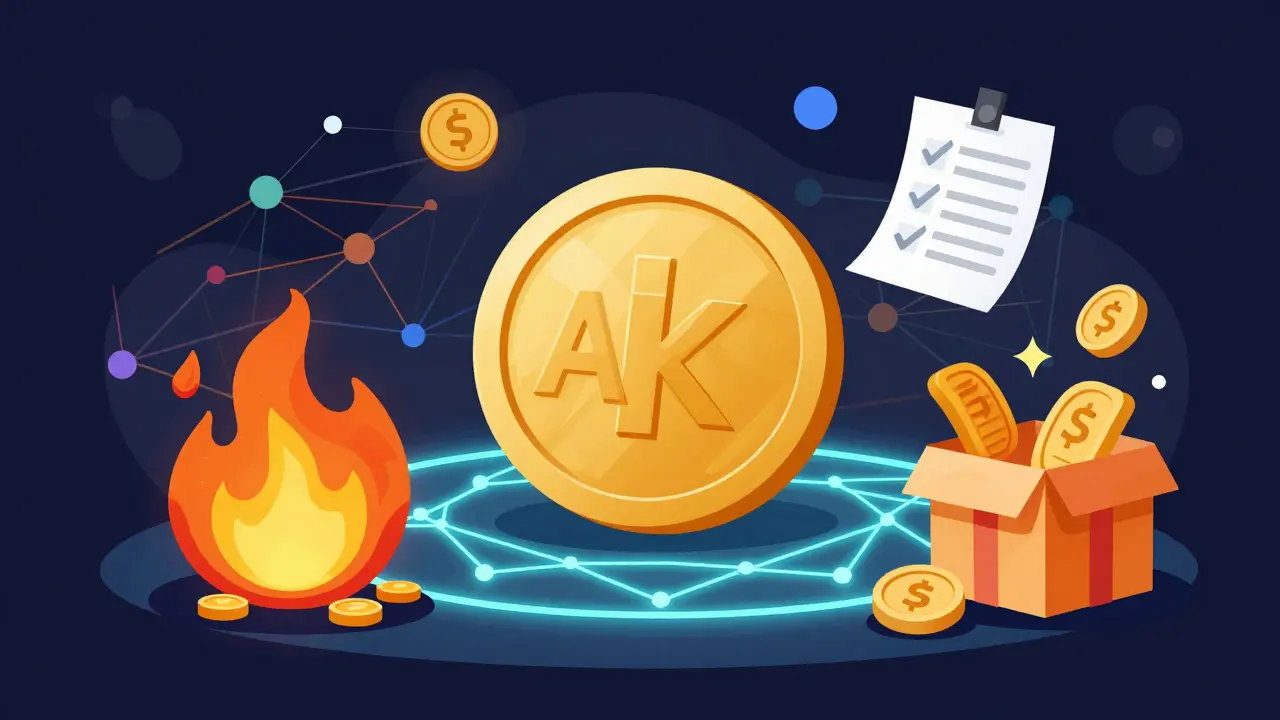
The tokenomics are designed to be deflationary. A portion of all platform fees is burned, meaning those tokens are permanently removed from circulation. This mechanism introduces artificial scarcity, which theoretically supports price appreciation if demand grows. With a maximum supply of 100 billion tokens, about 22.8 billion were circulating as of late 2025. The remaining 77.2% is locked in vesting contracts for investors and team members, with release periods ranging from 12 to 48 months.
Market Performance and Trading Data
Understanding the financial side of AKEDO requires looking at recent market data. As of December 2025, the AKE/USDT pair was trading around $0.0003458. This places the project with a market capitalization of approximately $7.88 million. However, the Fully Diluted Valuation (FDV)-what the market cap would be if all 100 billion tokens were in circulation-is closer to $34.58 million.
| Metric | Value |
|---|---|
| Current Price | $0.0003458 |
| Market Cap | $7.88 Million |
| Fully Diluted Valuation | $34.58 Million |
| Circulating Supply | 22.8 Billion |
| All-Time High | $0.003244 (Sept 2025) |
Note the significant gap between the current price and the all-time high. The token peaked at $0.003244 in September 2025 before dropping over 90%. This volatility is typical for early-stage GameFi projects. Investors should be aware that while the low current market cap suggests potential for growth, it also indicates high risk and speculative trading behavior.
Technical Infrastructure and Cross-Chain Support
While AKEDO launched on the BNB Smart Chain for its speed and low transaction costs, it is not limited to one network. The platform supports cross-chain compatibility with Solana and TON (The Open Network). This flexibility allows developers to choose the best environment for their specific game mechanics or target audience.
Using MetaMask or similar wallets compatible with BEP20 tokens, users can interact with the platform. Gas fees are paid in BNB, keeping costs minimal even during peak usage. This infrastructure choice makes AKEDO accessible to users who already hold BNB, reducing friction for new entrants.

Risks and Critical Considerations
No investment is without risk, and AKEDO has several factors to consider before diving in. First, the claim of "100x efficiency" remains unverified by independent third parties. While AI-generated games are impressive, they often lack the polish and depth of human-crafted titles. Complex mechanics, nuanced storytelling, and balanced gameplay design are still challenging for current AI models.
Second, the token distribution raises concerns about future selling pressure. With 77.2% of tokens locked in vesting schedules, massive unlocks could occur over the next few years. If these tokens hit the market without corresponding demand, the price could face downward pressure. Always check the latest vesting schedule updates on official channels.
Finally, regulatory uncertainty looms over the entire GameFi sector. As governments worldwide scrutinize crypto-gaming hybrids, platforms like AKEDO may face compliance challenges. Operating across multiple chains helps mitigate some jurisdictional risks, but it does not eliminate them entirely.
Is AKEDO Right for You?
If you are a developer tired of boilerplate code, AKEDO offers a fascinating playground for rapid prototyping. For investors, it represents a high-risk, high-reward bet on the convergence of AI and blockchain gaming. The platform’s unique position-combining no-code creation with integrated token launches-sets it apart from pure play-to-earn projects.
However, do not expect instant riches. The market has shown extreme volatility, and the technology is still maturing. Use small amounts you can afford to lose, and focus on the utility of the platform rather than just the token price. Engage with the community, test the vibe coding features yourself, and see if the generated games meet your quality standards.
What is the main purpose of the AKEDO platform?
AKEDO is an AI-powered GameFi engine that allows users to create blockchain games using natural language prompts instead of traditional coding. It combines game development, asset generation, and token launching into one platform.
Which blockchain networks does AKE support?
The AKE token operates primarily on the BNB Smart Chain (BEP20). The platform also offers cross-chain compatibility with Solana and TON (The Open Network) to expand reach and functionality.
What is "vibe coding" in AKEDO?
Vibe coding is AKEDO's proprietary method where users describe game mechanics, art styles, and rules in plain English. AI agents then interpret these descriptions to generate complete game code and assets automatically.
Is the AKE token deflationary?
Yes, the AKE token has a deflationary mechanism. A portion of all platform fees generated by creators is burned, permanently removing those tokens from circulation and reducing the total supply over time.
Where can I buy AKE tokens?
AKE tokens are traded on various cryptocurrency exchanges. Official trading pairs such as AKE/USDT commenced on platforms like WEEX in late 2025. Other major exchanges like Gate.io and CoinEx also list the token.