
Imagine trying to verify a million-dollar bank transfer without downloading the entire history of every transaction ever made. It sounds impossible, right? Yet, that is exactly what happens on the Bitcoin network every single day. How do lightweight mobile wallets confirm your payment is valid without storing terabytes of data? The secret lies in a clever architectural split inside every blockchain block: the block header and the the metadata container that acts as a cryptographic fingerprint for the block. Understanding the difference between these two components is not just academic trivia; it is the key to grasping how blockchain achieves security, scalability, and trust.
The Anatomy of a Blockchain Block
At its core, a blockchain is a chain of blocks. But each block is not a monolithic blob of data. Think of a physical book. You have the cover, the table of contents, and the ISBN number (the header), and then you have the actual pages with the story written on them (the body). In blockchain terms, this separation allows the network to handle verification and storage separately.
The block header is a fixed-size data structure containing metadata essential for linking blocks together and proving work was done. In Bitcoin, this header is incredibly small-exactly 80 bytes. That is tiny. For context, this article’s introduction alone is larger than a Bitcoin block header. Despite its size, this 80-byte packet holds the cryptographic keys that secure the entire network.
The block body is the variable-sized section of a block that contains the actual list of transactions included in that block. This is where the real-world value lives. If you send someone 1 BTC, that transaction record lives here. The body can grow quite large, currently capped at 4MB in Bitcoin due to SegWit rules, but often much smaller depending on network activity.
What Exactly Is Inside the Block Header?
If the header is only 80 bytes, what fits in there? Every byte counts. Here are the six critical fields found in a standard Bitcoin block header:
- Version (4 bytes): Indicates which version of the protocol rules were used to create this block. This helps nodes reject old or invalid blocks during upgrades.
- Previous Block Hash (32 bytes): This is the glue. It contains the hash of the previous block’s header. This creates the "chain" effect. If you change any bit in the previous block, this hash changes, breaking the link.
- Merkle Root (32 bytes): A single hash that represents all the transactions in the block body. We will dive deeper into why this is magic later.
- Timestamp (4 bytes): When the miner started working on this block. It must be within a reasonable range of the network time to prevent manipulation.
- Difficulty Target (4 bytes): A numerical representation of how hard it is to find a valid hash for this block. It adjusts every 2,016 blocks to keep block times steady.
- Nonce (4 bytes): A random number miners change repeatedly to try and find a hash that meets the difficulty target. This is the core of Proof-of-Work.
Notice something missing? There are no transaction details here. No sender addresses, no amounts, no signatures. The header is purely about structure and security.
The Block Body: Where Transactions Live
While the header is rigid and small, the block body is flexible and bulky. Its primary job is simple: store the transactions. The body starts with a counter (using variable-length integer encoding) that tells the node how many transactions follow. Then comes the raw transaction data.
In Bitcoin, a typical block might contain hundreds or thousands of transactions. Each transaction includes inputs (where the coins come from), outputs (where they go), and digital signatures proving ownership. All this data adds up quickly. While the header stays at a constant 80 bytes, the body fluctuates wildly based on network demand. During high-traffic periods, the body pushes against the 4MB limit. During quiet times, it might be only a few kilobytes.
This distinction is crucial for developers. If you are building a full node, you download both. If you are building a lightweight wallet, you mostly care about the header and specific parts of the body.
The Magic Link: The Merkle Root
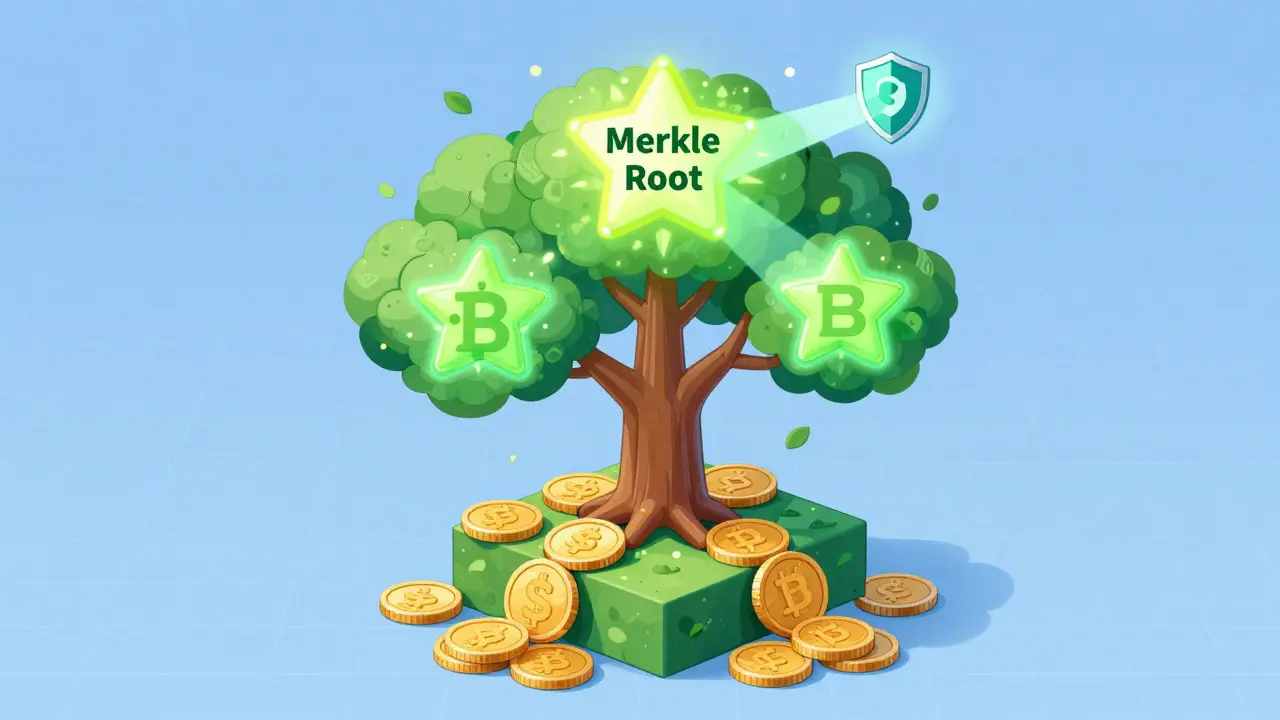
How does an 80-byte header know everything about the potentially massive block body? The answer is the Merkle Root is a cryptographic hash derived from hashing pairs of transactions until a single root hash remains.
Here is how it works conceptually: 1. Every transaction in the body is hashed individually. 2. These hashes are paired up and hashed together. 3. This process repeats, creating a binary tree of hashes. 4. The final single hash at the top is the Merkle Root.
This root is placed in the block header. Because of how cryptography works, changing even one comma in one transaction deep in the body will completely change the Merkle Root. Since the Merkle Root is part of the header, and the header is hashed to create the block ID, tampering with the body breaks the entire chain’s integrity. It makes fraud computationally impossible.
Why This Split Matters: SPV Clients
You might wonder, "So what? Why separate them at all?" The biggest benefit is efficiency for users who don’t want to run heavy hardware. This enables Simplified Payment Verification (SPV) clients, also known as light wallets.
An SPV client does not download the block bodies. It only downloads the block headers. When you check if a payment arrived, your phone asks a full node: "Did my transaction make it into this block?" The node replies with a "Merkle Proof"-a small subset of hashes from the tree that proves your transaction is linked to the Merkle Root in the header you already have.
Without the header/body split, every user would need to store the entire blockchain history to verify anything. That would kill adoption. Instead, the header provides the trust anchor, and the body provides the data payload. This allows billions of devices to participate in the network securely without needing server-grade storage.
| Feature | Block Header | Block Body |
|---|---|---|
| Size | Fixed (80 bytes) | Variable (up to 4MB) |
| Content | Metadata, Previous Hash, Merkle Root, Nonce | List of Transactions |
| Primary Purpose | Security, Chaining, Proof-of-Work | Data Storage, Value Transfer |
| Downloaded by Light Wallets? | Yes (Essential) | No (Only specific proofs) |
| Cryptographic Role | Creates the Block Hash | Feeds into the Merkle Tree |

Differences Across Blockchains
While Bitcoin set the standard, other blockchains tweak this model. Ethereum, for example, has a much larger header-around 500 bytes. Why? Because Ethereum’s state is more complex. Its header includes additional roots: the State Root (account balances), Transaction Root, and Receipts Root. It also historically included "ommers" (uncle blocks) in the body to reward miners who didn’t win the race but helped secure the network.
Solana uses a massive 1,280-byte header to accommodate its Proof-of-History mechanism, which timestamps events cryptographically before consensus. Cardano’s Ouroboros protocol uses a 128-byte header with stake-related fields. The core principle remains the same: header for metadata/security, body for execution/data. But the specific fields change based on the consensus mechanism and use case.
Future Changes: Verkle Trees and Scaling
The current Merkle tree structure is great, but it has limits. As networks scale, the proofs get heavier. Ethereum is moving toward Verkle Trees are a type of cryptographic data structure that replaces Merkle trees to enable stateless clients and reduce proof sizes. This upgrade aims to shrink the data needed to verify transactions by 97%, allowing even lighter clients to operate efficiently. Similarly, Bitcoin’s potential adoption of MAST (Merkelized Abstract Syntax Trees) could change how smart contracts interact with the Merkle Root, making complex scripts more efficient.
The header-body dichotomy is not going away. It is too fundamental to how distributed ledgers work. However, the internal structures of both are evolving to handle higher throughput and lower costs. Understanding this foundation helps you see why these changes matter: they are optimizing the balance between the lightweight security of the header and the heavy utility of the body.
Can I change the block body without affecting the header?
No. Any change to the transactions in the block body will alter the Merkle Root. Since the Merkle Root is stored in the block header, changing the body automatically invalidates the header's hash, breaking the chain linkage.
Why is the Bitcoin block header only 80 bytes?
It is designed for efficiency. Satoshi Nakamoto chose this size to include all necessary cryptographic links (previous hash, merkle root) and proof-of-work data (nonce, difficulty) while keeping it small enough for millions of devices to download and verify quickly.
Do light wallets download the block body?
Generally, no. Light wallets (SPV clients) download only the block headers. They request specific Merkle proofs from full nodes to verify that their specific transactions are included in the body, saving significant bandwidth and storage.
What is the nonce in the block header used for?
The nonce is a 4-byte field that miners increment randomly to produce a block hash that is lower than the current difficulty target. It is the core component of the Proof-of-Work mining process.
How does Ethereum's block header differ from Bitcoin's?
Ethereum's header is larger (~500 bytes) because it includes additional Merkle roots for account states, receipts, and logs, reflecting its Turing-complete smart contract capabilities compared to Bitcoin's simpler transaction model.