
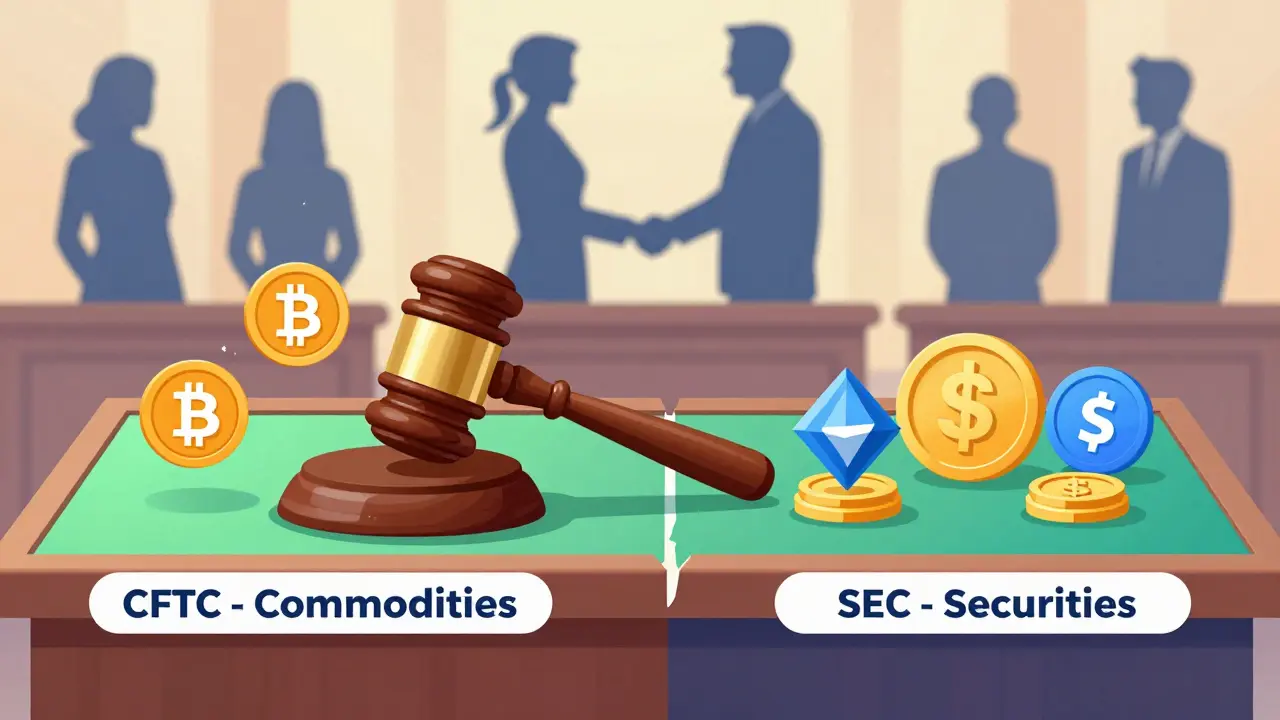
Imagine trying to build a house, but one inspector says you need a permit for the foundation, while another insists the roof is illegal. That is exactly where the U.S. cryptocurrency industry has been stuck for years. The battle between the Securities and Exchange Commission (SEC) and the Commodity Futures Trading Commission (CFTC) over who regulates crypto isn't just bureaucratic drama. It determines whether your favorite token is legal, whether exchanges can operate in the U.S., and billions of dollars in investment capital.
As of mid-2026, this turf war has shifted from aggressive enforcement to tentative legislative compromise. But for founders, investors, and traders, understanding which agency holds the leash is critical. If you classify an asset wrong, you don't just get a warning letter; you face massive fines or shutdowns. Let's break down how these two giants define power, why they disagree, and what the latest laws mean for your portfolio.
The Core Conflict: Securities vs. Commodities
To understand the fight, you first have to understand the weapons each agency uses. The conflict boils down to one question: Is a specific digital asset a security or a commodity?
The SEC argues that most tokens are securities. They rely on the Howey Test, a legal standard established by the Supreme Court in 1946. Under this test, if you invest money in a common enterprise with the expectation of profits derived from the efforts of others, it’s a security. For the SEC, many Initial Coin Offerings (ICOs) and newer tokens fit this description perfectly because early buyers relied on the development team’s work to increase value.
The CFTC, on the other hand, views Bitcoin and Ether as commodities. In 2015, during the Coinflip, Inc. case, the CFTC declared that virtual currencies fall under the definition of "commodities" in the Commodity Exchange Act. This classification gives them authority over derivatives like futures and options, and anti-fraud powers in spot markets, but less control over how tokens are issued or traded on exchanges.
| Feature | SEC (Securities) | CFTC (Commodities) |
|---|---|---|
| Primary Legal Basis | Securities Act of 1933, Securities Exchange Act of 1934 | Commodity Exchange Act (CEA) |
| Key Test/Criteria | Howey Test (Investment contract) | Definition of "Commodity" (Goods, services, rights) |
| Jurisdiction Scope | Issuance, trading, broker-dealers, exchanges | Derivatives (futures/options), anti-manipulation in spot markets |
| Typical Assets | Many ICO tokens, governance tokens, stablecoins (debated) | Bitcoin, Ether, Litecoin |
| Regulatory Style | Disclosure-heavy, registration required | Market integrity, position limits, clearing requirements |
How the Battle Played Out: Key Cases and Shifts
The landscape changed dramatically between 2023 and 2025. For years, the SEC, led by Chair Gary Gensler, took an aggressive "regulation by enforcement" approach. They sued Coinbase, Ripple, and Binance, arguing that their platforms operated as unregistered securities exchanges. The logic was that without clear rules, companies should assume everything is a security until proven otherwise.
This strategy hit a wall in court. In March 2024, Judge Katherine Polk Failla ruled that the SEC had plausibly alleged some Coinbase assets were securities, but she also noted that Bitcoin and Ether were likely not. Then came the big shift. By early 2025, political pressure and legal setbacks forced a change. On February 27, 2025, the SEC filed a joint stipulation with Coinbase to dismiss the lawsuit entirely. This wasn't just a loss; it signaled a retreat from the blanket assertion that all major altcoins were securities.
Meanwhile, the CFTC expanded its reach. In April 2025, they approved spot Ethereum exchange-traded funds (ETFs). This move effectively cemented Ether's status as a commodity in the eyes of regulators, allowing traditional finance to enter the space through regulated products. The contrast is stark: the SEC spent years fighting crypto firms in court, while the CFTC built bridges by approving new financial products.

The Legislative Fix: The CLARITY Act and Senate Drafts
Congress finally stepped in to draw the lines. The CLARITY Act (H.R. 4763), passed by the House in April 2024, proposed a clear split. It would give the CFTC primary oversight of "digital commodities" that meet three criteria:
- The asset is intrinsically linked to a mature blockchain system.
- The network is sufficiently decentralized (no single entity controls it).
- The token does not confer ownership rights or equity.
Assets failing these tests-like those tied to a central company’s profits-would remain under SEC jurisdiction as securities. This aligns with how courts have already treated Bitcoin and Ether. However, the Senate Banking Committee introduced a competing draft in March 2024 that suggested a more complex "digital asset determination" process before launch. As of 2026, the Bipartisan Policy Center forecasts a high probability (68%) of a compromise bill passing before the midterm elections, likely granting the CFTC broad authority over established coins while keeping the SEC focused on new, centralized offerings.
What This Means for Businesses and Investors
If you run a crypto business, this uncertainty has cost you dearly. A 2024 Deloitte survey found that U.S. crypto firms spend an average of $2.7 million annually on compliance, with 44% of that going directly to navigating the SEC-CFTC divide. Determining if a token is a security takes 3-6 months and costs around $185,000 per offering. Many companies adopted a "dual compliance" model, following both agencies' rules, which increased operational costs by 35%.
For investors, the risk is different. Regulatory clarity unlocks institutional money. Before the recent shifts, U.S. firms captured only 14% of the global crypto market share, down from 32% in 2020. The European Union’s MiCA regulation, effective June 2024, created a unified framework across 27 countries, giving EU-based firms a competitive edge. Morgan Stanley warned that without resolution, the U.S. could lose another 10-15% market share to offshore competitors. Now, with the dismissal of key lawsuits and pending legislation, we are seeing a return of confidence. The approval of spot ETH ETFs by the CFTC is a direct result of clearer commodity status, allowing pension funds and wealth managers to allocate capital safely.
Navigating the Gray Areas
Even with new laws, gray areas remain. Stablecoins are a prime example. Are they payment instruments, securities, or something else? The SEC has hinted at interest here, while the Treasury Department also claims a role. Governance tokens present another puzzle. If holding a token lets you vote on protocol changes, does that make it a security? Courts have generally said no, provided the voting doesn’t guarantee profit. But the line is thin.
State regulators are also filling the void. In April 2025, the Oregon State Attorney General sued Coinbase using theories similar to the old SEC playbook. This suggests that even if federal agencies agree on a split, states may continue to enforce their own blue sky laws. Companies must now prepare for a multi-layered regulatory environment: federal commodity rules for derivatives, federal securities rules for initial offerings, and state-level consumer protection laws.
Is Bitcoin considered a security or a commodity?
Bitcoin is widely recognized as a commodity. The CFTC affirmed this in 2015, and federal courts have consistently upheld that it falls under the Commodity Exchange Act. It is not considered a security because it lacks a central issuing entity whose efforts drive profits.
What happened to the SEC's lawsuit against Coinbase?
The SEC dismissed its lawsuit against Coinbase in February 2025. This marked a significant shift in the agency's strategy, moving away from aggressive enforcement against major exchanges toward a more collaborative approach pending new legislation.
How does the Howey Test apply to crypto?
The Howey Test determines if an asset is a security. If investors buy a token expecting profits from the work of a central team (like developers marketing and upgrading the network), it likely fails the test and is a security. If the network is fully decentralized and runs automatically, it may pass as a commodity.
What is the CLARITY Act?
The CLARITY Act is a bipartisan bill passed by the House in 2024 that aims to clarify crypto regulation. It proposes giving the CFTC authority over decentralized "digital commodities" like Bitcoin and Ether, while leaving the SEC to regulate digital assets that function as securities.
Why does the SEC-CFTC battle matter to me?
It affects market stability and innovation. Clear rules allow banks and institutions to invest safely, increasing liquidity and price stability. Uncertainty drives businesses overseas, reducing U.S. competitiveness and limiting access to new financial products for American consumers.
Jan Gilmore
May 22, 2026 AT 21:03People still think the Howey test is some magical spell that changes reality just because a lawyer says so. It’s absurd how much time we waste debating whether Bitcoin is a commodity when it clearly functions as one in every practical sense. The SEC’s entire strategy was built on fear and uncertainty, not actual legal precedent. Now they’re retreating because the courts finally saw through the nonsense. This isn’t a compromise; it’s a surrender to basic economic logic. The CFTC has been right about this since day one, but nobody wanted to listen until the lawsuits started failing.
Caique Muniz
May 24, 2026 AT 03:03lol another long boring article about bureaucrats fighting over who gets to tax our money. i dont care if its the sec or cftc or the department of motor vehicles regulating my bitcoin. they all want a cut. the whole point of crypto was to get away from these guys. now we have them all sitting around a table deciding what's legal. typical. also why does everyone keep using big words like 'jurisdictional' when they mean 'who gets the power'. keep it simple people.
beti macedo
May 25, 2026 AT 06:49This is such an important topic and I am very happy to see progress being made. It gives me hope for the future of financial inclusion. Although there are many typos in my head while typing this, I believe clarity is essential for growth. We must support these legislative efforts with positive energy. The CLARITY act sounds promising for small investors like myself. Let us remain optimistic despite the challenges. Thank you for sharing this detailed explanation. It helps us understand the complex landscape better. I look forward to seeing more stability in the market soon.
robert Whitehead
May 25, 2026 AT 10:42You are all missing the bigger picture here. The real issue isn't which agency regulates what, it's that the entire industry is built on fraud and speculation. The SEC was trying to protect consumers from scammers, and now you're celebrating their retreat? Disgusting. These tokens are worthless pieces of code designed to enrich early adopters at the expense of retail investors. The CFTC approving ETFs doesn't make it safe, it just makes the crash more expensive for taxpayers. Wake up and smell the Ponzi scheme.
Bradley Geldenhuys
May 25, 2026 AT 21:03think about it man. regulation is just control disguised as safety. they want to know where your money is so they can track you. the decentralization argument is weak if the regulators decide what counts as decentralized. its a paradox. you cant have true freedom under a government framework. but hey, if it keeps the price up for your bags, go ahead and cheer for the clariy act. just remember who really holds the keys. the state always wins in the end. its philosophical tragedy wrapped in financial jargon.
Pauline Larocco71
May 27, 2026 AT 20:00I feel so overwhelmed by all this legal talk but I try to stay informed because I care about my community. Its hard when everyone speaks in acronyms like SEC and CFTC without explaining simply. I worry about my friends who lost money during the chaos. Please let this new clarity help them recover. We need empathy in finance not just rules. I hope the EU model shows us a kinder way forward. Maybe we can learn from their mistakes too. Lets be gentle with each other during this transition period.
Michelle Bonahoom
May 28, 2026 AT 17:31why should we care about european regulations when america has its own problems. the US needs to stand strong and regulate everything itself. letting foreign models influence our laws is weak. we should ban crypto entirely if we cant control it properly. national security comes first not profits. stop looking overseas for answers. build american solutions. this dependency on global standards is dangerous for our sovereignty. wake up patriots.
Matt Davis
May 30, 2026 AT 05:23Oh, please. Spare me the patriotic rhetoric. You think banning crypto will save anything? It will just drive innovation to Dubai and Singapore, leaving American workers behind. Your ‘sovereignty’ argument is laughable when half your supply chain is already offshore. The fact that you’d rather destroy an emerging industry than adapt shows exactly why we’re losing ground. Grow up and accept that globalization is irreversible, or keep shouting into the void while your economy stagnates.
Albert Lee
May 30, 2026 AT 09:09Wow, that was intense! But seriously, Matt makes a great point about adaptation. Change is scary, but resisting it only hurts us in the long run. I’ve seen so many people struggle with the uncertainty, and it breaks my heart. We need to support each other through this transition. There is light at the end of the tunnel, even if it looks dark right now. Let’s focus on education and community building instead of anger. Together we can navigate these waters safely and successfully.
Ankush Pokarana
May 31, 2026 AT 18:55the essence of regulation is order but the soul of crypto is chaos. perhaps we seek balance not victory. the howey test is old law applied to new tech. it fits poorly like square peg in round hole. yet we force it. maybe the answer lies not in choosing between sec and cftc but in creating new frameworks entirely. we must think deeper about value creation versus extraction. the current debate misses the philosophical shift required for digital assets. let us contemplate the nature of trust in decentralized systems before accepting any compromise as final truth