
You’ve probably seen the name H2 Finance is a cryptocurrency token often mistaken for an exchange platform due to its naming convention pop up in search results or social media feeds. The name sounds official. It sounds like a place where you can deposit your Bitcoin and trade safely. But here is the hard truth that saves you from potential loss: H2 Finance is not a crypto exchange. It is a standalone digital asset-a token-trading under the ticker symbol $H2. Confusing it with a platform like Binance or Coinbase isn’t just a minor error; it’s a critical misunderstanding of what you are actually buying.
If you clicked on this article looking for a login page, customer support email, or a fee schedule for trading fees, you need to stop right there. There is no such thing as an "H2 Finance Exchange." Instead, you are looking at a speculative micro-cap token with significant information gaps. Let’s break down exactly what H2 Finance is, why it carries high risk, and how it compares to actual exchange tokens like BNB.
The Core Misconception: Token vs. Platform
The biggest issue with H2 Finance is the branding. In the crypto world, names matter. When you see "Finance" attached to a project name, your brain automatically associates it with banking services, lending protocols, or centralized exchanges. This is a common trap. Many projects use grandiose names to imply utility they do not possess.
Unlike Binance Coin (BNB) is the native utility token of the Binance exchange ecosystem used for fee discounts and launchpad participation, which has a clear function within a massive trading infrastructure, H2 lacks documented utility. According to data from mid-2024 through early 2026, authoritative sources like CoinCodex, CryptoSlate, and BeInCrypto classify H2 strictly as a tradable asset. There is no whitepaper detailing an exchange backend. There is no GitHub repository showing development activity for a trading engine. You cannot create an account on "H2 Finance." You can only buy the token on other platforms.
This distinction is vital. If you are looking for a place to store funds, H2 offers nothing. If you are looking to invest in a piece of a company, you are betting on a token with no clear revenue model or user base attached to it.
Technical Reality: Price, Volatility, and Market Cap
Let’s look at the numbers because they tell a story of extreme volatility and low liquidity. As of recent tracking data, H2 trades at approximately $0.001737. To put that in perspective, you would need over 500 of these tokens just to equal one US Dollar. This places H2 firmly in the "micro-cap" category.
| Metric | Value / Status | Implication for Investors |
|---|---|---|
| Current Price | $0.001737 | Extremely low entry cost, but high dilution risk. |
| Market Capitalization | ~$1.7 Million | Micro-cap status; highly susceptible to manipulation. |
| Variance (Volatility) | 19.80% | High swings mean rapid gains or losses. |
| RSI (14-Day) | 40.88 (Neutral/Bearish) | Lack of strong buying momentum. |
| Fear & Greed Index | 48 (Neutral) | Indecisive market sentiment. |
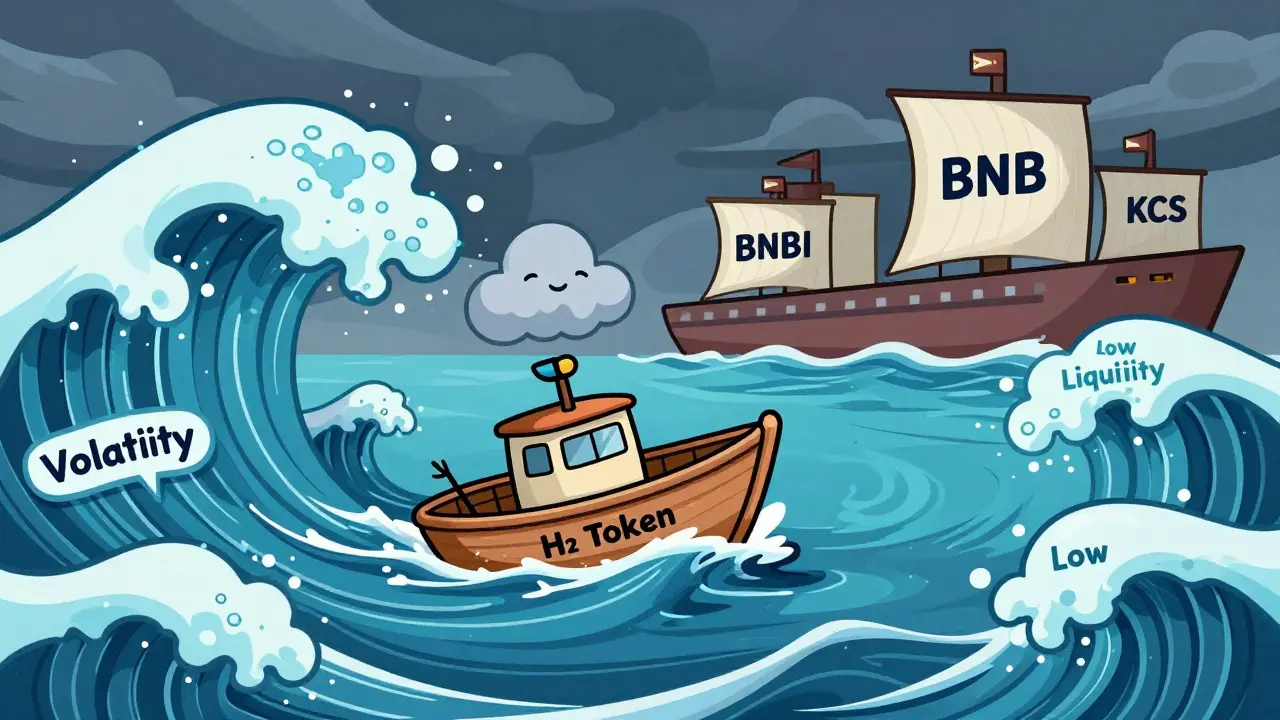
A market cap of roughly $1.7 million is tiny. For comparison, major exchanges process trillions in volume quarterly. A micro-cap token like H2 can be moved significantly by a single large sell order. This is known as low liquidity. If you decide to sell 10,000 dollars worth of H2, you might crash the price yourself because there aren't enough buyers waiting on the order book.
Furthermore, the technical indicators show a slight downward trend. The 50-day Simple Moving Average (SMA) sits above the current price, suggesting that short-term sellers have been more active than buyers. While some models predict a bounce, the lack of fundamental news to drive that bounce makes it purely speculative.
Why Are Predictions So Contradictory?
If you dig into analysis reports, you will find two very different stories being told about H2's future. This confusion stems from the fact that analysts are using mathematical patterns rather than fundamental business value.
On one side, you have models like those from CoinDataFlow. They use pattern recognition on candlestick charts. They see shapes like the "Hammer" or "Bullish Engulfing" and predict a rise. Their long-term forecast suggests H2 could reach $0.0068 by 2029. That sounds like a 293% gain, which is tempting.
On the other side, you have platforms like CoinCodex. They focus on moving averages and broader market sentiment. Their data shows the price falling below key support levels (both the 50-day and 200-day SMAs). Their prediction is bearish, forecasting a decline to $0.0013 by late 2025.
So, who is right? Neither necessarily. Because H2 lacks a real-world utility-like paying for gas fees on a blockchain or getting discounts on an exchange-its price is driven almost entirely by hype and speculation. When there is no product to anchor the value, predictions become guesses. One algorithm sees a pattern; another sees weakness. Without a whitepaper or a working product to validate either view, you are left gambling on which chart pattern wins.
The Missing Infrastructure: Where Is the Team?
In the modern crypto landscape, especially post-2022, transparency is non-negotiable. Regulators like the EU’s MiCA framework demand clear identification of issuers. Established projects have active Twitter accounts, regular blog updates, and public team members.
H2 Finance fails this basic test. As of 2026, there is no verified official website dedicated to the project’s roadmap. There are no developer commits on GitHub. Community inquiries on Telegram and Reddit often go unanswered or result in confusion. On Reddit, threads discussing H2 frequently feature users asking, "Is this a scam?" or "What does this token actually do?" with no definitive answers from insiders.
This silence is a red flag. In a healthy project, the team communicates milestones. In a ghost project, the silence allows the price to drift based on external factors alone. If the liquidity dries up, there is no team to step in and provide support or clarity. You are on your own.
H2 Finance vs. Real Exchange Tokens
To understand the risk, compare H2 to what a legitimate exchange token looks like. Take KuCoin Token (KCS) is the utility token of the KuCoin exchange offering profit-sharing dividends and fee rebates. KCS holders benefit directly from the growth of the KuCoin platform. If KuCoin makes money, KCS holders get a share. The value is tied to real revenue.
H2 has no such mechanism. It is not listed as having dividend rights, governance voting power over a protocol, or fee discount structures. It is a naked asset. Here is how they stack up:
| Feature | H2 Finance ($H2) | Binance Coin (BNB) | KuCoin Token (KCS) |
|---|---|---|---|
| Type | Speculative Micro-Cap Token | Exchange Utility Token | Exchange Utility Token |
| Primary Use Case | None Documented | Trading Fees, Launchpad, Ecosystem | Fee Discounts, Profit Sharing |
| Market Cap | ~$1.7 Million | ~$45 Billion | ~$1 Billion+ |
| Regulatory Compliance | Unclear / None | High (Global Licenses) | Medium-High |
| Developer Activity | Non-existent | Very High | High |
When you buy BNB, you are buying into a global financial infrastructure. When you buy H2, you are buying a digital receipt with no underlying service attached. The risk-reward ratio is heavily skewed toward risk.

Who Should Avoid H2 Finance?
Not every investor is built for the same level of risk. Based on the profile of H2 Finance, here is who should likely steer clear:
- Beginners: If you are new to crypto, stick to assets with clear explanations and high liquidity. H2 requires constant monitoring and a stomach for 20% daily swings.
- Long-Term Holders (HODLers): Without a utility roadmap, holding H2 for five years is a bet that someone else will pay more for it later. There is no cash flow or dividend to sustain the price during bear markets.
- Risk-Averse Investors: If losing your entire investment keeps you up at night, avoid micro-caps. H2’s small market cap means it can drop 50% on bad news or even no news at all.
Conversely, who might consider it? Only experienced traders who specialize in "meme" coins or unlisted gems, who understand how to read order books, and who are willing to treat the capital as disposable. Even then, the lack of community engagement makes it a difficult play.
Final Verdict: Proceed with Extreme Caution
H2 Finance is not a crypto exchange. It is a low-cap token with ambiguous utility, no visible development team, and contradictory price predictions. While the low price point ($0.0017) might seem like a bargain, it reflects the high risk associated with the asset. The absence of a whitepaper, official website, or clear use case places it in the speculative tier of cryptocurrencies.
If you are searching for a reliable platform to trade crypto, look elsewhere. Platforms like Coinbase, Kraken, or Binance offer insured custodial services, regulatory compliance, and transparent fee structures. If you are determined to trade H2, ensure you do so on a reputable secondary exchange like Crypto.com, and never invest more than you can afford to lose completely. In the world of crypto, obscurity is rarely a feature-it’s usually a bug.
Is H2 Finance a legitimate cryptocurrency exchange?
No, H2 Finance is not a cryptocurrency exchange. It is a standalone cryptocurrency token ($H2) that is traded on other platforms. There is no evidence of an exchange infrastructure, user accounts, or trading engine operated by H2 Finance itself.
Where can I buy H2 Finance tokens?
H2 Finance tokens are primarily listed under the ticker H2USD on exchanges like Crypto.com. However, due to its low market cap, liquidity may be limited, meaning you might face slippage when buying or selling larger amounts.
What is the purpose of the H2 token?
The specific utility or purpose of the H2 token is poorly documented. Unlike exchange tokens such as BNB or KCS, H2 does not appear to offer fee discounts, governance rights, or access to specific services. It functions largely as a speculative asset.
Is H2 Finance a scam?
While not definitively proven as a scam, H2 Finance exhibits several red flags common to fraudulent or abandoned projects, including a lack of official website, no visible development team, and unclear utility. Investors should exercise extreme caution.
What is the predicted price of H2 in 2026?
Predictions vary widely. Some models suggest a potential increase to around $0.003 by 2025-2026, while others forecast a decline to $0.0013 due to weak technical indicators and lack of fundamental support. These are speculative estimates, not guarantees.
amy miranda
August 13, 2026 AT 18:48It is absolutely tragic how many people fall for this nonsense. The audacity of these developers to slap the word 'Finance' on a worthless token and expect anyone to take it seriously is beyond belief. We are living in an era where basic due diligence should be mandatory, yet here we are watching retail investors throw money into a black hole. It’s not just risky; it’s morally bankrupt. The silence from the team isn't mysterious; it's criminal negligence disguised as anonymity.
Subhash Kashyap Dm
August 13, 2026 AT 23:59you think its just a bad token? look deeper. the lack of github activity isnt an oversight its a feature of the shadow economy. they want you blind. the liquidity traps are designed by algorithms that predict your panic selling before you even click the button. h2 finance is likely a front for something much larger a data harvesting operation or a wash trading ring to manipulate other markets. trust no one. the charts are lies.
Ed Wallace
August 15, 2026 AT 02:20I find it fascinating how branding acts as a psychological anchor in such a volatile space. When we see 'Finance,' our brains short-circuit and assume stability, bypassing the critical thinking centers entirely. This post highlights a fundamental flaw in human cognition regarding digital assets. We crave structure and utility, so we invent them where none exist. It’s a cautionary tale about the power of suggestion over substance.
Ed Mitchell
August 16, 2026 AT 16:30The mainstream media will tell you it is merely a speculative asset, but I suspect a coordinated effort to suppress genuine innovation. These 'red flags' are often manufactured narratives by centralized exchanges to eliminate competition. H2 Finance operates outside their control, which is precisely why the silence persists. They are being watched, yes, but by whom? The regulators who claim transparency while hiding behind closed doors? Do not let the fear-mongering distract you from the truth of decentralization.
Lorraine Surringer
August 17, 2026 AT 21:31omg this article is so helpful thank u!! i was literally about to put my rent money into this lol. glad someone pointed out it aint an exchange. feels like every time i try to learn crypto someone tries to scam me. why is everything so complicated??
Billy Cunningham
August 18, 2026 AT 01:02Micro-cap hell 📉🤡
Eric Zehr
August 18, 2026 AT 16:32Hey everyone, let’s keep the negativity in check. While the risks are real, this is a great learning opportunity for all of us. Understanding the difference between a utility token and a platform is crucial for long-term success. Let’s support each other in making smarter choices rather than just pointing fingers. Knowledge is power, and we’re all getting smarter together!
Joshua Hofford
August 18, 2026 AT 18:25In my travels through various crypto communities, I’ve seen this pattern repeat across borders. Whether in Tokyo or Toronto, the allure of the 'next big thing' blinds people to the basics. It’s a cultural phenomenon really-the desire for quick wealth overrides caution. But hey, at least we have stories to share now. Stay curious, friends.
Marcia Albert
August 20, 2026 AT 02:29I just sit back and watch the circus. One day it’s BNB, next week it’s some random H2 token with no website. The sheer creativity of these scams is almost artistic. I prefer to stick to Bitcoin and sleep well at night. Less drama, more peace.
Emma Smith
August 20, 2026 AT 15:01look at the rsi it says neutral but i feel like the market is lying to us. maybe the team is just quiet because they are building something huge in stealth mode? who needs a whitepaper when you have vibes? stop listening to these haters they just want to keep you poor. buy the dip or whatever.
Pernelia Wahkan
August 21, 2026 AT 12:14Let’s dissect the mechanics here. The volatility isn’t just noise; it’s a signal of illiquidity. When you see a 19% variance on a micro-cap, you’re looking at a market that can be moved by a single whale. It’s a delicate ecosystem of order books and slippage. For those interested in the technical side, studying the spread on DEXs versus CEXs for tokens like this reveals the true cost of entry. It’s a fascinating study in market inefficiency.
SUBHAM CHOUDHURY
August 23, 2026 AT 01:00Hi friends! Just wanted to add that patience is key in this journey. If you do decide to explore smaller caps, always start small. There is no shame in missing out if it means keeping your capital safe. You got this! Keep learning and stay positive.
Joy Kwant
August 23, 2026 AT 01:44It is simply disgusting how little accountability exists in this industry. People lose life savings because there is no one to blame. The moral decay of treating money like a game is evident here. We need stricter laws, not more 'do your own research' platitudes. Until then, avoid this trash.
Michael Mostyn
August 24, 2026 AT 11:49Upon reviewing the comparative analysis provided, the distinction between H2 and established entities like BNB becomes starkly apparent. The absence of a revenue-sharing model or governance utility renders H2 purely speculative. In financial theory, value is derived from future cash flows or utility. Without either, the price action is devoid of fundamental justification. Prudence dictates avoidance.