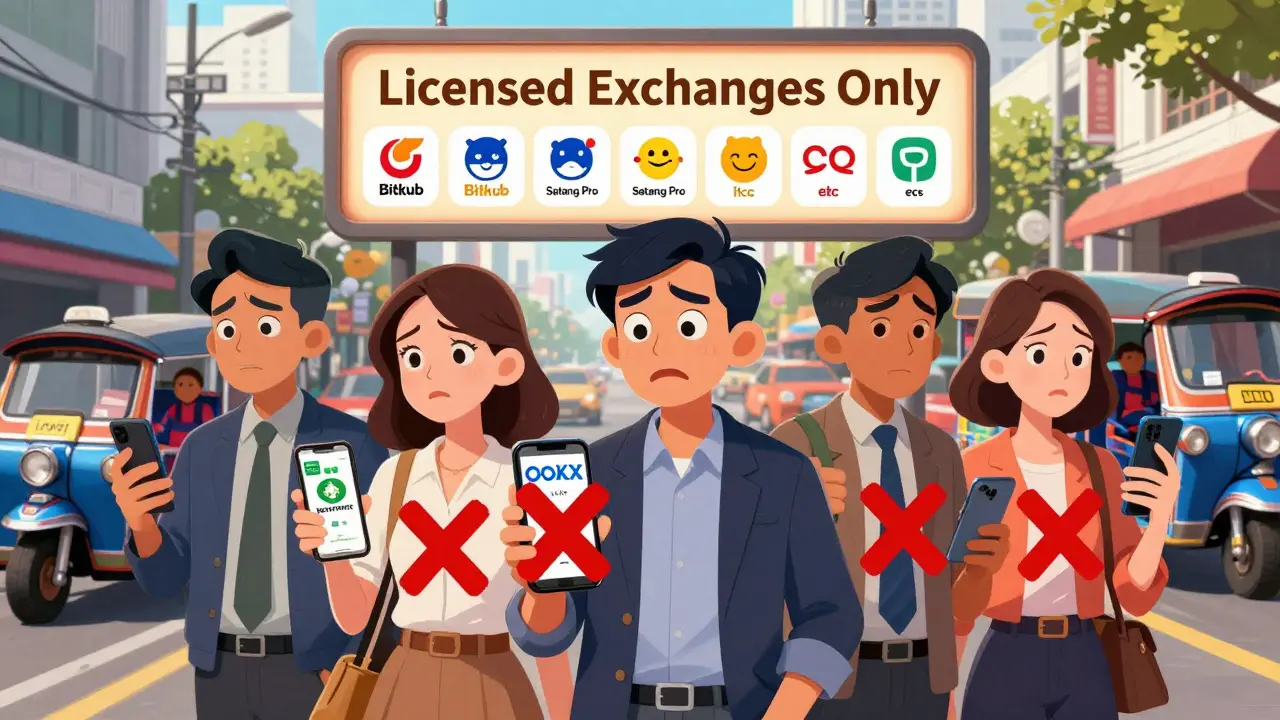
When Thailand tightened its crypto exchange rules in April 2025, it didn’t just update a policy-it rewrote the entire game for anyone trading digital assets in the country. If you’re a Thai investor, a foreign exchange operator, or even just someone who uses crypto while visiting Bangkok, you need to understand what changed. The Thailand SEC crypto regulations are now among the strictest in Southeast Asia, and they’re not going away. This isn’t about stopping innovation. It’s about stopping scammers. But the cost? Less choice, higher fees, and a growing underground market.
Who Needs a License to Operate in Thailand?
The Thai Securities and Exchange Commission (SEC) doesn’t just regulate local companies. If you’re a foreign exchange like Bybit, OKX, or Binance, and you’re serving Thai customers, you need a license. It doesn’t matter if your servers are in Singapore or your headquarters are in the Cayman Islands. If you’re targeting Thai users, you’re under Thai law. The SEC laid out seven clear signs that you’re serving Thai customers:- Your website is in Thai-or even partially in Thai
- You use a .th or .ไทย domain
- You accept payments in Thai baht or through Thai bank accounts
- You say Thai law governs your terms or Thai courts handle disputes
- You pay for Google or Facebook ads targeting Thai users
- You have staff or offices in Thailand to help Thai customers
- You do anything else the SEC says counts
What Happened to Foreign Exchanges Like Bybit and OKX?
Before April 2025, over 85% of Thai crypto trading happened on foreign platforms. Bybit, OKX, and Binance were the go-to choices. They had low fees, hundreds of coins, and no withdrawal limits. After the new rules took effect, those platforms had 30 days to apply for a license. None of them did. Why? The cost and complexity were too high. The application fee alone is 1 million baht ($27,400). Then there’s the annual fee of 500,000 baht ($13,700). Plus, you need to prove you have at least 50 million baht ($1.37 million) in operational capital. You need source code audits, AML systems that meet FATF standards, and a full Thai-language interface. Bybit and OKX shut down their Thai services. Their websites now show a message: “We are no longer available in Thailand.”Only Nine Licensed Exchanges Are Allowed
As of February 2025, only nine companies got approved. The biggest is Bitkub. Others include Zipmex, Satang Pro, and Coinone Thailand. These are the only platforms Thai residents can legally use. But here’s the catch: these exchanges don’t offer what foreign platforms did. They’re limited to just 35 approved digital assets. That means no Dogecoin, no Shiba Inu, no Solana, no Cardano. Only Bitcoin and Ethereum are allowed for ETFs. Meme tokens? Banned. Fan tokens? Banned. NFT trading? Also banned. Withdrawal limits are tight too. Bitkub users can only pull out 500,000 baht ($13,700) per day. For serious traders, that’s a dealbreaker. Transaction fees are higher too. On Bitkub, you pay 0.25% per trade. On Bybit before it left, it was 0.1%. That’s 2.5 times more.What Can Licensed Exchanges Do-And What’s Forbidden?
Licensed Thai exchanges can’t just trade crypto. They’re locked into a narrow set of rules:- No advertising crypto as payment for goods or services
- No offering wallets as a standalone service
- No lending or staking with guaranteed returns
- No accepting privacy coins like Monero or Zcash
- No facilitating transfers for payments
Why Did Thailand Go So Far?
The push wasn’t random. In early 2025, reports of crypto scams spiked. Thai police recorded a 42% jump in fraud cases linked to fake exchanges and phishing sites. One popular scam? Fake “guaranteed returns” on Telegram groups. People lost millions. The SEC’s goal, as stated by Secretary-General Pornanong Budsaratragoon, was “not to stifle innovation but to stop digital asset scammers exploiting loopholes.” And it worked-sort of. Crypto fraud reports dropped 37% in Q2 2025 compared to Q1. That’s real progress. But it came with a trade-off. Many Thai users say they now face worse trading conditions: fewer coins, higher fees, slower withdrawals. On Pantip.com, Thailand’s biggest forum, one thread with over 200 upvotes complained: “I used to trade 10 different coins. Now I can only pick from 35. And I can’t even withdraw my profits when I need to.”How Does Thailand Compare to Other Countries?
Thailand’s rules are stricter than Singapore’s. MAS lets foreign exchanges operate if they meet basic AML rules. Thailand demands full licensing and local presence. It’s also more open than China, which banned all crypto exchanges outright. But it’s less flexible than Japan, which allows foreign platforms to operate under their own licenses-even if they serve Japanese users. The biggest difference? Thailand’s extraterritorial reach. No other country blocks foreign sites so fast and so easily. The SEC doesn’t wait for court approval. It tells the Ministry of Digital Economy and Society: “Block this.” And it happens within hours. Compared to the EU’s MiCA rules, Thailand’s framework lacks clarity on stablecoins and doesn’t allow license portability. If you’re licensed in Thailand, you can’t automatically operate in Malaysia or Indonesia.What’s Next for Thailand’s Crypto Market?
The market is shrinking-but not dying. In Q1 2025, Thailand’s crypto market was worth $1.2 billion with 4.7 million active users. By Q2 2025, 78% of trading had moved to licensed exchanges. That’s a big shift. The SEC is planning more changes. In late 2025, they’ll start regulating DeFi platforms. In early 2026, they’ll pilot a central bank digital currency (CBDC) that could integrate with licensed exchanges. That could open new doors for institutional investors. They’re also preparing to approve altcoin ETFs in 2026. That could bring in $3 billion in new money-if the SEC allows it. But here’s the problem: 35% of Thai crypto activity is now happening offshore. People use VPNs to access Bybit, Binance, and Kraken. The SEC can’t block every VPN. And they can’t jail every user.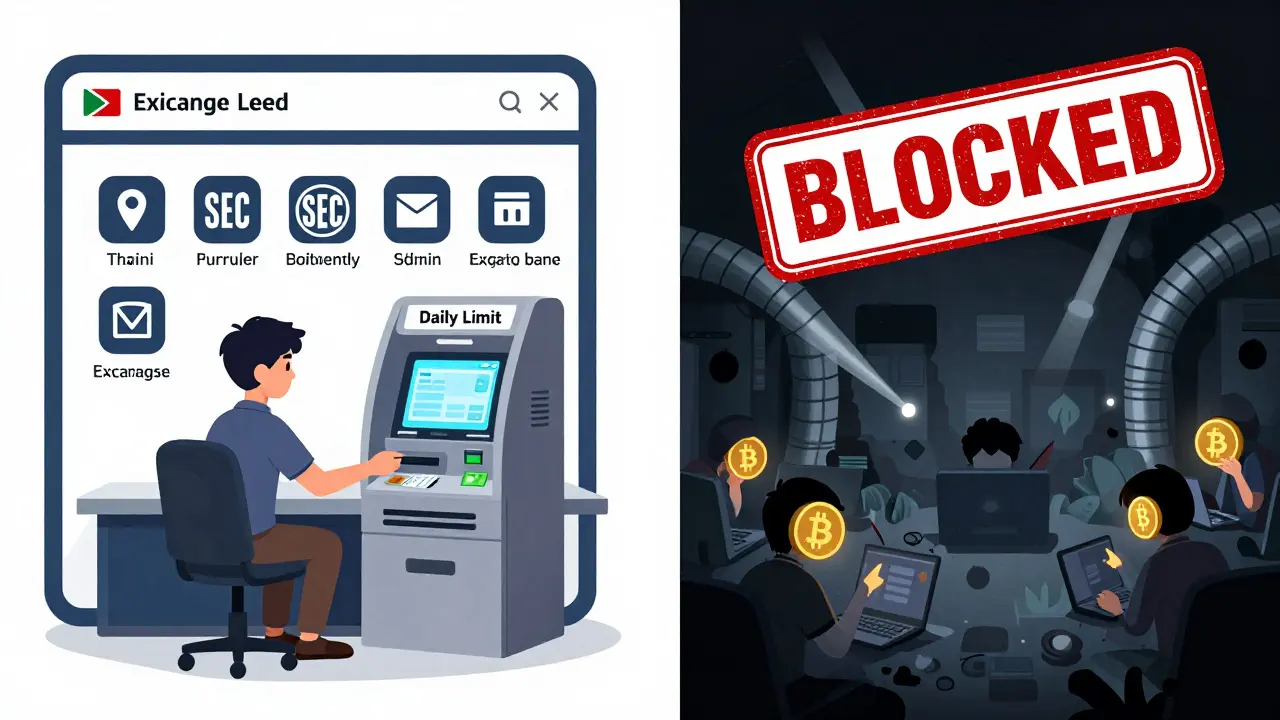
Is This System Working?
It’s working for safety. Scams are down. Users feel more protected. The licensed exchanges have strong security. No major hack has happened since the new rules took effect. But it’s failing for choice and accessibility. Traders miss the liquidity. Investors miss the coins. Developers can’t build on the platform because the rules are too tight. The Thai Blockchain Association called the 30-day compliance window “unrealistically short.” And they’re right. No exchange, even a big one, can rebuild its entire system in a month. CryptoCompare gave Thailand a 6.2 out of 10 on their 2025 regulatory index. Strong on protection. Weak on innovation.What Should You Do?
If you’re a Thai resident: Use one of the nine licensed exchanges. Bitkub is the most popular. But know the limits: fewer coins, lower withdrawal caps, higher fees. Don’t risk using unlicensed platforms-you could lose your money and have no legal recourse. If you’re a foreign exchange: If you want to serve Thai users, apply for a license. But be ready for a 90-120 day process, heavy costs, and strict operational rules. Most won’t bother. If you’re a traveler: Don’t trade crypto in Thailand unless you’re on a licensed platform. Even if you’re just visiting, you’re still subject to Thai law. If you’re an investor: Watch the ETF rollout in 2026. That’s where the real opportunity might be.What’s the Long-Term Outlook?
Thailand’s government is still committed to blockchain. They’ve allocated 2.1 billion baht ($57.6 million) through 2027 for blockchain projects. The National Blockchain Policy Office is pushing for Thailand to be a regional fintech hub. But if they keep pushing users offshore, that vision could collapse. The real test isn’t whether they can stop scammers. It’s whether they can build a market that people actually want to use. Right now, Thailand has the safest crypto market in Southeast Asia. But is it the most useful? That’s still up for debate.Are foreign crypto exchanges banned in Thailand?
Yes, foreign exchanges like Bybit, OKX, and Binance are banned from operating in Thailand unless they obtain a license from the Thai SEC. Since April 2025, these platforms have been blocked if they serve Thai users without a license. Only nine locally licensed exchanges are legally allowed to operate.
Can I still use Binance in Thailand?
No, Binance is not legally allowed to offer services in Thailand unless licensed. After the April 2025 regulations, Binance shut down its Thai operations. While some users access it via VPN, doing so violates Thai law and offers no legal protection if funds are lost.
What cryptocurrencies can I trade on Thai exchanges?
Thai licensed exchanges only support 35 approved digital assets as of June 2025. Bitcoin and Ethereum are the only ones eligible for ETFs. Meme coins like Dogecoin, fan tokens, NFTs, and privacy coins like Monero are completely banned. Altcoins like Solana, Cardano, and Polygon are not available on local platforms.
How much does it cost to get a crypto license in Thailand?
The application fee is 1 million Thai baht ($27,400), and the annual license fee is 500,000 baht ($13,700). Companies must also prove they have at least 50 million baht ($1.37 million) in operational capital. Additional costs include legal compliance, Thai-language interfaces, and SEC-approved audits.
What happens if I use an unlicensed exchange in Thailand?
Using an unlicensed exchange isn’t illegal for individual users, but it’s risky. You have no legal protection if the platform disappears or gets hacked. Your funds are not insured, and Thai authorities won’t help you recover losses. Plus, the platform itself is blocked, so you may lose access to your account without warning.
Can I stake crypto or earn interest on Thai exchanges?
No. Thai SEC regulations explicitly prohibit licensed exchanges from offering staking, lending, or any service that promises fixed returns on crypto. This includes interest-bearing wallets and yield farming. The goal is to prevent misleading “guaranteed return” scams.
Will Thailand allow more coins or ETFs in the future?
Yes. The SEC plans to expand the list of approved assets and launch altcoin ETFs in 2026. Bitcoin and Ethereum ETFs are already allowed. Broader ETF access could unlock up to $3 billion in new institutional investment, but new coins will still need to pass strict SEC security and compliance reviews.
Matthew Kelly
January 26, 2026 AT 17:11Adam Fularz
January 26, 2026 AT 20:59Linda Prehn
January 27, 2026 AT 06:32Nathan Drake
January 28, 2026 AT 18:20Arielle Hernandez
January 30, 2026 AT 09:51HARSHA NAVALKAR
January 31, 2026 AT 16:10Ryan Depew
February 2, 2026 AT 06:38Tammy Goodwin
February 2, 2026 AT 23:14Shamari Harrison
February 4, 2026 AT 06:19Nadia Silva
February 4, 2026 AT 19:46Roshmi Chatterjee
February 5, 2026 AT 07:31Julene Soria Marqués
February 6, 2026 AT 01:28Bonnie Sands
February 7, 2026 AT 11:35Jennifer Duke
February 8, 2026 AT 15:33Andy Marsland
February 9, 2026 AT 11:48Anna Topping
February 10, 2026 AT 00:45Jeffrey Dufoe
February 10, 2026 AT 13:00katie gibson
February 12, 2026 AT 03:14