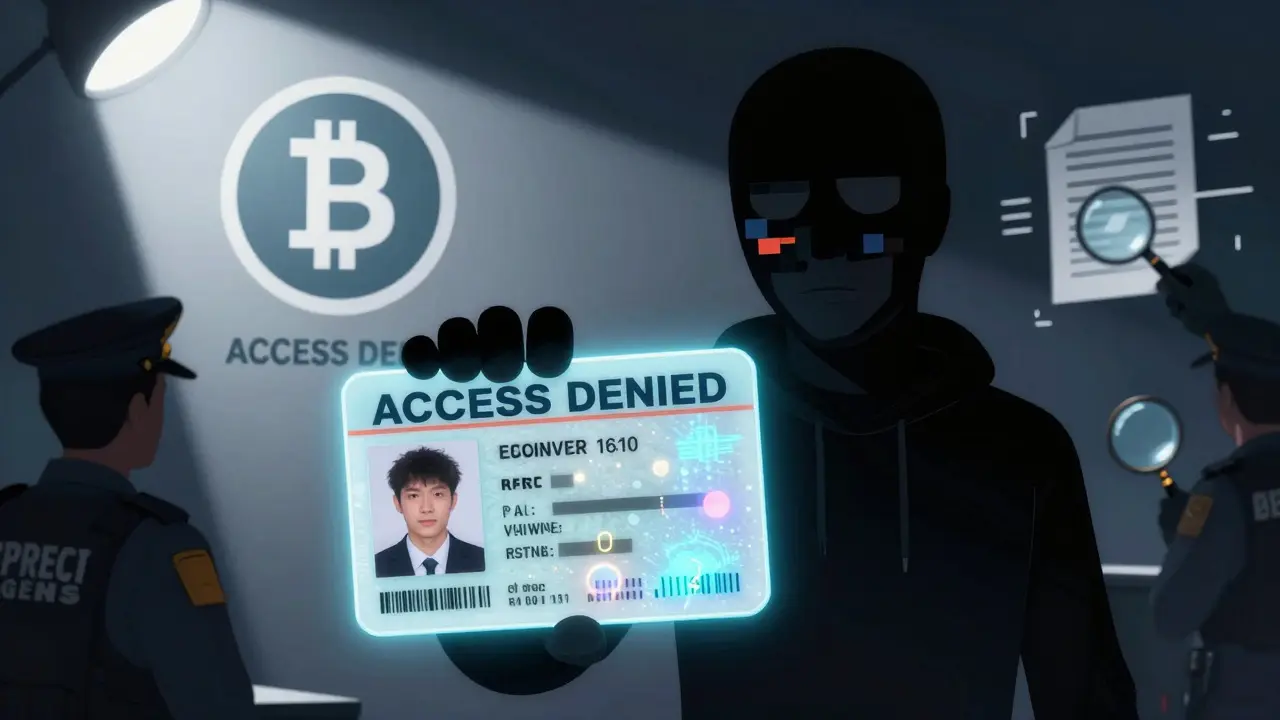
Using fake documents to get into a crypto exchange isn’t just a risky move-it’s a federal crime with real prison time attached. People think they’re outsmarting the system by using AI-generated IDs or deepfake videos to bypass KYC checks, but the truth is, regulators are already three steps ahead. This isn’t some underground hack you can get away with. It’s a direct violation of federal laws designed to stop money laundering, fraud, and financial chaos-and the penalties are harsh.
What Exactly Is Document Forgery in Crypto?
Document forgery for crypto exchange access means creating or altering identity papers-like driver’s licenses, passports, or utility bills-to trick platforms into letting you open an account. These aren’t hand-drawn fakes anymore. Modern fraudsters use AI tools to generate fully realistic government documents that include watermarks, holograms, and even fake barcodes. Some go further, using deepfake video to mimic live facial recognition checks. The system asks you to blink, turn your head, or say a phrase. The fraudster’s software plays a pre-recorded video of someone doing exactly that, sometimes even synced to match the timing of the request. It’s convincing enough to fool basic systems.These fake identity packages are sold on dark web marketplaces for as little as $15 and as much as $500. Buyers don’t just want to trade Bitcoin-they’re often trying to hide stolen funds, launder money, or avoid sanctions. That’s why this isn’t treated like a minor ID theft case. It’s seen as part of a larger financial crime ring.
Which Laws Are You Breaking?
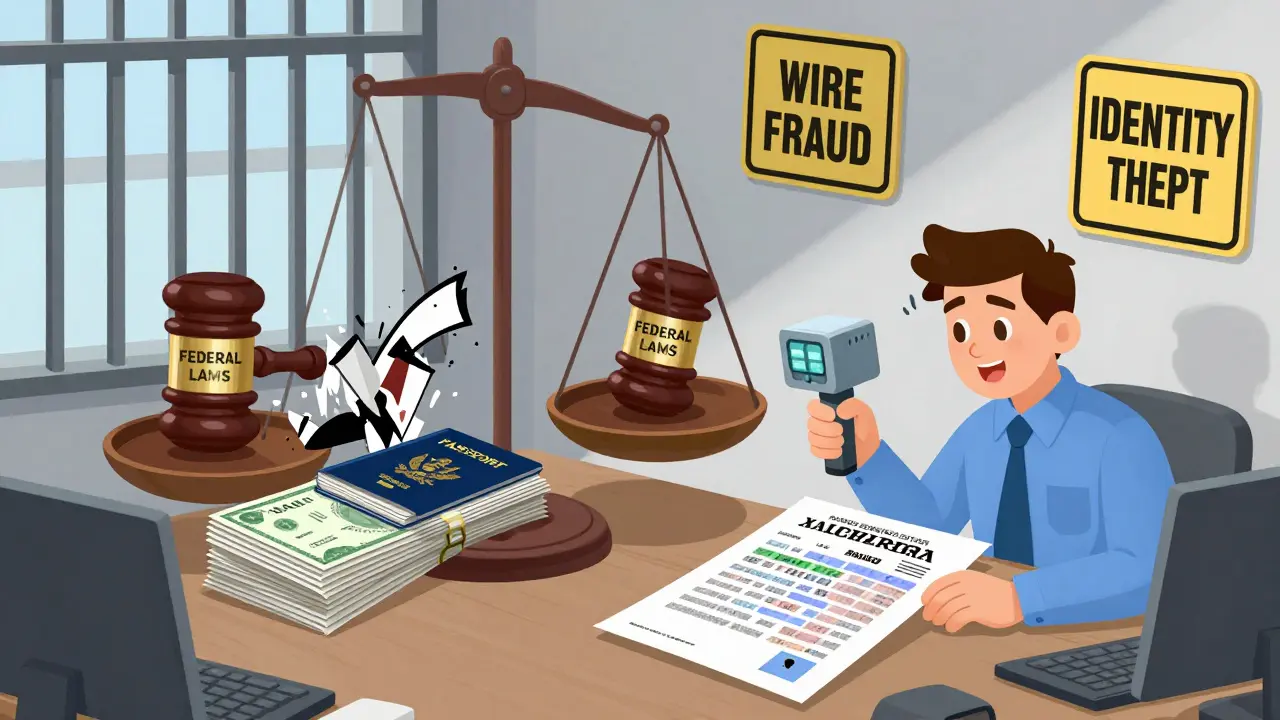
If you use forged documents to access a crypto exchange, you’re not just breaking exchange rules-you’re violating multiple federal laws. The main ones include:- Wire Fraud: Using electronic communications (like email or online forms) to deceive a platform into granting access.
- Securities Fraud: If you use the account to trade or manipulate crypto assets as if they were securities, you trigger SEC regulations.
- Money Laundering: The Financial Crimes Enforcement Network (FinCEN) treats crypto exchanges as financial institutions. Bypassing KYC to move illicit funds is a direct violation.
- Identity Theft: Using someone else’s real documents without permission is a separate federal offense.
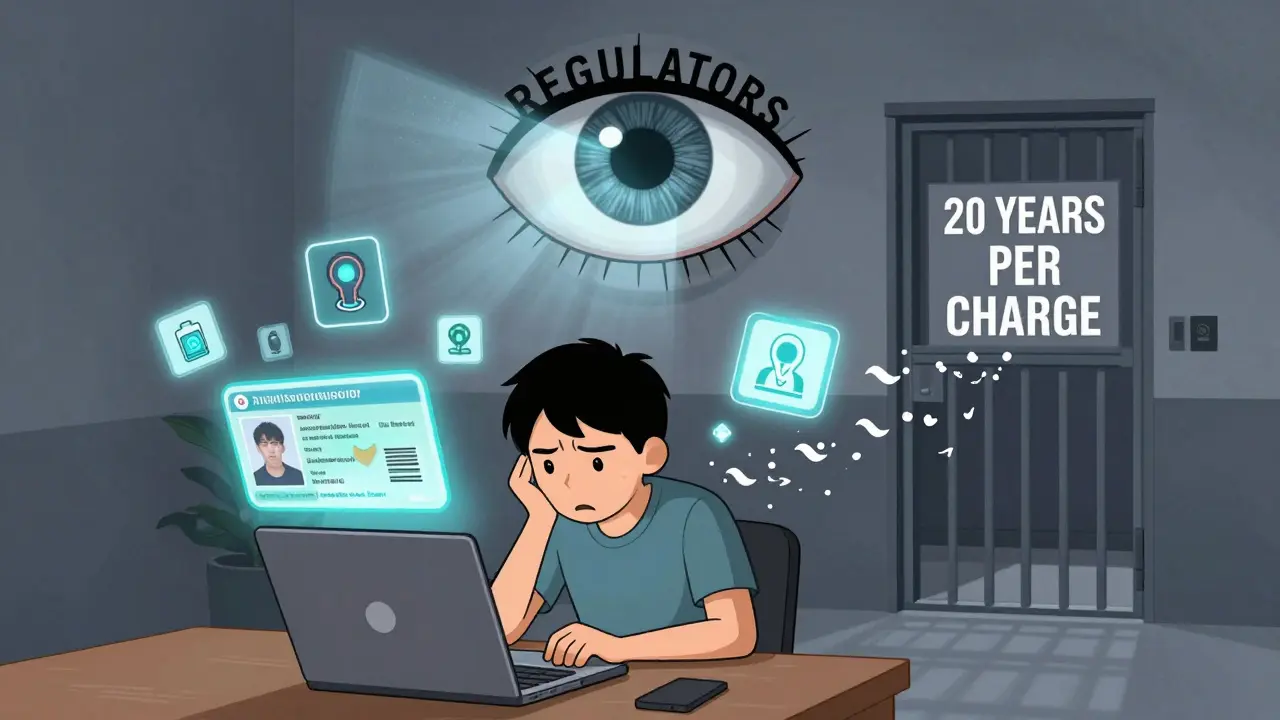
Each of these charges can carry up to 20 years in prison. And they’re often stacked. A single person caught using forged documents might face charges for wire fraud, money laundering, and identity theft all at once. That’s not 20 years total-it’s 20 years per count. Judges can run them consecutively.
Exchanges Aren’t Just Victims-They’re Liable Too
It’s easy to blame the fraudster, but exchanges that fail to catch these forgeries are also in legal danger. Regulators expect platforms to have strong verification systems. If an exchange lets someone open an account using clearly fake documents and that person later uses it to launder millions, the exchange can be held responsible.In 2022, Kraken paid a $30 million settlement to OFAC after it was found that users had traded with sanctioned individuals. The problem? Their KYC system didn’t catch the fake IDs. That’s not a one-off. The SEC and DOJ now monitor exchanges for compliance gaps. If your platform doesn’t use multi-layered verification, you’re asking for trouble.
Exchanges that skip advanced checks-like liveness detection, document consistency analysis, or external database validation-are opening themselves up to lawsuits from victims and regulatory fines. The message is clear: if you’re handling crypto, you’re a financial institution. Act like it.
How Are They Catching These Forgeries?
Fraudsters think AI makes them invisible. But detection tech has evolved just as fast. Here’s what’s working now:- Deepfake Detection: Systems analyze micro-expressions, unnatural blinking, and lighting inconsistencies in video submissions. Real human eyes reflect light differently than AI-generated ones.
- Document Forensics: Algorithms scan for pixel-level errors in government documents-missing hologram layers, mismatched font spacing, or incorrect UV ink patterns.
- External Verification: Instead of trusting the document alone, systems cross-check with government databases (where available) or utility providers to confirm address claims.
- Risk Scoring: Every application gets a score based on behavior-device fingerprinting, IP location, typing speed, and even how long someone takes to upload documents. Suspicious patterns trigger manual review.
One major exchange reported catching 1,200 fake accounts in a single month using just these tools. Each fraud attempt gets added to a training database, making future detection even smarter. The arms race isn’t slowing down-it’s accelerating.
What Happens If You Get Caught?
Getting caught doesn’t mean a slap on the wrist. Federal prosecutors treat crypto document fraud as organized financial crime. Here’s what you’re risking:- Prison Time: 5 to 20 years per charge, depending on the amount of money involved and whether you led a group.
- Fines: Up to $250,000 per count, or twice the financial gain from the fraud.
- Asset Forfeiture: Any crypto, cash, or property bought with the fraudulently obtained funds can be seized-even if it’s in someone else’s name.
- Criminal Record: A federal conviction follows you forever. It blocks jobs, travel, loans, and even some housing.
Prosecutors don’t need to prove you stole money. They only need to show you knowingly used fake documents to bypass security rules. Intent matters. If you bought a forged ID because you thought it was "just a way to trade," that doesn’t matter. The law doesn’t care about your excuse.
Why This Isn’t Going Away
Regulators aren’t waiting for this problem to solve itself. The SEC, FinCEN, and DOJ are tightening rules every year. New guidelines now require exchanges to use biometric verification, real-time document analysis, and AI-driven anomaly detection. Platforms that don’t comply risk losing their operating licenses.And it’s not just the U.S. Countries like the UK, Australia, and the EU have similar laws. If you’re using a crypto exchange that serves global users, you’re subject to international enforcement. New Zealand, for example, has started sharing fraud data with U.S. agencies. Cross-border cooperation is now standard.
The message is simple: the crypto world is no longer the wild west. It’s regulated. It’s monitored. And it’s watching.
What Should You Do Instead?
If you can’t pass KYC because your documents are expired, unclear, or you’re in a country with limited ID systems, don’t fake it. There are legal paths:- Contact the exchange’s support team-many offer alternative verification methods.
- Use a licensed crypto provider that specializes in underbanked regions.
- Work with a compliance advisor to fix documentation issues.
It takes time. It takes effort. But it’s safer than risking your freedom.
Can I get away with using a fake ID if the exchange doesn’t catch me?
No. Even if you’re not caught immediately, exchanges report suspicious activity to regulators. Your transaction history, IP address, and device fingerprint are stored indefinitely. If you later get flagged for another crime-like money laundering or tax evasion-your past fraud will be uncovered. Federal databases don’t forget.
Are all crypto exchanges required to verify identities?
Yes-if they operate in or serve users in jurisdictions like the U.S., EU, UK, Australia, or New Zealand. These regions require all crypto platforms to follow KYC and AML rules. Even exchanges based overseas must comply if they accept customers from these areas. Ignorance isn’t a legal defense.
What if I didn’t know the documents were fake?
The law doesn’t care if you were fooled. If you submitted documents you didn’t verify yourself and they turned out to be fake, you’re still responsible. Prosecutors look at whether you acted recklessly or ignored obvious red flags. Buying a $20 ID from a shady website? That’s not innocent-it’s willful blindness.
Can I be charged even if I didn’t steal any money?
Yes. The crime is using forged documents to gain access. You don’t need to profit from it. Just attempting to bypass security rules is enough for federal charges. Many cases are built on the act of fraud itself-not the outcome.
Do these laws apply to decentralized exchanges (DEXs)?
Not directly-because DEXs don’t hold your funds or require identity. But if you use a centralized exchange to buy crypto, then move it to a DEX, the original fraud still counts. Law enforcement tracks the entire chain. You can’t erase your digital footprint by switching platforms.
Shana Brown
March 24, 2026 AT 05:49Y’all act like this is some new thing, but I’ve been seeing these deepfake KYC attempts since 2021. One guy tried to use a video of his cousin blinking while holding a passport-except the reflection in the glasses was wrong. AI doesn’t do light physics right. Exchanges caught it in 3 seconds. We’re not talking about hackers here-we’re talking about people who think they’re outsmarting a system built by people who literally wrote the playbook on fraud detection.
And yeah, $20 fake IDs? Bro, I’ve seen them. The font on the driver’s license is always 0.2pt off. The hologram’s too shiny. It’s not even subtle. You’re not a genius-you’re just lazy and desperate.
Stop risking your freedom for a crypto trade. There are legit ways to get verified. Talk to support. Use a compliant provider. It’s not that hard.
Dominic Taylor
March 25, 2026 AT 18:39From a regulatory compliance standpoint, the real issue isn’t the individual fraudster-it’s the systemic failure of AML/CFT controls at the exchange level. The BSA mandates that VASPs implement risk-based due diligence, yet many still rely on static document validation without behavioral biometrics or device fingerprinting integration.
When FinCEN issues advisories like 2023-A12, they’re not mincing words: ‘Know Your Customer’ is a living process, not a checkbox. The Kraken settlement wasn’t about one bad actor-it was about institutional negligence. If your KYC stack doesn’t include liveness detection, cross-referencing with national ID repositories, and anomaly scoring based on temporal behavior patterns-you’re already non-compliant. Period.
Leona Fowler
March 27, 2026 AT 03:09I used to work at a fintech startup that handled crypto onboarding. We had a team of 12 people just reviewing flagged uploads. The most common mistake? People used expired IDs and thought the date would blur out. Nope. The system flagged the watermark mismatch instantly.
One guy sent a photo of his mom’s license-she was 72, he was 19. The skin tone didn’t match the lighting. The system caught it. He didn’t even realize his own photo was taken in a different room.
It’s not magic. It’s math. And it’s everywhere. Don’t be the guy who thinks he’s clever. Just do the right thing.
Sarah Terry
March 29, 2026 AT 00:37Just a quick reminder: if you’re using fake docs, you’re not just risking jail-you’re putting your family through hell too.
Federal cases take years. You’ll miss birthdays. You’ll lose your job. Your credit will be ruined. And even if you don’t get caught now, the data stays forever. One day, you’ll apply for a mortgage. Or a visa. Or a security clearance. And boom-there it is.
It’s not worth it. Ever.
Reach out. Ask for help. There are people who want to help you-not punish you.
Shayne Cokerdem
March 29, 2026 AT 05:41lol so the gov wants to control everything now? you think they really care about money laundering? nah. they just want to stop you from using crypto so they can print more fiat and steal your wealth. fake docs? yeah maybe. but what’s more fake? the whole system? they track your grocery cart now. they know when you pee. why are you even surprised they catch fakes? they built the traps. they want you to fail.
they’re not protecting you. they’re protecting their monopoly. stay woke.
aravindsai pandla
March 30, 2026 AT 14:34As someone from India who’s gone through KYC on multiple platforms, I can say this: the system works if you give it honest information. I had my Aadhaar card rejected twice because the photo was blurry. Took me 3 days to resubmit with proper lighting. No drama. No fraud.
There are tools for underbanked users. Exchanges like WazirX and CoinDCX have local verification partners. You don’t need to fake it. You just need to be patient.
And yes-this isn’t about control. It’s about inclusion. The law exists so people like me, who don’t have credit cards, can still access global finance. Don’t break the bridge so you can cross it faster.
Andy Green
March 30, 2026 AT 21:17Oh wow, another ‘crypto is regulated now’ sermon. Newsflash: the SEC doesn’t have jurisdiction over decentralized networks. They’re just scared because they can’t tax or control it anymore. You think they care about ‘money laundering’? No-they care about your Bitcoin.
And let’s be real: if you’re so good at detecting fakes, why do 80% of accounts still get hacked? Why do exchanges lose millions daily to phishing? You’re not protecting users-you’re protecting your boardroom.
Maybe the real crime is forcing people to hand over their ID to a private company that sells your data to advertisers.
Wake up. This isn’t safety. It’s surveillance.
Zion Banks
March 31, 2026 AT 06:53THEY’RE LYING TO YOU. EVERY SINGLE WORD IN THIS POST IS A LIE.
AI-generated documents? They’re not fooling systems-they’re fooling YOU. The government already has your face, your voice, your fingerprints, your location, your heartbeat. They don’t need your fake ID-they already have your identity.
Why do you think they’re so scared of fake documents? Because they know the real ones are fake. The passport you’re ‘forging’? It’s already a government tracking chip. The driver’s license? It’s linked to your social security number and your bank account.
You think you’re outsmarting them? You’re already their puppet. You’re not committing fraud-you’re performing in their script.
They want you to fear the fake ID so you never question the real one.
Jenni Moss
March 31, 2026 AT 20:13My cousin got arrested for this last year. He thought he was just trading Dogecoin. He used a fake ID from a guy on Reddit. Got caught because he sent $12,000 to a wallet linked to a darknet market from the same IP as a known drug dealer.
He didn’t even know the money was dirty. He just wanted to buy more Doge.
Now he’s in federal prison. His mom cries every night. He’s 22.
Don’t be him.
You don’t need to be smart. You just need to be careful.
Brijendra Kumar
April 1, 2026 AT 16:09Let’s not romanticize this. The people using fake docs aren’t rebels-they’re idiots. You’re not fighting the system. You’re feeding it. Every time you submit a forged document, you’re giving exchanges data to train their AI. You’re making the surveillance state smarter.
And for what? To trade ETH? To flip NFTs? To join a Discord group?
Pathetic. You’re not a hacker. You’re a liability. And you’re the reason real users get more friction.
Stop being the problem. Start being the solution.
Florence Pardo
April 2, 2026 AT 22:41I’ve read this entire thing twice. Honestly? It’s terrifying. Not because I’m thinking of doing it-but because I know people who have. People I care about. One guy I knew in college tried it. He thought he was being clever. He got flagged. Then he got a call from the FBI. He didn’t even have a lawyer. He cried in front of me for an hour.
I didn’t know how deep this went. I thought it was just ‘getting banned from Binance.’ No. It’s federal. It’s prison. It’s forever.
I just wanted to say… if you’re reading this and you’re thinking about it… stop. Talk to someone. Call a hotline. Email support. There’s help. You’re not alone. I promise.
Alicia Speas
April 3, 2026 AT 11:50While the legal implications are severe, I believe we must also address the root cause: access inequality. Many users in developing nations lack government-issued IDs. They are not criminals-they are excluded. The solution is not punishment, but innovation in inclusive verification: blockchain-based identity, community attestations, and decentralized credentialing.
Exchanges must move beyond Western-centric KYC. The technology exists. The willpower does not.
Let us not confuse compliance with justice. Regulation should empower, not exclude.
Dheeraj Singh
April 3, 2026 AT 21:43bro u just wanna control us. why u care if i use fake doc? u think u r the police? i dont even live in usa. why u care? u r just mad cause u cant track me. i use vpn, i use fake name, i use ai doc. u cant catch me. u r just scared. u r the one who fake. u fake ur democracy. u fake ur laws. u fake ur money.
crypto is free. u r not. u r just a slave to the system. i win. u lose.
Mansoor ahamed
April 4, 2026 AT 18:12Simple truth: if you can’t pass KYC, you’re not ready for crypto. Not because you’re bad-but because you’re not prepared.
It’s like trying to drive without a license. You don’t get to say ‘I know how to drive.’ The system exists for a reason.
Take the time. Learn the rules. Build your identity properly. It’s not about control. It’s about safety-for you, for others, for the whole ecosystem.
Patience beats panic every time.
Nicolette Lutzi
April 6, 2026 AT 05:54THEY’RE USING THIS TO JUSTIFY SURVEILLANCE. YOU THINK THEY’RE STOPPING CRIME? NO. THEY’RE USING ‘FRAUD’ AS AN EXCUSE TO TRACK EVERY SINGLE PERSON. YOUR FACE. YOUR VOICE. YOUR LOCATION. YOUR BLOOD TYPE. THEY’RE BUILDING A DIGITAL IDENTITY DATABASE. AND THEY’RE CALLING IT ‘SECURITY.’
THEY DON’T WANT TO STOP FORGERS. THEY WANT TO STOP YOU.
EVERY TIME YOU USE A REAL ID, YOU GIVE THEM MORE DATA.
THEY WANT YOU TO BE AFRAID OF THE FAKE ID SO YOU’LL GIVE THEM THE REAL ONE.
THIS ISN’T ABOUT LAWS. THIS IS ABOUT POWER.
STAY FREE. STAY OFF THE GRID.