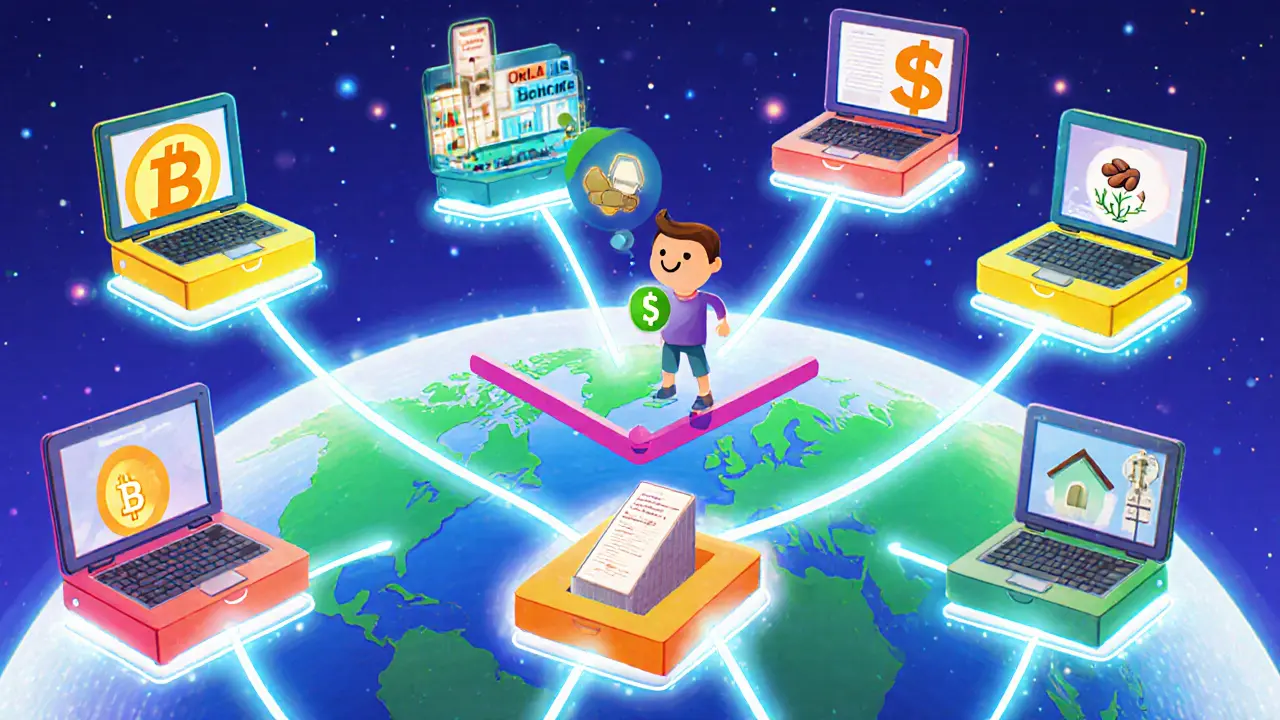
Blockchain Transaction Fee & Energy Calculator
Estimate Your Transaction Costs & Impact
See how much your blockchain transaction might cost and its environmental impact based on the network you choose.
Enter values above to see your transaction estimate
Imagine sending money to someone across the world for less than a dollar, and having it arrive in minutes-not days. No bank, no middleman, no paperwork. That’s what blockchain makes possible. It’s not just about Bitcoin. It’s about a new way of trusting digital systems without needing a central authority like a bank or government. If you’ve heard the word "blockchain" and felt lost, you’re not alone. But by the end of this, you’ll know exactly what it is, how it works, and why it matters-no jargon, no fluff.
What Is Blockchain, Really?
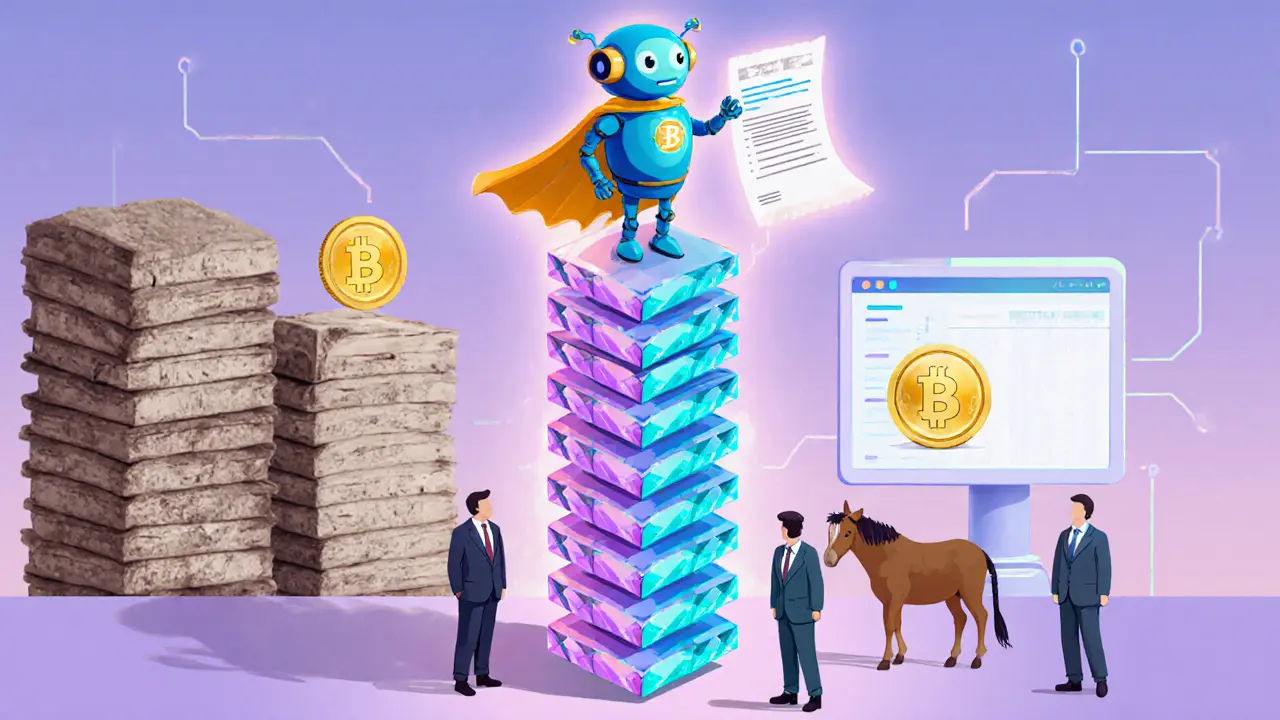
At its core, a blockchain is a digital ledger. Think of it like a shared Google Sheet that everyone can see but no one can secretly change. Every time a transaction happens-like sending 0.5 Ethereum or recording the shipment of a coffee bean from Colombia to New Zealand-it gets added as a new row. That row is locked in with cryptography, grouped with other recent transactions into a "block," and then chained to the previous block using a unique digital fingerprint. Once it’s there, it’s nearly impossible to alter.
This isn’t stored on one computer. It’s copied across thousands of machines worldwide. Bitcoin alone runs on about 15,000 active computers as of early 2025. Ethereum has over 8,500. No single company or person owns it. That’s what makes it "decentralized." And because every node checks every new block, fraud becomes extremely hard. If someone tries to fake a transaction, the network rejects it. That’s the magic.
How Does It Actually Work?
Let’s break it down step by step:
- A transaction is made-say, Alice sends Bob 1 Bitcoin.
- The transaction is broadcast to a network of computers (nodes).
- These nodes verify the transaction using cryptography: Is Alice really the owner? Does she have enough Bitcoin?
- Verified transactions are grouped into a block.
- A special computer (miner or validator) solves a complex math puzzle to add the block to the chain.
- Once added, the block gets a unique hash-a 64-character code made by the SHA-256 algorithm-and links to the previous block.
- Every node updates its copy of the ledger. Done.
This process is called consensus. Bitcoin uses "Proof of Work," where miners compete to solve puzzles using computing power. Ethereum switched to "Proof of Stake" in 2022, where validators are chosen based on how much cryptocurrency they "stake" as collateral. It’s faster and uses 99.95% less energy.
Here’s what you need to remember: blockchain technology isn’t the money-it’s the system that makes the money (and other digital assets) trustworthy.
Why Is It So Secure?
Blockchain’s security isn’t about firewalls or passwords. It’s about math and scale.
Every block has a unique hash. If you change even one letter in a transaction, the hash changes completely. That means if someone tries to alter a past transaction, they’d have to change every single block after it-and do it faster than the entire network adds new blocks. For Bitcoin, that would mean controlling more than half of all its computing power-the infamous "51% attack." As of March 2025, Bitcoin’s total computing power (hashrate) is over 600 exahashes per second. That’s more than the top 500 supercomputers combined. It’s not just hard-it’s economically impossible.
Plus, every transaction is public. You can look up any Bitcoin address on a blockchain explorer like Blockstream or Etherscan and see every transfer it’s ever made. Transparency is built in. You can’t hide anything. That’s why fraud is rare, and why banks and governments are starting to pay attention.
What’s It Used For Beyond Bitcoin?
People think blockchain = crypto. But that’s like thinking the internet = email. It’s just the first use.
Here’s where blockchain is making real differences in 2025:
- Supply Chains: Maersk uses blockchain to track shipping containers. Instead of paper bills of lading that take days to process, everything is recorded digitally. Result? 40% faster delivery times across 300+ partners.
- Real Estate: In places like Vermont and Georgia, property titles are now recorded on blockchain. No more lost deeds or title fraud. One click shows ownership history going back decades.
- Digital Identity: Estonia’s e-Residency program lets anyone in the world get a government-backed digital ID stored on blockchain. No more forgetting passwords or risking identity theft.
- AI Transparency: Companies are using blockchain to log how AI models make decisions. If an AI denies a loan, you can trace exactly which data points led to that decision-no black box.
- Tokenized Assets: Bitcoin’s Taproot Assets protocol (launched Jan 2025) lets you turn real-world things-like a share in a farm or a piece of art-into digital tokens on the Bitcoin network.
According to the World Economic Forum, 67% of Fortune 500 companies now use blockchain in some form-up from just 34% in 2022. It’s not hype. It’s efficiency.
What Are the Downsides?
Blockchain isn’t perfect. And it’s not always the best tool.
First, speed. Bitcoin handles about 7 transactions per second. Visa handles 24,000. That’s why you can’t use Bitcoin to buy coffee like you would with a credit card-at least not yet. But Layer 2 solutions like Polygon and Lightning Network are fixing this. Polygon can do over 2,000 transactions per second. Solana hits 65,000 under ideal conditions.
Second, cost. Ethereum’s gas fees spiked to $55 during peak times in January 2025. That’s insane for a $20 transfer. But since Ethereum’s Pectra upgrade in April 2025, fees dropped 22%. They’re still not cheap, but they’re getting better.
Third, complexity. Most wallets and apps still feel like they were built by engineers for engineers. MetaMask, the most popular wallet, has a 3.8/5 rating on Trustpilot-with 42% of users calling it "too confusing." That’s changing fast, but beginners still need patience.
And yes, energy use. Bitcoin still uses about 121 terawatt-hours a year-roughly the same as Belgium. But Ethereum and most newer chains use almost no energy thanks to Proof of Stake. The industry is moving away from energy-heavy models fast.

How Can You Get Started?
You don’t need to be a coder to understand or use blockchain. Here’s a simple 3-step path for beginners in 2025:
- Get a wallet: Install MetaMask (for Ethereum) or Phantom (for Solana). These are like digital bank accounts-but you own the keys. No one else can freeze your money.
- Try testnets: Go to a site like QuickNode Faucet and get free test Ether or SOL. These are fake coins used for learning. Send them to yourself. Break things. Learn how it feels.
- Practice real small transactions: Buy $10 worth of Bitcoin or Ethereum on Coinbase or Kraken. Send it to a friend. See how it works in real life. Fees? Usually under $1. Time? Under 15 minutes.
Want to go deeper? Try CryptoZombies.io-it’s a free, interactive tutorial that teaches you to code smart contracts by building a game. Over 450,000 people have used it since 2022. Or take the free Blockchain Specialization from the University of Michigan on Coursera. Completion rate? 82%.
What’s Next for Blockchain?
Three big trends are shaping 2025 and beyond:
- Modular Blockchains: Instead of one giant system doing everything, new chains split tasks: one layer handles transactions, another handles security, another stores data. This makes them faster and cheaper. Performance is up 40% compared to older models.
- AI + Blockchain: Companies are using blockchain to prove that AI models aren’t biased or manipulated. If a bank uses AI to approve loans, blockchain logs every decision. That’s huge for compliance and trust.
- Regulation Is Here: The EU’s MiCA rules are now active. The U.S. introduced the Digital Asset Market Structure Act in February 2025. Countries like Switzerland and Singapore have clear rules. This isn’t the Wild West anymore. It’s becoming a legitimate industry.
By 2030, the global blockchain market is expected to hit $164 billion. That’s up from $18.7 billion in 2024. But don’t be fooled: most of that growth is in enterprise use-not crypto speculation. Banks, insurers, logistics firms, and governments are the real drivers.
As Dr. Garrick Hileman from Cambridge University said in March 2025: "Blockchain’s real value is creating institutional trust through code." It’s not about replacing banks. It’s about making systems more honest, transparent, and efficient.
Final Thought: Is It Worth Learning?
If you’re just curious, spend an hour playing with a testnet. You’ll understand more than 90% of people who talk about blockchain.
If you’re thinking about a career? The demand is growing fast. Electric Capital tracks 22,000 active blockchain developers every month. Jobs in smart contract auditing, blockchain security, and decentralized identity are paying $100K+ even for junior roles.
And if you’re just trying to send money cheaper, faster, and without a bank? Blockchain already does that-for you, right now.
Is blockchain the same as Bitcoin?
No. Bitcoin is one application that uses blockchain technology. Blockchain is the underlying system-a digital ledger that records transactions securely. Bitcoin is the first and most famous use case, but blockchain can also record property titles, supply chain data, medical records, and more.
Can blockchain be hacked?
The blockchain itself is extremely hard to hack because it’s spread across thousands of computers and secured by cryptography. But wallets, exchanges, and smart contracts can be vulnerable. If you lose your private key or use a sketchy app, you can lose your funds-not because the blockchain was broken, but because you were tricked. Always use trusted wallets and never share your recovery phrase.
Do I need to buy cryptocurrency to use blockchain?
Not necessarily. You can explore testnets with free fake crypto to learn. But to interact with most real-world blockchain apps-like sending money, buying NFTs, or using DeFi-you’ll need real cryptocurrency. Start small: $10 is enough to get a feel for how it works.
Why is blockchain so slow sometimes?
Older blockchains like Bitcoin and early Ethereum were designed for security and decentralization, not speed. Bitcoin can only process about 7 transactions per second. But newer systems like Solana, Polygon, and Ethereum’s Layer 2 networks can handle thousands per second. Speed is improving fast, and most new projects prioritize performance.
Is blockchain environmentally bad?
It depends. Bitcoin’s Proof of Work system uses a lot of energy-about as much as Belgium annually. But Ethereum switched to Proof of Stake in 2022 and now uses 99.95% less energy. Most new blockchains are built with sustainability in mind. If you care about the environment, use Ethereum, Solana, or Cardano-not Bitcoin-for everyday transactions.
What’s the difference between public and private blockchains?
Public blockchains (like Bitcoin and Ethereum) are open to anyone. Anyone can join, verify transactions, and see the data. Private blockchains (like Hyperledger or R3 Corda) are controlled by a single organization or group. They’re faster and more private, but less decentralized. Most businesses use private chains for internal systems; public chains are for open, trustless applications.
Can governments shut down blockchain?
Not really. Since blockchain runs on thousands of computers around the world, no single government can turn it off. They can ban exchanges, restrict crypto use, or tax transactions-but they can’t delete the ledger. That’s why countries like El Salvador adopted Bitcoin as legal tender: it’s outside traditional control.
If you’re still unsure, start small. Try sending $5 to a friend using MetaMask. See how it feels. That’s how most people learn-not by reading whitepapers, but by doing.
Evelyn Gu
November 29, 2025 AT 05:30Okay, I just spent 45 minutes reading this like it was a novel, and I’m not even a tech person-so that’s saying something. I mean, I used to think blockchain was just Bitcoin’s weird cousin who wore too much leather and talked in riddles. But now? I get it. It’s like a giant, global, unstoppable Google Doc that no one can delete, and everyone can see, and if you try to cheat, the whole internet yells at you. And the part about Estonia’s digital ID? I’m crying. My grandma lost her passport three times. She’d love this. Also, I just sent $5 to my cousin in Mexico via MetaMask. It took 12 minutes. I felt like a wizard.
Michael Fitzgibbon
November 30, 2025 AT 02:08Interesting breakdown. I’ve been watching this space since 2017, and honestly, most explanations either sound like a cult pitch or a dry whitepaper. This? This is the first one that made me feel like I could explain it to my 70-year-old uncle without him nodding off. The supply chain examples are spot-on-Maersk’s real-world use case is way more compelling than another crypto moon meme. Still, I wonder how many of these enterprise deployments are just blockchain for show, with a centralized database underneath. But hey, if it makes the paperwork less painful, I’m not complaining.
jeff aza
November 30, 2025 AT 02:52Let’s be real-this is all just a glorified append-only log with consensus protocols that are either PoW (energy-wasting dumpster fire) or PoS (centralized by design). And you call this ‘decentralized’? Ha. The top 10 validators control 70% of Ethereum’s stake. That’s not a distributed network-that’s a cartel with a fancy UI. Also, Layer 2s? More like centralized relayers pretending to be decentralized. And don’t get me started on tokenized assets-‘a share in a farm’? Who’s auditing the farm? Who’s liable when the soybeans rot? You’re not solving trust-you’re just moving the trust problem from banks to coders who can’t even spell ‘smart contract’ correctly.
Vijay Kumar
December 1, 2025 AT 08:39You think this is revolutionary? In India, we’ve had digital ledgers since 1998 with Aadhaar. Blockchain? Just a new name for an old problem. You don’t need crypto to track coffee beans. You need good governance. And your ‘beginner path’? Useless. Most people here can’t afford a smartphone, let alone gas fees. Stop romanticizing tech for the privileged.
Felicia Sue Lynn
December 3, 2025 AT 04:32There is a profound philosophical shift here-one that moves the locus of trust from institutions to mathematics. This is not merely a technological advancement; it is a cultural recalibration. The notion that authority can be encoded, audited, and universally verifiable without human intervention challenges centuries of social contract theory. We are witnessing the emergence of a new epistemology-one where truth is not declared, but computed. And while the energy concerns are valid, they are not insurmountable. The real question is not whether blockchain works-but whether society is ready to relinquish its dependence on fallible human gatekeepers.
Martin Doyle
December 5, 2025 AT 01:47Bro, you’re all missing the point. This isn’t about wallets or gas fees. It’s about control. Banks don’t want this because they can’t control it. Governments don’t want this because they can’t tax it easily. And guess what? That’s why it’s powerful. You think your bank won’t freeze your account if you protest? Try sending $100 to a friend in a country they don’t like. See what happens. Blockchain doesn’t care who you are. It just moves the value. That’s freedom. And if you’re scared of it? That’s your problem, not mine.
Susan Dugan
December 6, 2025 AT 09:42Y’all are overthinking this. I’m a teacher. I don’t know what SHA-256 is. But I showed my 12-year-old niece how to get free test ETH and send it to herself. She screamed. Then she sent it to her dog’s imaginary wallet. We laughed. That’s it. That’s the whole thing. You don’t need to understand the engine to drive the car. Just try it. Break it. Fix it. Then do it again. That’s how you learn. Stop reading. Start doing. And if you’re scared of losing money? Use $5. Not $500. Just $5. You’ll thank me later. 🚀
SARE Homes
December 7, 2025 AT 06:46Ugh. Another blockchain fanboy post. You think you’re so smart because you know what PoS is? Newsflash: 99% of these ‘enterprise blockchains’ are just databases with a blockchain sticker on them. And ‘tokenized art’? Please. I saw a JPEG of a monkey sell for $100K. That’s not innovation-that’s a Ponzi with a whitepaper. And you call it ‘transparent’? HA. The only thing transparent is how easy it is to scam people who think ‘decentralized’ means ‘safe.’ Wake up. This is the new NFT bubble. And you’re all just holding the bag.
Grace Zelda
December 7, 2025 AT 15:16Wait-so if blockchain is this unchangeable ledger… then why do we keep hearing about ‘forks’? If it’s immutable, how come Bitcoin Cash exists? And if Ethereum can upgrade its consensus model… isn’t that just centralized control dressed up as ‘community governance’? I’m not anti-blockchain. I’m anti-illusion. If it’s not truly decentralized, why call it that? And why do we keep pretending that ‘nodes’ are ordinary people when 80% of them are run by AWS and Google Cloud?
Sam Daily
December 8, 2025 AT 23:34Guys, I just used this for the first time last week to send $2 to my buddy in Colombia for his empanadas. No bank, no fee, no waiting. He got it in 8 minutes. I cried. 😭 Not because it’s perfect-but because it worked. I’m not a coder. I don’t know what a ‘hash’ is. But I know what it feels like to send money without begging a bank for permission. That’s magic. And if you’re still stuck on ‘is it decentralized?’-just ask yourself: would your bank let you send $2 to someone in Venezuela? Exactly. 🙌
Kristi Malicsi
December 10, 2025 AT 07:47blockchain is just a database with extra steps and a cult following. people act like it’s the second coming but its just code. and yes i know what consensus means. i read a wiki page. the energy thing is still a problem. and no i dont care about tokenized farms. send me the money not the metaphor.
Rachel Thomas
December 10, 2025 AT 13:04So you’re telling me the same tech that lets people send fake monkey pictures for millions is now going to fix global supply chains? That’s like saying because someone built a LEGO castle, they can now design a real castle. This whole thing is a joke. The only thing blockchain is good for is making rich guys richer and confused people feel like they’re part of something. I’m not buying it.
Sierra Myers
December 11, 2025 AT 23:40Anyone else notice how every single ‘real world use case’ listed here is either in Estonia, Vermont, or run by a Fortune 500 company? Meanwhile, in real places-like my town in Ohio-no one’s even heard of blockchain. And when they do, they think it’s a crypto scam. This isn’t revolution. It’s a tech bro fantasy. The people who need this most? They’re still paying cash for groceries because their bank won’t let them open an account. So yeah, cool tech. But who’s it really helping?