CEX vs DEX: How Geography Blocks Your Crypto Trading
CEXs block users based on location due to regulations, while DEXs let you trade globally without ID - but come with big risks. Learn how geography shapes your crypto access.
Read MoreWhen you sign up for a crypto exchange, you’re often asked to submit a photo of your ID, a selfie, or even proof of address. That’s KYC crypto, the process of verifying your identity before you can trade or withdraw crypto. Also known as Know Your Customer, it’s not optional on most platforms—it’s the gatekeeper between you and your money.
KYC crypto isn’t just about paperwork. It’s tied to global rules like AML crypto, anti-money laundering regulations that force exchanges to track who’s sending and receiving funds. If you’re in a country like the U.S., Germany, or Japan, KYC is built into the system. But if you’re in Iran, Colombia, or Russia, KYC can be the reason you can’t use major exchanges at all. That’s why people turn to non-custodial wallets or decentralized exchanges—because those don’t ask for your ID. But here’s the catch: even if you avoid KYC, the exchanges you interact with downstream might still flag your wallet if they detect connections to sanctioned addresses.
It’s not just about legality. KYC crypto also affects your access to features. Some platforms offer higher withdrawal limits, staking rewards, or fiat on-ramps only to users who complete full verification. Others, like GalaxyOne, tie KYC to accredited investor status. Meanwhile, OFAC sanctions block entire regions from using platforms that enforce KYC, because those platforms must scan for blacklisted names and addresses. This isn’t just about privacy—it’s about control. Who gets to decide if you can trade? And what happens when governments use KYC data to freeze accounts?
You’ll see this play out in the posts below. Some explain how Iranian traders bypass KYC using DEXs like Uniswap. Others show how Colombia’s banking ban pushes users toward P2P, where KYC is minimal or nonexistent. There’s even a review of an exchange that claims to skip KYC—but turns out to be a scam. And then there’s the flip side: exchanges like KickEX and KoinBay that claim to be easy, but hide red flags like blocked withdrawals or fake volume. The truth? KYC crypto isn’t going away. But how you deal with it depends on where you live, what you’re trying to do, and how much control you want over your own money.
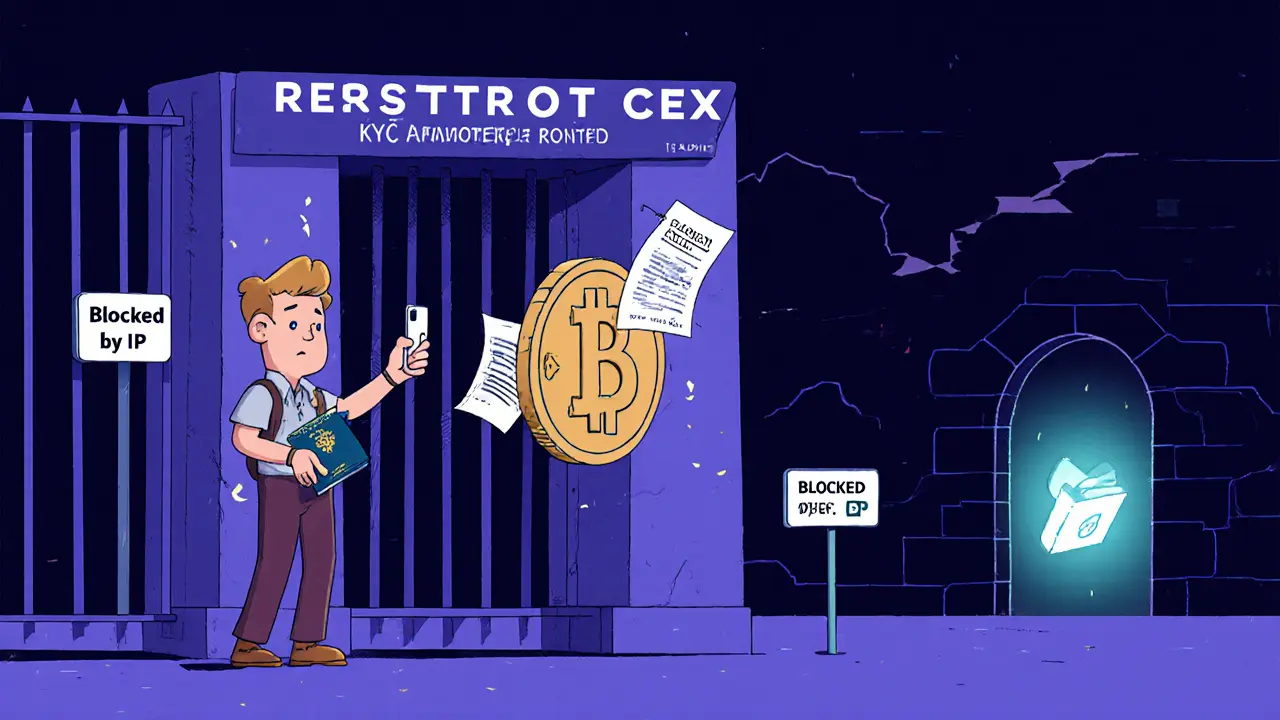
CEXs block users based on location due to regulations, while DEXs let you trade globally without ID - but come with big risks. Learn how geography shapes your crypto access.
Read More