Blockchain Scalability: Why It Matters and How Solutions Are Changing Crypto
When you send Bitcoin or swap tokens on Ethereum, you’re relying on a system that was never built for mass use. Blockchain scalability, the ability of a blockchain network to handle growing numbers of transactions without slowing down or becoming too expensive. Also known as network throughput, it’s what separates crypto that feels like a novelty from crypto that works like a utility. Right now, most blockchains can only process a few to a few dozen transactions per second. Visa handles 24,000 per second. That gap isn’t just technical—it’s why you pay $20 to send ETH or wait 10 minutes for a simple trade.
That’s where Layer 2 solutions, off-chain systems built on top of a main blockchain to process transactions faster and cheaper come in. Projects like Polygon, Arbitrum, and Optimism aren’t just buzzwords—they’re the reason DeFi apps like DODO and CRODEX can even function without drowning in gas fees. These systems bundle hundreds of transactions into one single proof that gets posted back to the main chain, cutting costs by 90% or more. And it’s not just about speed. Transaction throughput, how many transactions a network can confirm in a given time directly affects who can use crypto. If your wallet can’t afford to send $5 worth of tokens because fees are $3, you’re locked out. That’s why scaling isn’t a feature—it’s survival.
But scaling isn’t just about tech. It’s about trust. When a network like Bxlend or AfroDex tries to scale by cutting corners—reducing audits, ignoring security, or hiding volume—it doesn’t just slow down. It breaks. Real scalability means keeping decentralization and security intact while adding speed. That’s why Ethereum’s move to proof-of-stake wasn’t just an energy fix—it was the first step in a long scaling plan. And it’s why on-chain analytics tools are now used to track whether scaling solutions are actually working, or just pretending to. You can’t fake traffic. You can’t fake fees. You can’t fake adoption.
What you’ll find below are real-world examples of how blockchain scalability shapes everything: from airdrops you can claim without breaking the bank, to exchanges that survive because they solved the speed problem, to wallets that let people in restricted countries keep control of their money without relying on broken systems. This isn’t theory. It’s what’s already happening—and what’s next.
27
Sep
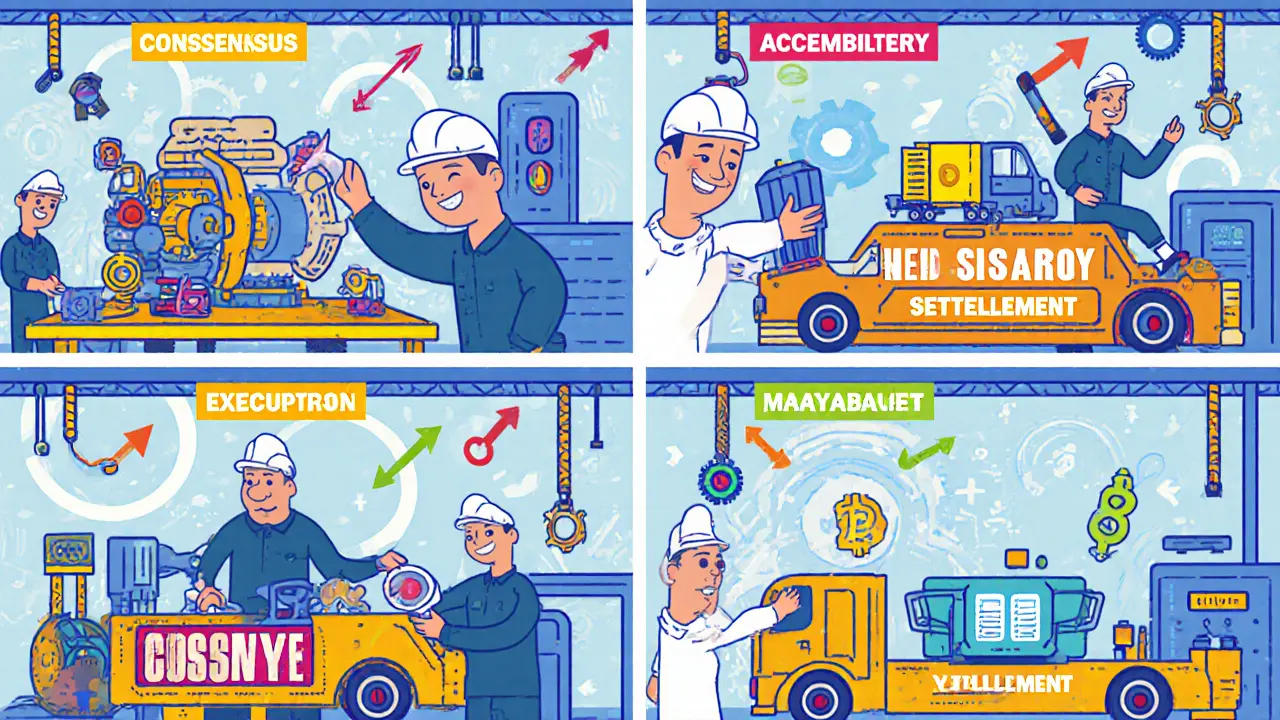
Modular blockchains split functions like consensus, execution, and data storage into independent layers. This lets each scale separately, boosting speed, lowering costs, and preserving security - without rebuilding the entire network.
Read More