Blockchain Performance: Speed, Scalability, and Real-World Limits
When you hear blockchain performance, how fast and reliably a blockchain network processes transactions and handles user demand. Also known as network throughput, it's what separates usable systems from ones that freeze when too many people try to use them at once. It’s not just about how many transactions per second a chain claims—it’s about whether those transactions actually go through, how long they take, and what happens when the network gets busy.
Blockchain performance isn’t a single number. It’s made up of transaction speed, how quickly a block is confirmed and added to the chain, network congestion, when too many users are trying to send transactions at the same time, and blockchain latency, the delay between sending a transaction and it being visible to others. You can have a chain that claims 10,000 TPS, but if half the time your transaction sits in a mempool for 20 minutes, that number means nothing. That’s what happened with some early DeFi chains in 2021—marketing looked great, but users couldn’t get their swaps to go through.
Real-world performance shows up in places you don’t expect. Take blockchain performance in restricted countries like Iran or Colombia, where people rely on DEXs to trade without banks. If the network is slow, every trade becomes a gamble. Or look at gaming tokens like IMT on Immutable zkEVM—low fees and fast finality are why players actually use them. Compare that to a dormant exchange like AfroDex, where the blockchain might as well be offline because no one’s sending transactions. Performance isn’t a feature—it’s the foundation.
High hash rates, like Bitcoin’s, make the network secure but don’t improve speed. Over-collateralized loans on DeFi platforms depend on fast settlement times—if the blockchain lags, liquidations get messy. Even MiCA compliance in Europe hinges on reliable transaction records. If a blockchain can’t prove when a transfer happened, it fails regulation. And when you’re mining on-chain data to track market behavior, slow blocks mean outdated signals.
What you’ll find below isn’t a list of technical specs. It’s a collection of real cases where blockchain performance made or broke the experience—whether it’s a DEX that works under pressure, a token that moves fast enough for gaming, or a platform that collapsed because it couldn’t handle its own hype. These aren’t theory pieces. They’re lessons from users who got stuck, waited too long, or lost money because performance wasn’t just a buzzword—it was a dealbreaker.
27
Sep
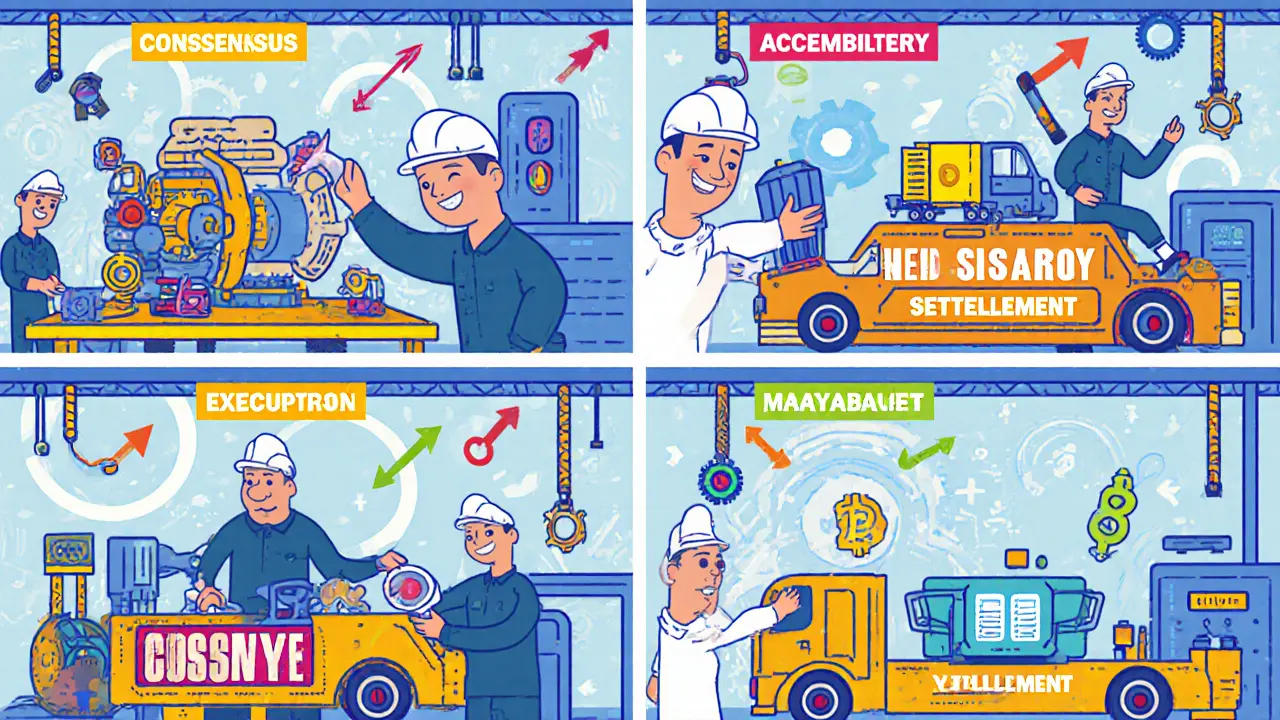
Modular blockchains split functions like consensus, execution, and data storage into independent layers. This lets each scale separately, boosting speed, lowering costs, and preserving security - without rebuilding the entire network.
Read More