For decades, musicians have been stuck in a broken system. They pour their soul into a song, release it, and earn less than a penny per stream. Spotify pays about $0.0043 per play. Apple Music? Around $0.006. Even if your song hits a million streams, you’re looking at roughly $4,300 - and that’s before your label, distributor, and platform take their cuts. Meanwhile, the people who bought your music - your fans - can resell it for thousands, and you get nothing. That’s where NFT royalties change everything.
What NFT Royalties Actually Mean for Musicians
An NFT, or non-fungible token, is a unique digital certificate stored on a blockchain. When a musician mints a song, album, or even a single track as an NFT, they can program a royalty into its code. This means every time that NFT changes hands on a secondary market - say, a fan resells it for $500 - the artist automatically gets a cut. No middleman. No delay. No negotiation.
The royalty percentage? Usually between 5% and 10%. Some artists set it as high as 15%, especially for limited editions. That 10% on a $500 resale? $50 straight to the artist. Multiply that across dozens or hundreds of resales, and suddenly you’re earning more from resale royalties than you ever did from streaming. One artist on Reddit, going by @SynthWaveSam, earned $1,200 in royalties over six months from a $50 NFT album. That’s more than his monthly Spotify income.
How It Works: Smart Contracts and Blockchains
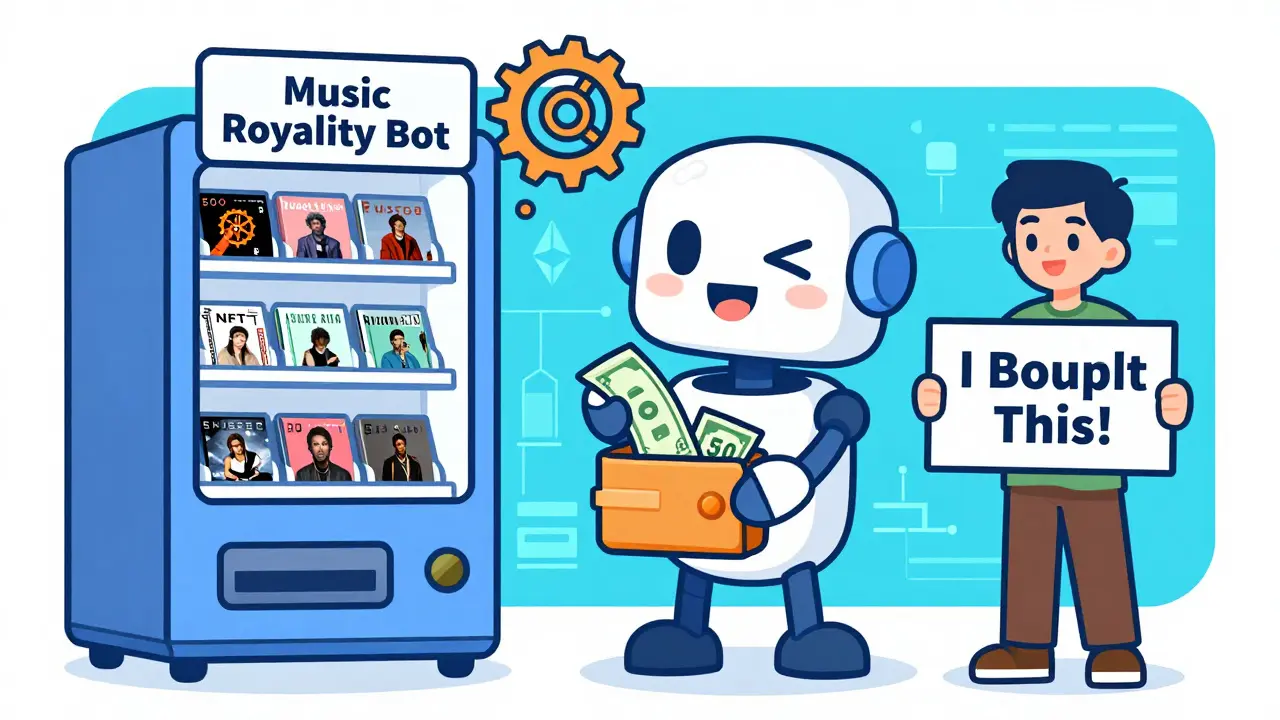
Behind every NFT royalty is a smart contract - a self-executing piece of code on a blockchain. Think of it like a digital vending machine. You set the rules: “When this NFT is sold again, send 8% of the sale price to this wallet.” The contract doesn’t need a lawyer or a bank. It runs on its own.
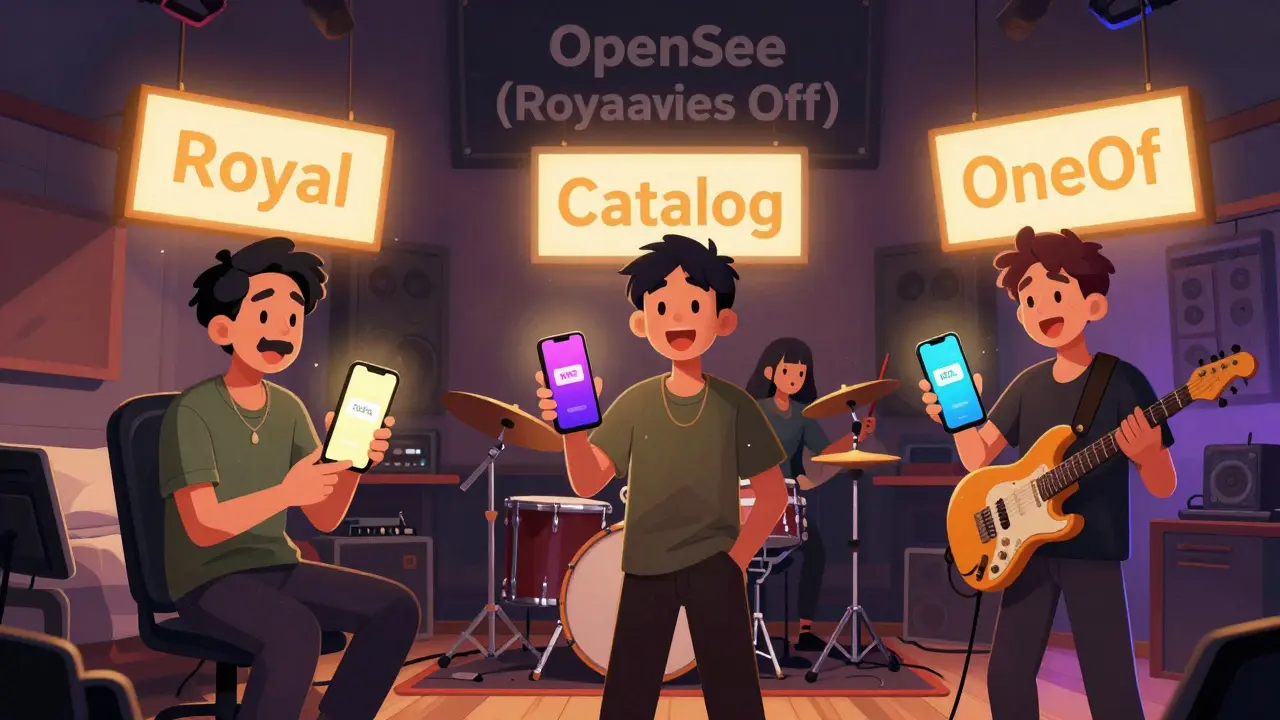
Most music NFTs live on Ethereum. It’s the most common, with about 80% of music-related NFTs built there. But Solana and Polygon are gaining ground because they’re cheaper and faster. Ethereum transactions can cost $1.50 to $15 in gas fees - sometimes more than the royalty itself on a low-value sale. That’s why platforms like Royal and OneOf use layer-2 solutions or alternative chains to keep fees low.
The magic happens in seconds. When a buyer purchases your NFT from someone else, the smart contract triggers a payment. In ideal conditions, the royalty hits your wallet within 15 to 30 seconds. No waiting for monthly statements. No chasing payments. Just clean, automatic income.
Real Examples: Who’s Making Money?
Kings of Leon didn’t just release an album in 2021 - they released it as an NFT. The primary sale brought in $2 million. But the real win? Ongoing royalties from every resale. While traditional album sales net artists about $0.70 per copy, NFT resales have kept rolling in for years. One fan bought the NFT for $50, later sold it for $1,200. The band got $120. That’s 170 times more than they’d earn from a single stream.
Then there’s RAC. He sold a single NFT for $1,000. Within a year, it changed hands 17 times. Each resale paid him 10%. Total royalties? $17,000. That’s 17 times his original sale - all from fans who loved his music enough to buy, hold, and trade it.
Even indie artists are seeing results. A bedroom producer in Wellington, New Zealand, minted a 5-track EP as NFTs with 7% royalties. Within four months, 23 resales generated $940. That’s more than her Spotify earnings for the same catalog in a year.
The Big Problem: Not All Marketplaces Play Fair
Here’s the catch: smart contracts are only as strong as the platforms that respect them. OpenSea, the largest NFT marketplace, used to enforce royalties automatically. Then, in 2022, they dropped enforcement. Why? They wanted to compete on price. Buyers could now avoid paying royalties by switching to platforms like LooksRare or Blur - where royalties are optional.
Artists like electronic producer BeatsByJen lost 60% of expected royalties because buyers moved to royalty-free marketplaces. She set a clean 8% royalty. The code was flawless. But the marketplace didn’t honor it. That’s not a bug. It’s a business model.
Some platforms are fighting back. Foundation still enforces 10% royalties. Royal and Catalog built their entire model around creator protection. Even LooksRare, once the villain, now shares 25% of its protocol fees with creators - a workaround that’s not perfect but helps. Meanwhile, artists are starting blacklists. Tyler Hobbs, a digital artist, publicly named marketplaces that ignore royalties. Fans now avoid them.
How Musicians Can Get Started
You don’t need to be a coder. But you do need to pick the right platform.
- Choose a music-focused NFT platform: Royal, OneOf, and Catalog are the top three. They’re built for musicians, with clear guides, artist support, and royalty enforcement.
- Prepare your asset: Upload your track, cover art, and metadata. Add unlockable content - like a live session, lyric PDF, or personal message - to increase value.
- Set your royalty: Stick to 5-10%. Too high, and buyers won’t bite. Too low, and you’re leaving money on the table.
- Mint on a low-fee chain: If you’re on Ethereum, use a layer-2 like Polygon to slash gas fees. Some platforms handle this for you.
- Market it to fans: NFTs don’t sell themselves. Use your email list, Instagram, Discord. Tell fans they’re not just buying music - they’re buying a piece of your legacy.
Most musicians spend 20-30 hours learning the basics. But once it’s set up? The royalties keep coming. Platforms like Royal offer 24-hour artist support. Catalog has a 120-page guide updated every quarter. You’re not alone.
What’s Next? The Future of NFT Royalties
By 2024, 78% of music NFT platforms say they’ll enforce royalties consistently. The Music NFT Alliance is pushing for a 5% minimum standard. That’s huge. It means the chaos might be ending.
Some platforms are experimenting with dynamic royalties - where the percentage drops over time to encourage trading, but creators still earn. Others are linking NFTs to DAOs (decentralized autonomous organizations), letting fans vote on how royalty funds are used - maybe funding a tour or a studio upgrade.
Blocktones is already bridging Web2 and Web3. It lets artists attach NFT royalties to traditional publishing deals. So you still get paid by ASCAP or PRS - but now, you also get paid every time your NFT is resold.
Long-term? Bernstein analysts predict NFT royalties will become a steady 10-15% of an artist’s income within five years. Not a replacement for streaming. A complement. A second income stream that grows as your music gains value.
Final Reality Check
NFT royalties aren’t magic. They’re not a get-rich-quick scheme. You still need to make great music. You still need to connect with fans. You still need to promote your release.
But for the first time ever, you’re not just selling music - you’re building a living asset. And when that asset is traded, you’re still in the room. You still get paid. You still own your value.
The old system treated artists like disposable content. NFT royalties treat them like creators. And that’s worth more than a stream.
Do NFT royalties replace streaming payments?
No. NFT royalties are a secondary income stream, not a replacement. Streaming still pays for plays, but NFTs pay when your music is bought and sold like a collectible. Together, they give artists more ways to earn - not fewer.
Can I set a royalty on any NFT platform?
Technically, yes - but not all platforms enforce it. Platforms like OpenSea, LooksRare, and Blur let buyers bypass royalties. Stick to music-specific platforms like Royal, OneOf, or Catalog if you want your royalties guaranteed.
How much can I realistically earn from NFT royalties?
It depends on your audience. A small indie artist might earn $500-$2,000 in a year from resales. A well-known artist with a loyal fanbase can earn tens of thousands. RAC made $17,000 from one NFT’s 17 resales. Your earnings grow with your fanbase - not your label.
Do I need to own crypto to use NFT royalties?
You need a crypto wallet (like MetaMask or Phantom) to receive royalties, but you don’t need to trade crypto or understand blockchain deeply. Most music NFT platforms walk you through wallet setup. Royalties arrive as ETH, SOL, or MATIC - you can cash them out to your bank via exchanges like Coinbase or Kraken.
Are NFT royalties legal?
Yes, as long as you own the copyright. The U.S. Copyright Office clarified in 2023 that owning an NFT doesn’t mean you own the song’s copyright. You must retain copyright and clearly state in your NFT terms what rights buyers get - like listening access or resale rights - to avoid legal issues.
Andrew Hadder
February 26, 2026 AT 18:04man i just tried minting my demo as an nft and got slapped with $12 in gas fees just to sell it for $8
felt like paying someone to throw my music in the trash
still think it's cool though, just not for beginners
Derek Sasser
February 27, 2026 AT 20:25this is actually one of the few web3 ideas that makes sense
artists deserve to profit when their work gains value
streaming is a scam, but nft royalties at least give you skin in the game
just avoid opensea and stick to royal or catalog
they actually honor the smart contracts
also, if you're an indie artist, add unlockable stuff like studio outtakes or handwritten lyrics - fans love that stuff
Neeti Sharma
February 28, 2026 AT 16:24in india we dont need nfts to earn
we have 1000s of artists making money from youtube and live shows
you guys just overcomplicate everything
Fiona Monroe
March 1, 2026 AT 19:49While the concept of blockchain-based royalties is theoretically sound, the practical implementation remains fraught with systemic vulnerabilities.
Marketplace non-enforcement, regulatory ambiguity, and the absence of standardized metadata protocols render this model economically precarious.
Furthermore, the reliance on cryptocurrency infrastructure introduces volatility, tax complications, and barriers to entry for non-technical creators.
Until a globally recognized legal framework is established - and until gas fees are rendered negligible - this remains a niche experiment rather than a sustainable revenue stream.
Molley Spencer
March 2, 2026 AT 11:27let’s be real - this is just crypto bros repackaging the same pyramid scheme with better branding
you think fans are going to pay $500 for a .wav file with a blockchain certificate?
it’s like selling autographs to people who don’t even listen to the music
and don’t get me started on the environmental impact
one ethereum transaction uses more electricity than a nepal village in a month
so yeah, congrats - you’re monetizing climate guilt
John Fuller
March 2, 2026 AT 20:18Lucy Simmonds
March 4, 2026 AT 04:34they want to know who you're buying from so they can tax you later
and don't tell me the blockchain is 'decentralized' - the big platforms still control the front-end!
they're using this to get us used to digital ownership so they can take it all away later
they did it with ebooks - now they're doing it with music
mark my words
Maggie House
March 5, 2026 AT 03:48i minted my first nft last month and got $37 in royalties from 4 resales
it wasn’t life-changing but it made me feel seen
one fan sent me a dm saying they bought it because they’d been listening to my song on loop during chemo
that’s worth more than a million streams
you don’t have to go viral - just find your people
and yeah, i still use spotify too - this just adds a layer of connection
Dana Sikand
March 5, 2026 AT 21:15oh my god i just cried
you have no idea what it means to be an artist who’s been told for 10 years that your work has no value
then one fan buys your nft for $80 and resells it for $300 and you get $30
and you’re like… wait
someone thinks my music is worth that
and they’re willing to pay to own it
and they’re still paying me
for the next 10 years
that’s not money
that’s dignity
Cameron Pearce Macfarlane
March 7, 2026 AT 18:54because people don’t care
it’s not a revolution
it’s a garage sale with blockchain dust on it
Elizabeth Smith
March 9, 2026 AT 07:22art is sacred
when you commodify a song into a tradable token
you kill its soul
the real tragedy isn’t that artists get paid too little
it’s that we’ve accepted that everything must be monetized
you’re not building a legacy
you’re building a stock ticker
Daisy Boliaan
March 9, 2026 AT 11:07okay so i posted this on my discord and now my whole fanbase is flipping out
one guy bought my nft and resold it for $1,200
and i got $120
but then he posted a screenshot of his wallet on twitter like ‘look what i did’
and i just sat there staring at my phone
because i made that music
and he didn’t even say thank you
and now i’m wondering if this whole thing is just about ego
and not love
and i don’t know if i can keep doing this
but i also don’t know how else to survive
so… i guess i’ll keep minting
but i miss when people just listened