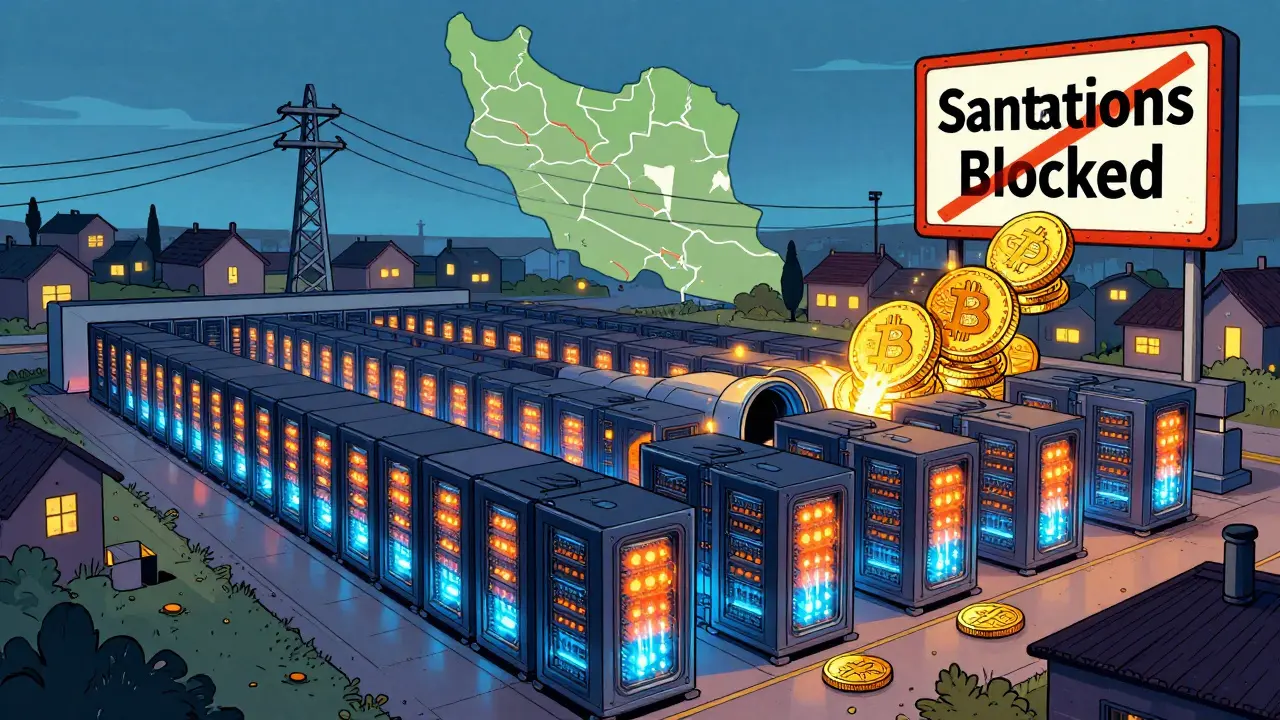
For years, international sanctions have strangled Iran's access to global banking systems. Traditional trade routes are blocked, and US dollars are off-limits. So, the Islamic Republic looked elsewhere. They turned to cryptocurrency, specifically Bitcoin, not just as an investment tool, but as a strategic weapon to bypass financial restrictions. By 2025, this wasn't just a niche experiment; it was a state-sponsored infrastructure designed to move billions of dollars out of the country while keeping the government’s fingerprints clean.
You might think crypto is anonymous by nature. It isn’t. But for a nation under heavy scrutiny, the blockchain offers a layer of complexity that traditional banks cannot match. The question isn’t whether Iran uses crypto-it does. The real question is how effective this strategy actually is when faced with sophisticated blockchain intelligence and severe energy constraints.
The Scale of Iran’s Crypto Infrastructure
To understand the strategy, you first need to look at the sheer scale of operations. This isn’t about a few traders buying coins on their phones. This is industrial-grade infrastructure. As early as 2021, Iran was responsible for nearly five percent of all new Bitcoins mined globally. By 2022, the government had issued licenses for over 10,000 mining farms. These facilities consume massive amounts of electricity, often diverting power from residential grids during peak hours.
Alongside mining, the government permitted approximately 90 cryptocurrency exchanges to operate within its borders. This created a domestic liquidity pool where citizens could convert Rials into digital assets. The goal? To create a bridge between the sanctioned Iranian economy and the open global market. By 2024, $4.18 billion worth of cryptocurrencies had left Iran, a 70 percent increase from the previous year. This capital flight wasn’t accidental; it was a feature of the system.
| Metric | Value / Status | Context |
|---|---|---|
| Global Mining Share | ~5% | Peak production in early 2021 |
| Licensed Mining Farms | 10,000+ | State-sanctioned operations |
| Crypto Outflows (2024) | $4.18 Billion | 70% YoY increase |
| Domestic Exchanges | ~90 | Operated under strict CBI oversight |
Nobitex: The Heart of the System
If there is one entity that defines Iran’s crypto strategy, it is Nobitex. Claiming to support more than 11 million users, Nobitex became the dominant venue for digital asset trading in the country. For ordinary Iranians, it was a way to preserve savings against hyperinflation. For the state, it was critical infrastructure.
Data analysis by blockchain intelligence firm Elliptic revealed that Nobitex wasn’t just a neutral marketplace. The platform was linked to a network of wallets and behaviors consistent with activities aligned with the Islamic Revolutionary Guard Corps (IRGC). This connection made Nobitex a high-value target for international regulators and, ironically, for cybercriminals.
On June 18, 2025, the system suffered a catastrophic failure. A devastating exploit drained over $90 million from the exchange across multiple digital assets. This wasn’t just a technical glitch; it struck at the heart of Iran’s sanctions evasion apparatus. The loss exposed the vulnerability of relying on centralized exchanges for state-critical financial functions. When the primary gateway is hacked, the entire flow of capital is disrupted.

The Shadow Banking Network
Mining and exchanges are only half the story. The other half involves moving that money to buy goods, particularly oil and military equipment. This is where the "shadow banking" network comes in. In September 2025, the US Department of the Treasury’s Office of Foreign Assets Control (OFAC) targeted a $600 million Iranian shadow banking network.
This network facilitated over $100 million in cryptocurrency purchases directly related to Iranian oil sales between 2023 and 2025. The operation was sophisticated, using international front companies and complex transaction layers to obscure the origin of funds. Key figures like Arash Estaki Alivand were designated, along with specific Ethereum and Tron wallets they controlled. The goal was to move funds on behalf of the IRGC Quds Force.
This reveals the core mechanic of the strategy: Iran sells oil or other resources, receives payment in crypto (often via intermediaries), converts it through local exchanges like Nobitex, and then uses those funds to import essential goods. The blockchain acts as the ledger, but the opacity of the intermediate steps provides plausible deniability.
Regulatory Tightening and Energy Costs
The strategy came with significant internal costs. The Central Bank of Iran (CBI) grew increasingly concerned about the lack of transparency and tax evasion. In early 2025, the CBI ordered the closure of Rial payment gateways for cryptocurrency exchanges. The reasoning was clear: operators were handling billions in transactions without paying taxes or maintaining transparent financial statements.
Furthermore, the energy cost was unsustainable. Legal framework maintained that mining was legal but heavily restricted. However, illegal mining operations strained the national grid, leading to widespread power outages. The government found itself in a bind: shutting down mining hurt revenue, but allowing it continued hurt the civilian population and infrastructure.
Using cryptocurrency for domestic payments remained banned. You couldn’t buy bread with Bitcoin in Tehran. However, crypto payments for imports were legalized. This distinction highlights the dual nature of the policy: restrict citizen mobility to prevent capital flight, but enable state-level mobility to evade sanctions.

Blockchain Intelligence vs. State Secrecy
A common misconception is that blockchain technology makes sanctions evasion easy because it is decentralized. In reality, the public ledger makes it easier for authorities to track flows than ever before. Firms like Chainalysis and Elliptic developed sophisticated methods to map Iranian crypto activities.
They combine on-chain forensics with geopolitical context. They don’t just see a transaction; they see patterns. They identify clusters of addresses associated with known entities like the IRGC or specific exchanges. This has allowed international partners to freeze assets, designate individuals, and disrupt networks worth hundreds of millions of dollars. The transparency of the blockchain is a double-edged sword: it enables cross-border transactions without banks, but it also creates an immutable record that investigators can use against you.
Why the Strategy Is Backfiring
Initially, the Bitcoin strategy seemed like a breakthrough. It allowed Iran to generate foreign currency reserves without engaging with the SWIFT system. But closer examination shows significant vulnerabilities. First, the energy infrastructure strain is real. Creating Bitcoin from domestic gas and electricity is less efficient than exporting those resources directly if the political situation allowed it.
Second, the security risks are mounting. The Nobitex hack demonstrated that centralized points of failure exist even in a decentralized ecosystem. Third, international enforcement is getting smarter. OFAC’s actions in 2025 showed that the US government is no longer ignoring crypto-based sanctions evasion; it is actively targeting it.
For businesses trying to engage in legitimate trade with Iran, the environment is hostile. The complex regulatory landscape and the risk of being implicated in sanctions violations make cross-border transactions incredibly difficult. The friction is intentional, but it also stifles economic activity beyond what the state intends.
Is Bitcoin mining legal in Iran?
Yes, but it is heavily regulated. The Central Bank of Iran requires licenses for all participants. While the government encourages licensed mining to generate foreign currency, illegal mining operations are cracked down on due to their strain on the national energy grid. Unlicensed miners face confiscation of equipment and legal penalties.
Can I use cryptocurrency to pay for goods in Iran?
No. Using cryptocurrency for domestic payments is banned. Citizens cannot use Bitcoin or other cryptos to buy everyday items like food or fuel. However, crypto payments for imports are legalized, allowing businesses to use digital assets to bring goods into the country, bypassing traditional banking restrictions.
What happened to Nobitex in 2025?
On June 18, 2025, Nobitex, Iran's largest cryptocurrency exchange, suffered a major security exploit resulting in losses exceeding $90 million. This event was significant because Nobitex serves as critical infrastructure for Iran's cross-border capital flows. The hack highlighted the security risks inherent in centralized crypto platforms used for state-level financial strategies.
How does OFAC track Iranian crypto sanctions evasion?
OFAC works with blockchain intelligence firms like Chainalysis and Elliptic. These firms analyze on-chain data to identify patterns, clusters of addresses, and connections to known entities such as the IRGC. By combining technical forensics with geopolitical intelligence, they can trace funds from illicit sources to specific wallets and individuals, enabling targeted sanctions and asset freezes.
Why did the Central Bank of Iran close Rial payment gateways for exchanges?
The CBI closed these gateways in early 2025 to combat tax evasion and lack of transparency. Cryptocurrency exchanges were processing billions of dollars in transactions without proper taxation or transparent financial reporting. The move aimed to tighten control over capital flows and ensure that the state could monitor and tax large-scale movements of wealth.
Albert Lee
May 12, 2026 AT 22:39Wow, this is actually a massive deal for the entire crypto space. I mean, seeing a state actor try to weaponize Bitcoin like this is wild but also kind of fascinating from a tech perspective. It shows that even with all the sanctions and the heat from OFAC, people are still finding ways to move money around because they have to. The Nobitex hack was probably a nightmare for everyone involved though, losing $90 million in one go is insane. I hope the regular users who just wanted to save their savings didn't lose everything too. This really highlights how dangerous centralized exchanges can be when you're relying on them for critical infrastructure.
Ellie Riddell
May 13, 2026 AT 19:07Oh look, another article pretending that blockchain is some magical privacy tool while ignoring the fact that it's basically a public ledger for investigators to play whack-a-mole with. The irony is palpable here. Iran thinks they're being clever by using Bitcoin to evade sanctions, but Chainalysis and Elliptic are laughing all the way to the bank. They've been mapping these clusters for years. It's not 'evasion' if your money trail is written in neon lights on an immutable database. The only thing this strategy achieved was draining their national grid and getting their biggest exchange hacked. Truly a masterclass in self-sabotage.
Amit Varpe
May 14, 2026 AT 03:28Let me get this straight. You guys are sitting there judging Iran for trying to survive under unfair sanctions while your own banks do whatever they want? 😡 Typical Western hypocrisy. If my country was being strangled economically, I'd find a way out too. Crypto is just a tool. Stop acting like it's evil just because you can't control it. Iran has every right to protect its economy from foreign interference. 🇮🇳💪
Bronwen Butler
May 15, 2026 AT 03:55actually nobody cares about your political rant amit. the point is that blockchain is transparent. period. end of story. irans strategy failed because they thought anonymity existed where none does. also stealing electricity from citizens to mine bitcoin is just plain stupid regardless of your geopolitical stance. you cant eat satoshis during a blackout
Amit Varpe
May 16, 2026 AT 19:42You clearly don't understand the context. Sanctions kill people. Real people. Not just numbers on a chart. And yes, the grid issues are bad, but blaming the victims for trying to adapt is lazy. Try reading more than just headlines before jumping to conclusions. 🙄
Matt Davis
May 18, 2026 AT 07:53I must say, the sheer audacity of a nation attempting to bypass international financial systems via a technology designed for peer-to-peer transactions is both breathtakingly bold and utterly doomed. The narrative that this was a 'strategic weapon' is laughable when you consider the catastrophic security failures inherent in centralized custodial models. Nobitex wasn't just an exchange; it was a honeypot for cybercriminals and regulators alike. To think that any rational actor would bet billions on such a fragile infrastructure is simply baffling.
Pauline Larocco71
May 18, 2026 AT 11:12i feel so sad for the ordinary people in iran who lost their savings in that nobitex hack. its terrible that they had to rely on crypto just to preserve value against inflation. the government promised stability but gave them chaos instead. i hope they recover soon because no one deserves to live with that level of financial stress and uncertainty. its heartbreaking really.
Michelle Bonahoom
May 18, 2026 AT 14:40typical american sympathy for terrorists lol. they should have stuck to traditional banking if they wanted safety. now they got what they deserved. weak systems fail. stop crying about it
Pauline Larocco71
May 19, 2026 AT 16:24that is so rude. its not about terrorism its about human suffering. people just wanted to feed their families. you dont know what its like to have your currency become worthless overnight. please show some basic empathy instead of being mean.
Ankush Pokarana
May 21, 2026 AT 05:15the philosophical implications of state-sponsored crypto mining are profound. we see a clash between sovereign autonomy and global regulatory hegemony. the energy cost is merely a symptom of a deeper systemic inefficiency. perhaps the real lesson here is that decentralized finance cannot be fully captured by centralized power structures without eventually collapsing under its own weight. the irony is that in trying to escape surveillance they created a more visible footprint. interesting times indeed.
Yash Lodha
May 22, 2026 AT 18:47They aren't just mining Bitcoin, they are mining data for the deep state. Every transaction is a beacon for the shadowy operators of the global financial elite. The IRGC isn't evading sanctions; they are playing a longer game, feeding false trails to distract from the real flow of resources. The hack at Nobitex? Staged. A controlled burn to reset the ledger and eliminate dissenting nodes within their own network. Wake up. The blockchain is a trap.
John Gonzalez Bentham
May 22, 2026 AT 23:32everyone is missing the point. the us treasury is just jealous that iran found a loophole. ofac is powerless against true decentralization. the hack was just a glitch in the matrix. keep stacking sats boys. the system will collapse anyway.
Jesse Alston
May 23, 2026 AT 15:32Actually, from a technical standpoint, the vulnerability highlighted here is crucial for anyone running or investing in centralized exchanges. The exploit likely targeted the hot wallet management or smart contract logic rather than the blockchain itself. It's a reminder that 'not your keys, not your coins' applies doubly so when the entity holding your keys is under international scrutiny and potential cyberattack. Always use hardware wallets for storage, never leave large amounts on an exchange, especially one operating in a high-risk jurisdiction. Stay safe out there! 🔒✅
Sudarshan Anbazhagan
May 24, 2026 AT 16:16It is imperative that we recognize the gravity of this situation. The central bank of iran made a grave error in allowing such unregulated entities to operate with impunity. The lack of transparency is not merely a inconvenience but a direct threat to global financial stability. One must question the competence of those who allowed this infrastructure to develop without adequate safeguards. The consequences are severe and far-reaching affecting not just the local population but the integrity of the digital asset ecosystem as a whole.
Sharada Vakkund
May 25, 2026 AT 06:39I think it's important to look at this from a community perspective. How can we help educate people in sanctioned regions about safer ways to manage their finances? We need more inclusive solutions that don't put vulnerable populations at risk of hacks or government crackdowns. Let's discuss how decentralized finance can be used ethically to support humanitarian efforts rather than just sanctions evasion. We can learn from this mistake.
Kimberly Herbstritt
May 25, 2026 AT 15:29Friendly reminder that most of you don't actually understand how blockchain forensics works. It's not magic. It's pattern recognition. And yeah, Iran's strategy was kinda dumb but hey, desperate times call for desperate measures. Still, $90M gone is a lot of coffee. ☕️
Sarah C
May 25, 2026 AT 16:42This is a really complex issue and I appreciate the detailed breakdown. It makes sense why the CBI would close the Rial gateways, tax evasion is a huge problem everywhere. I'm curious if there are any other countries trying similar strategies that haven't been caught yet. It seems like a cat-and-mouse game that will only get harder for the evaders.