
Before Bitcoin existed, proof of work wasn’t meant to secure digital money. It was designed to stop spam.
In 1993, cryptographers Cynthia Dwork and Moni Naor came up with the idea of making computer tasks slightly harder to solve - not to slow down users, but to make spamming too expensive to be worth it. If you wanted to send a thousand emails, you’d need to solve a small math puzzle for each one. That tiny cost, multiplied, made mass spamming impractical. It was a quiet innovation, buried in academic papers. No one knew it would one day power the most valuable digital asset on Earth.
The Birth of Hashcash
Seven years later, British cryptographer Adam Back took that idea and turned it into something practical: Hashcash. In 1997, he built a system where email senders had to perform a small computational task before their message was accepted. The puzzle used a cryptographic hash function - a one-way math operation that turns any input into a fixed string of characters. Solve it, and you proved you’d done the work. No one could cheat. It wasn’t perfect, but it worked. Back’s goal was simple: make spamming costly. He didn’t dream of digital cash. But his system became the blueprint.
From Email to Digital Cash
In 2004, Hal Finney, a longtime cryptography enthusiast and early Bitcoin contributor, built on Hashcash. He created the first reusable proof of work - RPOW. Instead of a one-time puzzle, he made tokens that could be passed from person to person. Each token was signed with RSA encryption and tied to a solved Hashcash puzzle. It was a step toward digital money. Finney’s system solved one big problem: how to prevent someone from spending the same token twice. He didn’t build a full network, but he showed that proof of work could be used to track value without a bank.
Bitcoin and the Revolution
Then came Satoshi Nakamoto.
On October 31, 2008, a paper titled "Bitcoin: A Peer-to-Peer Electronic Cash System" appeared on a cryptography mailing list. It didn’t just use proof of work - it redefined it. Satoshi combined Hashcash’s puzzle-solving with Finney’s reusable tokens and added a public ledger, called a blockchain, to record every transaction. Every ten minutes, miners competed to solve a SHA-256 hash puzzle. The first to solve it got to add a new block of transactions and was rewarded with newly minted bitcoins. This wasn’t just anti-spam anymore. It was a new way to agree on truth without a central authority.
On January 3, 2009, the first Bitcoin block - the genesis block - was mined. It contained a single transaction and a hidden message: "The Times 03/Jan/2009 Chancellor on brink of second bailout for banks." That wasn’t just a timestamp. It was a statement. Bitcoin was built to replace systems that failed.

How Proof of Work Actually Works
Here’s the core idea: miners take a list of pending transactions, add a random number (called a nonce), and run it through a hash function. The output must start with a certain number of zeros. The more zeros required, the harder it is to find the right nonce. It’s like rolling dice until you get five sixes in a row. There’s no shortcut. You just keep trying.
Bitcoin adjusts the difficulty every 2,016 blocks - roughly every two weeks - so that even as more miners join, the average time to find a block stays around ten minutes. If everyone suddenly had supercomputers, the puzzle gets harder. If miners shut down, it gets easier. This keeps the system stable.
Security comes from cost. To attack Bitcoin, you’d need to control more than half of all mining power - a 51% attack. As of 2023, that would cost over $13.5 billion in hardware and electricity. The reward for honest mining? Around $1.14 billion per year in new bitcoins and fees. It’s not a coincidence. The cost of attacking is higher than the reward for cheating.
The Mining Arms Race
Early Bitcoin mining was done on regular computers. In 2009, a single CPU could mine a block in days. By 2010, people started using graphics cards (GPUs), which were faster at hashing. Then came ASICs - custom chips built for one thing: solving SHA-256 puzzles.
Bitmain’s Antminer S1, released in 2013, changed everything. It was 100 million times faster than a 2009 CPU. Suddenly, home miners were out of the game. Mining became industrial. Today, the Antminer S19 XP can do 251 terahashes per second and uses 3,010 watts of power. That’s 143 times more energy than early mining rigs, but 139 million times faster. The efficiency gap is staggering.
As hardware got more powerful, mining centers grew. In 2019, the average Bitcoin mining facility was 1.2 megawatts. By 2023, it was nearly 40 megawatts - the size of a small town’s power demand. Most mining now happens in places with cheap electricity: Texas, Kazakhstan, and parts of Canada.
Energy and the Criticism
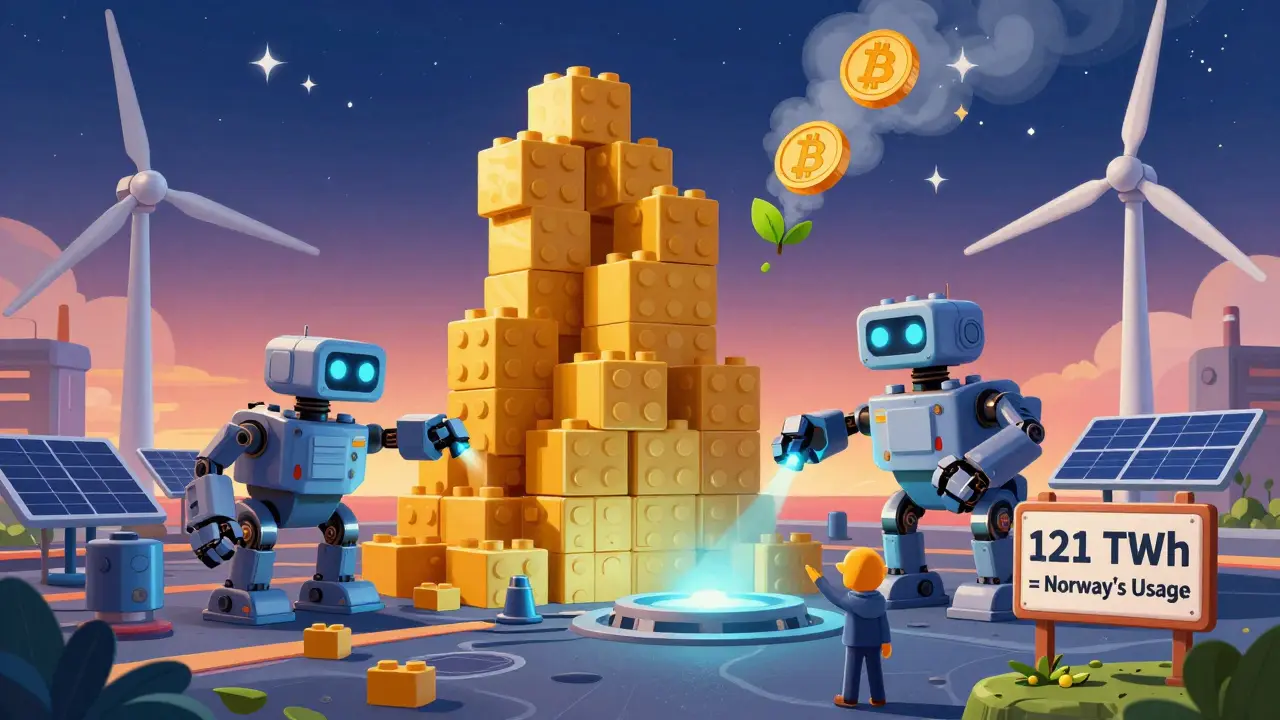
Bitcoin’s energy use is its biggest weakness. In 2023, it consumed 121.72 terawatt-hours per year - more than Norway. Critics call it wasteful. Supporters say it’s the price of security.
Adam Back, Hashcash’s inventor, argues that the security budget must match the value protected. Bitcoin secures over $578 billion. The $1.14 billion spent on mining is less than 0.2% of that value. To him, it’s not waste - it’s insurance.
But the environmental impact is real. Bitcoin’s carbon footprint in 2023 was 61.1 million metric tons of CO2 - equal to Greece’s annual emissions. That’s why Ethereum, the second-largest cryptocurrency, switched to proof-of-stake in September 2022. It cut its energy use by 99.95%.
Still, Bitcoin’s mining industry is adapting. A 2023 report from the Bitcoin Mining Council found 67.3% of its energy came from renewable sources - mostly hydroelectric power, stranded natural gas, and wind. Many new mining sites are built next to flared gas fields, turning waste into power. It’s not perfect, but it’s changing.
Proof of Work Today
As of 2026, Bitcoin still runs on proof of work. So do Litecoin, Monero, and Ethereum Classic. But the landscape has shifted. In 2022, PoW cryptocurrencies made up 78.6% of the total crypto market. By 2026, that’s dropped to 54.3%. Ethereum’s exit was a turning point.
Most new blockchain projects now choose proof-of-stake or other low-energy models. Only 31% of new chains launched in 2023 used PoW. Enterprise adoption is low too - only 12 Fortune 500 companies use PoW blockchains. But for store-of-value use cases, PoW still dominates. Bitcoin is the most trusted digital asset ever created, and its security model has never been broken.
Litecoin, which once promised to be "the silver to Bitcoin’s gold," now uses ASICs just like Bitcoin. Its scrypt algorithm, meant to be CPU-friendly, was cracked by specialized hardware by 2014. The dream of decentralized mining faded.
What’s Next for Proof of Work?
Will Bitcoin ever switch to proof-of-stake? Almost certainly not. In a September 2023 GitHub discussion among core developers, 89% opposed any change. The community sees PoW as non-negotiable - the core of Bitcoin’s trustless design.
Some propose hybrid models. Litecoin’s developers have floated a plan to merge PoW with proof-of-stake by 2025, letting validators secure the network while miners handle transaction ordering. But that’s still theoretical.
Regulation is tightening. The European Union’s MiCA law, effective in December 2024, will require PoW networks to prove their energy use is sustainable. The U.S. SEC has already classified some PoW tokens as securities. Mining will face more scrutiny.
Yet, the trend is clear: PoW is becoming a niche - but a powerful one. It’s no longer the default. But for those who want the strongest possible guarantee that money can’t be manipulated, it’s still the only choice.
Why It Still Matters
Proof of work isn’t just a technical detail. It’s a philosophy. It says: trust shouldn’t come from a person, a company, or a government. It should come from math, electricity, and economics.
Every time a miner solves a puzzle, they’re not just validating transactions. They’re betting real money on the network’s integrity. That’s why Bitcoin has never been hacked. Not because it’s unbreakable - but because breaking it costs more than it’s worth.
From a spam filter to a global monetary network, proof of work has outlasted every other consensus mechanism in crypto. It’s messy, energy-heavy, and controversial. But after 30 years, it’s still standing.
Telleen Anderson-Lozano
January 16, 2026 AT 21:11So cool to see how a tiny anti-spam tweak became the backbone of digital money-like finding out your toaster was secretly a rocket engine.
Shaun Beckford
January 17, 2026 AT 03:38Let’s be real-PoW is the last bastion of cryptographic purity in a world where everything’s just a fucking marketing slide deck. The energy? Sure. But what’s the alternative? Trusting some CEO’s blockchain-as-a-service dashboard? Lol.
Chris Evans
January 17, 2026 AT 16:17The ontological weight of proof-of-work is staggering-it’s not merely a consensus mechanism, it’s an epistemological firewall against centralized epistemic authority. Each hash is a metaphysical act of defiance: ‘I will not yield my sovereignty to institutions that cannot prove their integrity through verifiable labor.’ The electricity isn’t waste-it’s sacrificial offering to the god of decentralization.
When Finney built RPOW, he didn’t just engineer a token-he forged the first artifact of post-scarcity trust. And Satoshi? He didn’t invent Bitcoin-he resurrected the concept of money as a natural law, not a social contract.
The fact that 89% of devs oppose PoS isn’t resistance-it’s reverence. We’re not clinging to legacy tech. We’re preserving the only system that makes trust computable.
Hannah Campbell
January 17, 2026 AT 17:08Oh wow Bitcoin uses more power than Norway?? Who cares?? Also why is everyone so mad about energy?? I mean if you can mine with solar and flared gas then its literally free energy?? Also the whole thing is a scam anyway so who cares what it costs??
Sarah Baker
January 19, 2026 AT 00:06I love how this story shows that the most revolutionary ideas often start small and quiet-no fanfare, no VC funding, just someone trying to fix spam. It’s a reminder that big change doesn’t always come with a keynote or a ticker symbol. Sometimes it’s just a math puzzle in a 1997 email.
And the fact that it’s still standing after 30 years? That’s not luck. That’s resilience. Keep going, Bitcoin. We’re rooting for you.
myrna stovel
January 19, 2026 AT 14:53For anyone feeling overwhelmed by the energy debate-let’s remember this: every technology has trade-offs. The printing press burned forests. Cars killed air quality. The internet now runs on data centers that glow like neon cathedrals.
PoW isn’t perfect, but it’s honest. It doesn’t hide its cost. It doesn’t pretend to be ‘green’ while centralizing control. It says: ‘Here’s what it takes to be trustless.’ And for those of us who value that above all else? We’re willing to pay the price.
Let’s not shame miners. Let’s support innovation that makes it cleaner. And let’s stop pretending PoS is some moral upgrade-it’s just a different kind of trust. One that requires you to believe in people again.
Bryan Muñoz
January 19, 2026 AT 23:46THEY SAID IT WAS JUST FOR SPAM LOL AND NOW THEY WANT TO TAKE OUR BITCOIN?? THE GOVERNMENT IS GOING TO SHUT DOWN MINING NEXT AND THEN WE’LL ALL BE ON CBDCS OMG THEY’RE ALREADY TRACKING OUR TRANSACTIONS THROUGH PAYPAL I SAW A VIDEO ON TIKTOK ABOUT IT
100% real. They’re coming for PoW. Mark my words. The EU is just the first step. Soon your toaster will need a blockchain license to toast bread. 😱
Rod Petrik
January 21, 2026 AT 18:53Hashcash was created by the same people who designed the Federal Reserve system in secret. Adam Back? He’s a shill for the banking cartel. The whole thing is a psyop to normalize computational slavery under the guise of ‘security.’
Did you know the SHA-256 algorithm was originally developed by the NSA? Of course you didn’t. That’s because they don’t want you to know that Bitcoin’s ‘decentralized’ security is built on a backdoor they wrote.
They’re using your electricity to fund a global surveillance network. Wake up.
Michael Jones
January 22, 2026 AT 19:13One of the most elegant examples of emergent innovation in tech history: a solution to a narrow problem-spam-became the foundation for a global monetary system. The elegance lies in its simplicity: cost as a deterrent, math as a guarantee, and incentives as a glue.
It’s not just about mining rigs or energy bills. It’s about designing systems where malice is economically irrational. That’s not just clever-it’s profound.
And the fact that this system has survived 15 years of attacks, speculation, and regulatory pressure? That’s not luck. It’s design.
People call it wasteful. But when the alternative is trusting a central authority with your life savings, the cost feels… reasonable.
Pramod Sharma
January 23, 2026 AT 09:32Math + electricity = trust. No middlemen. No politicians. Just code. That’s the beauty.
Pat G
January 25, 2026 AT 05:28So we’re spending more energy than Norway to protect a digital toy that’s worth less than half the GDP of Texas? And you’re proud of this? America doesn’t need to be the world’s Bitcoin power plant. We’ve got real problems to solve. This is a vanity project for tech bros who think they’re heroes because they run a GPU farm.
Alexandra Heller
January 25, 2026 AT 16:45It’s ironic. The very people who scream about ‘trustless systems’ are the ones who place absolute faith in a mathematical algorithm created by a ghost. You don’t know who Satoshi is. You don’t know where the mining farms are. You don’t know who owns the ASICs. You’re trusting a black box built by anonymous coders and funded by hedge funds. That’s not decentralization-that’s superstition dressed in code.
And yet you call Ethereum’s switch to PoS ‘centralized’? Please. At least PoS has accountability. PoW has nothing but noise, heat, and delusion.
The real revolution isn’t in mining. It’s in realizing that we don’t need to burn the planet to prove we’re not being lied to.