
Staking cryptocurrency used to be simple. You lock up your coins, you wait, and you get a small reward. But as the crypto world has grown more complex, so have the ways we earn yield. Enter LiNEAR Protocol, an omnichain liquid staking and restaking platform built on the NEAR blockchain. If you’ve seen the ticker LNR popping up in market data or heard whispers about "chain abstraction," you’re probably wondering what it actually does.
This isn’t just another wrapper for staking rewards. LiNEAR aims to solve two major headaches for crypto users: the hassle of managing validator health across dozens of nodes and the friction of moving assets between different blockchains to maximize security and yield. It positions itself as the largest DeFi protocol on NEAR by total value locked, but like any project making big claims, you need to look under the hood before committing funds.
How LiNEAR Protocol Works
To understand LiNEAR, you first need to grasp the concept of liquid staking. In traditional staking on networks like NEAR, you delegate your tokens to a validator. Those tokens are then illiquid-you can’t easily spend them while they’re working for you. Liquid staking changes this. When you stake with LiNEAR, you receive a derivative token called LINEAR (Liquid Staked NEAR). This token represents your staked NEAR plus any accrued rewards. You can trade LINEAR on decentralized exchanges, use it in other DeFi protocols, or hold it until you decide to unstake.
Here is where LiNEAR gets interesting. It doesn’t stop at basic staking. It introduces "liquid restaking." This means you can take that staked position and reuse it to secure other networks or infrastructure layers, such as EigenLayer or Octopus Network. Normally, bridging assets to these platforms involves complex steps, high gas fees, and significant risk. LiNEAR uses an aggregated account structure to abstract away this complexity. You interact with one interface, and the protocol handles the cross-chain mechanics behind the scenes.
The core innovation here is automation. Instead of manually choosing validators and hoping they stay online, LiNEAR’s smart contracts automatically optimize your delegation. The system distributes your stake across more than 200 validators on the NEAR network. This massive diversification reduces the risk of slashing penalties if a single validator fails and helps decentralize the network further. For the average user, this means higher security without needing to become a validator expert yourself.
The Two Tokens: LNR vs. LINEAR
Confusion often arises because LiNEAR operates with two distinct tokens. It is crucial not to mix them up, as they serve completely different purposes and have vastly different price behaviors.
| Feature | LNR (Governance Token) | LINEAR (Liquid Staked Token) |
|---|---|---|
| Purpose | Voting, governance, protocol incentives | Represents staked NEAR + rewards; tradable asset |
| Supply Cap | 1,000,000,000 (Fixed) | Inflationary (Grows with staking demand) |
| Price Driver | Market speculation, utility adoption | Underlying NEAR price + staking yield |
| Trading Volume | Low/Illiquid (Often <$15k/day) | Higher (Often >$200k/day on DEXs) |
| Risk Profile | High volatility, speculative | Moderate, tied to NEAR performance |
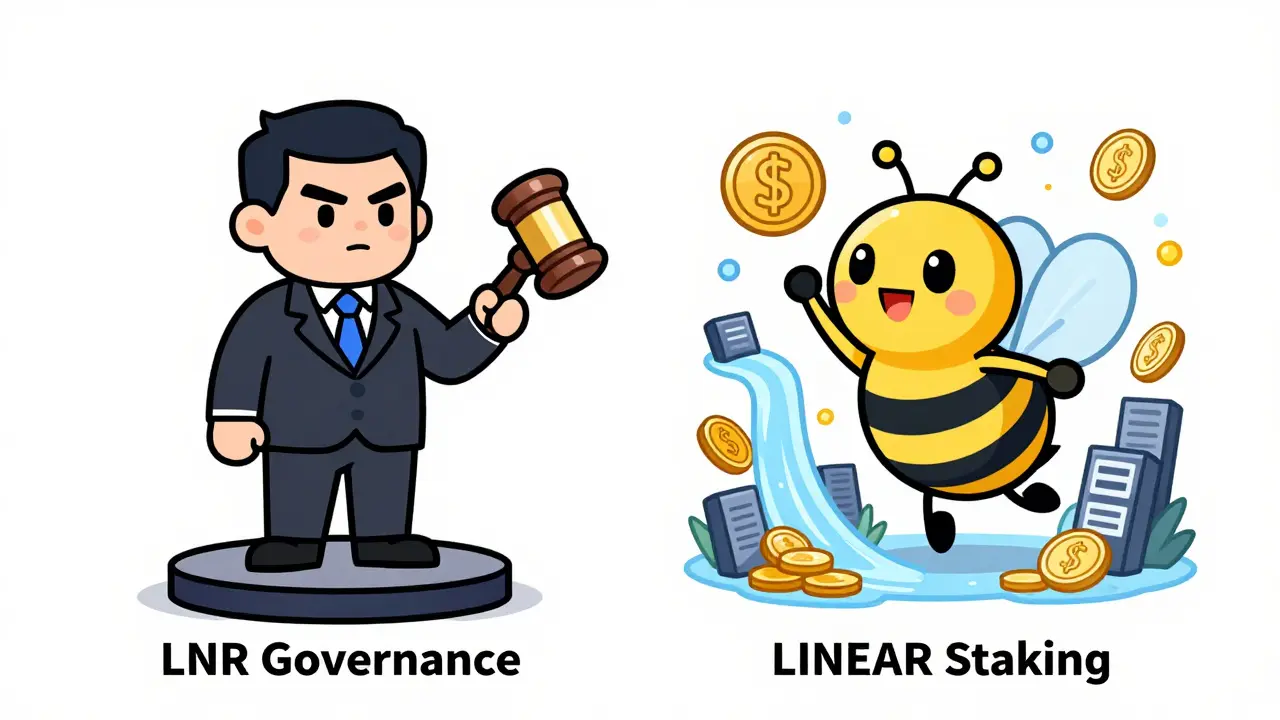
LNR is the governance token. Holding LNR gives you a voice in the protocol’s future. You vote on parameter changes, new integrations, and treasury allocations. With a fixed maximum supply of 1 billion tokens, its scarcity is baked into the code. However, liquidity for LNR is currently thin. Trading volumes on major aggregators often hover below $15,000 per day, meaning large buys or sells can cause significant price slippage.
LINEAR, on the other hand, is the workhorse. When you stake NEAR, you get LINEAR. Its value tracks closely with NEAR but includes the added benefit of accumulated staking rewards. Because it represents real underlying assets, it tends to have deeper liquidity, particularly on decentralized exchanges like Rhea Finance, where trading pairs like LINEAR/WNEAR see significantly higher volume than the governance token itself.
Tokenomics and Supply Dynamics
Understanding the supply dynamics of LNR is essential for assessing its potential value. The protocol has a hard cap of 1,000,000,000 LNR tokens. According to data from CoinMarketCap, approximately 800,000,000 of these tokens are reported as circulating. This suggests that 80% of the total supply is already in the hands of investors, teams, or treasuries, leaving only 20% potentially reserved for future emissions or unlocks.
However, you will notice discrepancies across different data providers. Some platforms, including Coinbase and Binance, may list the circulating supply as zero. This is usually a data tracking error rather than an indication that the token doesn’t exist. These centralized exchanges often struggle to index native NEAR tokens accurately compared to ERC-20 tokens on Ethereum. Always rely on on-chain explorers or dedicated NEAR analytics tools for the most accurate supply figures.
The founders, identified in some reports as Kevin Tai and Drey Ng, have structured the token to prioritize long-term alignment. By locking a portion of the supply and distributing the rest through community incentives and liquidity provision, the protocol aims to avoid the massive dump risks seen in earlier DeFi projects. Keep in mind that while the max supply is fixed, the *value* of each token depends entirely on how much utility the governance layer provides. If voting becomes irrelevant, LNR loses its primary reason for existing.
Security and Decentralization
Security in liquid staking rests on two pillars: the robustness of the smart contracts and the distribution of the underlying stake. LiNEAR addresses the latter aggressively. By automatically delegating to over 200 validators, the protocol ensures that no single entity controls a disproportionate amount of stake. This is critical on Proof-of-Stake networks like NEAR, where concentration of power can lead to censorship or centralization risks.
From a technical standpoint, LiNEAR is non-custodial. This means you never send your NEAR to a company’s wallet. Instead, you interact directly with their smart contracts using your own self-custodied wallet, such as Meteor Wallet or MyNearWallet. While this eliminates counterparty risk (the risk that the company runs away with your money), it introduces smart contract risk. If there is a bug in the LiNEAR code, hackers could exploit it. Therefore, auditing status and bug bounty programs are vital indicators of safety, though specific audit reports were not detailed in the immediate public snapshots.
The restaking feature adds another layer of complexity. By allowing assets to secure multiple networks simultaneously via EigenLayer and Octopus, LiNEAR increases capital efficiency. But it also expands the attack surface. A vulnerability in the bridge mechanism or the restaking logic could theoretically impact the underlying staked assets. Users should view restaking as a higher-risk, higher-reward strategy compared to standard staking.
Market Performance and Liquidity Realities
If you are looking to trade LNR, you need to manage your expectations regarding liquidity. The market for the governance token is fragmented and relatively shallow. Price quotes vary wildly across platforms due to asynchronous order books and low trading volume. For instance, one snapshot might show LNR at $0.000847 on one exchange, while another lists it at $0.0024, and a third at $0.000095. These discrepancies highlight the lack of arbitrage efficiency typical of low-cap altcoins.
Be wary of slippage. Trying to buy or sell large amounts of LNR on a decentralized exchange could move the price significantly against you. The daily trading volume often ranges between $300 and $12,000 depending on the day and the platform. Compare this to the LINEAR token, which regularly sees over $200,000 in daily volume on DEXs. This disparity confirms that while the *protocol* is widely used (high TVL in LINEAR), the *governance token* (LNR) is still finding its footing in terms of trader interest.
For most users, the entry point isn’t buying LNR for speculation, but engaging with the protocol by staking NEAR to earn LINEAR. The governance token is secondary, intended for those who want to actively participate in the protocol’s direction rather than just earn yield.

Who Is LiNEAR For?
LiNEAR Protocol isn’t designed for everyone. Here is a quick breakdown of who benefits most:
- Passive NEAR Holders: If you want to stake NEAR but don’t want to research validators or worry about downtime, LiNEAR’s automatic optimization handles the heavy lifting.
- DeFi Power Users: If you want to use your staked assets in other protocols without unstaking, the LINEAR token provides the necessary liquidity.
- Cross-Chain Enthusiasts: If you are interested in shared security models like EigenLayer but find the current UX too complex, LiNEAR’s abstraction layer simplifies the process.
It is likely not suitable for:
- Short-Term Traders: The low liquidity and high volatility of LNR make it risky for quick flips.
- Risk-Averse Investors: Smart contract risks and the experimental nature of restaking mean this is not a safe haven asset.
Future Outlook and Chain Abstraction
The long-term vision of LiNEAR revolves around "chain abstraction." The goal is to make the underlying blockchain irrelevant to the end-user. Whether your assets are secured on NEAR, Ethereum, or a Layer 2, the experience should feel seamless. By integrating with major restaking infrastructure, LiNEAR positions itself as a key player in this multi-chain future.
As NEAR continues to mature-highlighted by events like its recent halving which reduced inflation from 5% to 2.5%-protocols like LiNEAR that enhance network security and usability stand to gain. However, success will depend on execution. Can they maintain their status as the largest DeFi protocol on NEAR? Can they expand their user base beyond the current niche? And can they ensure the security of their cross-chain bridges as they integrate with more networks?
For now, LiNEAR offers a compelling solution for NEAR stakeholders who want efficiency and automation. Just remember to distinguish between the governance token (LNR) and the staking derivative (LINEAR), and always do your own due diligence on smart contract risks before connecting your wallet.
What is the difference between LNR and LINEAR?
LNR is the governance token used for voting on protocol decisions. LINEAR is the liquid staking derivative you receive when you stake NEAR. LINEAR tracks the value of NEAR plus rewards, while LNR is a speculative asset with a fixed supply of 1 billion tokens.
Is LiNEAR Protocol safe to use?
LiNEAR is non-custodial, meaning you retain control of your assets via your wallet. However, all DeFi protocols carry smart contract risk. Additionally, restaking features introduce complexity. Always verify audit statuses and start with small amounts to test the system.
Why is the LNR price different on every website?
LNR has low liquidity and trades on various fragmented markets. Different exchanges have different order books and update frequencies, leading to significant price discrepancies. This is common for low-volume altcoins.
Can I buy LNR on Coinbase or Binance?
While these platforms may list price charts for informational purposes, LNR is primarily traded on decentralized exchanges within the NEAR ecosystem. Centralized exchanges often have limited or no direct trading pairs for native NEAR tokens due to indexing challenges.
What is "automatic validator optimization"?
This feature automatically distributes your staked NEAR across more than 200 validators. This maximizes security and decentralization by preventing stake concentration in a few nodes, reducing the risk of slashing penalties if a single validator goes offline.