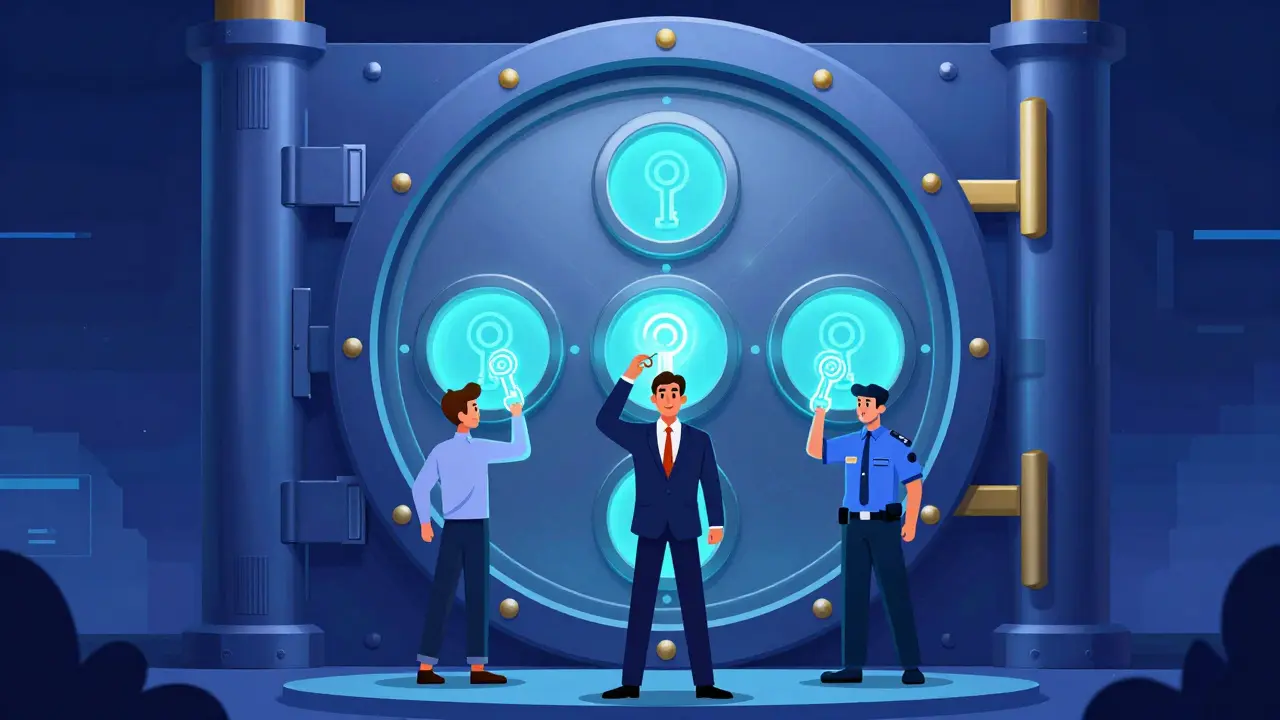
Imagine you have a vault containing millions of dollars in digital assets. If you hold the only key, you're a prime target for hackers, or worse, one misplaced piece of paper could wipe out your entire fortune. But what if that vault required three different keys, held by three different people, to open? That's the core of multi-signature technology is a security framework in blockchain that requires multiple independent digital signatures to authorize a transaction. Also known as multisig, it moves us away from the dangerous "single point of failure" model that plagues traditional crypto wallets.
For years, we've seen multisig used as a basic safety net. But as we move through 2026, it's evolving from a simple "extra lock" into a complex governance tool. Whether it's a company managing its payroll or a global community governing a treasury, the way we authorize movement of value is shifting from individual trust to mathematical certainty.
How Multisig Actually Works: The M-of-N Logic
To understand where the technology is going, we need to be clear on how it works today. Most systems use an M-of-N structure. In this setup, "N" is the total number of people who have a key, and "M" is the minimum number of those people who must sign off for the transaction to go through.
A common setup is a 2-of-3 arrangement. You might give one key to your business partner, one to a trusted lawyer, and keep one yourself. If you lose your key, the other two can still move the funds. If your partner tries to run off with the money, they can't, because they only have one signature. It's a digital version of the checks and balances system we've used in banking for decades, but without the need for a central bank teller to verify the IDs.
The technical execution differs depending on the network. Bitcoin is a decentralized ledger that supports native multi-signature scripts, meaning the rules are baked directly into the protocol. On the other hand, Ethereum uses smart contracts to simulate this behavior. Instead of the protocol itself requiring multiple signatures, a piece of code acts as a gatekeeper, holding the funds and only releasing them once the required number of approvals is recorded on-chain.
Comparing Traditional Multisig vs. Threshold Signatures
As the volume of transactions grows, the old way of doing multisig is becoming too slow and expensive. Traditional multisig requires every signature to be uploaded to the blockchain, which eats up space and costs more in gas fees. Enter Threshold Signature Schemes (TSS).
Unlike standard multisig, Threshold Signatures are a cryptographic method where a single signature is generated collectively off-chain. The blockchain only sees one signature, even though it took multiple parties to create it. This provides better privacy and significantly lower costs.
| Feature | Standard Multisig | Threshold Signatures (TSS) |
|---|---|---|
| On-Chain Footprint | Large (all signatures recorded) | Small (single signature) |
| Privacy | Low (signatories are visible) | High (signatories are hidden) |
| Gas Costs | Higher per transaction | Lower / Standard |
| Complexity | Simple to implement | High cryptographic overhead |

The Role of Multisig in DAO Governance
One of the most exciting shifts is how Decentralized Autonomous Organizations (or DAOs) are using this tech. In the early days, DAOs often struggled with "whale's weight," where a few people with the most tokens made all the decisions. Now, many DAOs use a hybrid model: community voting determines the direction, but a multisig treasury manages the actual funds.
Take a 3-of-5 setup for a project treasury. The community votes to fund a new developer. Once the vote passes, three of the five elected "signers" must manually approve the transaction. This prevents a single hacked account from draining the entire project's war chest. Platforms like Safe (formerly Gnosis Safe) have become the industry standard here, providing a user-friendly interface for what is essentially a complex piece of security infrastructure.
Real-World Use Cases: From Corporate Payroll to Custody
It's not just for crypto enthusiasts. Traditional financial institutions are integrating these patterns into their digital asset custody solutions. When a bank manages billions in Bitcoin for clients, they can't rely on one person with a password. They use institutional-grade multisig to ensure that any movement of assets requires approval from a compliance officer, a risk manager, and an executive.
We're also seeing this in collaborative business ventures. Imagine a joint venture between two companies. Instead of trusting a third-party escrow service, they can set up a 2-of-2 multisig wallet. No money moves unless both companies agree. It removes the middleman and replaces them with a transparent, immutable ledger.
Overcoming the Implementation Hurdle
If multisig is so great, why isn't everyone using it? The main issue is administrative friction. Managing keys is hard. If you have a 3-of-5 setup and three people lose their keys, your money is gone forever. There is no "forgot password" button in decentralized finance.
Moreover, changing the membership of a multisig wallet can be a nightmare. In some older systems, adding a new signer required regenerating the entire wallet address and moving all funds to a new location. While newer smart contract wallets make this easier, it still requires a level of technical coordination that scares off the average user.
The future involves "Account Abstraction." This is a fancy way of saying that your wallet becomes a smart contract. This allows for things like social recovery-where your friends can help you regain access to your account without needing to hold your private keys-essentially making the power of multisig invisible to the end user.
What's Next for Multi-Signature Tech?
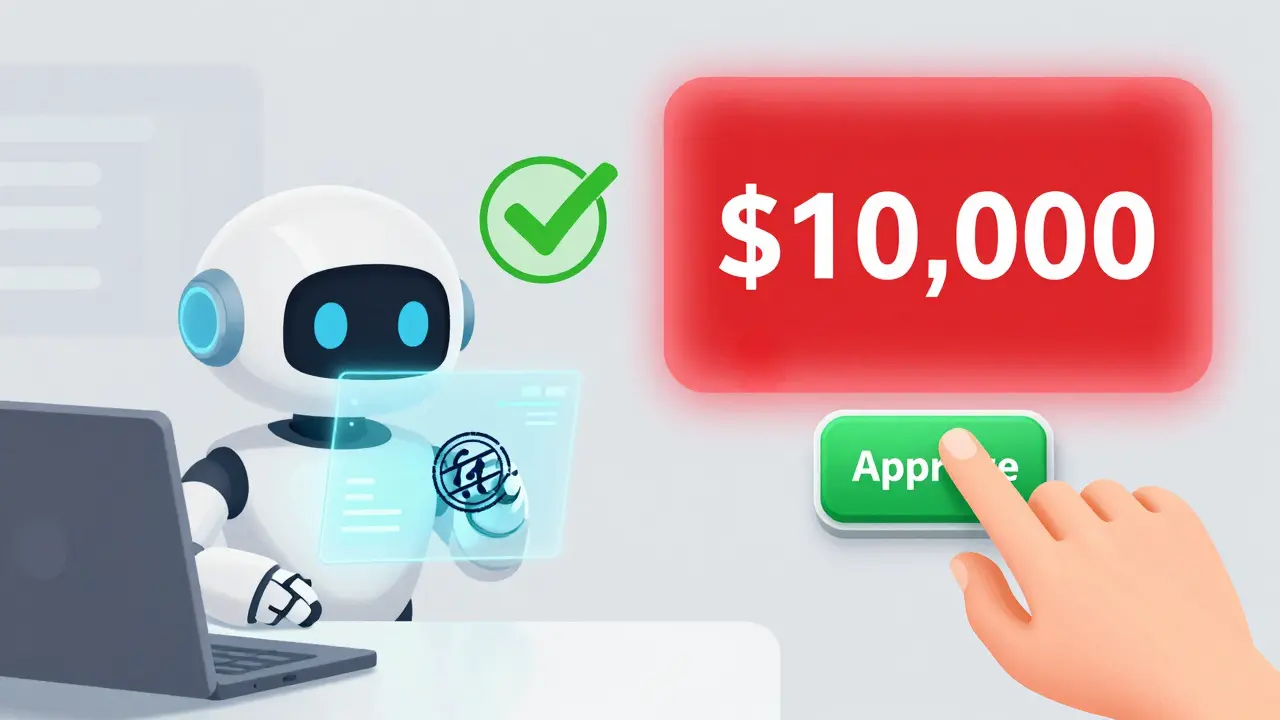
Looking ahead, we can expect multisig to merge with AI-driven automation. Imagine a "conditional multisig" where a transaction is automatically signed by a bot if certain real-world data points are met (like a price hit or a delivery confirmation), but still requires a human signature for amounts over $10,000. This would combine the speed of automation with the security of human oversight.
We'll also see more cross-chain multisig solutions. Currently, your Bitcoin multisig and your Ethereum multisig are two different animals. As interoperability layers improve, we will likely see "universal signatures" that can authorize actions across multiple different blockchains simultaneously, simplifying the experience for users who hold a diversified portfolio.
Is a multi-signature wallet safer than a hardware wallet?
It's not necessarily about "one or the other." A hardware wallet protects a single private key from being stolen online. A multisig wallet protects you if that single key is compromised or lost. The gold standard of security is actually using a multisig setup where each individual key is stored on its own separate hardware wallet.
Can I change the number of signers in a multisig wallet after it's created?
If you are using a smart-contract-based wallet (like those on Ethereum), yes. You can usually vote to add or remove signers. However, for native Bitcoin multisig, changing the participants usually requires creating a new address and transferring all the funds to it, which can be costly and tedious.
What happens if I lose the majority of the keys in a 3-of-5 setup?
If you lose three out of the five keys, the funds are permanently inaccessible. This is why key management and backup strategies are the most critical part of using multisig. It's highly recommended to store backup seeds in geographically separate, secure locations.
Does multisig make transactions slower?
Yes, in terms of human coordination. You have to wait for multiple people to sign. However, once the signatures are collected and the transaction is broadcast, the confirmation time on the blockchain is the same as any other transaction.
How is Threshold Signature (TSS) different from standard multisig?
Standard multisig puts all signatures on the blockchain, making it transparent but expensive. TSS creates a single "combined" signature off-chain. The blockchain only sees one signature, which saves on gas fees and hides who exactly signed the transaction, providing much better privacy.
Carroll Foster
April 10, 2026 AT 09:47Oh, look at us moving from 'single point of failure' to 'mathematical certainty.' Truly a paradigm shift for the masses. I'm sure the average Joe is just thrilled to manage the cryptographic overhead of a Threshold Signature Scheme while trying to buy a coffee. It's just purely poetic how we've replaced the bank teller with a smart contract that can permanently delete your life savings if you misplace a seed phrase. Truly the peak of efficiency. Cheers to the bold new world of account abstraction where my friends are my new bank managers.
Lela Singh
April 10, 2026 AT 21:52TSS is absolute magic! 🚀 It's like a secret handshake for your money. Total game changer for privacy!
7stargee Emmanuel Obani
April 12, 2026 AT 02:05Who cares about TSS? 🙄 its just another way for devs to make it complicated so they can charge more fees. lol 🤡
Will Dixon
April 12, 2026 AT 02:47i think the account abstraction part is the real deal here. makes it way easier for regular peple to use this stuff without breakin everything.
Kelly Cantrell
April 12, 2026 AT 17:14Funny how this "mathematical certainty" is pushed exactly when the government wants more control over digital assets. Once these multisig structures are standard, it's a piece of cake for the alphabet agencies to demand a key in the name of "national security." We're just building our own digital prisons with fancy names. Don't trust the smart contracts that are designed by people who work for the very systems they claim to replace. It's all a facade to get us comfortable with a centralized control masquerading as a decentralized tool.
Terrance Hausmann
April 13, 2026 AT 00:51I can see why some people feel uneasy about the control aspects, but maybe we can look at it as a way to empower small communities to protect themselves from bad actors. It's really about finding a balance where we can trust the process without needing to blindly trust a single person, which is a beautiful step toward a more collaborative future for all of us.
Rima Dinar
April 14, 2026 AT 00:50If you are just starting out with crypto, please remember that the most important part of this whole process is the physical backup of your keys because no matter how advanced the multisig technology becomes, if you lose your access and haven't set up a recovery path, the blockchain will not care about your struggle. I always tell my students to treat their seed phrases like the most valuable document in their lives and store them in a fireproof safe and a separate geological location to ensure they never face the heartbreak of a lost wallet.
Amanda Faust
April 14, 2026 AT 09:03everyone knows that 2-of-3 is the only viable setup for personal use because any more and you're just creating unnecessary friction for your own assets
Hope Johnson
April 15, 2026 AT 22:09There is something profoundly philosophical about moving trust from a human heart to a cryptographic proof. By removing the necessity of trusting an individual's morality, we are essentially creating a digital architecture for honesty. It allows us to collaborate with strangers across the globe not because we believe in their goodness, but because we believe in the immutable laws of mathematics, which is perhaps the only universal language we truly share. I wonder if this will eventually lead to a world where the concept of a "middleman" is entirely obsolete, shifting the power dynamics of society back to the collective.
jennelle williams
April 17, 2026 AT 13:06it is a peace of mind
Jessie Tayaban
April 19, 2026 AT 08:37omg i tried setting up a multisig once and it was a total nightmare!! i almost lost my mind tryin to get my partner to sign the transaction 😭 literally the worst expeirence ever
Rebecca Violette
April 20, 2026 AT 19:04my wallet got hacked and now i have no money and no one helps me i hte this technolgy so much it just ruins everything for us
ssjuul z
April 21, 2026 AT 21:37Let's keep the energy positive! 🌟 Multisig is just the start of a safer web for everyone. Let's crush those security hurdles together! 💪