
Have you ever felt like the house always wins when you trade crypto? Between high fees on centralized exchanges and the sluggish speed of older decentralized platforms, traders have been stuck in a middle ground. Enter Paradex, a next-generation decentralized derivatives exchange built on Starknet Layer 2 technology. Launched in early 2024 and incubated by Paradigm, this platform has quickly become a favorite for those who want the security of self-custody without sacrificing the speed or liquidity of traditional brokers.
As of late 2025, Paradex isn't just another DEX; it's positioning itself as a "super exchange." It combines zero-fee trading, institutional-grade privacy, and deep liquidity into one ecosystem. But does it live up to the hype? Let’s break down what makes Paradex tick, who it’s for, and whether it deserves a spot in your trading portfolio.
What Is Paradex and How Does It Work?
At its core, Paradex is a decentralized exchange focused on futures, options, and spot trading. Unlike older DeFi platforms that struggled with slow transaction times and high gas fees, Paradex runs on its own independent Layer 2 appchain called DimeVM. This proprietary blockchain powered by zk-rollup technology enables high-speed transactions.
The magic happens through zero-knowledge (zk) proofs. These cryptographic techniques allow the network to verify transactions without revealing sensitive data, ensuring both speed and privacy. The system anchors state updates to Ethereum for maximum security, meaning your funds are protected by the same robust network that secures the entire Ethereum ecosystem. You connect your wallet, bridge assets from over 20 supported chains-including Ethereum, Arbitrum, Solana, and Base-and start trading. Your assets remain in your custody unless they are actively being used in a trade.
Key Features That Set Paradex Apart
Why are traders flocking to Paradex? It comes down to three main pillars: cost, speed, and privacy.
- Zero Trading Fees: For retail users using the standard interface, maker and taker fees are 0%. Compare this to competitors like GMX (0.1%) or Kwenta (0.15%), and the savings add up quickly, especially for high-frequency traders.
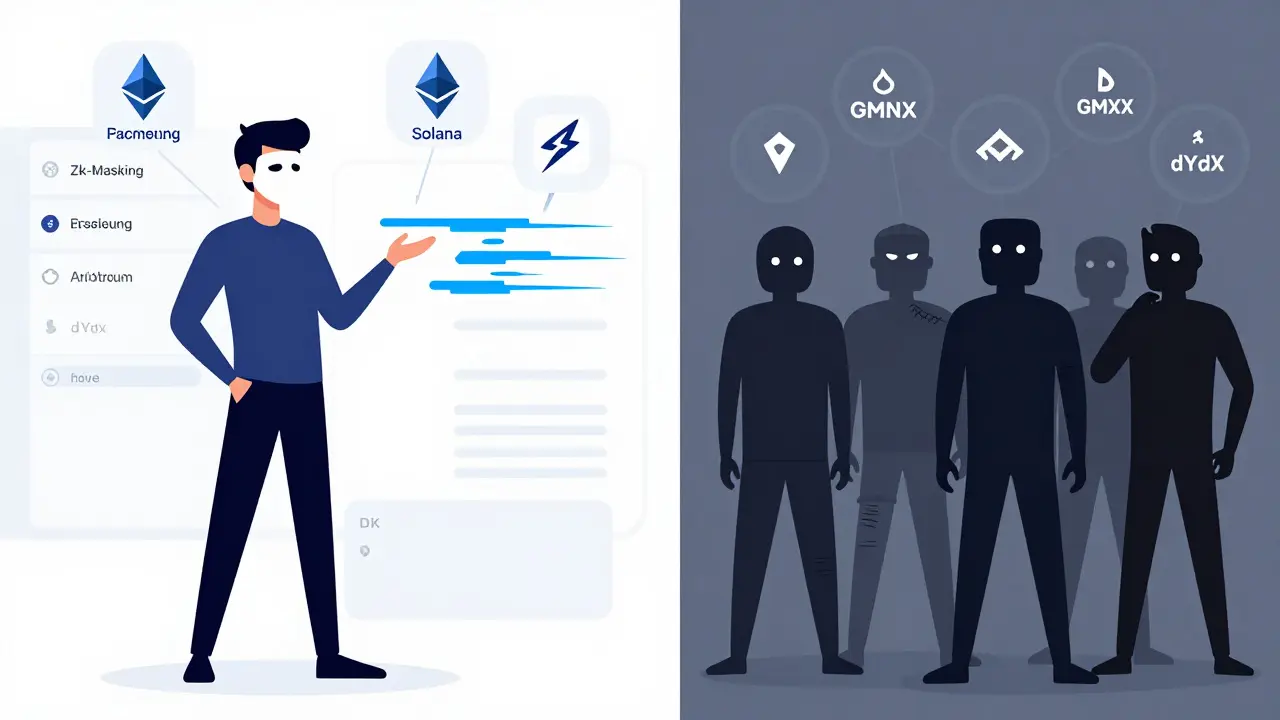
- Institutional-Grade Privacy: Most DEXs broadcast every move you make. Paradex uses zk-style account masking to hide your positions, entry/exit points, liquidation levels, and profit/loss data. This prevents other traders and bots from front-running your strategies.
- Blazing Fast Execution: Thanks to DimeVM, order execution happens in under a second. Market orders fill instantly, with many users reporting speeds between 100-200 milliseconds. This rivals top centralized exchanges like Binance Futures.
Additionally, Paradex supports unified margin, cross-margin, and isolated-margin trading across 250+ markets. You can leverage up to 50x on perpetual futures, giving you significant flexibility in how you manage risk and capital efficiency.
Paradex vs. Competitors: A Head-to-Head Comparison
To understand where Paradex stands, we need to look at the competition. Here is how it stacks up against other major decentralized derivatives exchanges as of late 2025.
| Feature | Paradex | Hyperliquid | dYdX | GMX |
|---|---|---|---|---|
| Trading Fees (Retail) | 0% / 0% | Low (varies by pool) | 0.05% - 0.1% | 0.1% |
| Max Leverage | 50x | Up to 50x | Varies by asset | Up to 50x |
| Privacy Features | Advanced (zk-masking) | Basic | None | None |
| 30-Day Volume (Nov 2025) | $5.98 Billion | $4.21 Billion | $8.5 Billion (est.) | $2.1 Billion |
| Underlying Tech | DimeVM (Starknet L2) | L1 Blockchain | Cosmos SDK | Avalanche Subnets |
While dYdX still holds the largest market share due to its early start, Paradex has surged to #3 in volume thanks to its aggressive fee structure and superior privacy tools. Hyperliquid remains a strong contender for pure speed, but it lacks the comprehensive privacy layer that Paradex offers.
Pros and Cons: Who Should Use Paradex?
No platform is perfect. Before you deposit funds, consider these strengths and weaknesses based on real user feedback and expert analysis.
Pros
- Cost Efficiency: Zero fees mean you keep more of your profits. This is huge for scalpers and day traders.
- Deep Liquidity: With backing from firms like Optiver and Akuna Capital, Paradex claims "better-than-CEX liquidity," reducing slippage on large orders.
- Self-Custody Security: You control your keys. Funds are only locked during active trades, minimizing exposure to hackable hot wallets.
- Multi-Chain Support: Easy bridging from Ethereum, Solana, Arbitrum, and others makes onboarding seamless.
Cons
- Steep Learning Curve: The interface is feature-rich but complex. Beginners might find the unified margin system confusing. One Trustpilot reviewer noted accidentally over-leveraging because they didn’t fully grasp the margin settings.
- Centralized Block Proposals: Currently, block proposals are handled by a centralized operator. While this ensures speed, purists may worry about censorship resistance until full decentralization is achieved.
- Correlated Risk: The unified margin system allows you to use one collateral balance for multiple positions. While convenient, experts warn this can create correlated risks during extreme market volatility if not managed carefully.
How to Get Started with Paradex
If you decide to give it a try, here is a simple roadmap to get you trading safely.
- Connect Your Wallet: Paradex supports MetaMask, Rabby, and other popular Web3 wallets. Make sure you’re on a supported chain like Ethereum Mainnet or Arbitrum.
- Bridge Assets: Use the native bridge or third-party tools like Orbiter to move USDC or other supported assets to the DimeVM network. Gas fees are near-zero on L2.
- Familiarize Yourself with Margin: Start with small positions. Use the interactive margin calculator to see your liquidation price in real-time. Begin with cross-margin to understand how collateral flows between positions.
- Execute Your First Trade: Try a small perpetual futures trade with low leverage (e.g., 2x-5x). Notice how fast the order fills compared to other DEXs.
- Explore Advanced Tools: Once comfortable, look into perpetual options or algorithmic trading via API if you are an advanced user.
Experienced traders typically get proficient within 2-3 hours, while complete beginners should budget 8-10 hours to read the documentation and test with small amounts.

Security and Regulatory Considerations
Security is paramount in DeFi. Paradex undergoes regular audits by top firms like OpenZeppelin. Their architecture follows "least authority" design principles, meaning smart contracts have minimal permissions, reducing the blast radius of any potential exploit.
However, remember that you are trading leveraged derivatives. The SEC has issued advisories regarding DeFi derivatives, noting inherent risks. Always do your own research (DYOR) and never trade with money you can’t afford to lose. The platform operates non-custodially, which helps avoid some regulatory hurdles, but local laws vary by jurisdiction.
Future Roadmap and Tokenomics
Paradex is moving fast. The $DIME token powers the ecosystem, offering utility in governance and potential fee discounts for future tiers. Looking ahead to Q2 2026, the roadmap includes AI agents for automated vault management, expanded spot trading functionality, and support for multi-collateral types beyond USDC.
Analysts predict Paradex could capture 8-10% of the DeFi derivatives market by the end of 2026, driven by its technological edge and institutional backing. If you believe in the growth of decentralized finance, Paradex is definitely one to watch.
Is Paradex safe to use?
Paradex employs robust security measures, including zk-rollup technology and regular audits by OpenZeppelin. Since it is non-custodial, you retain control of your private keys. However, as with any DeFi platform, there are smart contract risks. Always start with small amounts and ensure your wallet is secure.
Does Paradex charge trading fees?
No, Paradex offers 0% maker and 0% taker fees for retail traders using the standard UI. This is a major advantage over competitors like GMX or dYdX, which charge between 0.05% and 0.15% per trade.
What is the maximum leverage on Paradex?
Paradex supports up to 50x leverage on perpetual futures contracts. High leverage amplifies both gains and losses, so it is recommended for experienced traders who understand risk management.
Can I trade options on Paradex?
Yes, Paradex launched perpetual options for 25 assets in November 2025. This allows traders to hedge positions or speculate on price movements with defined risk parameters.
Which blockchains does Paradex support?
Paradex connects to over 20 chains, including Ethereum, Arbitrum, Avalanche, Base, Solana, and Binance Smart Chain. This multi-chain approach makes it easy to bridge assets from various ecosystems.
Is Paradex suitable for beginners?
Paradex is better suited for intermediate to advanced traders due to its complex features like unified margin and derivatives trading. Beginners should spend time learning the basics of futures and margin before trading real funds.
Matthew Malone
June 6, 2026 AT 16:58another american tech startup trying to save the world from itself while ignoring that our infrastructure is crumbling 🇺🇸
JEVON HALL
June 8, 2026 AT 10:26hey guys just wanted to drop a quick note about the zk-rollup tech here because it actually matters for your privacy 🤓
most people dont realize that standard DEXs broadcast every single move you make on chain which means bots can front run you easily paradex uses zero knowledge proofs to mask this data so your entry exit and liquidation points are hidden this is huge for institutional traders who need discretion but also great for retail users who dont want their strategies leaked
i have been testing the dmevm chain speed and it really does feel like using a CEX but with self custody the gas fees are basically non existent compared to eth mainnet so if you are trading high frequency this could save you thousands in fees over time just make sure you understand the unified margin system before you go crazy with leverage 👍
Greg Lewis
June 10, 2026 AT 09:18why do you care about my positions greg lewis? i know you are reading this and judging my trades stop lurking and start trading or get off the platform its rude to watch people fail without helping them out
Dr Lynea LaVoy
June 11, 2026 AT 06:38it is important to remember that high leverage is a double edged sword especially for those new to derivatives trading
while the zero fee structure is incredibly attractive for day traders and scalpers the risk of liquidation remains very real when using up to 50x leverage i would strongly recommend starting with isolated margin rather than cross margin until you fully grasp how collateral flows between positions
many experienced traders have noted that the unified margin system can create correlated risks during volatile market conditions if not managed carefully take your time to read the documentation and perhaps use the interactive margin calculator to visualize your liquidation price before committing significant capital
we are all learning together in this space and safety should always come before profit seeking behavior
dan kaffeman
June 11, 2026 AT 17:31only weaklings need privacy because they have something to hide real men trade openly and proudly on centralized exchanges where the government can see everything and ensure compliance with regulations that protect us from ourselves
aaliyah zahid
June 12, 2026 AT 17:19oh please tell me you havent been paying your taxes properly matthew because that sounds like a cry for help wrapped in nationalism sarcasm aside the privacy features are actually quite useful for legitimate business operations that require confidentiality not just tax evasion
Erik Kirana
June 14, 2026 AT 10:12the audacity of these developers to claim superior technology when the block proposals are still handled by a centralized operator is truly laughable 😂
one must question the integrity of a platform that claims decentralization while relying on central authorities for basic network functions this is not true freedom this is a facade designed to lure in unsuspecting retail investors who do not understand the nuances of blockchain architecture
until full decentralization is achieved this platform should be viewed with extreme skepticism and caution by any serious trader who values censorship resistance above all else
Meg Gran
June 15, 2026 AT 22:05im not saying its bad but the typo prone nature of some comments here makes me wonder if anyone actually reads the docs before complaining about the interface being complex maybe if we took five minutes to learn instead of typing angry rants we would all be richer philosophers of finance 🤔
Karthikeyan S
June 17, 2026 AT 21:24bro this is fake news the whole thing is a scam designed to steal ur money i lost 500 bucks last week and now im broke u all should stay away from this garbage exchange it sucks big time 😡😡😡
Dinesh Pattigilli
June 18, 2026 AT 16:06your analysis is flawed because you clearly do not understand the underlying tokenomics of the DIME ecosystem which will undoubtedly lead to massive gains for early adopters unlike yourself who seems to be stuck in the past with outdated perspectives on DeFi evolution 🚀
Madhu Menon
June 19, 2026 AT 11:18the essence of trading lies not in the speed but in the patience of the mind 🧘♂️