You see the ticker $HOME pop up on a screen, maybe in a chat group or on a tracking app. It promises governance, staking rewards, and a piece of an ecosystem built on Arbitrum. But before you connect your wallet, you need to know what you are actually looking at. Is this the next big decentralized exchange, or is it a thin-liquidity experiment with confusing data?
OtterHome ($HOME) is a decentralized finance (DeFi) token operating on the Arbitrum Layer2 network. Its goal is to provide a decentralized trading platform similar to Uniswap but with lower fees due to its position on a scaling solution. The token itself serves as the backbone for governance, payments, and staking within this specific ecosystem. However, if you dig into the numbers right now, in mid-2026, things get messy. You will find wildly different prices, conflicting supply figures, and questions about whether the project is active or just lingering.
The Core Identity: What Exactly Is OtterHome?
To understand OtterHome, you have to look at where it lives. It does not run directly on the Ethereum mainnet, which is famous for high gas fees. Instead, it uses Arbitrum One, a popular Layer2 scaling solution. This technology batches transactions off-chain and posts proofs back to Ethereum, keeping security high while making swaps cheap and fast.
The platform features OtterHome Swap, a decentralized exchange (DEX). Think of it like a vending machine for crypto: users deposit tokens into pools, and traders swap against those pools using algorithmic pricing. The $HOME token is meant to be the fuel for this machine. You use it to vote on changes to the protocol, pay for services within the ecosystem, and lock it up to earn rewards.
There is a bit of confusion about when this started. Some sources say the project launched in 2021 by a team of blockchain enthusiasts. Others point to June 14, 2023, as the date it first appeared on major trackers. This gap suggests that the initial concept might have existed earlier, but the actual token deployment or public listing happened later. For now, treat it as a relatively young project in the long timeline of crypto.
The Supply Problem: 1 Billion or 10 Billion?
If you want to calculate the value of a coin, you need to know how many exist. With OtterHome, this is where your calculator might break. Different data providers are telling you two completely different stories.
On one side, platforms like Coinranking report a circulating supply of 10,000,000,000 (10 billion) HOME tokens. If this were true, the market capitalization would be tiny even at higher prices. On the other side, Crypto.com lists a maximum supply of just 1,000,000,000 (1 billion) HOME. Which one is right?
Here is a clue: The staking reward schedule described by CoinCarp plans to distribute 500 million tokens in Year 1, dropping to 62.5 million in Year 4. That totals 937.5 million tokens over four years. This math aligns much better with the 1 billion max supply figure than the 10 billion figure. It is highly likely that older data feeds or mislabeled contracts are causing the 10 billion error. When analyzing any metric below, assume the 1 billion cap is the more accurate reflection of the intended tokenomics, but always verify the contract address yourself.
Price Chaos: Why Do Numbers Vary So Much?
Let’s talk about the elephant in the room: the price. If you check five different sites today, July 2026, you will see five different prices. This is not normal for established coins like Bitcoin or Ethereum. It is a hallmark of low-liquidity assets.
| Platform | Reported Price (USD) | Context / Notes |
|---|---|---|
| Coinbase | $0.37 | High outlier; may reflect thin order book or old cache. | CoinGecko | $0.054 | Moderate valuation; shows recent daily increases. | Crypto.com | $0.036 | Aligned with lower-end valuations; zero daily change reported. |
| Binance | $0.018 | Tracks volume (~$446k) but lists circulating supply as 0. |
| Dropstab | $0.0000015 | Extreme low; implies massive crash or different contract. |
Why such a spread? It usually means one of three things:
- Fragmented Liquidity: Trades are happening on small, isolated exchanges (like Gate or MEXC) rather than deep, unified markets. A single large sell order can drop the price on one exchange without affecting another.
- Data Aggregation Errors: Automated bots scrape prices from various APIs. If one feed lags or pulls from a dead pool, the average gets skewed.
- Honeypot or Contract Issues: In worst-case scenarios, some tokens have multiple contract addresses. Make sure you are looking at the correct Arbitrum contract:
0x1bD013bD089C2B6b2D30a0e0B545810a5844E761.
For a realistic view, look at the median of reliable aggregators rather than the highest quote. The volatility here is extreme. Drops of 30% in a single day have been recorded. If you cannot handle losing half your money overnight, this is not the place for your savings.
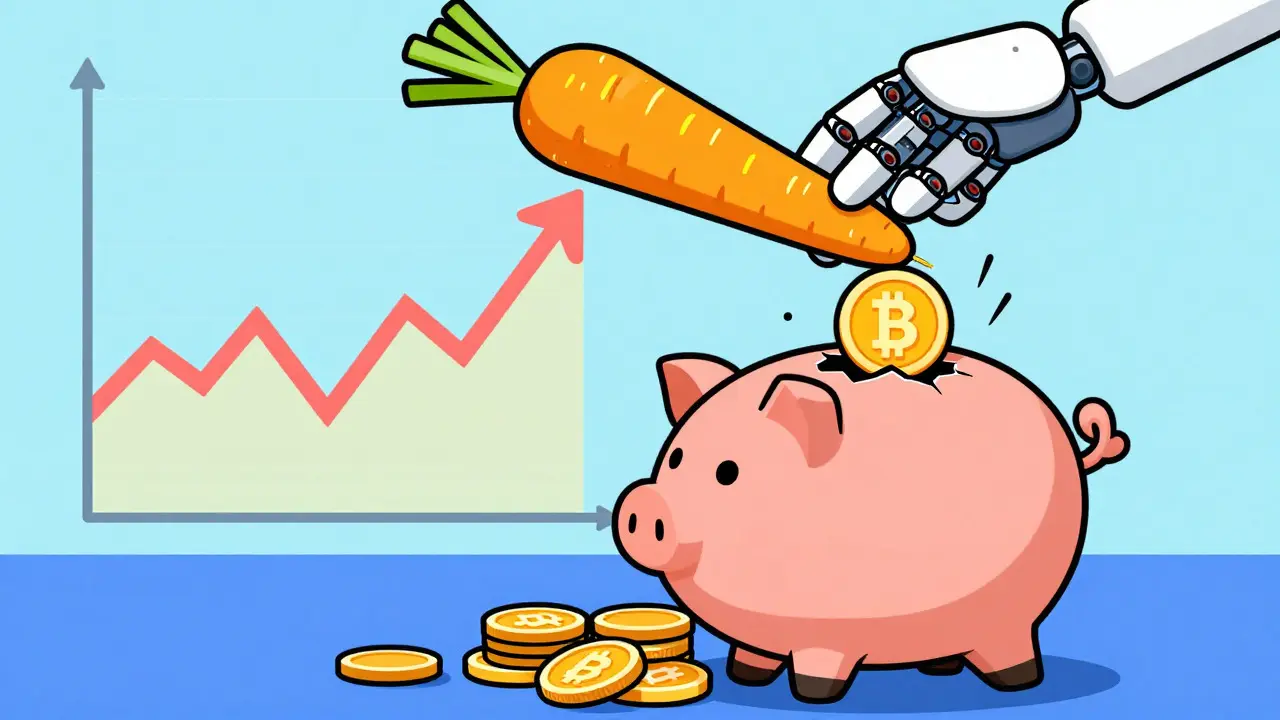
Staking Rewards: The Carrot on the Stick
Since the price action is wild, the project relies heavily on staking to keep holders interested. The idea is simple: lock your $HOME tokens, and the protocol pays you more $HOME tokens. This reduces the selling pressure because tokens are locked up.
The emissions schedule is designed to be deflationary over time. Here is how the planned distribution breaks down according to official documentation:
- Year 1: 500,000,000 HOME distributed
- Year 2: 250,000,000 HOME distributed
- Year 3: 125,000,000 HOME distributed
- Year 4: 62,500,000 HOME distributed
This structure aims to create a "robust ecosystem" by rewarding early adopters heavily while tapering off as the project matures. However, remember that earning more tokens only helps if the token has value. If the price drops faster than your staking rewards accumulate, you are still losing purchasing power. This is known as negative real yield.
Trading Venues: Where Can You Buy or Sell?
Unlike Bitcoin, which you can buy anywhere, $HOME is niche. You won't find it on every major centralized exchange. Currently, activity is concentrated on platforms like Gate.io and MEXC. These exchanges offer USDT trading pairs, which provides a baseline for liquidity.
You can also trade directly on the OtterHome Swap interface on Arbitrum. This is the purest form of DeFi interaction. You connect a wallet like MetaMask, switch to the Arbitrum network, and swap directly from your pocket. The advantage is speed and no middleman. The disadvantage is that you bear all the risk of smart contract errors and slippage.
Be wary of listings that claim to support HOME but show zero volume. Some trackers list tokens theoretically, but if there are no buyers, you are stuck holding the bag.

Risks You Cannot Ignore
Before you buy, let's strip away the hype. What could go wrong?
1. Lack of Audits: There is no widely publicized record of independent security audits for the OtterHome smart contracts. In DeFi, unaudited code is a gamble. If there is a bug, funds can be drained.
2. Regulatory Gray Area: As of 2026, regulations around DeFi tokens are tightening globally. OtterHome operates as a community-driven initiative without clear legal entity backing mentioned in public docs. This makes it vulnerable to regulatory crackdowns if deemed a security.
3. Concentration Risk: With a low market cap (estimates range from $50k to significantly higher depending on the supply debate), a few large holders (whales) can manipulate the price easily. Check the holder distribution on a block explorer like Arbiscan before investing.
4. Opportunity Cost: Arbitrum is home to giants like GMX, Camelot, and Uniswap. These projects have billions in total value locked (TVL) and proven track records. Investing in a micro-cap like OtterHome means betting against these established leaders. Ask yourself: why should users choose OtterHome Swap over the others? If the answer isn't clear, neither will it be for the market.
How to Get Started Safely
If you decide to proceed, do it carefully. Treat it as experimental capital-money you are okay with setting on fire.
- Set Up Your Wallet: Use MetaMask or Rabby Wallet. Add the Arbitrum One network manually if it doesn't auto-detect.
- Verify the Contract: Double-check the address
0x1bD013bD089C2B6b2D30a0e0B545810a5844E761. Scammers often create fake tokens with the same name. - Buy Small: Start with a minimal amount on a reputable CEX like Gate.io to test the waters, or swap ETH for HOME on OtterHome Swap.
- Check Slippage: Due to low liquidity, set your slippage tolerance appropriately (usually 0.5% to 1%) to ensure trades execute, but watch out for front-running bots.
- Monitor Staking: If you stake, read the terms. Are there lock-up periods? Can you unstake anytime? Understand the exit strategy before entering.
Final Thoughts on OtterHome
OtterHome represents the raw, unfiltered side of decentralized finance. It offers the potential for high returns through early adoption and staking yields, powered by the efficiency of Arbitrum. But it comes with the baggage of inconsistent data, extreme volatility, and unknown security standards.
It is not a "set it and forget it" investment. It requires active monitoring, skepticism, and a healthy dose of caution. If you love hunting for hidden gems and understand the mechanics of Layer2 DEXs, it might fit your portfolio. If you are looking for stability, stick to the blue chips.
Is OtterHome (HOME) a safe investment?
Like most low-market-cap DeFi tokens, OtterHome carries high risk. It lacks widespread security audits and suffers from extreme price volatility. Only invest what you can afford to lose entirely.
What blockchain is OtterHome built on?
OtterHome operates on the Arbitrum One Layer2 network, which scales Ethereum. This allows for cheaper and faster transactions compared to the Ethereum mainnet.
Why are there different prices for HOME on different sites?
The discrepancies arise from fragmented liquidity across small exchanges, data aggregation errors, and potentially different contract addresses being tracked. Always cross-reference multiple sources and check the specific contract address.
What is the total supply of HOME tokens?
There is conflicting data. Some sources cite 10 billion, while others and the staking schedule suggest a max supply of 1 billion. The 1 billion figure aligns better with the documented emission schedule of 937.5 million tokens over four years.
Can I stake HOME tokens?
Yes, OtterHome offers a staking program where users lock their tokens to earn rewards. The rewards decrease annually over a planned five-year period, starting with 500 million tokens in Year 1.
Where can I buy OtterHome (HOME)?
You can trade HOME on centralized exchanges like Gate.io and MEXC, or directly on the OtterHome Swap decentralized exchange on the Arbitrum network.